The Art of No Deal
Also, service or work? The ultra-Orthodox options, and a hero found after 78 years.
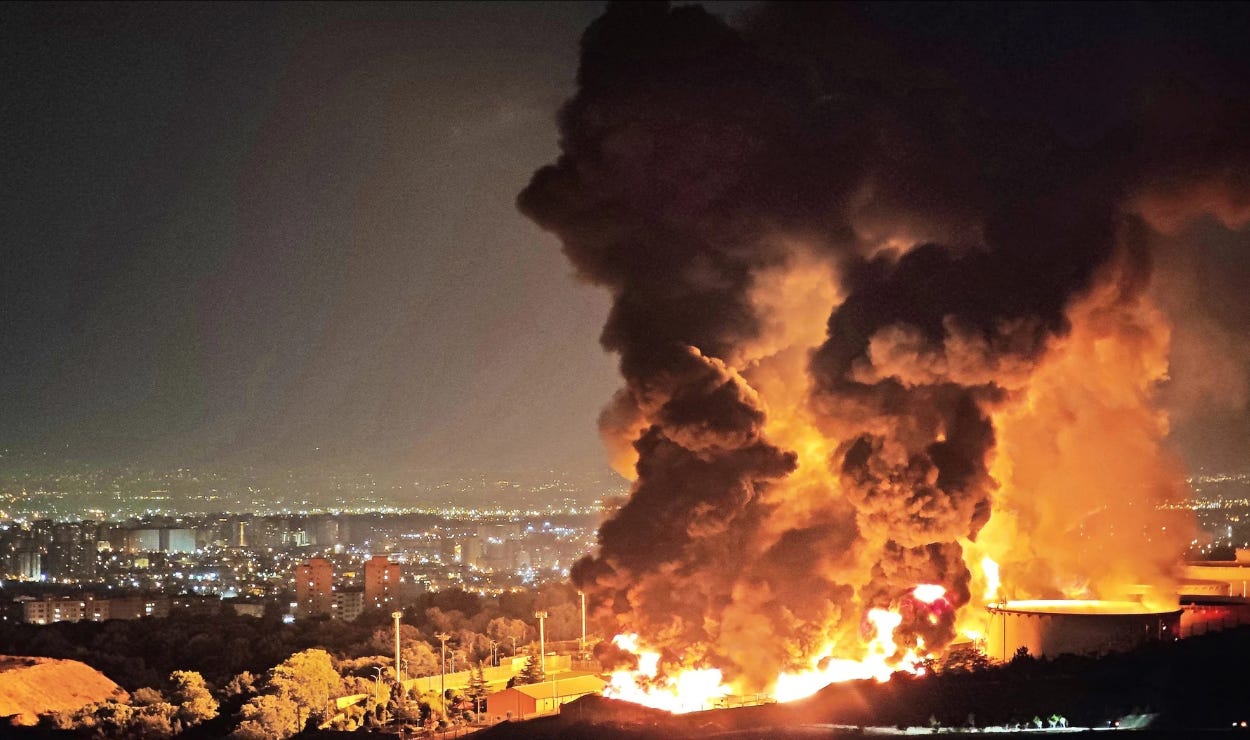
A photograph said to show a US strike in Chabahar, a city and port in southeastern Iran, posted by Donald Trump.
It’s Thursday, July 9, and for the second night in a row the US struck Iranian targets, and for the second night in a row Iran retaliated against US targets in the Gulf. Despite his declaration that the MoU is “dead,” Donald Trump has reportedly told his advisers that he will not “resume the war“ unless Iran kills US servicemembers.
Assuming Iran refrains from crossing Trump’s line, that still leaves quite a bit of escalation ladder to climb before it pays the ultimate price. The regime’s willingness to attack ships in the strait—fully aware it would trigger US retaliation—reveals its strategy. It can absorb a few strikes now and then; what it cannot survive is losing control of the strait.
Over the past month, the Israeli defense establishment tried to find a scenario in which something good might come out of the bad situation in Iran. They thought and thought, scratched their heads, and then said: maybe a Sadat will rise in Iran, abandon missiles and nuclear weapons, offer peace to Israel, and economic cooperation to the US. That is how faint the hope was. One of Trump’s close associates said something similar: maybe, he tried to convince his Iranian interlocutors, you will realize that instead of collecting pennies for passage through the Strait of Hormuz, you will make huge money on oil after giving up the nuclear program and having sanctions lifted.
Well, much to everyone’s surprise, it turns out there is no Sadat for peace in Iran yet, nor a Roosevelt for economic development. The fanatics won, as usual. They inhaled the reports in the American and Israeli media about their own colossal, historic victory, acted with arrogance, and the end is well known. The sanctions returned before a single barrel of Iranian oil even reached its destination.
Of course, there is no need to be overly impressed by President Trump’s words about “the end of the memorandum of understanding,” just as there was no need to take too hard his words about peace with Iran last month. As the dust settles over recent months, the picture is quite clear: there will be no agreement that removes the nuclear program, it is highly doubtful that the war will return in full force, and Israel may awkwardly and strangely get its preferred scenario: neither war nor an agreement. Only the continuation of sanctions and the siege in a way that collapses Iran’s economy slowly, but surely. Top security officials are convinced that if the US persists, this will lead to the collapse of the regime by the end of 2026, maybe a few months later.
Only it remains doubtful what Trump will do. In the Prime Minister’s Office, an emergency alert was declared this week ahead of the upcoming trip to Washington next week. In normal times, any visit to the White House, especially with this president, is a net profit in the form of taking over the agenda and receiving positive coverage in an area clearly under Benjamin Netanyahu’s control—the diplomatic arena.
But with this president, at this time, such a trip could also end in humiliation in front of the cameras, similar to what Trump and his Vice President J.D. Vance did to Zelensky. The ‘Wing of Zion’ (Israel’s Air Force One) could take off amid the winds of war and land in a Washington that has shifted back to talking about a historic peace and a new regime in Iran.
Ultra-Orthodox Jewish men study Torah outside the Justice Ministry in Jerusalem during a silent protest against the imprisonment of yeshiva students who failed to comply with military recruitment orders. (Chaim Goldberg/Flash90)
The internet was flooded this week with viral speeches from opponents of the Basic Law: Torah Study—shell-shocked veterans, bereaved fathers, children of reservists. Everyone, of course, is right, and it is clear to all that the law will not pass, and if it passes it won’t change anything, and if it changes anything it will be struck down. In short: this is a political move that the Haredi parties need for the purpose of mobilizing voters. And what about the electoral damage to the Netanyahu bloc? One can guess that Netanyahu believes what happens in July stays in July. By October there will be other issues, the legislative wave will subside and be forgotten, and he will be left with his insurance policy against going to the opposition—the bloc.
But there is one matter, completely non-political, that is missed in the storm. The Haredi issue poses great challenges of various kinds to the state: the security front with the shortage of soldiers will not be solved in the coming years anyway. One can be angry at the lack of morality, furious at the indifference, and appalled by the chutzpah. The catch is that drafting thousands of Haredi soldiers into the army will not happen instantly and by force, but through deep, patient work and indirect maneuvering.
The main front threatening the country right now is the economic one. Israel will not exist in a generation if a non-Haredi family continues to pay thousands of shekels more to the state each year than it receives from it, and every Haredi family exactly the opposite. An event that was negligible forty years ago has now become a heavy burden, and in twenty years it will sink the economy to the depths.
The more severe problem is that even when Haredim go out to work, they earn less. For instance, a study by the Aaron Institute and “Out for Change” shows that even when Haredim leave the community or become national-religious, their average salary is 35 percent lower for men and 12 percent for women. An old joke says that the last thing left for ex-Haredim to shake off from their past is voting for UTJ and a fear of dogs. What is less funny is that the massive gaps in math and English remain years later.
The cause is righteous. It is also a dead end. As the poet Yehuda Amichai wrote: “From the place where we are right / flowers will never grow in the spring.” Nearly thirty years of being right on this issue delivered the mandates to the politicians and the recruits to no one. What an irony it is that the sanctions required now are exactly the discipline every yeshiva dean already enforces—except now it would be the state holding the stick: no driver’s license, no working, no traveling abroad.
Conversely, when the economic aspect was targeted—once and only once during Netanyahu’s tenure as Finance Minister—the result was a tremendous success. Cutting budgets for institutions that do not teach the core curriculum is not like provocative arrests. What Naftali Bennett, Bezalel Smotrich, Avigdor Liberman, Yair Lapid, and others have in common is that over the years they proposed exactly this: do not insist on enlistment, let the Haredim work without restrictions from age twenty-one, and cut their benefits. They and their colleagues act irresponsibly when they smash themselves repeatedly against the rock of enlistment, which will not break anytime soon.
Pvt. Yaakov Zarihan
April 20, 1948. Jerusalem is besieged—more than a hundred thousand Jewish residents are on the verge of starvation. They had to break through. Operation Harel, commanded by a young Yitzhak Rabin, was determined to bring 600 trucks of supplies to the beleaguered defenders.
Among the escorts was Pvt. Yaakov Zarihan, a new immigrant born in Casablanca, Morocco, who had made aliyah with his youth movement and enlisted in the Palmach just eight days earlier.
At some point during the day, his unit was attacked. Zarihan, along with 13 other members of the convoy, was killed in battle near Sha'ar Hagai. He was listed as a fallen soldier whose burial site was unknown—a status he held until this week.
After years of efforts to determine Yaakov's fate, a special investigation team was established in 2024. Through "document analysis, witness interrogation, soil analysis and archaeological surveys," they found the young soldier. Zarihan had been buried on April 22, 1948, in a mass grave at the Harel Brigade cemetery in Kibbutz Kiryat Anavim, along with seven other fallen soldiers.
His family, after 78 years of uncertainty, has found its lost brother. An official ceremony will be held to consecrate a headstone at his resting place. Yaakov is one of hundreds still unidentified or lost from Israel's wars. As his discovery attests, Israel will not stop until all those who were lost have been found.
English Editor: Ari Tatarka
If you enjoy the newsletter, you can show your support by becoming a paid subscriber—it really helps keep this going. I’m also offering a special monthly briefing for a small group of premium members. I’d love to have you join us—just click below to find out more.
Thanks for reading It’s Noon in Israel! Subscribe for free to receive new posts and support my work.


I noted with interest your story on the discovery at Kibbutz Kiryat Anavim of the grave of Yaacov Zarihan, Z''L, who died fighting in the 1948 war. I worked there one summer as a teenager visiting from the US. It was a lovely place. A few years ago, the quaint guest house was now a 5 star hotel, representative of the changes in Israel over the years.
Separate the right to vote from the economic benefits. No service, no vote. It won't be simple but it's a start.