It’s Noon in Israel: The Battle of Bnei Brak
Also, Jerusalem becomes a tool for annexation, Israeli drones are evicted from New York City, and more.
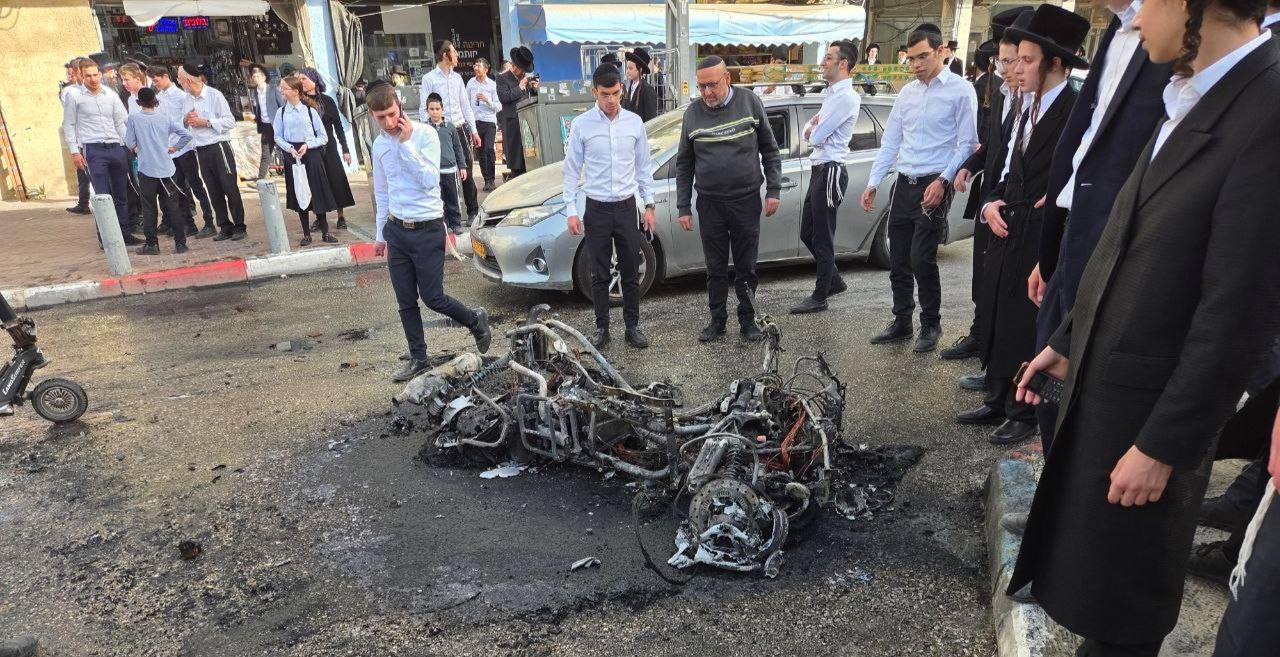
The police motor cycle set on fire during the riot in Bnei Brak yesterday.
It’s Monday, February 16, and if I asked you, of all the cities in the Middle East, which one the IDF cannot operate freely in, you might have a hard time answering. We’ve seen explosions in the heart of the Gulf, the destruction of nuclear facilities near Baghdad, and the utter domination of Tehran’s skies. After yesterday, it seems the only city the IDF can’t control is Jewish and about four kilometers east of Tel Aviv: the ultra-Orthodox city of Bnei Brak.
Yesterday, female officers on a routine operation had to be rescued from the city after locals believed they had come to deliver draft notices. During the riot that followed, a patrol car was flipped and a police motorcycle set on fire. After a strong response that involved tear gas and riot police, order was restored.
As violent insurrections go, it’s impressive. For a population with nothing more dangerous than rocks or a communication system more complicated than flip phones, the ability to stage such a riot and flood the streets with hundreds on short notice is impressive.
The riot wasn’t a popular uprising; those in the streets were largely extremist factions, unpopular inside and outside the community. Just how unpopular is difficult to say. Most Haredim wouldn’t endorse their actions—but they certainly tolerate them.
Mainstream rabbinic figures aren’t widening the distinction, with their oratorical flair for the dramatic.
Last year, one of Israel’s chief rabbis, Rabbi Yitzchak Yosef, responded to the escalating draft issue by warning that if enlistment were forced, there would be a Haredi exodus from the state. I’m not sure he expected the most common answer to his threat to be “Yes, please.”
When asked a few months ago what to do if the army comes to enforce the draft law, the rabbi answered that a street uprising would be an appropriate response. But yesterday, when cars started getting flipped and motorcycles burned, Rabbi Yosef delivered an unequivocal condemnation of the rioters.
The fact that the rabbi is still living in Jerusalem, has not been seen in any street-level resistance, and condemned yesterday’s riots suggests his religious ruling on the issue may be: do what I do, not what I say.
But the rabbi’s grandiose statements highlight an important point: the difference between a regular ultra-Orthodox person and an extremist ultra-Orthodox person is basically non-existent on paper. Both view the draft as existential, and a large number of both would be willing to suffer the consequences of draft dodging. The difference lies in their willingness to back up their beliefs with disruption and violence.
That doesn’t mean all Haredim share the same perspective. Despite the outfits, Haredim are not monolithic. There is a considerable number who would support drafting those usually referred to as “dropouts”—those who do not spend their time in religious learning. But here’s the problem: when the political conflict is framed by both sides as a simple us-versus-them struggle, extremists find shelter in the mainstream and moderates don’t speak up.
Yesterday’s riots produced plenty of evidence for both narratives.
One side is watching video confirmation that Haredim are an illiberal and extremist threat to the state of Israel: female soldiers being chased by mobs of Haredim.
Meanwhile, Haredim are seeing videos of some officers engaging in random beatings and arrests of bystanders. In one particularly unjustified scene, an officer rips the wig off an ultra-Orthodox woman.
If you want to confirm the Haredi impression of the state as fundamentally opposed to their way of life, I can’t think of a better way than a public de-wigging.
My belief is that Haredim should be drafted and that they pose a serious fiscal challenge to the state of Israel. But on this issue, and on many others, there is something to be said for the wisdom of political cartoons.
If you look at secular Israeli newspapers, you will probably see depictions bordering on the antisemitic, portraying Haredim as parasitic. If you look at almost every Haredi paper, you will see a lone Haredi constantly under attack from a bloodthirsty Israeli society.
If you look at the cartoons of Israel’s enemies, the Israel depicted looks less like a modern Tel Avivian and more like one of yesterday’s rioters. Israel’s enemies don’t see a distinction. If they don’t, I don’t see why we should.
Finance Minister Bezalel Smotrich with Defense Minister Israel Katz in Judea and Samaria last week. (@bezalels/X)
For the first time in almost 60 years, Jerusalem’s borders are expanding. Finance Minister Bezalel Smotrich’s journey toward annexation continues with a housing plan designed to expand Israel’s capital.
In a series of well-publicized reforms last week, Smotrich radically shifted the Judean and Samarian real estate markets. It was the most prominent step in his three-year plan to annex Judea and Samaria de facto, if not de jure.
Since the last election, Smotrich has recognized 69 new settlements in Judea and Samaria. In the same time period, 150 farms have been built—some with approval and some without—and development has begun in the E1 corridor, an area that would cut East Jerusalem off from a theoretical Palestinian state.
Yesterday’s move, approving hundreds of housing units to create a contiguous strip from the Jerusalem neighborhood of Pisgat Ze’ev to the bordering settlement of Adam, is par for the annexation course.
Jerusalem has always been viewed differently from other territories. Unlike the Golan, Judea and Samaria, or the Sinai, when the city was taken during the Six-Day War, it was annexed immediately—literally within three weeks. In every negotiation with the Palestinians, there were many critical issues, but one sacred cow was not to be touched: unified Jerusalem. That didn’t stop the Ehuds—Barak and Olmert—from slaughtering it on the altar of peace, but that’s neither here nor there.
Smotrich knows that Israelis will fight for Jerusalem more fiercely than for any settlement bloc; hence his solution: tie them together. That doesn’t mean he will expand Jerusalem 90 kilometers north to the Samarian settlement of Ariel, but there are plenty of nearby options. The Gush Etzion bloc is 14 kilometers away; the city of Ma’ale Adumim, only eight.
If you look at enough anti-Israel propaganda, you might see crackpot conspiracies linking scraps of historical evidence to claims that Israel is looking to conquer Jordan and Sinai in pursuit of dreams of “Greater Israel.” Greater Israel is a fantasy Israel’s right largely gave up on years ago, if they ever truly believed it was possible in the first place. But the dream of Greater Jerusalem is alive and well.
Easy Aerial’s drone-in-a-box (EasyAerial)
The New York City municipality is evicting an Israeli drone business for “business considerations.” Needless to say, nobody is buying it.
Easy Aerial, a drone manufacturer that works with the IDF, received notice that it will have to leave its New York offices at the Brooklyn Navy Yard municipal complex. They were given 60 days—insufficient time to relocate its 100 employees to another location in the city. The company’s chairman, Shahar Abuhatzira, thinks this isn’t a local decision—“100 percent from the top.”
Easy Aerial isn’t the only Israeli company facing the wrong end of “business considerations.” When Israeli investor Zohar Levy attempted to buy a large portfolio of property in the city last month, the municipality unsuccessfully tried to sink the deal on flimsy grounds.
Whether it is the hand of Zohran Mamdani or a different radical activist given power in his administration, the principle is the same.
Easy Aerial does some business with the IDF, but most of its transactions are with the U.S. Army—mainly the Marine Corps—along with sales in 25 other countries. Levy was attempting to buy and would have had to maintain more than 90 buildings and about 5,100 rent-stabilized apartments. If New York City wants to hurt Israel, they aren’t going to come out of it unscathed.
It’s what you might call cutting off your Jewish—I mean Zionist—nose to spite your face.
Dana Eden and her son, Gur.
Israel has lost an extraordinary talent, taken before her time. Last night, Dana Eden, the creator and producer of the Emmy-winning series Tehran, passed away in Athens during the filming of the new season at the age of 52.
The acclaimed series follows a Mossad agent trapped in the Iranian capital attempting to take down Iranian air defenses long enough to enable the Israeli Air Force to bomb a nuclear plant. If that plot sounds familiar, it is because Eden’s writing was prophetic. Without any insider information, to my knowledge, she managed to predict the June war and get millions invested in the plight of Iranians under the regime.
Eden was not just a brilliant writer but a dear friend and creative partner. Those of you who have joined me for one of my tours of Israel’s Knesset may remember that she and I were developing a series on the dark underbelly of Israel’s government. Now the fate of that project is unclear, but if it is made, it will undoubtedly be poorer for her absence.
If you enjoy the newsletter, you can show your support by becoming a paid subscriber—it really helps keep this going. I’m also offering a special monthly briefing for a small group of premium members. I’d love to have you join us—just click below to find out more.


Isn’t 4 km west of Tel Aviv, the Mediterranean Sea?
Funny how outraged people are by the Haredem rioting but the left that burned tires stopping movement on the Ayalon, setting garbage cans on fire at the PMs residence, firing at the PMs home, that's all ok....
And Amit, many of us have concluded after the atrocities of Oct 7 that we don't want these neighbors. You missed that fact that most of us now support "greater Israel".