The Conspiracy Vance Needs
Also, a bad omen in Congress, and Israel's "democratic" dictator demoted.
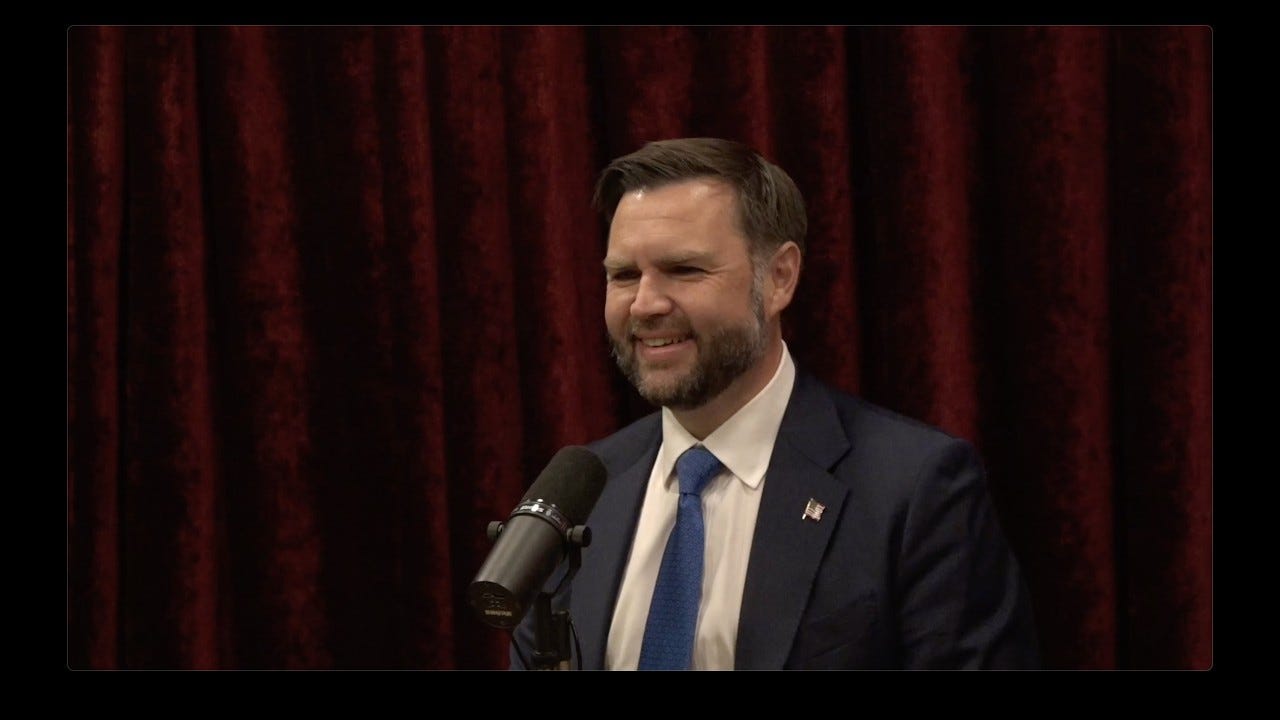
Vice President JD Vance on Joe Rogan’s podcast. (Joe Rogan)
It’s Thursday, July 16, and there is apparently a “very discreet, extremely well-funded campaign” to derail negotiations between the U.S. and Iran, according to Vice President JD Vance on Joe Rogan’s show last night. Why is the Vice President perpetuating this dubious claim? The reason is simple: it benefits him too.
Much like other theories that find a home on Rogan’s podcast, this one is thinly sourced and vastly misinterpreted. The article Vance cites for this conspiracy does indeed point to an Israeli-funded influence operation—a FARA-registered, Israeli-government-funded campaign, run through political consultant Brad Parscale’s Clock Tower X, pushing pro-Israel content into the MAGA ecosystem, including through paid influencers who reportedly received suggested language via private group chats and compensation tied to engagement.
Where the article cuts against him is on the one point his whole story depends on: that this was a deliberate campaign built “to derail the negotiations” and keep the war going indefinitely. The Time magazine reporting establishes no such intent. Per the article, the contracted goal was preventing young conservatives from turning against Israel—a reputation campaign, not an anti-ceasefire operation. The sabotage motive is Vance’s attribution, not the reporting’s finding.
And the two people best positioned to know deny his version. Parscale flatly says he never worked to undermine Trump, the memorandum of understanding, or the ceasefire, and calls the “prolong the war” charge false—the invention of anonymous officials who needed a bogeyman. The Israeli side, far from running a war-prolonging operation, is furious the expensive campaign failed—”we are pissed at Brad Parscale… things have only gotten worse”—with Pew Research Center polling showing Israel’s favorability at a decade’s low. Perhaps they shouldn’t be so negative; apparently the failed Hasbara campaign was not a waste of money, after all, a senior source has alleged it destroyed the memorandum of understanding.
On the other hand, one would think an operation potent enough to derail a superpower’s negotiations could, at minimum, impose a cost on the man denouncing it. It couldn’t. Vance named it, on the biggest podcast in the country, and likely walked away stronger for it.
More revealing than the theory itself was Vance’s posture toward the supposed psychological operation.
“[Israel is] a country of 9 million people. We have 330 million people. And so, of course, they’re going to try to persuade Americans,” Vance told Rogan. Israel’s efforts to sway American foreign policy are not themselves suspect—”a lot of other countries do [it],” he said—the danger, in his telling, is that American officials “will act in ways that do not serve the American public” as a result.
Vance folded Israel in with Qatar and Russia. “It doesn’t bother me that Qatar tries to influence the United States…. I like a lot of the Qataris, just like I like a lot of the Israelis…. It frankly doesn’t even bother me that Russia or some of these other countries do it. It’s just the nature of being a political leader in 2026,” he said.
Israel might reasonably object to the company. The “it doesn’t bother me” is not magnanimous tolerance but a demotion. Bundle Israel with a Hamas sponsor and an adversary state under one shrug, and Israel is no longer a friend or ally that recently fought beside the U.S. wing to wing but simply the more agnostic and malicious-sounding “foreign interest.”
Note, too, where he relocates the guilt. In another indictment disguised as an absolution, Vance doesn’t blame Israel; his anger lands on “American officials” who “act in ways that do not serve the American public.” It echoes the statement that sent Jewish groups into a frenzy, when, asked whether Israel controls the government, he assured a young Republican only that it does not control “this administration.” In short: the conspiracy exists—he is simply not part of it, though one suspects he’ll be able to name who is when the time is right.
It is the same dance he performs on the “divergent interests” between Israel and the U.S. He never names them, because naming them would force him to describe the divergence. Far easier to gesture at a shadow, assuring believers that it does exist and holding its contents in reserve for a moment when he’ll need to brandish it.
Why romance the conspiracists now?
Because, as the Wall Street Journal put it, Vance has had a “Terrible, Horrible, No Good, Very Bad Week.” His crowning foreign-policy achievement—the ceasefire he negotiated with the Iranian regime—has been going up in fire and smoke for a week. His doctrine of restraint took another blow when President Trump broke with him by signaling greater support for Ukraine. And to cap it off, hedge-fund magnate Ken Griffin, a major Republican donor, said he’d favor Secretary of State Marco Rubio over Vance in a 2028 GOP primary.
He has stumbled on a fantastic escape from having to admit that his signature foreign-policy achievement collapsed because his boss is less predictable than quantum mechanics and the men he sat across from are fanatics: blame Israel. It’s hardly original.
But none of this pays unless there’s a constituency that wants to hear the explanation. By Vance’s own framing, there is a “massive pro-Israel, anti-Israel debate in the United States of America”—and he is the highly electable “reasonable moderate” standing in the middle of it.
Vance professed confusion at being called antisemitic. His defense doubles as the explanation for why he keeps sounding like it: “look at the way young Republicans versus Republicans over the age of sixty-five approach this issue,” he said. “Right now, Israel is losing the public opinion battle in the United States of America. It is a simple and obvious fact. Donald Trump has said that publicly.”
Few genuinely believe he harbors an animus against Jews. His animus is toward power—Israel is simply, at this moment, a convenient face of it. But a friendly suggestion to the vice president: if you’d rather not be called antisemitic, it might help not to claim—against the Department of Justice, the Central Intelligence Agency, the Federal Bureau of Investigation, and the very files you released—that Jeffrey Epstein “clearly had connections to the highest levels of Israeli intelligence.” People can easily get confused.
Dome of the Capiol Building. (Ian Hutchinson/Unsplash)
“The tide is changing,” Representative Thomas Massie declared last night after his attempt to zero out Israel aid failed 104-314. What made it a shift in tide wasn’t the outcome—a doomed show vote from the start—but the Democratic split: 103 Democrats voted yes, 98 voted no, and ten voted present. Massie was the sole Republican in favor.
The good news: that’s well short of the 150 some predicted—a figure inflated precisely because the measure was certain to fail, letting members vote against Israel at no policy cost. The bad news: it’s 66 more than two years ago, when the House faced a similar vote, and 99 more than 2016, when the chamber passed the memorandum of understanding 405-4. According to sources, another 60 Democrats might have joined the provision without leadership pressure holding the line.
More bad news: those 98 who voted no are not, by and large, Israel hawks. Congressman Hakeem Jeffries called the amendment “overly broad,” warning it would gut humanitarian aid, refugee resettlement, and the ability to confront Hamas and Hezbollah—then conceded that “there are more decisive ways to achieve the urgent change necessary when it comes to the far-right Netanyahu government,” and that “a meaningful change in direction is needed” ahead of the new memorandum of understanding. Congressman Sam Liccardo, who opposed the underlying funding through a separate vote, drew the line others left implicit: no to 3.3 billion dollars in offensive weapons, yes to defensive systems like Iron Dome, and a new memorandum of understanding treating Israel “as an important ally, not a supplicant.” The no column was against the vehicle, not the destination.
Good news: there aren’t 103 Zohran Mamdanis in Congress. Representative Katherine Clark voted yes “not because I agree with the entirety of the amendment, or the GOP’s cynical motivations for its consideration, but because I believe we must change course”—the status quo, she said, “is not tenable.” Former Speaker Nancy Pelosi was blunter, calling the amendment “ill-conceived” and voting yes anyway “for the message that it sends.” Clark even swiped at the mechanism she was endorsing, dismissing it as “more stunts from Congressional Republicans who would rather score cheap political points than lead.”
Halie Soifer, executive director of the Jewish Democratic Council of America, captured the hedge: many yes-voters “haven’t turned their back on Israel, recognizing there’s a distinction between the people of Israel and the current Israeli government.”
The problem is how much longer that distinction holds; one suspects that the anti-Israel passion in the Democratic party is not simply directed against the current makeup of Israel’s governing coalition, no matter how much moderate Democrats wish it were.
The vote itself was a Republican maneuver. GOP leadership controls the floor—they decide which amendments reach it—and they let Massie’s through not because they support it (215 of them voted no, and they uniformly despise the man) but because forcing Democrats onto the record would expose and deepen the party’s Israel rift. Congressman Brad Sherman said it plainly, accusing Republican leaders of pushing the vote to “drive a wedge.”
But a wedge only splits wood that’s already cracked. Joel Rubin, a former Obama State Department official, gave the bluntest read: “The vote reflected a real antipathy toward Israel among the Democratic base… The base wants to terminate any relationship with Israel and that will only grow in the next Congress.” The frame across coverage was electoral: several pro-Israel incumbents have lost primaries to Israel-critical challengers this cycle, and IMEU and AIPAC now threaten primaries from opposite directions—a measure of how far the center of gravity has shifted. A New York Times/Siena poll in May found 74 percent of potential Democratic voters oppose additional support for Israel; just twenty percent back it. The members are trailing their base, not leading it.
One suspects that Progressive Caucus Chair Greg Casar was prescient when he remarked: “Nothing will be the same on this issue ever again.”
Israeli attorney general Gali Baharav Miara attends a House committee meeting at the Knesset, June 9, 2026. (Yonatan Sindel/Flash90)
In the U.S., Todd Blanche, John Sauer, and David Warrington serve as the attorney general (head of state prosecution), the solicitor general (the government’s defense attorney), and the White House counsel (adviser to the government), respectively. Their Israeli equivalent is Gali Baharav-Miara. Despite the three distinct names, that is in fact a single person — one woman who until yesterday shouldered the immense responsibility to advise the government, lead its prosecutions, and defend the state in court. I doubt many Americans could name Sauer or Warrington; quite a few know Blanche; but every single Israeli knows Baharav-Miara.
After all, she is the lone watcher on the wall, fighting every coalition appointment, law and action tooth and nail to protect either Israeli democracy or the deep state — depending on who you ask. She is unique among the world’s legal officials in that she doubles as the unofficial leader of the opposition; at anti-government protests, it is her face, not Yair Lapid’s, on the placards. And most relevant to today, she is the subject of a law that just cleared the Knesset that changes her role. The Constitution Committee wanted to carve the office into separate officeholders but ran out of time before the Knesset dissolved ahead of October’s elections. So they dropped the attorney-general/prosecutor-general division and instead opted to make her legal opinions no longer binding on the government.
That gets at one of the peculiar exigencies of the office. Israel’s attorney general isn’t merely the government’s lawyer; she is its legal gatekeeper, and the strange power of the job is that her opinions bind the executive. When she tells the government an action is unlawful, that has, until now, been the end of it. The new law demotes the wall to a suggestion. The government may now hear her out and proceed anyway.
Defenders of “democracy,” never fear: Baharav-Miara has never met a coalition bill she didn’t call illegal. A petition to the High Court landed by end of business. Expect her to weigh in regardless, deaf as ever to the long-since-discarded notion of conflict of interest. The problem is her ground is shaky. The petitioners want the court to strike the law as a blow to “the fairness of elections and preservation of democratic norms.” But granting them deliverance on constitutional grounds that do not exist would require the justices to ascend to the position of the nation’s messiah — the anointed few who have divined the ineffable Israeli will and legislate from its revelation. They are not quite so idolatrous yet.
So here is my counsel to Baharav-Miara: don’t fight it. Start acting like the neutral official the office was always supposed to house — before the next government comes to finish the job and split the conflict of interest this one left intact. And I wouldn’t wait on deliverance from the opposition. Should her powers be restored, nothing but her own political convictions prevents Israel’s judge, jury, and executioner from imposing her will on an Eisenkot government as freely as she imposed it on this coalition. No one likes a gatekeeper when they’re the ones holding the gate. When a different majority in the Knesset comes for her powers, perhaps she’ll finally grasp the word she’s spent three years misusing: democracy
English Editor: Ari Tatarka
If you enjoy the newsletter, you can show your support by becoming a paid subscriber—it really helps keep this going. I’m also offering a special monthly briefing for a small group of premium members. I’d love to have you join us—just click below to find out more.
Thanks for reading It’s Noon in Israel! Subscribe for free to receive new posts and support my work.


So let’s look at this. JD Vance is not an Anti-Semite? Scapegoating Israel? check. “Some of my best friends?” Check. Lumping Israel with Qatar and Russia. Check. Yep. If it looks like a duck, quacks like a duck, walks like a duck…………….
The Democrats are being subsumed by the DSA, and they are doing so without so much as a whimper of protest. In terms of policy, they will soon be indistinguishable from the UK's Labour Party, or Canada's NDP. Israel had best prepare itself for this inevitability, and it should start doing so immediately.