The Election’s Two Secret Wildcards
Also, the feeling which will decide the Prime Minister.
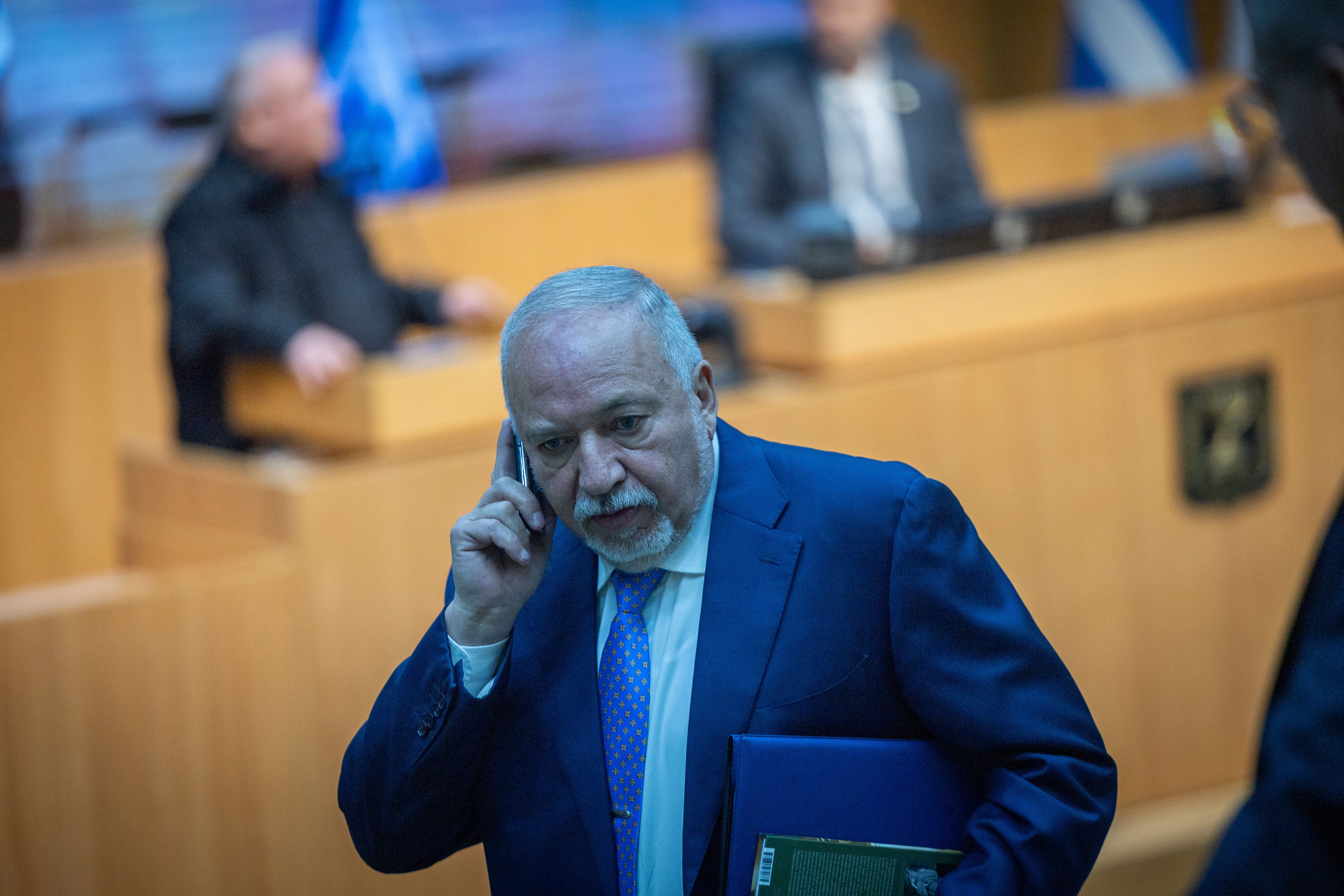
MK Avigdor Lieberman attends a special plenary session at the auditorium in the Knesset. (Yonatan Sindel/Flash90)
It’s Friday, May 1, and this week, the prediction market site Polymarket raised Bennett’s chances of becoming prime minister to 40 percent, roughly tying him with Netanyahu. If I had a million dollars to risk, I would probably diversify and invest equally between the two. But if I had a thousand dollars to go wild with on an “all or nothing” bet, I’d invest it in the person currently given a mere 1 percent chance: Yisrael Beitenu Chairman Avigdor Lieberman.
A week ago, Lieberman announced he would be the next prime minister. The declaration was met with a shrug at best, ignored at worst and ridiculed in the most likely scenario. A rookie mistake. First, the math: the “Together” list is not a single party, but two factions joined together. If the polls are correct, Naftali Bennett will have 14-15 MKs at best, and Lieberman, at worst, eight or nine. Bennett had fewer seats than Lieberman when he demanded the premiership of their short-lived government from Lapid (who had 17 at the time) in 2021.
Unlike the Netanyahu bloc, there is no real hierarchy in the opposition. On what grounds will Lapid, Eisenkot, Bennett and Golan demand that Lieberman settle for finance minister again—and that’s the best-case scenario? What will they tell him if, the day after the elections, he demands the premiership for himself, or else he’ll consider other options? Will Bennett tell him it’s unacceptable and immoral to lead a country with a single-digit number of seats?
Of course, there is a difference between Lieberman in 2026 and Bennett in 2021. The Yisrael Beitenu chairman isn’t currently the tie-breaker between the blocs. His rhetoric against Netanyahu and the ultra-Orthodox is harsher than any of his partners, and the competition is tough. Ostensibly, he has no choice but to bite his lip and play second or third fiddle in someone else’s concert.
That is true, but Lieberman has a dilemma. While Bennett once had to choose between a right-wing government or a change government, Lieberman seemingly lacks even a single viable option. Some of his closest confidants are convinced he will never again join a coalition relying on the Ra’am party, having been badly burned last time. In other words, he has zero incentive to once again be the silver platter serving up a government supported by Mansour Abbas. The only way to tempt him—if neither the Zionist opposition nor the Netanyahu bloc secures 61 seats—is the grand prize of the prime minister’s office.
Are the chances of this high? Not particularly. Are they higher than 1 percent? Absolutely. To me, it sounds like an interesting opportunity for a calculated bet.
Update: Since I published this article in Hebrew, Liberman’s odds have surged by 500 percent—bringing him to a commanding 5 percent. Let this be a lesson to all of us: Don't tell people about your bets before you place them.
This is an excerpt from my weekly column in Israel Hayom.
To read this article on my website click here.
Chairman of the New Right party Ayelet Shaked and Naftali Bennett attend the campaign launch of the right-wing Yamina party, ahead of the Israeli general elections in 2020. (Tomer Neuberg/FLASH90)
As the tabloids would say: Naftali and Ayelet are done. The political system’s longest-standing duo has ended their partnership. For 13 years, they were inseparable, moving through five different parties together. But even without an official announcement, it’s over. Over the past year, Ayelet Shaked, Bennett’s right-wing Jiminy Cricket, has continued to make the studio rounds defending her former client. But after he announced the addition of two women to his party she fell silent. When he brought on strategic adviser Lior Chorev, who had attacked her for years on Twitter, she remained quiet. And when he formed a party with Lapid, it became perfectly clear the house had fallen apart.
In the last elections, Bennett voted for Shaked’s short-lived party, “The Jewish Home,” which failed to pass the electoral threshold. It was a glorious failure. A failure because she didn’t cross the threshold; glorious because 56,000 voters chose her knowing with certainty their vote would be thrown in the trash. As fate would have it, this “seat and a half” is one of the most important factors in the current election cycle.
Polls showing high personal opposition to Shaked are slightly misleading. The right is furious with her over her role in the change government, while the center-left boils over the fact she prevented the passing of the “Defendant’s Law,” which would have banned politicians under criminal indictment (like Netanyahu) from forming a government. But what matters are the mandates in the political center: non-“Anyone But Bibi” change-seekers, non-Bibi right-wingers, politically homeless religious Zionists and free-market supporters who refuse a government with Arab parties.
The most prominent option of all is teaming up with Lieberman. The Bennett-Lapid union cleared a crucial niche for him among precisely these voters, and reserving Shaked as his number two would make it easier for him to capture some of those votes. The two have maintained a good relationship for years.
A new right-wing party is also a possibility. Right now, when it comes to a list that seeks unity and right-wing policies but isn’t beholden to the ultra-Orthodox, there is high demand but no real supply.
And there is also a third option, which sounds, admittedly, entirely imaginary: that Netanyahu would reserve a spot for Shaked in the Likud. The Netanyahu family’s historical loathing of Shaked is well-known in Israel. But if Shaked were to declare that Bennett is about to form a government with the left and the Arabs, she would be handing Netanyahu a massive gift that no one else can provide. Will Netanyahu be willing to give a gift in return?
To read this article on my website click here.
Former IDF Chief of Staff Gadi EIsenkott and head of opposition Yair Lapid. (Moshe Shai/FLASH90)
A deeply human image from a cemetery was at the center of last week’s political drama. Yair Lapid arrived at the Memorial Day ceremony at the Herzliya Military Cemetery, where he embraced Gadi Eisenkot, whose son, Gal, is buried there. Originally, another member of Knesset from Yesh Atid was scheduled to deliver the speech, but a swap was made in the days leading up to the event.
This week of national holidays was also the week the Lapid-Bennett deal was finalized, shaping the landscape of the 2026 election. The “Together” (Yachad) list claimed the details had already been locked in the previous Saturday night in the opposition leader’s basement. However, sources within the bloc argued that the cemetery photo gave Naftali Bennett’s camp the sense that they needed to close the deal quickly. They wanted to win the bidding war against Eisenkot—a steep price, but for a highly valuable prize: leading the bloc that currently holds the advantage in most polls.
A day before the announcement, a poll conducted for the Public Broadcasting Corporation yielded alarming conclusions for both Bennett and Lapid: Bennett received 20 seats, Eisenkot gained another seat to reach 15, and Lapid dropped to just 5. The union was swiftly finalized, the poll was shelved and the danger to both parties passed.
The claim that an exorbitant price was paid for Lapid ignores a basic rule of “mergers and acquisitions”: you aren’t just buying the asset’s value, but also mitigating the risk of them merging with someone else. The agreement’s mechanism guarantees Lapid a double-digit number of MKs, regardless of any potential future unification with Eisenkot. The logic was that without securing placements for Yesh Atid members, Lapid’s motivation to bring Eisenkot into the fold would diminish. Throw in two or three Yesh Atid MKs as the first in the line to replace any resigners, and the majority of the faction is satisfied.
After years of covering military maneuvers and bombings, it was refreshing to return to pure politics this week: passions, hatreds and surprises. Still, the election won’t be decided in Lapid’s basement, but rather in the bunkers of Fordow and the tunnels of southern Lebanon. In Israeli embassies across the West, it is currently common to speak of “Israel fatigue”—an exhaustion with Israel and its endless presence in the news.
Within Israel, there is “war fatigue.” The sour mood among the public, particularly Netanyahu voters, stems from the feeling at the start of Operation “Lion’s Roar” that it would be the final round. Instead, they discovered the matter was far from over, compounded by the supposedly closed Lebanese front reopening. “Do they want us to eliminate a 1,400-year-old fundamentalist current in one blow?” the prime minister wondered recently. Well, not in one blow, but a solid six months would help.
A similar sentiment characterized the 2021 elections, which coincided with the final COVID-19 lockdown and the vaccination campaign. The public was exhausted from a year of restrictions and found it hard to believe it would ever end. The victim of that fatigue was Netanyahu; voter turnout in his strongholds dropped, and the rest is history. If the feeling of endless fighting persists into October, Bennett will inch closer to the premiership regardless of his campaign’s quality. If a significant military achievement is reached, no political union will matter.
To read this article on my website click here.
English Editor: Ari Tatarka
If you enjoy the newsletter, you can show your support by becoming a paid subscriber—it really helps keep this going. I’m also offering a special monthly briefing for a small group of premium members. I’d love to have you join us—just click below to find out more.
Thanks for reading It’s Noon in Israel! Subscribe for free to receive new posts and support my work.


