



Workers prepare ballot boxes for Israel’s upcoming general elections at the Central Elections Committee warehouse in Shoham, ahead of their distribution to polling stations across the country, October 14, 2026. (Yonatan Sindel/Flash90)
It’s Sunday, October 25, and sometime in the next two weeks, somewhere between 11 and 13 delegations will call at the President’s Residence. In front of the cameras, each will tell President Isaac Herzog whom it recommends for prime minister. Whoever emerges victorious in that election will then have to contend with the results of the previous one, and depending on the outcome, will face one of four scenarios.
Let us start with the simplest: the chair of the Central Elections Committee goes to the President’s Residence and hands the president the certified results, showing that the change bloc has reached that magical yet frustratingly elusive number of 61 seats. After likely short negotiations in which demands for the premiership are exchanged for the defense ministry, Gadi Eisenkot, the former IDF chief of staff, emerges at the head of a stable government without a trace of Benjamin Netanyahu, the Haredim or Itamar Ben Gvir.
Unfortunately for the Yashar! chairman, it is October, and the last time this looked like a real possibility was in mid-July, and even then it was an outlier. Since then, projections of Arab turnout have soared and the small parties have been oscillating above and below the electoral threshold. But even if the Reservists-Economic Party makes it while Bibi-aligned Amcha Yisrael does not, few polls suggest that would be enough.
The second possibility is even less likely: the results show that it is not the change bloc but Bibi’s coalition that emerges with the comfortable number of 61. In that case, an even more stable government will follow. The Haredim and the far right are locked together in a shotgun marriage, with the opposition holding the gun. None have any options outside the Bibi fold, and despite United Torah Judaism’s grandiose statements about betrayal, they will likely be home when Bibi comes calling.
In that world, the never-Bibi boycott will likely collapse at the prospect of another term of this government, and someone from the center will cross the aisle to blunt Ben Gvir’s influence. Blunt, not replace. Even with a center-right partner available, Bibi will neither provoke the crocodile tamer by ejecting him nor tempt the center by making himself dependent on its votes.
A more likely outcome is the one most polls have been showing: an ostensible defeat for both Bibi and Eisenkot, with neither reaching a comfortable majority.
But who ends up on top matters. If Eisenkot outnumbers Bibi, his path to the Prime Minister’s Office remains open. The consultations at the President’s Residence will likely end with Eisenkot holding the mandate. When he brings his 56-or-so-seat government to a vote, the tally reads 56 in favor and around 50 against, while 14 or so Arab lawmakers sit on their hands.
This road has barriers of its own. Naftali Bennett and Yisrael Beytenu leader Avigdor Liberman, with some 20 seats between them, have sworn off any government dependent on Arab parties, whether as partners or as silent supporters. Without them, the 56 shrinks to the mid-30s. Meanwhile, Ra’am, with six or so seats, has made clear it wants a seat at the table rather than a role as the government’s mistress.
If campaign promises were ironclad, that would be the end of it, and the only solution would be further elections, which recent experience teaches are far from a solution. But history also suggests that neither barrier is insurmountable. Liberman and Bennett have both broken this campaign promise before: one served as finance minister in such a government, the other as its prime minister. Ra’am, meanwhile, will have to ask itself whether holding out for a ring is worth waking up next to Ben Gvir. It may mourn the lack of legitimacy, but the same material gains for its constituents can arrive just as well under the table.
The plan is not to brave the next four years in what would be an unstable relationship. The former chief of staff is planning a raid: get in, pass the popular draft law, establish a state commission of inquiry and get out. The subsequent election would then be run on the plunder.

Chairman of the Electoral Committee and Supreme Court judge Yitzhak Amit presents the official results of the elections to Israeli president Isaac Herzog, at the President's residence in Jerusalem, November 9, 2022. (Yonatan Sindel/Flash90)
But what if, when Herzog is handed the official results, he reads that, while neither bloc has triumphed, Bibi’s outnumbers Eisenkot’s? When that 53-seat Eisenkot government goes up for a vote, abstaining will no longer be enough. The Arab parties will have to pull their hands out from under themselves and raise them. Both the more moderate Ra’am and the rabidly anti-Zionist Joint List will carry Eisenkot to the Prime Minister’s Office, leaving their fingerprints all over the “Zionist” prime minister.
That makes another option possible: a unity government.
If aliens were observing Israeli politics, this would be their obvious solution: a government of the parties that are Zionist but not extreme, religiously or politically, made up of Eisenkot, Bibi, Bennett and Liberman, with Democrats leader Yair Golan or Religious Zionism leader Bezalel Smotrich as possible attachments. But humans do love complexity. Unity means a rotating premiership, and so Eisenkot and Bibi will find themselves performing the oldest routine in politics and comedy: Who’s on first? In this performance, though, both men will insist the first baseman’s name is Me.
Eisenkot can’t trust Bibi not to bring the government down before the handover, as he did to Benny Gantz, Eisenkot’s predecessor in uniform and his former boss in politics. That would leave Eisenkot explaining not only how he broke his promise never to serve under Bibi, as Gantz did, but how he then fell for the very same trick. Bibi’s reasoning is similar. Eisenkot doesn’t have a history of backstabbing, but he does have an extensive record of promising to oust Bibi. When the time comes, his voters will forgive him for not passing the baton to the man he was elected to unseat. Besides, Bibi wants to secure his legacy in the last two years of Donald Trump’s term. He won’t agree to an arrangement in which the good years go to Eisenkot while he is left to deal with a President Alexandria Ocasio-Cortez in 2029.
But here is where the electoral outcome becomes important. If Bibi finishes with even one seat more than Eisenkot, he will have the leverage to demand the first turn. Still, beating this veritable prisoner’s dilemma may require something more: a sunset clause for Bibi. If he were willing to break his iron rule and raise the possibility of retiring after two more years, that might be enough for Eisenkot, with much apprehension, to hand him the wheel of the ship of state one last time.

View of the Bitcoin Change center on Dizengoff Street in Tel Aviv, showcasing a museum describing the history of the cryptocurrency as well as hosting a Bitcoin ATM and a meeting place for cryptocurrency community meetups. November 5, 2017. (Miriam Alster/FLASH90)
Plutarch records that Sparta’s money was made of iron bars, so heavy and so worthless abroad that no foreigner would accept them. Nearly three millennia later, speaking to Channel 10’s economic network, Benjamin Netanyahu floated a solution for the day foreigners stop accepting Israel’s money: a currency that weighs nothing at all. Crypto.
In his Friday appearance, Netanyahu probably did not mean to evoke his own super-Sparta speech of 2025. More likely, he was trying to borrow the tech-futurist shine of Donald Trump’s 2024 promise of a national crypto reserve. Yet rather than the economies of the future, the comment reminded Israelis of North Korea.
The opposition promptly piled on. Opposition leader Yair Lapid said Netanyahu had all but admitted that another term would cost Israel American military aid and bring sanctions that would cripple the economy. Avigdor Liberman, a former finance minister, pointed out that blockchain transactions are traceable, which makes them a poor hiding place, and that Netanyahu had blocked crypto regulation at home for years. Yashar leader Gadi Eisenkot went for the blunter charge that Netanyahu is dismantling the Israeli economy.
Even the Bank of Israel offered its own criticism, declaring that “cryptocurrencies cannot serve as a means to circumvent sanctions.”
Iran and North Korea, both heavy users of the technology, make it obvious that if you are sanctioned by the entire world, the blockchain will not preserve a third-world economy, let alone a first-world one. Still, the simple fact that the government is thinking about the problem is a good sign.
The remark could be read as a dire warning of impending sanctions or as an election stunt gone wrong. While the threat behind the former is real, I would place this statement of Netanyahu’s firmly in the latter category.
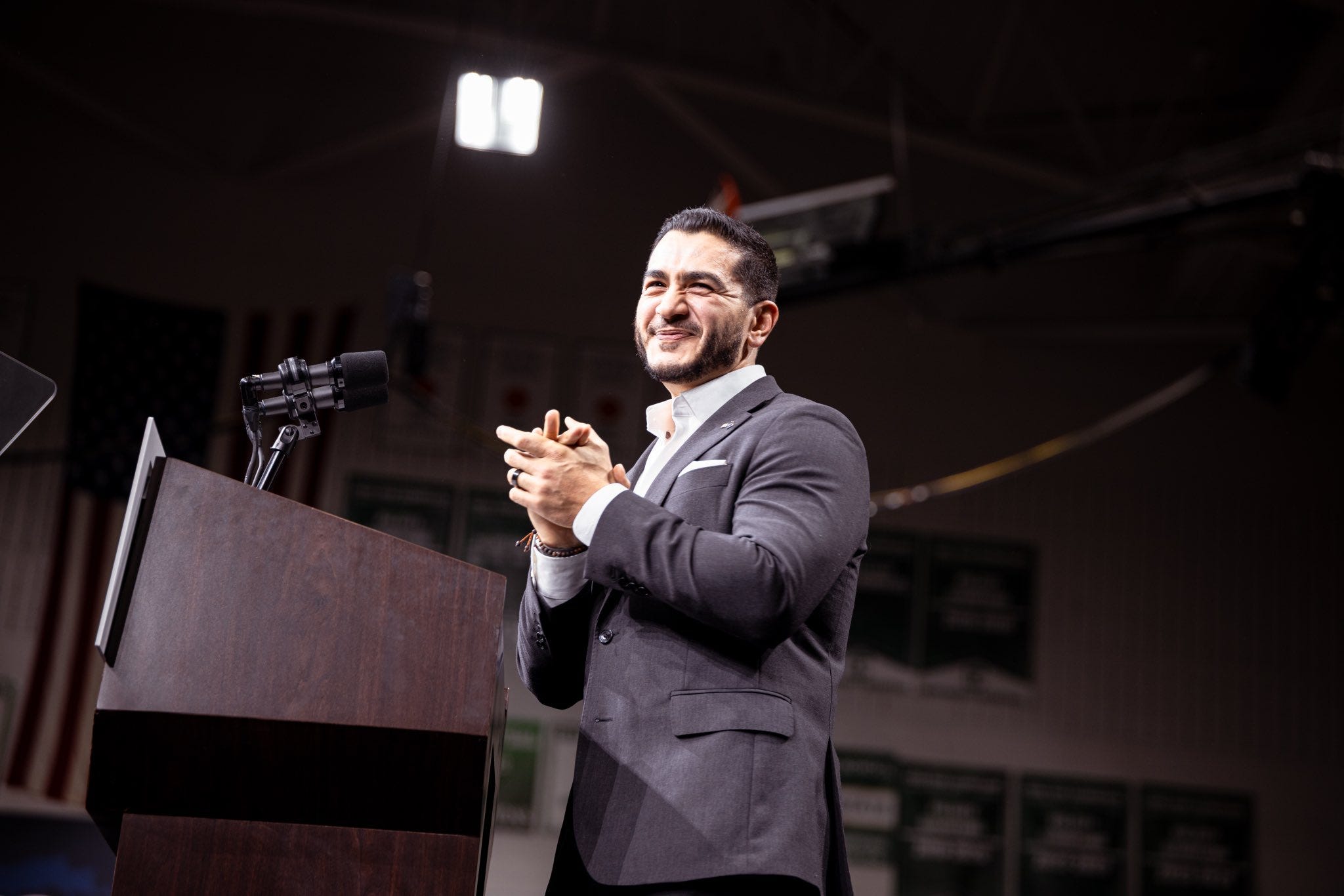
Michigan Senatorial Candidate Abdul El-Sayed at a rally last night. (@AbdulElSayed/X)
Perhaps the election that matters the most for Israel’s future will take place next week in Michigan. Two years ago, that Rust Belt swing state handed Trump the victory and the presidency, thanks to Muslims who were angry at Biden for supporting Israel too much and Jews who were angry at him for supporting it too little.
Now most of the anger is at Trump, and that is the prelude to the decisive test of the radical wing of the Democratic Party. In the summer primary, the party chose, even if by a tiny margin, Dr. Abdul El-Sayed as its Senate nominee. Next to him, New York Mayor Zohran Mamdani is practically a member of Otzma Yehudit. El-Sayed, of Egyptian family origin, believes Israel is an “ethnostate” of the kind that has no right to exist. He gave an interview to someone who said he came to the United States to hijack September 11, posted in the past in support of the Muslim Brotherhood in Egypt, and implicitly justified the attack on a synagogue in Michigan by explaining that the terrorist’s family members had been killed by an Israeli missile.
Mamdani took over New York with a pyramid scheme: he recruited enough enthusiastic supporters to win the primary in a deep-blue city where Republicans don’t get elected anyway. That is not the situation in Michigan, a swing state whose 21st-century winner won the entire United States. If a fanatic like him is elected on its behalf, the progressive-radical wing of the Democratic Party will see it as proof that all of America can be taken over. In that case, El-Sayed would immediately become a name in the presidential race, if not in 2028 then in 2032. If, on the other hand, the Republicans manage to build an effective dam against the “blue wave” in Michigan of all places, the Democrats will be forced into deep soul-searching over the radicalization, including the sharp anti-Israel sentiment. Figures like Pennsylvania Gov. Josh Shapiro, former Chicago Mayor Rahm Emanuel and others are just waiting for this moment, to say “we told you so” and offer a dose of reality.
As fate would have it, the state where gas prices rose the most sharply of any in the United States is Michigan. In Israel they are following the race with deep concern and tension, since the result may mark the loss of America, at least for the foreseeable future. The polls show a small lead for El-Sayed, within the margin of error. Behind the scenes, supporters of Israel are investing enormous efforts to tip the balance. Michigan gave, and perhaps Michigan will take away.
English Editor: Ari Tatarka
If you enjoy the newsletter, you can show your support by becoming a paid subscriber—it really helps keep this going. I’m also offering a special monthly briefing for a small group of premium members. I’d love to have you join us—just click below to find out more.
Thanks for reading It’s Noon in Israel! Subscribe for free to receive new posts and support my work.


Who were you referring to about the September 11 comment? Did you mean to write that he gave an interview to a guy who said America deserved 9/11?