
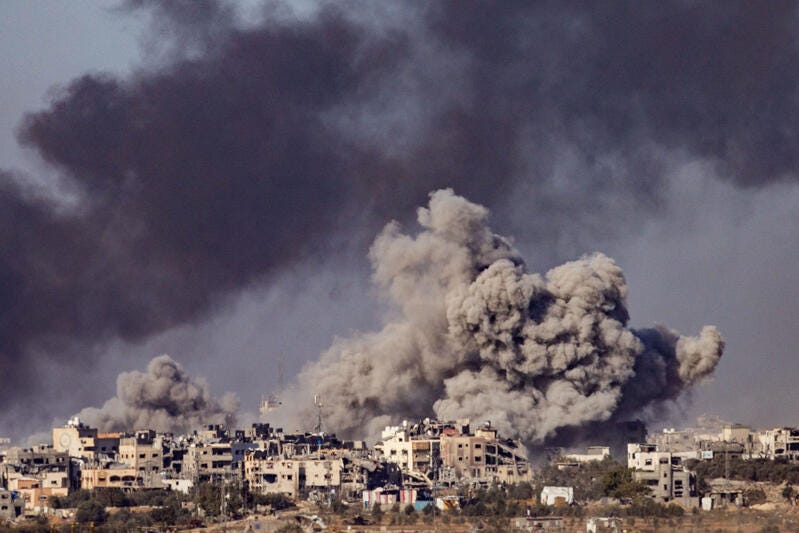
Smoke rises during Israeli airstrikes, in the Gaza Strip, as seen from the Israeli side of the border, on December 11, 2023. (Chaim Goldberg/Flash90)
It’s Tuesday, October 13, and a month into the war, 70 percent of Palestinians expected Hamas to win. A year later, that figure had fallen to 39 percent, and by August 2026 it was 20. Is this the end of armed resistance?
According to a new paper from professor Kobi Michael, a senior researcher at the Institute for National Security Studies, Hamas’s concept of victory has broken down. In an INSS survey in June, 57 percent of Palestinians said armed struggle had failed. A combined 56 percent backed nonmilitary alternatives: 43 percent preferred negotiations and 13 percent nonviolent resistance. Just over half, 52 percent, supported a two-state solution. Asked who won the war, 27 percent said neither side and 38 percent said both sides lost.
That hardly sounds like total defeat, but it is virtually unprecedented. Polled as the 2014 war ended, 79 percent said Hamas had won and just 3 percent said Israel had. Eighty-six percent backed renewed rocket fire if the blockade stayed, and Hamas leader Ismail Haniyeh beat Mahmoud Abbas 61 to 32 in a hypothetical presidential race. After the 2021 round, 77 percent again named Hamas the winner, against about 1 percent for Israel. Fifty-three percent called Hamas the movement most deserving to lead the Palestinians, against 14 percent for Fatah. Haniyeh’s lead over Abbas grew to 59 to 27, up from a dead heat three months earlier.
This time, Gaza is driving the shift. Support for Hamas ruling the Strip after the war has dropped since the 2024-2025 surveys, and more Palestinians now want technocrats, the Palestinian Authority or an international body to govern it instead. Residents of Judea and Samaria, who lived through the war at a distance, remain significantly more hawkish.
Losing faith in Hamas has not made Palestinians moderates. According to the Palestinian Center for Policy and Survey Research, 72 percent still oppose disarming Hamas before Israel withdraws completely, and half still say armed resistance has served the national cause. Two-thirds, 66 percent, oppose requiring electoral candidates to accept the PLO’s commitments, including its agreements with Israel, a figure that has risen since last October. Fatah has gained nothing from Hamas’s decline either: 65 percent call the Palestinian Authority a burden, and 83 percent say its institutions are corrupt. Jailed Fatah leader Marwan Barghouti remains the leading presidential candidate, and Hamas’s Khalil al-Hayya polls well ahead of Abbas.
Michael calls this a “dialectic” of contradictory views. Palestinians concede that armed struggle failed but refuse to give up their arms. They back two states but reject the agreements that would lead to them. What has changed, he argues, is that the public now puts survival ahead of national ambition.
Michael’s verdict on the war is “an Israeli victory, albeit an incomplete one.” Israel has won the argument in the minds of Palestinians, but it has not yet imposed its terms on Hamas or turned that perceptual gain into a political outcome.
Windows like this tend to close quickly.
We have been here before. By late 2004, with the Second Intifada crushed, 83 percent of Palestinians wanted both sides to stop the violence. A year later, a majority opposed attacks from Gaza. But exhaustion was not defeat. When Israel left Gaza without an agreement, 84 percent called it a victory for armed resistance. Hamas took the credit, then the legislature, then the Strip.
The superficial lesson is that withdrawal equals defeat. The deeper one is that what Palestinians take from this war will depend largely on what Israel does next. Proving that armed resistance does not pay came at a terrible price for Gazans and Israelis alike, but it was a lesson that had to be taught. Those who urged Israel to answer October 7 with negotiations and a political process ignore that doing so could only have increased support for further violence. If Hamas hails international recognition of a Palestinian state as a victory won by arms, how much more would it have claimed an Israeli peace process?
But now that armed resistance has been discredited, the question is what alternative Israel can offer.
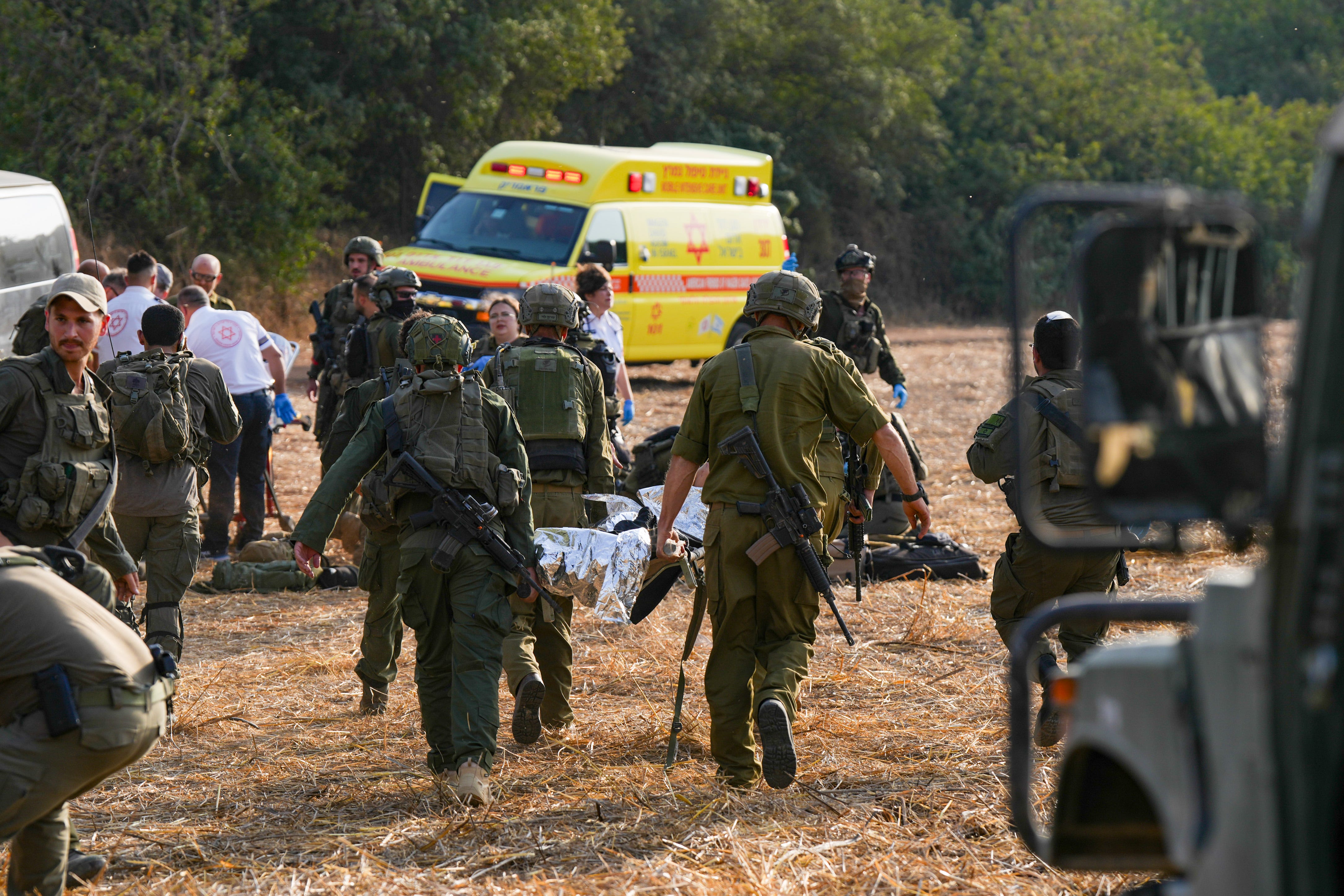
Israeli security and rescue forces evacuate injured people near the site where suspected unexploded ordnance detonated during a school trip, killing a 15-year-old student and injuring 24 others near Kibbutz Yiftah in the Ramim Ridge area, close to the Israeli border with Lebanon, October 12, 2026. (Ayal Margolin/Flash90)
The students thought it was a souvenir. About 50 students and teachers were walking the Ramim Ridge, above the Hula Valley near the Lebanese border, when some of the students came across a small metal object beside the trail. They picked it up and took photos with it. According to the preliminary police inquiry, one boy put it in his backpack. Shortly after 3:30 p.m., as the group sat near the bus parking lot, it exploded.
Elazar Yair Wilensky, 15, was killed at the scene. Twenty-four others were wounded, two of them seriously.
Within hours, Israel Defense Forces troops had found more bomblets near the site. Students told investigators they had seen several, and that more than one had gone into a backpack. The IDF now estimates that thousands of unexploded munitions may remain across the north.
During the war, Hezbollah fired Grad rockets carrying dozens of submunitions each into the Galilee. A cluster munition is designed to scatter its bomblets over a wide area, and many fail to go off on impact.
Responsibility for clearance is split: the police handle civilian areas, the Nature and Parks Authority handles nature reserves, and the Jewish National Fund (KKL-JNF) handles forests. No single public map shows which trails have been swept, when, or how thoroughly. The Education Ministry approved the route, yet KKL-JNF signs posted since May warned that the area was dangerous and closed to visitors. The state comptroller warned about munitions clearance in 2017, 2021 and again last year: “Explosive materials have already claimed lives. The writing is on the wall—we must not wait for the next disaster.”
In the 2006 Second Lebanon War, Hezbollah fired 113 cluster rockets into the Galilee, scattering roughly 4,400 bomblets that killed one civilian and wounded 12.
It is a terrifying reminder that, even though Israelis can now return to the north, the scars of war are far from faded. Besides the ever-present threat of renewed conflict, there is the damaged infrastructure, the hollowed-out communities and, as yesterday’s disaster shows, the dangerous remnants of war. Much work remains before the north is a place where one can travel safely.
English Editor: Ari Tatarka
If you enjoy the newsletter, you can show your support by becoming a paid subscriber—it really helps keep this going. I’m also offering a special monthly briefing for a small group of premium members. I’d love to have you join us—just click below to find out more.
Thanks for reading It’s Noon in Israel! Subscribe for free to receive new posts and support my work.


Responsibility for clearance is split: the police handle civilian areas, the Nature and Parks Authority handles nature reserves, and the Jewish National Fund (KKL-JNF) handles forests......And The Student...Teacher?
Every hike my kids took with school which as long before this war they were warned to never pick up anything shall I say man made. How did these teachers allow this and how do you not even mention this fact? We live in a war zone and especially now we need to be especially vigilant.