The End of the OPEC Era
Also, is it about Bibi? And Germany loses a MasterChef.
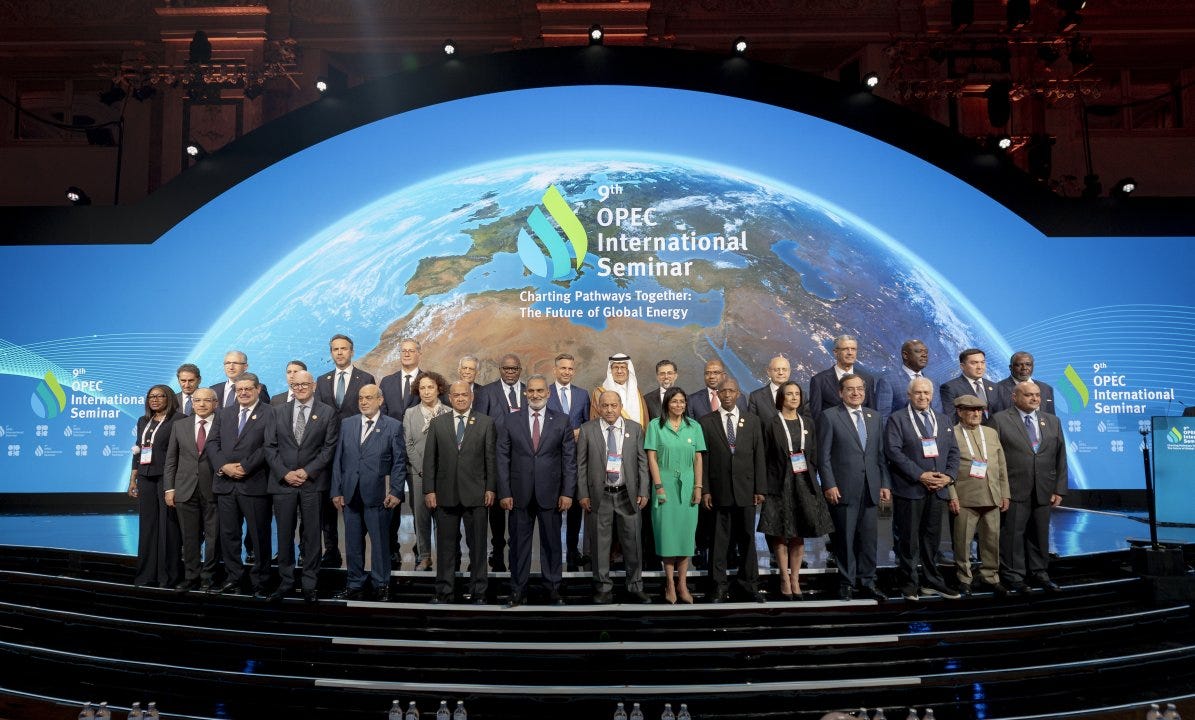
9th OPEC International Seminar. (OPEC)
It’s Wednesday, April 29, and the United Arab Emirates has announced its departure from the Organization of the Petroleum Exporting Countries (OPEC). As the group’s third-largest producer, the move is monumental. By way of comparison, it is akin to a permanent member of the Security Council leaving the United Nations—except, of course, the world actually cares about what OPEC has to say.
To understand why this has huge implications, some context.
OPEC was formed in 1960 by Iraq, Iran, Kuwait, Saudi Arabia and Venezuela, ostensibly to ensure the global stability of the oil supply, but fundamentally to act as a cartel to fix the price of oil at a level that benefited the members. As their charter states:
“The principal aim of the Organization shall be the coordination and unification of the petroleum policies of Member Countries and the determination of the best means for safeguarding their interests, individually and collectively.”
But the organization has defined its “interests” quite broadly. Most notoriously, the cartel decided in 1973 that the members’ interest was the punishment of the global economy for Israel’s victory in the Yom Kippur War, leading to a period of stagflation and economic decline. That wasn’t their only time flirting with political manipulation; other instances include pressuring Iran during the Iran-Iraq War and cutting production to keep prices high in 2022, punishing the U.S. for criticizing the Saudi government and enriching Russia during its invasion of Ukraine.
So, why now?
Well, the oil market is vastly different from that of the 1970s. The first blow to the OPEC monopoly was that the U.S. now ranks among the world’s top three exporters of crude following the shale revolution in the 2010s. The U.S.’s impending control over the reserves of one of OPEC’s founding members, Venezuela, is another, and Operation Roaring Lion is the third. During the recent conflict, production policy was coordinated through OPEC, but in some ways it was every oil nation for itself: the Saudis had their contingency for bypassing the Strait of Hormuz, and the UAE had its own.
The exit also resolves a long-standing tension between the UAE’s rapidly expanding production capacity—which targeted 5 million barrels per day by 2027—and restrictive cartel quotas that forced the nation to operate roughly 30 percent below its capability. This is reflective of a fundamental difference in interests: Saudi Arabia requires crude prices near $80 per barrel to balance its national budget and fund Crown Prince Mohammed bin Salman’s ambitious plans for the country.
Conversely, the UAE possesses a vastly more diversified economy and massive sovereign wealth funds. The UAE’s overall economic health is tied more closely to global macroeconomic growth than to the nominal price of a barrel of oil. By exiting OPEC and actively increasing global supply to lower energy costs, the UAE can deliberately stimulate the global economy, curb Western inflation and thereby bolster the returns of its own massive international investment portfolios.
Perhaps most interestingly, the withdrawal signals a deepening geopolitical rift with Saudi Arabia. Though the two nations have long clashed through proxies in Yemen and Sudan, the UAE is now charting a more permanent, independent course—one that hugs the U.S. and Israeli coasts rather than being bound to the Saudi winds. This isn’t just speculation; MBZ’s top adviser, often considered his mouthpiece, has grown increasingly vocal about his disappointment with the Arab League and the Gulf Cooperation Council. But even when the relationship isn’t overtly adversarial, the UAE is clearly finished with regional conformity.
The notion of regional conformity is deserving of a quick tangent. For decades, the West operated under the belief that the Middle East was a unified, monolithic bloc—one in intractable opposition to the existence of Israel. This misconception led successive U.S. administrations to treat Israel at arm’s length, demanding Israeli concessions as a prerequisite for gaining “Arab favor.” The UAE’s exit from OPEC further proves that this framework is outdated, if it was ever true at all. The region isn’t a monolith; it is a collection of sovereign states with divergent and often competing national interests.
I am losing count of the tectonic shifts occurring in the Middle East under the Trump administration, but this is easily one of the most significant. The transition of oil toward a true free-market commodity is virtually unprecedented in global history.
And this may only be the beginning. Today, the UAE’s most prominent voice, Amjad Taha, promised another historical day is imminent. While the nature of that day remains a mystery, we may very well be on the cusp of a new economic era.
Protesters block a road and clash with police during a demonstration against Prime Minister Benjamin Netanyahu and his government outside the government offices in Jerusalem. (Yonatan Sindel/Flash90)
Any election with Netanyahu leading the Likud—and this marks his twelfth—is fundamentally a referendum on the man himself.
But what is the participation rate in this referendum? Well, the last election saw an all-time record. Ninety-nine percent of voters (98.81 percent to be specific) voted in 2022 for parties that announced in advance whether they would sit with Netanyahu or boycott him. Only about 1 percent of the votes went to Ayelet Shaked’s party, which maintained ambiguity on the matter.
Have October 7, the war, fatigue and the passing years caused other considerations to prevail? According to the poll, the answer is ostensibly a resounding “yes.” Forty-eight percent of the Israeli public state they have more pressing considerations than Netanyahu’s continued tenure. Eighteen percent say they want him to remain, but feel the government’s composition and policy positions are more important. Another 30 percent are averse to him, yet would consider a government under his leadership if it were based on a sensible coalition and sound fundamental guidelines. Among all voters, the “Netanyahu question” remains most important to Likud voters, with a 51 percent majority admitting it is their most critical issue.
In plain English: half the public declares support for Netanyahu, but would still consider a unity government—say, one without the ultra-Orthodox, headed by Eisenkot or Bennett. Conversely, many who oppose him would still give their blessing to a logical government formed under his leadership. On the surface, this is a political earthquake predicting a tsunami of votes for centrist parties and, subsequently, a broad unity government.
The question, of course, is whether to believe the public. After all, the phrasing of the poll doesn’t make it easy for respondents. It can be uncomfortable to admit that a personality-driven issue, however important, outweighs ideological positions. Therefore, it is advisable to treat this data with a great deal of caution.
Still, it is clear that far more than a single percent of the population is ready to break the old voting patterns that dominated the last five—perhaps six—consecutive election campaigns and led to the greatest political crisis in the country’s history. Even if only 10 percent of the public actually shifts their vote, it still creates an opening for a 12-seat party—one capable of forcing a unity government and completely upending the political rules we have grown accustomed to over the last decade.
This is an excerpt from my weekly column in Israel Hayom
Eyal Shani during the finale of Israeli MasterChef. (Abir Sultan/Flash 90)
After a years-long struggle against violent protesters and boycotts, the Israeli restaurant “Gila and Nancy” in Berlin has permanently shut its doors. But this is more than one of the run-of-the-mill antisemitic restaurant attacks—a phrase I couldn’t have imagined saying three years ago.
The restaurateur behind it, Chef Eyal Shani, is essentially Israel’s Gordon Ramsay. Known for his enduring, almost poetic love of tomatoes, Shani operates a global chain of restaurants and serves as a judge on Israel’s version of MasterChef. When he attempted to open this new Berlin branch in the summer of 2025, BDS and anti-Israel protests outside the venue turned violent, forcing the opening to be postponed time and again.
As Shani explained at the height of the crisis: “Death threats were spray-painted on the neighborhood’s garbage cans, tomatoes were smashed against the restaurant’s windows (much to his anguish). Direct threats were made against my life, and therefore we decided this wasn’t the moment. I didn’t want to make targets out of my staff members and put their lives at risk.”
Ultimately, the restaurant only managed to open its doors in September 2025, on its third attempt and under unprecedented police security that included dozens of officers and the arrests of rioters. Even on opening night, protesters continued to gather outside the venue, clashing with police and chanting against the owners.
This isn’t even the first of Shani’s restaurants to be targeted; a branch of his famous Miznon chain was attacked in Australia alongside a wave of other localized hate crimes.
The bitter irony is that few have done more to feed Gazans than Shani’s longtime business partner and the co-founder of their global restaurant group, Shahar Segal (no relation). Segal served as the spokesman for the Gaza Humanitarian Foundation, which distributed 163 million meals to Gazans during its operations.
Eyal Shani’s left-wing politics are well documented: he openly criticized a MasterChef contestant for living in Judea and Samaria and was a vocal opponent of the judicial overhaul. His business partner, Shahar Segal, has done more to materially help Gazans than any protester outside his restaurant’s doors. Yet, their businesses were targeted anyway.
To these protesters, individual Israelis with unique thoughts and beliefs simply do not exist. In their minds there is only a monolithic “Israel,” large-nosed and with a ravenous hunger for the blood of innocents. But the cost of objectifying people is that you lose out on who they are.
Those protesters will never taste Shani’s unique culinary talents, nor the hospitality that Segal has spent a lifetime perfecting. In the end, self-righteousness is a poor substitute for a good meal.
English Editor: Ari Tatarka
If you enjoy the newsletter, you can show your support by becoming a paid subscriber—it really helps keep this going. I’m also offering a special monthly briefing for a small group of premium members. I’d love to have you join us—just click below to find out more.
Thanks for reading It’s Noon in Israel! Subscribe for free to receive new posts and support my work.


An insightful article, especially because with the Strait of Hormuz blocked, the UAE export capacity is limited to its pipeline to Fujairah, about 1.5m bpd. Leaving OPEC was a long-term move by the UAE.
PS is it possible to include a link to the Israel HaYom article? It's not there yet.