The International Stabilization Force Returns?
Also, Israel getting pushed down the list of priorities, and more.
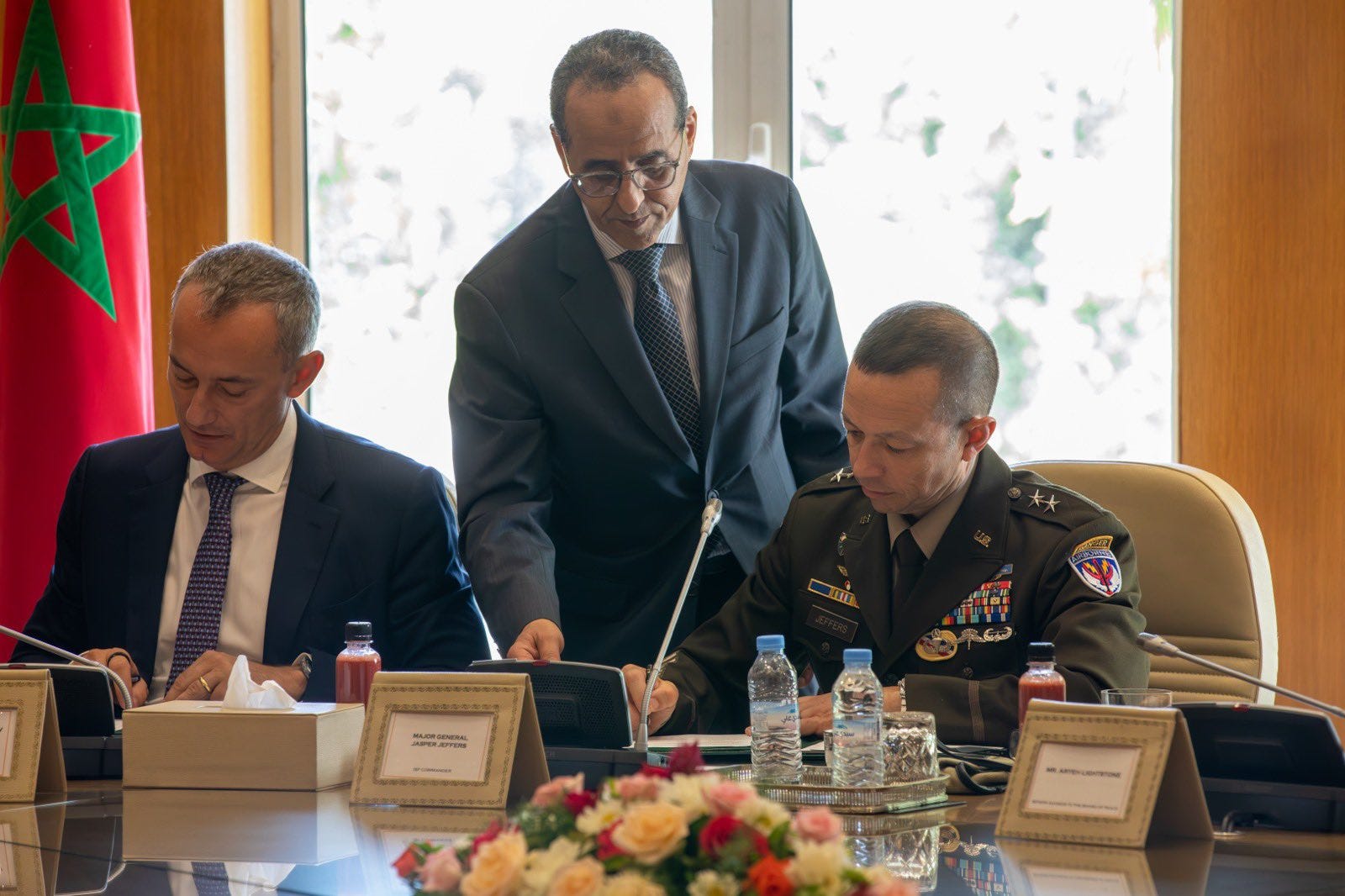
Morocco formally signing its Participating Country Agreement with the International Stabilization Force.(@BoardOfPeace/X)
It’s Monday, July 27, and yesterday Israel’s Cabinet approved the entry of the International Stabilization Force into Gaza. Is this the start of Phase Two of the Gaza agreement?
The first thing to note is that, much like the Lebanese Armed Forces deploying alongside UNIFIL in southern Lebanon—nobody mistakes them for a force that will actually disarm anyone—it’s a pilot, not a deployment. It is approval for the limited entry of the ISF, with troops first deploying along the borders of a pilot humanitarian zone being planned by the Board of Peace. The vote was tied to a broader humanitarian pilot project—the Board of Peace’s attempt at regaining relevance and departing the resort at Sharm el-Sheikh to actually begin governing the Strip.
The underlying ask is relaxing certain restrictions on “dual-use” humanitarian items, signing agreements to let ISF-contributing countries’ troops enter, and approving the vetting and entry of a Palestinian police force under the Trump plan.
Crucially, the approval does not authorize an actual deployment. The Cabinet granted the ISF legal immunity under Israel’s “Immunities for International Organizations” law, and allowed the force to operate in “full coordination with the IDF” in areas outside IDF control—in other words, not an inch of withdrawal or stepping outside of the IDF’s framework. Entry of any ISF personnel still requires the personal approval of Netanyahu, Defense Minister Israel Katz and Foreign Minister Gideon Sa’ar. A major step this vote is not.
Tactical vehicles arrive at Logistics Support Area: Endurance. (@BoardOfPeace/X)
There also remains the more basic problem that the ISF lacks anywhere near enough troops to man it. What was planned as a 20,000-strong force has already been moderated down to a target of 10,000 by the end of 2026—and even that flatters it. The two sites the mission is being built around, the “Endurance” logistics hub in Israel near Kerem Shalom and a mission support site inside Gaza that has yet to break ground, are together designed to hold roughly 5,500 personnel. What can actually move first is smaller still: an initial group of ten to twenty troops, a handful of Moroccan officers who will secure the logistics hub before anything resembling operations inside Gaza begins.
The manpower simply hasn’t materialized. Indonesia alone was expected to provide 8,000, by far the largest single pledge, before putting its participation on hold. Jakarta first cited a Washington distracted by its war with Iran; then, in the weeks that followed, four Indonesian peacekeepers were killed in clashes between Israel and Hezbollah in Lebanon. The single largest would-be contributor to the ISF watched its own blue helmets die in precisely the scenario Gaza is asking it to walk into. What’s left are four countries—Albania, Kazakhstan, Kosovo, and Morocco—now on course to sign formal commitments that, scraped together, barely reach four figures. The pilot force itself comprises just 200 members from “friendly countries such as Uganda and Morocco,” each contingent requiring individual Israeli approval, with no clear deployment date.
As of this morning, the facts on the ground are unchanged. The security architecture exists in theory, but it sits atop a Phase Two—the disarmament-for-withdrawal exchange—that has not begun and, by Israel’s own officials’ account, will not begin absent Hamas disarmament. Hamas gestured at the governance half this week, with its governing body saying it would step down in favor of the technocratic council, but it pointedly declined to commit its military wing to laying down arms—movement on the easy question, absolute refusal on the hard one.
The approval reads most likely as a goodwill gesture: something for Netanyahu to carry into his seventh meeting with the U.S. president tomorrow. That meeting is likely to be a microcosm of Gaza’s problem, with Iran eclipsing any real discussion of the strip. A new Rafah, it seems, will have to wait for something new in Tehran.
Donald Trump participates in an interview with Trey Yingst of Fox News. (White House)
“Call us when you’re serious,” Secretary of State James Baker told Prime Minister Yitzhak Shamir in the early 1990s. In the current Republican administration, with the current Likud prime minister, they still answer the phone. Netanyahu and Trump talk, though no longer on a daily basis.
Something’s grinding in the relationship between the White House and the Prime Minister’s Office since the Iran war became complicated. The president’s circle is narrower and more closed than in previous administrations, and it’s become harder and harder to penetrate. The Americans are making clear to Israelis that they’re running the war and everything’s fine, thank you, but everyone knows Israel is being relegated to the back seat.
As an experienced politician, Netanyahu surely knows how to identify deliberate distancing. When U.S. Vice President J.D. Vance said, “Israel’s situation isn’t good in America, and there doesn’t seem to be room for disagreement on that,” he clarified the week before that he was “in the healthy center,” between those who think Israel is a problem and those who think it’s an asset. That’s interesting, but the president’s silence is more interesting.
Not to mention Saudi Arabia. Trump handed the kingdom this week the civil nuclear program it’s been wanting, in contradiction to Israel’s position and without the package deal Israel requested. Biden had previously delayed a similar move to tie it to the Abraham Accords; his successor did it without linking the moves. Lindsey Graham is surely turning in his grave. This is already the second time this has happened: the removal of sanctions on Syria also prevented achieving a peace agreement with Israel. And all while Israeli fighter sorties keep being postponed.
It also affects the elections. I once heard from a campaign operative that, from an Israeli perspective, everything happening in the Middle East is foreign news as long as missiles aren’t landing here. Oddly enough, that’s what’s happening now: the United States is striking Iran, Jordan is being bombarded along with all the Gulf states, but the agenda here is taken up with July-August vacations and haredim. The main reflection of the fighting is the question of whether the refueling planes at Ben Gurion will lead to canceled flights. A security agenda, as is known, is good for Likud and a civilian agenda is bad for it. But the indifferent shrug of the shoulders probably stems from understanding that Israel is in a relatively passive position.
All of this, you can guess, is about to change. Netanyahu didn’t insist for no reason on the possibility of canceling Likud primaries in case of security events. Anyone with eyes knows he didn’t insist for nothing, and this won’t remain theoretical.
This is an excerpt from my weekly column in Israel Hayom.
Are the U.S. and Iran once again on the brink of direct conflict? Would Israel’s military take part in a renewed confrontation? What could a third round of fighting actually look like? And how might elections in both Israel and the United States shape the decisions ahead?
I joined Dan Senor and Nadav Eyal to discuss all this and more on the most recent episode of Call Me Back.
English Editor: Ari Tatarka
If you enjoy the newsletter, you can show your support by becoming a paid subscriber—it really helps keep this going. I’m also offering a special monthly briefing for a small group of premium members. I’d love to have you join us—just click below to find out more.
Thanks for reading It’s Noon in Israel! Subscribe for free to receive new posts and support my work.


