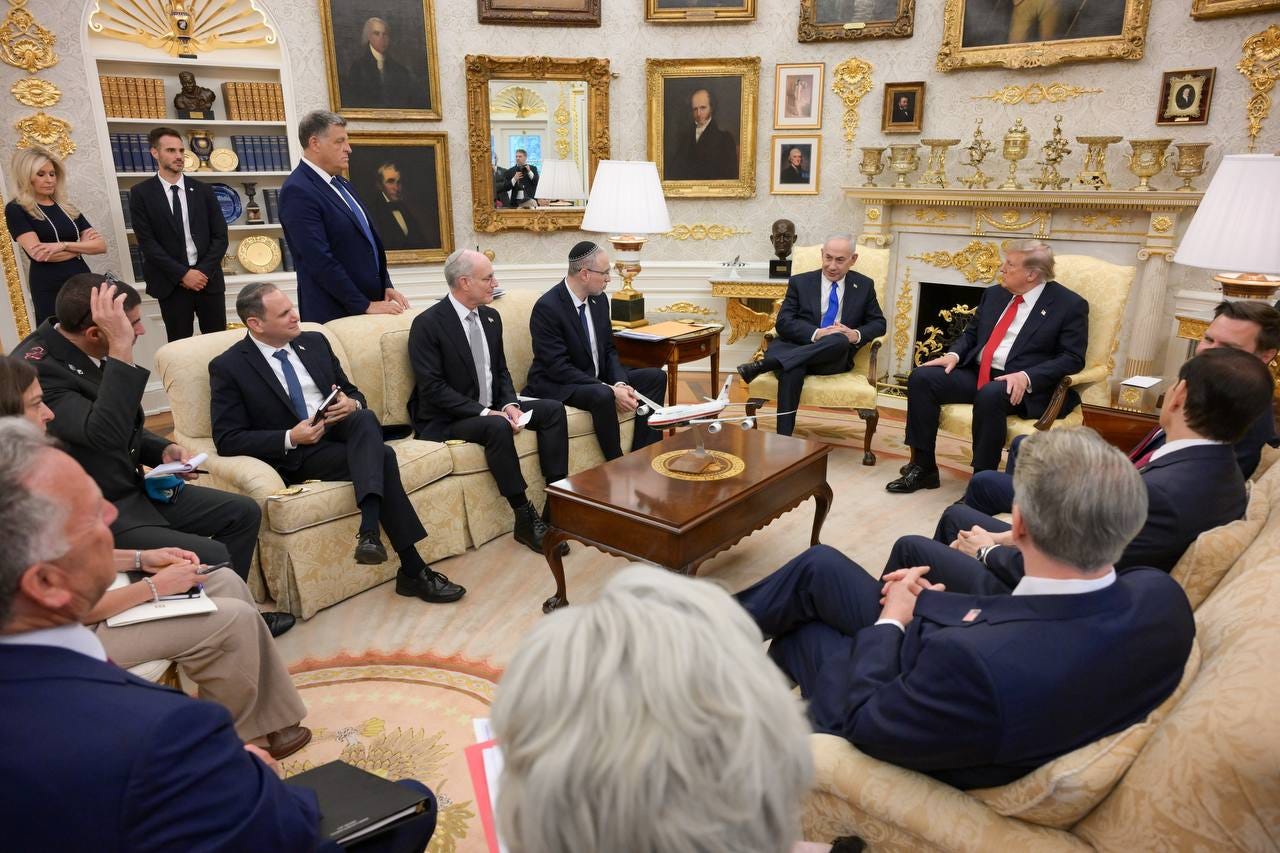
The Iran Roundtable
Also, voters don't care about Judea and Samaria, and Israeli universities rank highly on AI.
It’s Thursday, July 30, and according to a senior source on Netanyahu’s staff, Bibi wasn’t lying when he called his recent meeting with Trump “one of the greatest conversations” he’s had with the president. Though it was unlike any that came before it.
The conversation, according to my source, was less a one-on-one than a roundtable—Secretary of State Marco Rubio, Vice President J.D. Vance, and others weighing in across a wide range of issues.
Netanyahu isn’t losing sleep over the lack of face time. His goal was never to sell Trump on a renewed war; if anything, a private audience on the eve of one would only confirm the suspicion that he was the man pouring poison in the president’s ear, with any potential consequences of such an action laid entirely at his feet.
Netanyahu reportedly laid out three paths: diplomacy, war or blockade. He was far more interested in the latter two, assuming any diplomatic agreement with Iran would collapse on Iranian intransigence and pointing to continued economic pressure and military campaigns as the live options. But he was careful not to show it. As a senior source told The Times of Israel’s Jacob Magid, “Netanyahu did not tell Trump which of the three scenarios he preferred, although the premier did acknowledge doubts regarding the possibility that Iran will uphold any agreement it signs.”
This is not the same Netanyahu who walked into the White House on February 11, plan in hand, slideshow cued, testimonials from Israeli security officials at the ready. The change is deliberate. That presentation, and its consequences, have become a weight on his reputation—in Israel as much as in the United States. His selling point as Israel’s premier “Trump Whisperer” took a serious blow over the last few months of rocky relations and inconclusive results in Iran. Maybe it was time to return to an actual whisper: less room for a spectacular win, but less room for a spectacular loss.
Trump’s only line before the meeting came on Fox News: “We already know everything,” and “we don’t need Israel’s intelligence.” Whether or not that’s true, this was no Mossad chief unveiling Syria’s clandestine reactor to the Bush administration—it was a friendly workshop. As they say, teamwork makes the regime change work.
MK Simcha Rotman attends a demonstration calling for Israeli sovereignty over Judea and Samaria and opposing a Palestinian state, outside the weekly Cabinet meeting at the Prime Minister’s Office in Jerusalem, November 23, 2025. (Yonatan Sindel/Flash90)
During the November 2025 New York City mayoral election, an NBC News exit poll found that roughly 4 in 10 voters called the candidates’ positions on Israel a major factor in their vote. That’s a good deal less attention than Zohran Mamdani gives the subject—but it’s still more weight than the issue carries in Israel itself, where a Palestinian state, Judea and Samaria, and the conflict writ large don’t crack voters’ top three concerns.
The latest wave of terror attacks briefly brought public attention back to what is happening in Judea and Samaria. But the issue that once decided elections has evaporated from the agenda. In the 2006 election, Olmert opened the Kadima campaign by declaring that “over the next four years we must shape Israel’s permanent borders and consolidate into the settlement blocs.” Netanyahu’s defeat in that election stemmed from broad support for a broad withdrawal. If Netanyahu is defeated in 2026, it will be because no one is talking about withdrawals.
“I never said ‘a Palestinian state,’” Eisenkot keeps repeating. Bennett says he is a right-winger; Lieberman likewise. They all read the polls showing how far the people have moved right, and they probably also see how absent the issue is. How absent? One of the moments that symbolized the shift came during one of the Kaplan protests, when Brothers in Arms activists forcibly took down an “End the Occupation” sign so as not to hurt public support for the struggle.
So yes, 78 percent of the public say the issue of Judea and Samaria and a Palestinian state is important or very important. But when the public is asked to prioritize, this is the least important issue of all those examined. Cost of living at 35 percent, Haredi conscription at 18 percent, the war in Iran at 17 percent, judicial reform at 16 percent, and the future of Judea and Samaria at just 7 percent. Even among the religious public, only 12 percent see it as an important issue—a warning signal to Finance Minister Bezalel Smotrich, whose entire party leadership lives in Judea and Samaria.
Still, one may assume this is temporary indifference. According to most polls, the very next government will see a sharp argument over the future of Judea and Samaria, as evidenced by several inflammatory statements from senior figures on the Democrats list. And by all assessments, the next administration in America will not shrug at what is happening beyond the Green Line either. The Israeli public would be well advised to replenish its reserves of interest in the subject.
This is an excerpt from my weekly column in Israel Hayom.
A campus view of the Technion, Israel Institute of Technology, in the northern Israeli city of Haifa, on February 19, 2019. (Hadas Parush/Flash90)
Among the world’s 30 leading universities for producing artificial intelligence talent, research and entrepreneurship, sit two Israeli universities, according to a new global index released last week.
The Technion placed 25th in the AI Production Capacity Index, a ranking of 50 academic institutions compiled by the U.S.-based AI communications firm 5W. Tel Aviv University also made the top 30, at 28th. The university surpassed Harvard in several key areas, including AI entrepreneurship and the strength of its faculty and alumni connections to the AI industry. The report found that, when adjusted for institutional size, the Technion’s ability to produce AI entrepreneurs is comparable to Stanford, which ranked first overall.
The ranking scores institutions across six equally weighted categories, among them research output, AI degree programs, startup creation, computing infrastructure and ties to frontier AI companies. In the entrepreneurship category—measuring how many graduates go on to found AI startups—the Technion ranked eighth in the world, ahead of several Ivy League universities, including Harvard.
The report credited the Technion’s standing to the tight links between academia, industry and Israel’s technology ecosystem, alongside a talent pipeline flowing out of the military’s elite technology and intelligence units. It noted the university’s dense ties to Nvidia’s R&D operations in Yokneam—the chipmaker’s largest engineering site outside the United States—Intel’s operations in Kiryat Gat and Haifa, and the alumni pipeline from IDF Unit 8200. Compute infrastructure, the report said, is the only structural constraint.
“Despite the dramatic disparity in resources between the Technion and leading American universities and other top institutions worldwide, the Technion has secured a place among the world’s leading universities,” said Technion President Prof. Uri Sivan. “Technion researchers were among the pioneers of machine learning, helping lay the foundations for leadership in AI as a whole.”
“AI tools are now essential in the workplace, and we ensure that our students acquire these skills alongside a strong foundation in mathematics, science and engineering,” he added.
English Editor: Ari Tatarka
If you enjoy the newsletter, you can show your support by becoming a paid subscriber—it really helps keep this going. I’m also offering a special monthly briefing for a small group of premium members. I’d love to have you join us—just click below to find out more.
Thanks for reading It’s Noon in Israel! Subscribe for free to receive new posts and support my work.


Was a “senior source on Bibi’s staff” ever going to say anything else, but that the meeting was the greatest ever?