It’s Noon in Israel: The Kurdish Invasion That Couldn't
Also, Hamas splits in three, and the Likud's new nightmare.
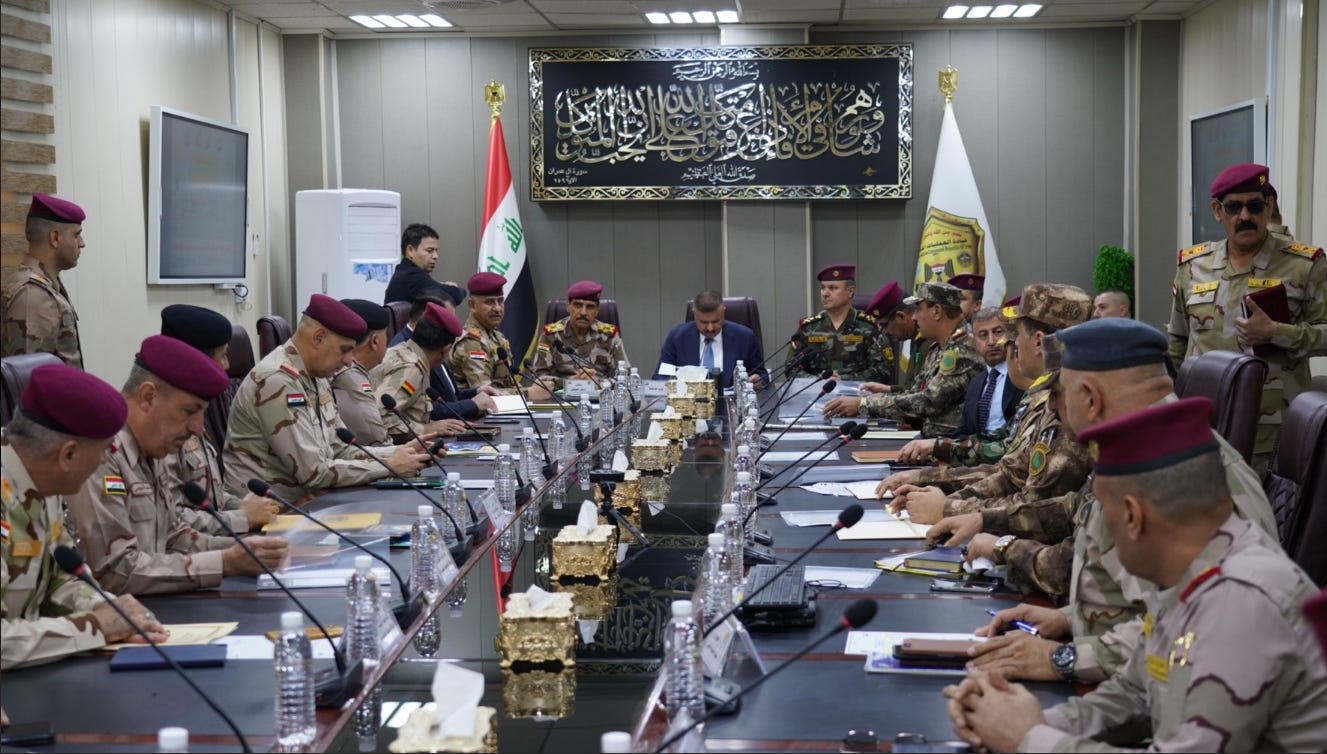
A delegation from the Peshmerga ministry convening with Iraq’s interior and defense ministries in 2024. (GOV.KRD)
It’s Friday, May 8, and it was an ambitious plan—some would say almost absurdly so. A Kurdish invasion comprising thousands of fighters crossing from Iraq into Iran, intended to liberate the Kurdish regions, home to eight million people, including tens of thousands of armed men. Together, they were supposed to advance eastward while, simultaneously, armed militias of other minority groups would bite into Iranian territory from all directions, pushing all the way to Tehran.
The problem with Mossad operations, unlike military ones, is the lack of precedent to rely on. The pager operation surely also seemed fantastical—exclusive to the realm of fantasy—before it was executed.
The reports indicating an Israeli attempt to drag President Trump into a doomed regional adventure ignore one critical fact: The CIA was also a full partner in the planning.
After all, the Kurdish parties are a lot like the Israeli opposition: five parties that do not speak to one another. The idea was to bring them all together on a shared platform, namely toppling the despised Ayatollah regime. For the move to even be considered, the Kurds had to agree to a form of “Seven Noahide Laws”: an agreement not to murder, not to loot and, above all, not to harm Iran’s territorial integrity. The IDF had already begun attacking Revolutionary Guard bases in the border area to clear the ground. One can only guess what weapons were placed at the Kurds’ disposal and from which front they arrived. In the Middle East, weapons you buy in the first act are sometimes turned against you in the third.
The plan is too good to be true, and for now, indeed, it isn’t. When Fox News reported that the attack was beginning, Turkish President Erdogan called Trump and, in a furious phone call, talked him out of the idea. It didn’t help that the party affiliated with the PKK, despised by the Turks, was not a partner in the move. In fact, two phone calls significantly slowed down the plans to topple the regime. The call from Erdogan halted the Kurdish offensive, and the call from the emir of Qatar, following the strike on an Iranian energy facility, halted the continued destruction of the Revolutionary Guards’ economy.
Could the plan still materialize? Has the disruption of these plans soured relations between Washington and Jerusalem? Top officials deny this, claiming coordination is even tighter now than at the start of the campaign. Nevertheless, it seems the Kurds will have to keep warming up on the bench for a while longer.
This is an excerpt from my weekly column in Israel Hayom.
To read this article on my website, click here
Palestinian supporters of Hamas attend a rally marking the 25th anniversary of the Islamist movement’s foundation in Ramallah, 2012. (Issam Rimawi/Flash90)
Hamas is currently dividing into three factions, observes a senior official in the Peace Council: those who want to die as martyrs, those who do not want to die as martyrs, and those who want to buy time without the population rebelling against them. The first faction shrank significantly during the war because, as we know, most of them indeed got what they asked for. The question of whether the demilitarization of Gaza will succeed depends heavily on the current balance of power.
Hamas has discovered a very different kind of American than the ones they encountered during the hostage release negotiations last year. Last year, they were spoken to as equals, befitting an entity holding dozens of Israelis. Now, the Americans look down on them and issue direct orders.
Last year, the whole world courted them, and they enjoyed the mediation services of numerous countries seeking proximity to the center of global attention. Since then, four Arab countries have already announced the severing of ties with Hamas. It is no coincidence that these are four countries that were attacked by Iran. “We are being bombed and you remain silent?” they raged at Hamas.
The most prominent of these is Qatar, which effectively expelled Khalil al-Hayya, a senior Hamas official. The man left Doha and has not been allowed to return since. Senior Hamas officials are now relocating their residences to Turkey, their last remaining supporter in the world. We’ll always have Istanbul.
All this is well and good, but what will actually come of it in the Gaza Strip? After all, an atmosphere of gloom prevails in Israel amid claims that Hamas is strengthening its position in the areas it still controls within the Strip. When Hamas wants to cheer itself up, it reads the Hebrew press, and when Israelis want to cheer themselves up, they go on social media to look at accounts from Gaza.
Well, the Peace Council believes that in the coming months (even before Oct. 27, for the attention of reader Netanyahu), some areas of Gaza will be cleared of weapons and tunnels and formally handed over to the new entity. Israel will be required to withdraw only after the entire cleanup is complete, certainly not at its start. The pressure is heavy, backs are against the wall, international isolation is worsening—all that remains is for Hamas to be convinced as well.
To read this article on my website, click here
Israel Beyteinu party leader Avigdor Liberman speaks with Yesh Atid party leader Yair Lapid, with Naftali Bennett, then head of Jewish Home, in the foreground, 2015. (Miriam Alster/Flash90)
The Likud is closely monitoring the strengthening of premier candidates Gadi Eisenkot and Avigdor Liberman with a mix of hope and apprehension. Hope—because for two years, the Likud machine was exclusively calibrated to fight the previous front-runner, Naftali Bennett, constantly battling over the right-wing votes he supposedly brought as his political dowry. Apprehension—because Eisenkot and Liberman will be much harder to dismantle.
Bennett and Lapid are familiar foils—the Rosencrantz and Guildenstern of Israeli politics—complete with a heavily loaded archive of past missteps to exploit. But the Likud has repeatedly failed in its attempts to push Liberman below the electoral threshold, and Eisenkot arrives with a record free of political zigzagging and a biography of service that makes him very difficult to attack.
The working assumption within the Likud is that the ultimate rival for the premiership will be Gadi Eisenkot. Perhaps this is why the “Change Bloc” is in a relentless frenzy of recruiting, mergers and acquisitions, while on the right, there is nothing new.
The organizing principle in the Likud until today was: We will hit Bennett with a pincer movement. We on the right will brand him a leftist, and the left-wing parties will brand him a rightist. Once he weakens and loses the leadership of the bloc, his desire to form another “change government” will vanish, since he wouldn’t be leading it. That would open the door for his return to the Netanyahu fold. This maneuver forced Bennett into an earlier and fiercer-than-expected battle for the opposition’s votes, which culminated in a unification with Yair Lapid.
That was the idea, but the composition of the “Together” list pretty much thwarts this possibility. So far, there is not a single kippah wearer or identified right-winger on Bennett’s list. Even if Bennett wanted to crawl into Netanyahu’s coalition tomorrow morning, he has no one to bring with him.
And just as Bennett’s list reflects a pivot toward the opposition’s electorate, Liberman’s list reflects a pivot toward the coalition’s base. The party that began its journey with a clear majority of former Soviet Union immigrants is changing its face. The latest additions are Rafi Ben Shitrit, a bereaved father; Sharon Sharabi, the brother of a hostage; Yisrael Ben Shitrit, a reserve combat soldier; and a senior settler figure, Kobi Eliraz. This reflects an understanding that the Russian electorate, once estimated at 17 seats, is steadily fading, and on the day after, it will be difficult to form a government reliant on Arab parties.
How exactly a coalition emerges from all this math is anyone’s guess.
To read this article on my website, click here
English Editor: Ari Tatarka
If you enjoy the newsletter, you can show your support by becoming a paid subscriber—it really helps keep this going. I’m also offering a special monthly briefing for a small group of premium members. I’d love to have you join us—just click below to find out more.
Thanks for reading It’s Noon in Israel! Subscribe for free to receive new posts and support my work.


insane that turkey and Qatar have the influence from afar that they do 🤦🏼♂️
the premise of the noahide laws being imposed upon the Kurds seems absurd for the rehava Kurds seem to be the optimized modernized Islam we sought until Trump and Tom Barack threw them under the bus
divisions within Kurdish society indicate a parallel ancient society such as Iran and the Jews ☺️🤦🏼
Moshe Feiglin doesn't get featured or talked about enough, I think he's the only one who can stand tall and be tough and repudiate all of the deranged entities from within and without.