The Monster Beneath the Mountain
Also, Bibi's coalition breaks a 53-year curse.
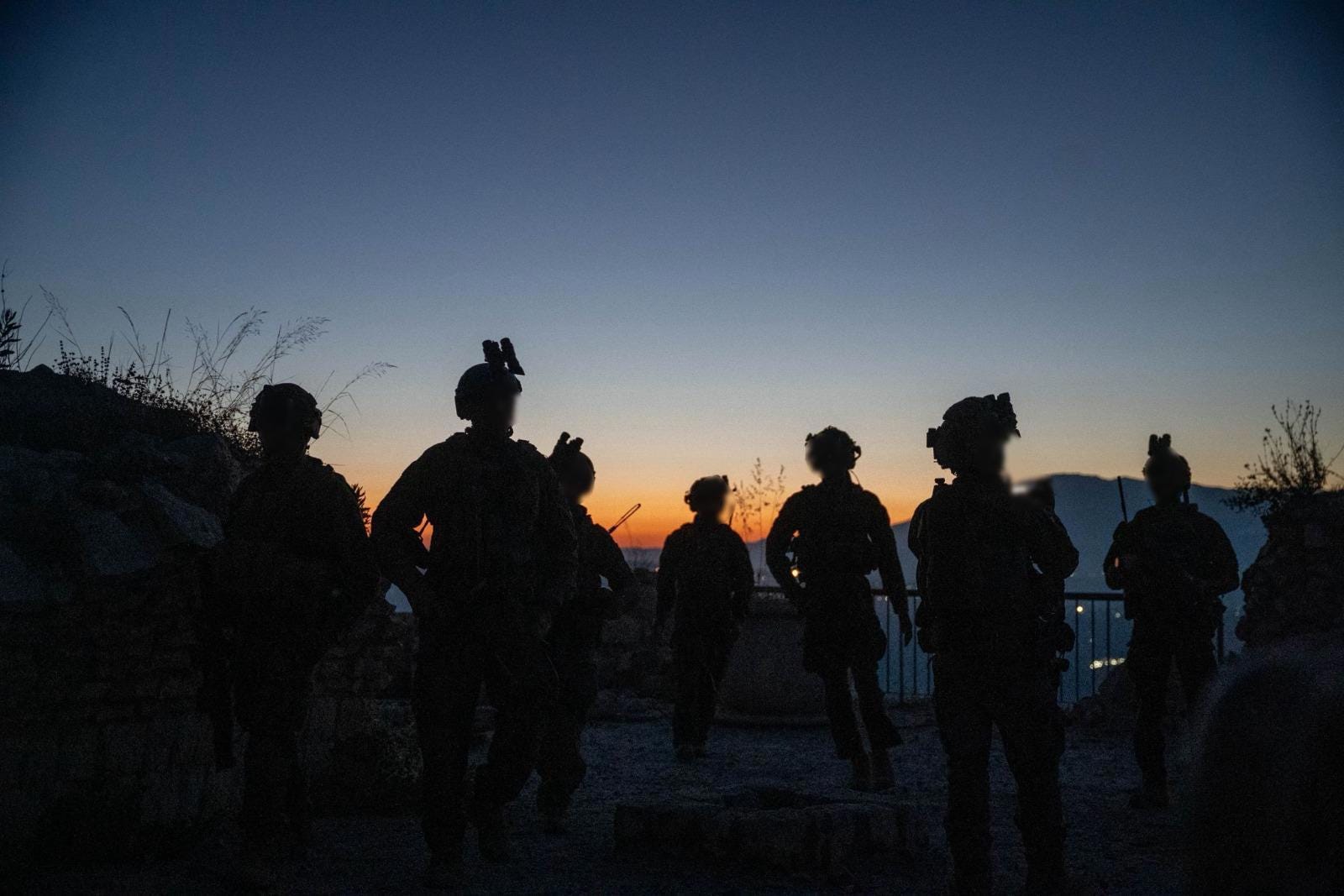
IDF forces on Beaufort Ridge after its capture in May. (IDF)
It’s Monday, July 13, and high on a rocky spur above the Litani River—southern Lebanon rolling away on one side, the Galilee Panhandle spread out on the other—sits Beaufort Castle. The ancient Crusader fortress was once the linchpin of Israel’s security zone in southern Lebanon: taken in a bloody and heroic assault in the opening hours of the 1982 war, then ringed for the rest of the occupation by IEDs and Hezbollah guerrillas until the outpost earned its nickname—the Monster on the Mountain. Forty-four years later, there is a new monster, and it dwells beneath the crumbling ruins.
Israel did not come back for the view. Since early March, the Beaufort and Wadi Saluki sector has served as one of Hezbollah’s principal firing platforms—more than 400 rockets launched toward northern Israel, most of them at the northern town of Metula, alongside drones and anti-tank fire at troops operating across southern Lebanon, with the ridge functioning as the command node directing the fighting.
The infrastructure sits in territory where the Lebanese army nominally operates. Israel submitted a request through U.N. channels for the LAF to address the site. The request met the fate of Lebanese politicians who oppose the terror group—quietly silenced.
Air power had been tried as well: the complex was struck from above several times, the rock absorbed it, and Hezbollah went back to work. What cannot be bombed from above must be taken from within. So the IDF planned a ground operation long in advance, waited for its moment, and on May 31 the Golani Brigade raised the flag over a fortress Israel had not held since 2000.
Last week, the IDF walked reporters into the mountain. The tunnel—one node in Hezbollah’s “Land of Tunnels” project, an underground construction effort across southern Lebanon supervised by IRGC officers alongside North Korean advisers—runs 1.3 kilometers from the cliff face into solid rock. Inside: water and electricity, living quarters with showers, toilets, and kitchenettes (stocked mini-fridges included, per the Daily Mail’s tour), even a fully equipped, completely sterile operating room. Operatives could live underground for months at a time. It is estimated that construction of the facility took 10 to 15 years and tens of millions of Iranian dollars. The purpose was dual, an officer explained: to fire directly at Israel—step out of the tunnel and Metula is visible on the horizon—and to defend the ridge against precisely the ground maneuver that eventually took it.
The complex functioned as a significant command-and-control center where hundreds of operatives were stationed, managing the fighting from inside the mountain—until the ground operation began, at which point they fled.
As of last Tuesday’s tour, the Beaufort tunnel is wired: charges laid through the rooms and passages, reporters warned not to light cigarettes. That is itself news. Through late June, tunnel demolitions across southern Lebanon were frozen at the American request, when negotiations with Iran had temporarily grabbed President Donald Trump’s attention. Gadi Eisenkot revealed that commanders had been given no authorization to detonate—until the Majdal Zoun complex was finally destroyed on June 28. The freeze, evidently, has thawed. Intelligence assessments reportedly point to something larger still beneath the Beaufort area—a four-story underground bunker, also built with Iranian assistance.
Above ground, meanwhile, diplomacy continues. On Thursday, an American official announced that Israel and Lebanon have entered the implementation stage of the framework signed in Washington on June 26—the first pilot zone to launch within days, with further zones being mapped. On Saturday, an American military delegation sat down with Lebanese army command in Beirut to work out the mechanics of the first zone: Israel withdraws, the Lebanese army deploys. On Wednesday and Thursday, delegations from both countries will meet in Rome—in a closed session, according to the American framing—to hand the framework off to technical teams. Beirut had conditioned its attendance on Israel first completing the pilot-zone withdrawal; on Saturday it confirmed it will attend anyway.
Later on the calendar, President Joseph Aoun is expected to fly to Washington on July 21 to ask Trump for military support, reconstruction funding, and backing for an international conference on the Lebanese army.
On Friday, he said something Lebanese presidents are often hesitant to say out loud: that despite the presidency’s efforts to avoid another war after the November 2024 ceasefire, Hezbollah refused to cooperate—and that the organization’s decisions are ultimately made in Iran. Aoun is stating the obvious, which in Lebanon is an act of considerable bravery. It is the admission that the real monster was never on the mountain, nor beneath it. In the twist everyone knew but no one dared say aloud, the monster sat in Parliament the entire time.
An illustration of ballots ahead of the Jerusalem municipal elections at a warehouse in Jerusalem on February 22, 2024. (Yonatan Sindel/Flash90)
“He’s playing the political game with the most extreme elements in Israeli society. It won’t end well,” Opposition Leader Yair Lapid said in January 2023, just weeks after Netanyahu’s new coalition took office. The judicial reform was beginning to erupt, and the ultra-Orthodox parties were already blackmailing their way toward broader military exemptions. Lapid was reflecting the consensus when he predicted the government would fall by 2024, or “maybe even sooner.” When the protests continued to balloon and Netanyahu declared that this government would use “every day” of its mandate, he was greeted with laughter and disbelief. He was right.
Yesterday, the Knesset officially set a date: Elections will be held on the originally scheduled October 27, the latest day permitted by law. This is the first time elections have been held on schedule in 38 years and the first government to complete a full term in 53 years. Despite the presence of both ultra-Orthodox parties, divine intervention had nothing to do with this coalition’s longevity. The plain truth is that the weaker the parties, the stronger the coalition: none of the far-right parties, the ultra-Orthodox parties, or the quickly fading New Hope had many other coalition options—and little to gain from another election.
One implication of having an election date is that it sets up the competition before the competition: who gets what slot on the party lists. Under Israeli election law, political parties must finalize and formally submit their candidate slates to the Central Elections Committee by the 47th day before the election. And where there are hard deadlines, limited spots, and no shortage of candidates, chaos follows.
A lot of airlines have an arrangement under which they take care of each other’s passengers in the event of unscheduled cancellations. There seems to be a similar agreement among the parties of the change bloc. Until two months ago, Bennett was busy administering placement tests—literally—to dozens of prospective candidates who besieged his offices, while Eisenkot could barely find enough candidates for the top 10.
Now, as Yashar! takes off and closes in on Likud while Beyachad is grounded, the problem has reversed. Bennett has already announced eight candidates when, according to recent polls, that is roughly the number of seats his share of a joint list with Lapid would receive. Eisenkot, on the other hand, still needs to fill at least 15 more slots.
With Eisenkot, there are no placement or loyalty tests, but there is an orderly process for the flood of applicants. First comes coordination in principle with other parties to verify who is courting whom, in order to prevent future opportunism and midterm party-hopping. Afterward comes a meeting with one of the senior team members, followed by a meeting with the party chairman himself. The candidates will be arranged in groups of 10: two safe tiers of 10 and a third that could become safe depending on final polling. Within each group, there will be roughly equal gender representation as well as age diversity. Eisenkot can call in plenty of big names, but most of them—like him—are old enough that “fresh face” is no longer part of the pitch.
Those who do not make the list may instead be selected for the “List of 200.” These are the people expected to make up the professional ranks of the next government if the political tide turns: ministry directors general, heads of public authorities, deputy directors general, and board chairmen.
Above all, the frantic pace at which things have been managed until now makes it easy to forget that the elections are still a long way off. There are still two months until the candidate lists close. At the equivalent point in previous election cycles, the Knesset had not even been dissolved yet, and no mergers had taken place. Bennett’s early move to unite with Lapid shuffled the deck and effectively pressed the WhatsApp-style double speed button on the entire race. Eisenkot, as is well known, does not operate with that kind of temperament. In short, the door is still open, and there is still plenty of room on board.
English Editor: Ari Tatarka
If you enjoy the newsletter, you can show your support by becoming a paid subscriber—it really helps keep this going. I’m also offering a special monthly briefing for a small group of premium members. I’d love to have you join us—just click below to find out more.
Thanks for reading It’s Noon in Israel! Subscribe for free to receive new posts and support my work.


