The Next Roaring Lion
Also, my interview with Israel's secret powerbroker, peace with Lebanon, and more.
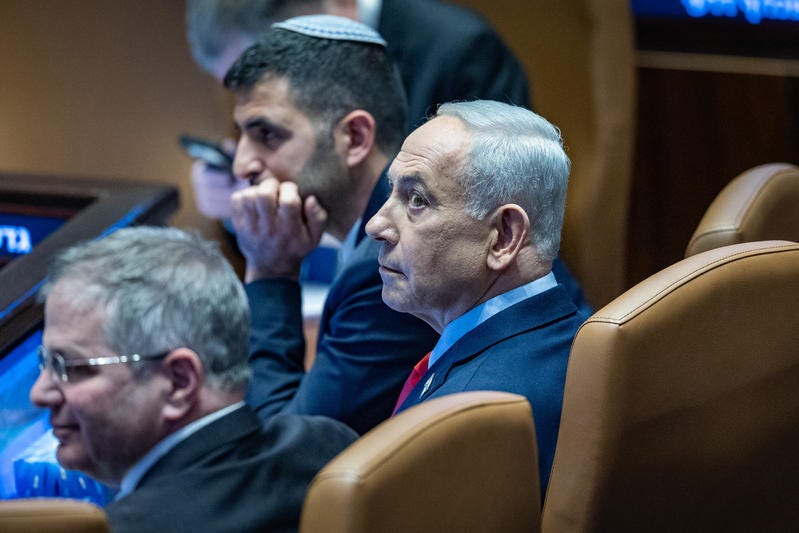
Israeli Prime Minister Benjamin Netanyahu at a 40 signatures debate, at the plenum hall of the Knesset, the Israeli parliament in Jerusalem. (Yonatan Sindel/Flash90)
It’s Friday, April 10, and before we dive into today’s headlines, we have exclusive statements from Prime Minister Benjamin Netanyahu. During our conversation last night, he highlighted three key points:
On Iran he asserted that without the two recent operations, Iran would have already acquired nuclear weapons by 2026.
On U.S. relations he argued that Israel’s standing in the United States is only an issue among those who have a problem with America itself. He stressed that this is not a new development, nor is it related to the current war.
On the northern front he claimed that Hezbollah has been begging for a ceasefire for a month, and teased that there will be further ‘interesting developments’ in the negotiations with Lebanon.”
Now on to the news.
IDF fighter jets on the way to Iran last month. (IDF)
We’re used to wars that look like movies. Midnight Hammer was a short action thriller with a clear beginning, middle, and happy ending. Roaring Lion, however, is a TV series. Following season one’s Rising Lion, we are now in season two, with a third season—my suggestion is Screaming Lion—likely in the early stages of development.
That isn’t to say war will become a biannual event. Roaring Lion was a significant operation, but success isn’t binary.
It delivered a substantial reduction in nuclear capabilities, an even greater crippling of ballistic assets, and a potentially fatal blow to the regime’s long-term survival. Iran does resemble a movie character: the armless, legless Black Knight from Monty Python and the Holy Grail, threatening to bite at Israel and the U.S.’s shins.
With its funding apparatus in ruins and sanctions still in place, the regime’s resources are stretched incredibly thin, forcing an agonizing financial dilemma. With its still-depreciated rials, it must choose between rebuilding a ballistic missile industry, outfitting a brand-new navy, or investing in air defense. It could also try investing in improving the lives of its population, but that is far less likely.
As early as the second week, it became clear that the regime would not fall from airstrikes alone. The U.S. and Israeli strategy pivoted: hit them hard, then allow internal pressure to build while the U.S. military remains in the region as a passive deterrent against mass repression. The recent prospect of negotiations complicates that signal to the Iranian public, but the core strategy may still hold.
While the Iranian threat has been at least temporarily defanged, a new long-term threat is rising: U.S. public opinion.
There is a two-part problem.
First, the United States has not yet achieved its stated objectives. Second, as long as those objectives remain unmet, the finger of blame will inevitably point toward Israel. We can already see the narrative forming: Israel gave the U.S. false intelligence that the regime was on the brink of collapse, deceiving Trump into wasting American resources and lives in pursuit of its own interests. Ignoring the likely fact that Donald Trump hasn’t been led into doing anything he didn’t want to do since he was an infant, this is the story that’s being told.
Israel cannot afford to be seen as the party that overpromised. It cannot be left holding the proverbial bag for an Iranian version of Iraq’s nonexistent WMDs.
Moving forward, Israel must urgently invest in rebuilding its own infrastructure devastated by the war: public support in the U.S.
Shas party leader Aryeh Deri arrives to a Shas faction meeting at the Knesset, the Israeli parliament in Jerusalem. (Yonatan Sindel/Flash90)
He hasn’t been a minister in three years, has been outside the coalition for six months, and barely sets foot in the Knesset. And yet there is no issue on the national agenda that Shas chairman Aryeh Deri isn’t involved in up to his neck. Operation Roaring Lion? He sat in the dramatic cabinet sessions. The draft law? In the Haredi community, his word is final. Ziv Agmon? (Prime Minister Benjamin Netanyahu’s former top aide) He called him “a proud baboon.”
Now I sit down with Deri for a rare interview on what it was like facing Trump, what the Mossad promised on the eve of the war, the far-reaching plans for Lebanon.
Q: Did we win?
“Yes.”
Q: A decisive victory?
“I don’t understand the phrase ‘decisive victory.’ Did we go into this campaign facing a grave threat to the Jewish people, and thank God we pushed back that threat in a very significant way? Clearly yes. The opposition loves to use pharmacy words – ‘strategy’ and other lofty terms that we ‘baboons’ don’t understand – so let’s speak in their language. After October 7, we were at rock bottom in terms of the entire region and the entire world, when everyone saw the images of the motorcycles taking our people captive, and for nearly an entire day, we couldn’t tell left from right. Look at Hamas in Gaza today. We’ve already had several rounds against Iran and Lebanon. Not a single rocket has been fired from Gaza; that threat no longer exists. Today, the safest place in Israel is the Gaza border communities – people went there during the war because it was safe.”
Q: Now, on Iran.
“What did we want to stop all these years? Just the nuclear weapons story. We never dreamed we could strike inside Iran. So we started with Operation Rising Lion, when our planes flew through Iranian skies and caused enormous damage and halted the race to nuclear weapons. That’s true – they didn’t eliminate everything, because the nuclear material was deep underground. But we neutralized most of their scientists, struck heavily at the entire weapons industry, and pushed them back months or years.”
But that wasn’t enough, Deri stressed. “We saw that the Iranian people are a very strong people with an extraordinary industrial base and fierce determination and hatred, and they drew lessons. First, go deeper underground so that even the United States can’t strike them deep in the earth. They were already at a stage where they were starting to move their missile industry and their weapons industry underground, too. Within a few months, we would not have been able to do anything. Everyone talks about nuclear weapons, but the ballistic threat is no less dangerous – in some ways even greater – because you don’t use nuclear weapons quickly, but ballistic missiles? freely.”
Q: So on the nuclear question – what did this operation actually achieve?
“Oh… look, I’ll leave that to the IDF chief of staff and the military. I’m sure they’ll present it in an orderly fashion.”
One day after the ceasefire announcement, Israelis had a sense of confusion, with some wondering whether the promises now being made weren’t a replay of those made at the end of Operation Rising Lion.
“Something happened to the Iranian people as a result of Operation Rising Lion, because of the terrible economic situation,” Deri explained. “It started in the great bazaar in Iran, with merchants revolting because you needed suitcases of banknotes just to buy one dollar, and Trump decided on his own initiative that he wanted to help the protesters. The truth is, at that point there wasn’t yet the readiness – not on our military’s part and not on the American military’s part – to carry out an intensive operation beyond a pinpoint strike.
“This is the story with Netanyahu – the opposition praises the military, military intelligence, the pilots, and at the same time spits on the prime minister and the government as if it were all a failure. The chief of staff and the Mossad director said all along that without the United States, Israel had nothing to gain from going into this operation alone, and Netanyahu brought Trump. All they asked of Netanyahu was that the Americans give their consent and provide protection. Nobody dreamed the Americans would join the attack.”
Centrifuges in Iran (EPA)
Q: So in all honesty – if you were taken back in a time machine to the day before the operation, when you raised your hand in favor, and someone told you: major achievements, but the regime won’t fall, the uranium is still there, and about half the ballistic threat remains – would you have been disappointed?
“You’re young, so you’ll probably see the protocols when they’re published. I certainly won’t live to see them. You’ll see that we hoped all the other plans in play would cause the Iranian public to rise up and bring about a change of regime. But that was not the stated goal, nor was it a promise Netanyahu made to Trump.
“It’s like the Dayenu of Passover – for this operation, it’s more than enough. Far more than I expected. I never dreamed the Americans would go with us for 38 days and drop close to 20,000 munitions there.”
Q: So you weren’t disappointed when the ceasefire came?
“No. I thought that given where we’d arrived, a replacement regime hadn’t emerged in Iran, and on the other hand, there was very great destruction – on the contrary, maybe the nuclear material will be brought up in negotiations. I tell you again with full responsibility – Netanyahu did not say to Trump and to the American administration anything that, God forbid, we didn’t believe to be true.”
Q: OK – so we didn’t lie. But maybe we were wrong to think there would be regime change, and we misled the Americans?
“No, no, no,” he answered flatly. “War is like a cholent [a slow-cooked Shabbat stew] – you know what you put in, you don’t know what you get.”
Q: But you don’t promise that the cholent will come out in a particular way.
“Yes, we presented to them a plan for how, based on the data we had, if all these things came to pass... The goal was to create conditions for the regime’s fall, and I think we created those conditions. That’s actually why I think the ceasefire is a blessing – there’s a greater chance the regime will fall from within. Iran begged for a ceasefire. They’re presenting it – together with our own opposition – as an Iranian victory. To my great sorrow, that’s very nice cooperation between the two of them. But you can see that in the end they stopped the fire for two weeks with no commitments at all, and now even Lebanon, which was one of their conditions, that’s not happening either.”
During the war, reports emerged of a certain disappointment with Mossad promises that the war would bring regime change in Iran, which did not happen.
Q: Were there Mossad plans for toppling the regime that didn’t come to fruition? Netanyahu himself spoke of surprises.
“The military achieved above and beyond. The Mossad, which was more responsible for the regime-change plan, has not yet reached. I say ‘yet’ because in my assessment it will be reached very soon.”
Q: Will we see a regime change in the near future?
“I believe so. By the way, Trump believes the current regime is far more measured and responsible than what came before. In a certain sense, I agree. The diplomatic figures there effectively forced the ceasefire because of the constraints, not because of any genuine change of heart. They understood that within two weeks Iran would go bankrupt.”
Q: “And aren’t you worried that Israel’s gains come at a cost – a growing sense in America that we dragged them into a war that wasn’t theirs?”
“That has nothing to do with Iran. We have a problem with the Democrats, and somewhat with some Republicans, too. But precisely because of that, this period with Trump in power is a major opportunity for Israel to cement its regional standing. In the end, the Americans – whatever administration – will understand that their real ally is us.”
Q: Looking at the broader picture, you sat in the dramatic cabinet of 1991, when the US president told Prime Minister Yitzhak Shamir not to attack Iraq in response to the Scud missiles, and after 35 years, another president is with us in a coalition and tells everyone else to go to hell.
“That’s beautiful – I hadn’t thought of it that way. I remember that cabinet meeting on a Saturday morning, and Shamir’s distress. He understood intellectually that small Israel could not respond against the will of America. By the way, I supported him. And today everything has been turned upside down.”
Q: Now, Lebanon.
“Look at Hezbollah. Fourteen months after we reached the agreement, we’ve killed close to 500 operatives in the field, and not a single bullet has been fired in the north. The fact that Hezbollah has now rejoined the fight is because it saw that we eliminated Khamenei, and there’s a very real danger that the regime funding it will disappear.”
Q: So we weren’t surprised?
“Not in the slightest.”
Q: Because you know there’s a gap between what you, the chief of staff, and the prime minister say – and what the public felt, which was that this episode was behind us.
“First of all, people still don’t know the details of the massive blow they took during the holiday. A blow – because we went into their most deeply hidden locations inside apartments in Christian neighborhoods and Druze neighborhoods, where they thought they could run the operation and escape the army’s long reach, and they were eliminated there. I’m not saying we’re done or that they can’t fire. This is not Hamas. But we are now several kilometers inside Lebanon. The army is not leaving until Hezbollah is disarmed. There is no force in the world that can bring us back until the agreement is honored.”
Q: So we’ll stay there for years?
“Years.”
Q: But will northern residents be able to return soon without sirens?
“They’re already back there – most of the northern residents have returned and the situation is much better now. Hezbollah is deterred, and it fired only because of Iran. Who’s begging for a ceasefire now, tell me?”
Q: Meaning Hezbollah wants to stop fighting now, but we have demands.
“Unambiguously.”
To read the full interview in Israel Hayom click here
Smoke rises from southern Lebanon following Israeli airstrikes. (Ayal Margolin/Flash90)
On March 15, Reuters reported that Lebanese President Joseph Aoun attempted to initiate direct ceasefire talks with Israel and even floated the idea of normalization, but Israel allegedly never responded. Last night, Prime Minister Netanyahu announced that Israel would begin negotiations with Lebanon to reach a ceasefire “as soon as possible.” What changed?
It certainly wasn’t Hezbollah. The terror group remains degraded but very much alive, recovering in its refuges north of the Litani River. The obvious reason is that larger geopolitical factors intervened—namely, the ceasefire with Iran. The U.S. is deeply invested in the ongoing negotiations in Islamabad, and Israel’s war against Hezbollah was threatening to derail that diplomatic effort.
But as Netanyahu clarified, “there is no ceasefire in Lebanon.” The U.S. pressured Israel to scale down the intensity of the campaign, not end it. We can expect a return to the pre–Roaring Lion “quiet”—perhaps one or two airstrikes a day. Still, the U.S. would do well to remember that in negotiations with fundamentalist factions, placating gestures are almost always perceived as weakness.
Putting aside how all parties arrived at the table, what is the possibility of peace with Lebanon?
It is possible, but it would require Beirut to break a 40-year habit and actively disarm Hezbollah. President Aoun’s recent order to disarm Hezbollah in Beirut sounds like a positive development—until one realizes that total disarmament is already 20 years overdue.
More recently, Aoun issued the same order for southern Lebanon. The Lebanese Armed Forces declared that mission accomplished in early January; let’s just say Israel’s northern communities disagree.
There is one major factor that might change Beirut’s calculation: 600,000 Shiites. About a tenth of Lebanon’s population are currently displaced and will remain so until Hezbollah is disarmed. Even with the return to relative quiet, Israel has not withdrawn from its positions south of the Litani River and is unlikely to do so anytime soon. If Lebanon wishes to regain sovereignty over the entirety of its territory, it must first prove it can exercise sovereignty in the territory it currently controls.
One thing remains absolutely certain: despite the talk of normalization, there will be no Israeli embassy in Beirut as long as Hezbollah remains part of the Lebanese government.
Yesterday I joined CNN International’s One World With Zain Asher and Bianna Golodryga to discuss Israeli strikes on Lebanon.
Shabbat Shalom! We’ll be back on Sunday.
English Editor: Ari Tatarka
If you enjoy the newsletter, you can show your support by becoming a paid subscriber—it really helps keep this going. I’m also offering a special monthly briefing for a small group of premium members. I’d love to have you join us—just click below to find out more.
Thanks for reading It’s Noon in Israel! Subscribe for free to receive new posts and support my work.


שבת שלום
עם ישראל חי 🇮🇱
Jewish-American perspective here: I live in the U.S., and the anti-Israel sentiment is palpable. I've said it before and I'll say it again--Israel should start preparing itself IMMEDIATELY for a future where the United States will be (at best) ambivalent towards Israel. Become militarily independent ASAP. Become financially independent ASAP as well. If AOC wins the Presidency in 2028, the United States will likely be anti-Israel in much the same way as Ireland or Spain. JD Vance will only be marginally better (instead of Ireland or Spain, think of the UK, Australia or Canada). Don't think that that can happen? Look at what's happening in the Democratic Party right now, where the DSA is engaging in what is apparently a non-hostile takeover of the party. Look at what's happening in the Republican Party as well, where younger Republicans are in thrall to the likes of Tucker Carlson, Nick Fuentes and Candace Owens. And most ominously of all, look at the young people in this country: Overwhelmingly anti-Israel. These are our future societal leaders. The future cannot be denied, but one can prepare for it.