It’s Noon in Israel: The Peace Washington Missed
Also, terrorism in journalism revealed, and do Israeli's vacations affect the outcome of the election?
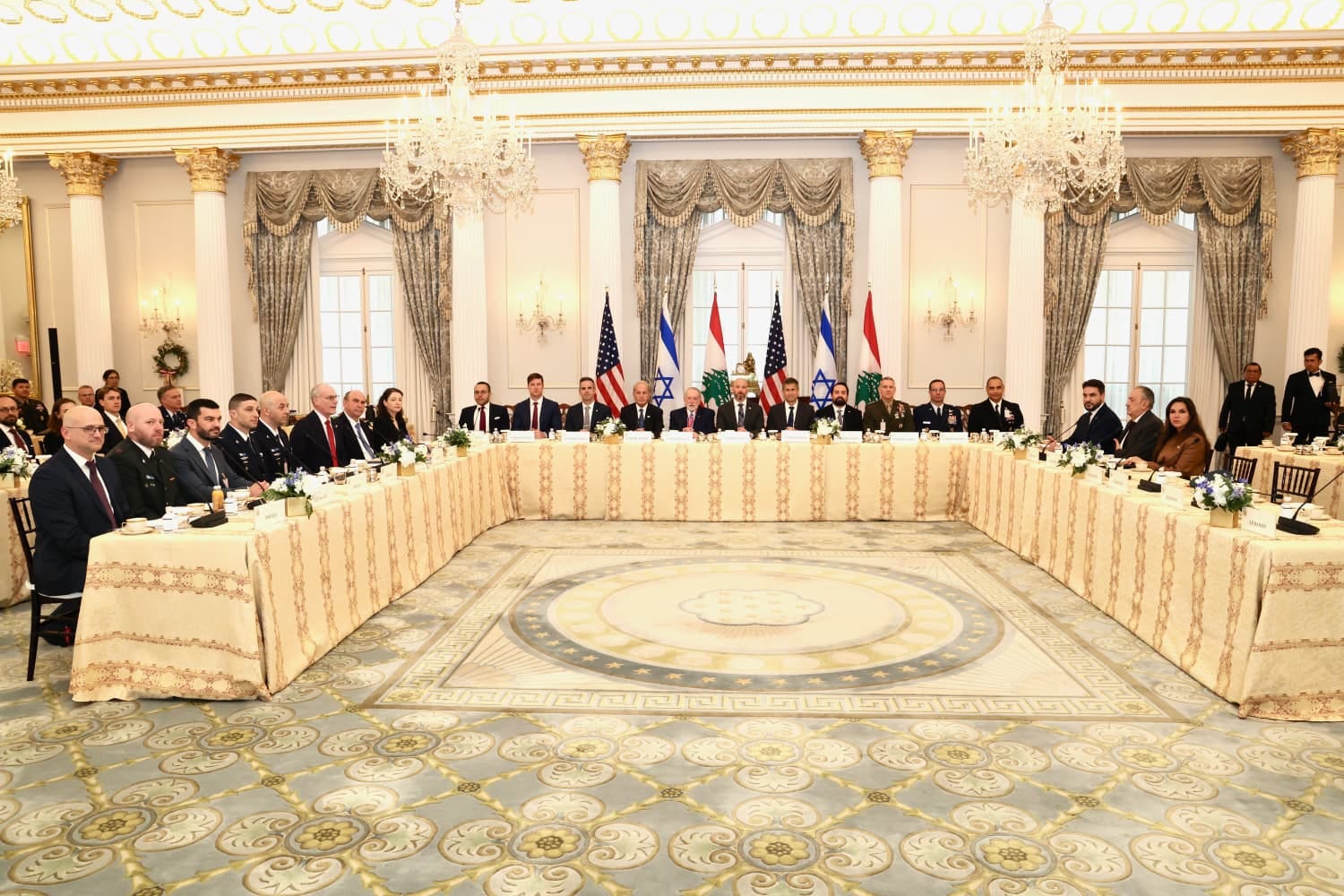
Diplomats take part in direct Israel-Lebanon talks hosted at the US State Department in Washington on June 23, 2026. (Israeli Embassy)
It’s Wednesday, June 24, and there is a famous phrase: “If you want peace, prepare for war.” For Israel, the experience has been closer to “If you want peace, be at war.” While fighting still raged in Gaza, while Israel was striking Syria, and while another war with Iran loomed, peace with two of those countries looked genuinely within reach. Lebanon might finally be rid of Hezbollah; a newly independent Syria might normalize with Israel. Now that the fronts have gone relatively quiet, both of those options are off the table.
At the outset of yesterday’s talks—the fifth round between Lebanon and Israel—Israeli Ambassador to the U.S. Leiter remarked that “we all got on the same train.”
“We sat in the same car and traveled to the same destination, with the United States serving as the locomotive. The train was heading in a very clear direction: full peace between the countries, Iran and its malign influence out of Lebanon, the disarmament of Hezbollah, and peace and security for Lebanon and Israel. Today, this train is in danger of derailing. I hope we can get it back on track,” Leiter said.
The truth is, it’s already a wreck. What began in April as a desperate Lebanese effort to stop Israel’s advance on Hezbollah has completely inverted. The supplicant now makes demands: President Joseph Aoun set the tone before talks even started—”we accept nothing less than an end to the Israeli occupation”—and Lebanon is reportedly now pressing for a complete Israeli withdrawal, with Hezbollah’s disarmament looking less and less like a precondition it is willing to accept.
The roads to peace have largely disintegrated because, instead of peace going forth from Jerusalem, it is being dictated by Washington. In late June 2025, the U.S. issued sweeping sanctions relief for the ex-al-Qaeda-led government in Syria, which, according to my sources, would have been a successful bargaining chip for normalization. Meanwhile, the U.S.’s recent forced peace with Iran has weakened the confidence of Hezbollah’s opposition, pushing the Lebanese to take the easy way out: demanding withdrawal with no plan to disarm the terror group. It is worth restating that the chances the LAF will disarm Hezbollah under current circumstances are somewhere between zero and never. This is the same army that was stopped at the door of a Hezbollah safe house by a group of women while the weapons were carried out the back. When Iran was actively being beaten by Israel and the U.S., and Hezbollah dragged Lebanon back into war on Iran’s behalf, the government ordered the army to act against the terror group. The chief of staff refused, afraid of mutiny in his ranks and renewed civil war; and out of fear that a mutinous general might turn generalissimo, the government backed down. That chief of staff is still in his job. The LAF are effectively scarecrows—meant to scare off Hezbollah, but more often used by the birds as a perch instead.
Egypt and Saudi Arabia are currently pushing a plan to integrate Hezbollah into the armed forces—which, apart from being unlikely, seems to require a complete Israeli withdrawal as a precondition. It’s unclear whether the plan is even being discussed in higher circles, but the question remains: Why are Egypt and Saudi Arabia effectively helping Iran?
Because, contrary to what some might assume, there are not two axes in the region but three. There is the anti-Iran axis, with Israel at its center; there is the Axis of Resistance, with Iran at its head; and then there is the go-along-to-get-along axis, which includes Egypt and Saudi Arabia. There is also the U.S. wildcard, which—as recent events attest—can jump between axes. To chart their course through this turbulent period, the Egyptians and Saudis can’t afford to let either axis gain absolute dominance, short of an outright victory that neither Israel nor Iran seems capable of winning. Absent a decisive shift, they want to strengthen their own bloc at the expense of the other two. In their eyes, a slightly chaotic Lebanon is better than an Israeli-dominated one.
Is Israel going to withdraw? Certainly not. To put it bluntly: Israel doesn’t trust the Lebanese government. It has never missed an opportunity to miss an opportunity.
An unnamed senior official was quoted by Channel 13 as saying the IDF “captured territory in recent days for the purpose of negotiations, to then withdraw from them.” Israel is standing on the precipice of a slippery slope: first a partial withdrawal, then back to the yellow line, then the outposts, and finally Israel’s own border. At that point, Israel’s border no longer means the line where sovereign territories meet, but the range of Hezbollah’s missiles and drones. So, Israel is going to throw up barricades and fight for every inch of Lebanese territory.
Personally, I’ve got a suggestion for President Aoun: if you want to regain the south, start with the north and work your way down. Once you’ve reclaimed sovereignty in the Bekaa Valley and Dahiyeh, I’m sure Israel will be happy to hand you the land south of the Litani.
Let us suppose, for a moment, that the U.S. had demanded normalization from Syria as a precondition for sanctions relief, or that it had maintained overt pressure on Iran rather than opening negotiations. There is a real possibility that an Israeli embassy would now be under construction in Damascus—while, with no other option remaining and plenty of regional backing, Hezbollah was being driven out of Beirut. As the vice president has been fond of saying recently, the U.S.’s and Israel’s interests are not always aligned—but I believe that would be a region better for all involved.
Combo pictures, clockwise from top left: Ahmed Abu Eisha in civilian attire and in Palestinian Islamic Jihad uniform; Mohamed Nased Abu Huwaidi with press flak jacket and in Islamic Jihad uniform; Ahmed Abu al-Atta in football shirt and Palestinian Islamic Jihad uniform; Hussam al-Adlouni in civilian attire and in Hamas military wing uniform. (Pictures from Hamas and Palestinian Islamic Jihad social media, Facebook and social media; used in accordance with Section 27a of the Copyright Law)
“At least 260 journalists have been killed since Israel’s war on Gaza began in October 2023,” claims the Committee to Protect Journalists, the International Federation of Journalists called it the “deadliest period in the history of journalism.” Yet, as Israel has long suspected, a number of these journalists held a second position.
According to a report in The Times of Israel, Hamas and Palestinian Islamic Jihad have in recent weeks published “martyr” lists and obituaries that claim as their own fighters several men who, until now, sat on the press-freedom ledgers as fallen journalists. It isn’t the first time the CPJ has found its list in need of editing. After being cited as a source for Nick Kristof’s dog rape libel last month, the organization quietly removed six names from its Gaza “journalist casualties” database. According to The Washington Free Beacon, those removed included a member of Hamas’ Jabalia Battalion, an Islamic Jihad operative, a commander in the Nasser Salah al-Din Brigades, and three additional militants.
In recent weeks, it has been required to remove eight other Palestinians from a list of media workers it alleges were killed by Israel after determining they had “participated in combat.” The list, which once included 276 names killed in the conflict, including Israelis and journalists from Yemen, Lebanon and Iran, now sits at 259, with others removed for various reasons unrelated to combat roles.
None of this is new. A study in late 2025 reviewed 266 media workers reported killed and found roughly 60 percent were either members of, or worked for outlets tied to, Hamas or Islamic Jihad. The Israeli military says captured documents put several Al Jazeera staff on militant payrolls.
Take Mohammed Nasser Abu Huwaidi, killed in December 2023 and mourned by UNESCO as another journalist felled in pursuit of his noble craft. This past March, Islamic Jihad added him to its roster of fighters. Or Ahmed Abu Eisha, billed as a reporter and killed in Nuseirat—for a channel that happens to be an Islamic Jihad mouthpiece.
Across the West, the credibility of the press is being eroded by what many call activist journalism. It appears that when it comes to activism for their cause, Gaza’s journalists are ahead of the curve.
Passengers at Ben Gurion Airport near Tel Aviv during the Iranian missile fire toward Israel, June 8, 2026. (Avshalom Sassoni/Flash90)
“The right doesn’t fly abroad that much—most of our voters don’t have the means for that”—these were the words spoken last month by Minister Dudi Amsalem of the Likud, in the context of the question of when to hold the elections. Only once in the country’s history were elections held in the July-August season, and that was during the massive economic crisis of 1984, when no one had any money, and if you flew abroad you had to pay the “Peace for Galilee” levy to help finance the war in Lebanon.
Is Amsalem right? It depends how you look at it. Most right-wing voters indeed do not intend to fly abroad this year. And yet, it’s a small majority. Forty-six percent do intend to take off from Ben Gurion Airport or from Haifa.
And yes, among opposition voters the rate reaches 60 percent. By and large, Israel’s economic situation has improved dramatically: Everyone is flying—Arabs and Jews alike. But right-wing voters vacation more within the country (53 percent) than center-left voters do (29 percent), and it seems this is more a matter of economic considerations than of patriotism levels.
Netanyahu’s decision to postpone the elections to the end of October did not stem from the fear that his voters would be abroad at the time of voting, but rather from an attempt to buy time—yet the implication is that the election campaign will be conducted when most Israelis have already returned from abroad and are paying attention. Unless some of them are planning one more little hop during the holidays, two weeks before the polls open.
This is an excerpt from my weekly column in Israel Hayom.
English Editor: Ari Tatarka
If you enjoy the newsletter, you can show your support by becoming a paid subscriber—it really helps keep this going. I’m also offering a special monthly briefing for a small group of premium members. I’d love to have you join us—just click below to find out more.
Thanks for reading It’s Noon in Israel! Subscribe for free to receive new posts and support my work.


