The Parasitic Regime
Also, the last architect of October 7 eliminated, and the ultra-Orthodox run out of options.
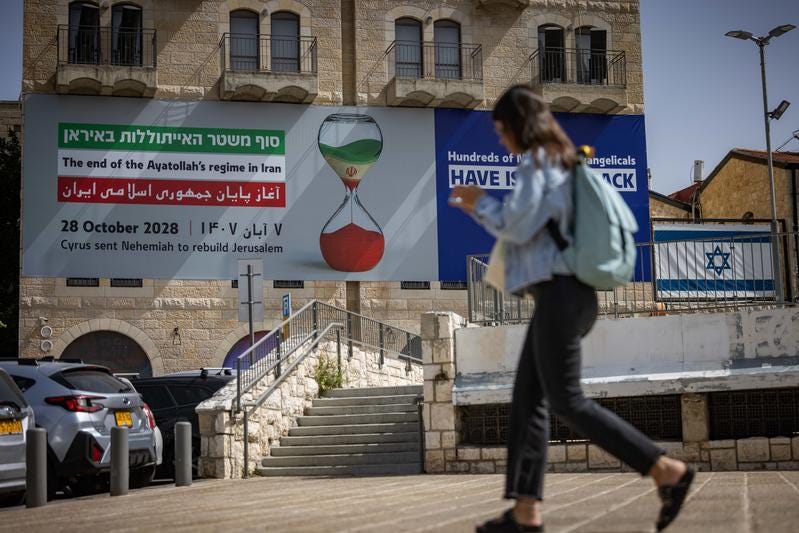
People walk next to a large sign written “the end of the Ayatollah's regime in Iran,” May 20, 2024. (Chaim Goldberg/Flash90)
It’s Sunday, May 17, and despite decades of crippling international sanctions, a collapsing domestic economy, and an ongoing blockade, the Iranian regime continues to function. The secret to its endurance, according to Jerusalem Center for Security and Foreign Affairs researcher Ella Rosenberg, lies in a fundamental disconnect between the Iranian state and the ruling regime itself. While ordinary citizens face skyrocketing prices, severe infrastructural decay, and a genuine possibility of starvation, the regime relies entirely on a robust shadow economy to survive and bypass formal global banking systems.
To maintain this hold on power, the regime sustains itself through a sophisticated web of gray banking and illicit oil sales. Funds are systematically laundered through exchange houses and shell companies situated in free-trade zones in the UAE and Turkey before seamlessly reaching European markets. The problem is that a vessel or shell company can operate cleanly for months, passing basic sanctions screening, only to be officially designated by the Treasury Department long after the illicit funds have been moved and new shells have opened to replace them.
A critical vulnerability in the West’s current approach, Rosenberg argues, is weak enforcement. “Sanctions are like schoolyard bullying,” she explains. “If there is no real enforcement, it’s like a bully who cannot throw a punch. He loses effectiveness.” But things appear to be changing: The UAE has recently taken preliminary steps to close its secrecy banking loopholes, threatening to freeze billions of dollars in Iranian assets flowing through Dubai.
A critical node in this underground economy is the maritime “shadow fleet”—a covert armada of vessels systematically evading global maritime law. To smuggle oil undetected, the regime routinely executes ship-to-ship cargo transfers in open-ocean hotspots like the Gulf of Oman and the coast of Malaysia. Recently, monitoring agencies tracked a sudden, coordinated reappearance of these ships on Automatic Identification System (AIS) radars, only for them to vanish into the shadows mere hours later. This phantom-like behavior is part of a broader, highly sophisticated doctrine of maritime deception: to obscure the movement of sanctioned cargoes, the regime clones tracking numbers, simulates fake port calls, and even deploys “zombie tankers” using the stolen identities of scrapped ships.
Meanwhile, the regime is attempting to project an illusion of macroeconomic stability. After a three-month suspension, Iran will reopen its stock market on Tuesday. “The suspension of stock market activities from the start of the war was aimed at protecting shareholders’ assets, preventing panic-driven trading, and allowing for more transparent pricing conditions,” says Hamid Yari, deputy supervisor at the Securities and Exchange Organization. “Now, with the reopening of the stock market, we will see the full resumption of all capital market sectors.” Beneath this bureaucratic optimism, however, the market threatens to collapse the moment trading floors open. Key industries like petrochemicals and steel—already struggling before the war—have seen their facilities reduced to rubble.
Domestically, the regime has largely abandoned its populace. Decades of zero investment in civil projects have left the country facing severe, preventable water shortages—an ecological crisis the state absurdly blames on Israel using “atmospheric modifier weapons” to make Iranian clouds barren and steal the country's snow.
While domestic anger is palpable across all demographics, Rosenberg cautions against expecting an imminent revolution. After enduring brutal, militarized crackdowns, Iranian citizens are unlikely to risk their lives again without guaranteed, active backing from the West. Ultimately, the West must understand that the Iranian state isn’t functioning normally; it is merely surviving, and the regime is singularly focused on protecting itself at the expense of its people.
Hamas Gaza chief Izz al-Din al-Haddad, then the commander of the terror group’s Gaza City Brigade, is seen in a video released by Hamas’s military wing in May 2022 (Social media)
Yahya and Mohammed Sinwar, Marwan Issa, Mohammed Deif, and Izz al-Din al-Haddad share two critical things in common: They masterminded the October 7 massacre, and they have all been systematically hunted down by Israel. Al-Haddad is the most recent addition to the list. Having served as Hamas’s supreme commander since Mohammed Sinwar’s death in May 2025, he was killed in a precision strike in northern Gaza this past Friday.
Throughout the war, he was heavily involved in holding Israeli hostages. Two of those hostages, Romi Gonen and Emily Damari, recounted the 35 days being held as direct human shields for the terrorist. They were moved to al-Haddad’s personal tunnel complex in eastern Gaza City. Enduring extreme conditions, Gonen lost 10 kilograms and was blackmailed by al-Haddad. He explicitly offered her priority release during the January 2025 prisoner exchange strictly on the condition that she remain totally silent regarding the sexual assaults she endured during her captivity.
Unlike his predecessors, al-Haddad has gone unavenged. No barrages or series of attacks have been forthcoming, though not for lack of will. It appears Israel has degraded Hamas to a point—or placed them in an incentive structure—where retaliation is no longer possible. Al-Haddad’s death leaves the top political spot of Gaza and the supreme command of the surviving Al-Qassam Brigades vacant; a power struggle is likely to ensue.
Speaking after the operation, IDF Chief Eyal Zamir stated that the IDF “will continue to pursue our enemies, strike, and settle accounts with everyone who took part in the October 7 massacre.”
Leader of United Torah Judaism Moshe Gafni and Degel Hatorah head Yitzchak Goldknopf attend a plenum session in the assembly hall of the Knesset, 2026. (Yonatan Sindel/Flash90)
“The Ashkenazim [Jews of European descent] are a problem,” they sighed this week in the coalition. “They are cold, calculating, and lack sentimentality.” They are referring, of course, not to all Ashkenazim, but specifically to the ultra-Orthodox among them. So, how seriously should we take the announcement by Rabbi Lando—the spiritual head of the Ashkenazi ultra-Orthodox party—that there is no longer a political “bloc” and that Netanyahu has lost their trust?
This isn’t the first time. The 2022 elections opened with signs of a budding romance between the Ashkenazi Haredim and the center-left. Yair Lapid, then-prime minister, came to wish United Torah Judaism leader Moshe Gafni a happy 70th birthday, and later asked to attend his granddaughter’s wedding. Along the way, contacts were made regarding the formation of a new party and a political alliance. Businessman Yitzhak Shapira—a confidant of the influential Hasidic leader, the Gerrer Rebbe—was in touch with the Yesh Atid party about providing a safety net for the Bennett-Lapid government.
This week, Shapira’s name was mentioned again as the supposed mastermind behind the Ashkenazi rebellion against Netanyahu. The logic is taken straight from the 1990s, the decade when the alliance with the current prime minister was first forged: aAnti-Haredi rhetoric serves as a cover for the center-left parties, but at the moment of truth, they are more interested in reducing the influence of Likud and Religious Zionism.
It is doubtful that anyone truly believes this is possible today. Even with the less radical left-wing during the Oslo years, the alliance sputtered and creaked; it is certainly less likely in a political landscape defined by the more stridently anti-Haredi Yair Golan, Avigdor Lieberman, and Yair Lapid. “We all know there is no one to sit with, and it’s not relevant to sit with them,” says a senior Haredi official, “but elections will be good, because when a phone is slow or stuck, you turn it off and turn it back on, and then it starts working.” Interestingly, this works even with a “kosher” phone.
There is one person who believes the Haredim will go with the center-left, and that is, of course, Netanyahu. He already dismantled a government with Lapid and Bennett in 2014 after being sold the story that the Haredim were on the verge of forming a coalition with the left. In his autobiography, he confessed that he was misled and had made a mistake. Since this is the only mistake he admits to in the entire book, it shouldn’t be underestimated.
What does this mean now? Not much. The tactical debate over holding elections in September or October is crucial for Likud. They fear running a summer campaign: opposition voters are already alert and galvanized, whereas coalition voters would need to be roused while many are abroad or on vacation. More importantly, a month and a half in the Middle East is an eternity. As long as the regime in Iran hasn’t fallen, Netanyahu needs time. He wants things to move slowly; his rivals want them to happen as quickly as possible.
English Editor: Ari Tatarka
If you enjoy the newsletter, you can show your support by becoming a paid subscriber—it really helps keep this going. I’m also offering a special monthly briefing for a small group of premium members. I’d love to have you join us—just click below to find out more.
Thanks for reading It’s Noon in Israel! Subscribe for free to receive new posts and support my work.


Good riddance to another Hamas leader! The Charedim know that Ted secular left has nothing but contempt for them and will not join the secular left in any coalition
"the West must understand that the Iranian state isn’t functioning normally; it is merely surviving"
Unfortunately, that is all that the regime needs to do, to "win".