The Phony Ceasefire
Also, Hungary votes on Israel's fate in the EU.
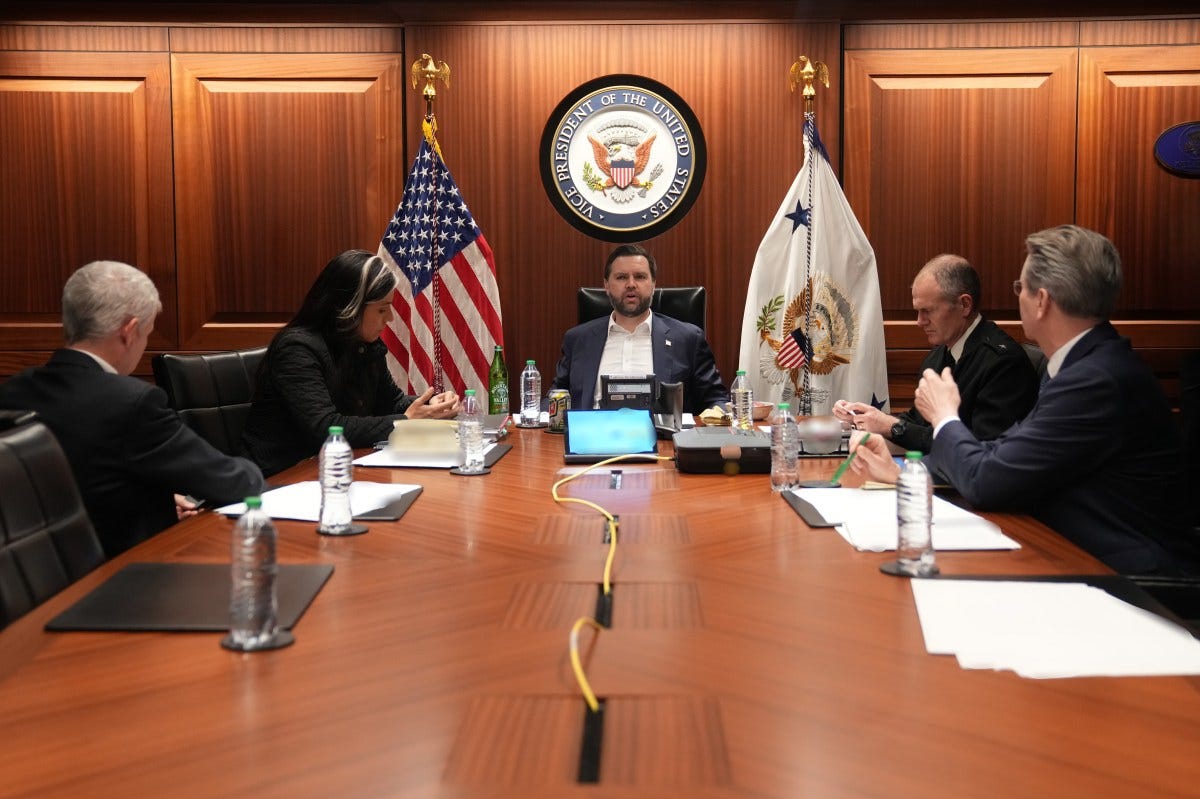
Vice President J.D. Vance at the beginning of Operation Epic Fury. (White House)
It’s Sunday, April 12, and after Germany’s invasion of Poland in 1939, Britain and France responded with a declaration of war—and then proceeded to wait for eight months. Commenting on the inactivity, a U.S. senator famously remarked, “There is something phony about this war,” lending the period the title the “Phony War.”
Today, we seem to be living through a “Phony Ceasefire.” Following the supposed halt in hostilities with Iran, nations including Saudi Arabia, the UAE, Kuwait, Qatar and Bahrain reported attacks on their territory, with one impact in Bahrain reported as recently as yesterday. The Strait of Hormuz, while no longer actively engulfed in flames, remains largely closed. Meanwhile, both sides quietly prepare for another round.
This fragile state of affairs is unlikely to persist. Negotiations in Pakistan appear to be in a slow process of collapse. Following a 21-hour marathon session in Islamabad yesterday, Vice President J.D. Vance emerged without an agreement.
Vance stated the administration requires an “affirmative commitment” that Iran will not pursue nuclear weapons. Conversely, Tehran’s delegation presented strict “red lines,” demanding compensation for U.S.-Israeli strikes and the immediate release of frozen assets.
The diverse mix of diplomats, parliamentarians and high-level economic technocrats within the gigantic 70-person Iranian delegation indicates that Tehran is not merely posturing with its demands. They are seeking a deal that completely upends the status quo, while the U.S. is pushing for a similar revolution in the exact opposite direction. The Artemis II spacecraft is about the same distance from Earth as the two parties’ negotiating positions are from one another. The difference is that Artemis II is getting closer to Earth.
The lesson I have learned from decades of observing political negotiations is that all actions taken while discussions are underway are simply negotiations by other means.
Iran announced on Thursday that, due to the presence of mines in the Strait of Hormuz, it has established and recommended alternative shipping routes. Coincidentally, these routes run directly through Iranian territorial waters, presenting a lucrative opportunity for the regime to extract tolls and fees.
How many mines are actually in the Strait? The number is unknown, but much like the threats issued by the IRGC during the war, the mere possibility of danger is sufficient to deter commercial passage.
Yesterday, the U.S. began its efforts to deprive Tehran of this leverage. Two U.S. destroyers tested the Strait, daring Iran to enforce its closure and laying the groundwork for the resumption of safe passage. U.S. mine removal operations have been announced to begin this week, and Qatar has already announced it will resume operations “for all types of maritime vessels and ships.”
(Institute for the Study of War)
There exists an ironic deterrent to resuming hostilities: Trump’s threat. By declaring he would devastate Iran’s energy infrastructure unless an agreement was reached, Trump armed a nuclear bomb that only negotiations can defuse. Iran fears this bomb will explode in Tehran—perhaps not returning them to the Stone Age, but utterly devastating the country. Trump, meanwhile, fears the fallout in global energy markets.
Trump has the option to disarm his threat by pivoting to a different target. But short of taking dramatic actions—like seizing Iran’s enriched uranium stockpiles, conquering Kharg Island, or forcibly reopening the Strait, all of which demand an unpopular ground campaign—he has few options to resume the war and eventually re-enter negotiations from a position of greater power.
Regardless, unless something fundamentally shifts in Islamabad, this state of affairs—much like the Phony War—is destined for conflict.
Benjamin Netanyahu with his Hungarian counterpart Viktor Orban in Budapest. (Avi Ohayon/GPO)
Beyond the U.S. midterms this November, another pivotal election taking place today holds major implications for Israel’s international standing: Hungary’s parliamentary elections. After 16 years in power, incumbent Prime Minister and close Benjamin Netanyahu ally Viktor Orbán is facing a formidable challenge from Péter Magyar, with Israel’s fate in the EU on the line.
Orbán, a fierce opponent of the political establishment in Brussels, has repeatedly wielded Hungary’s veto power to block EU measures critical of Israel. By leveraging the bloc’s unanimity requirements, he has effectively stalled the EU’s numerous attempts at sanctions.
Magyar, conversely, has adopted a much more conciliatory approach toward the European Union. Continuing to play the sanctions spoiler is highly unlikely to help achieve his campaign promise to unlock billions in frozen EU funding.
Compared to much of the bloc, Magyar remains relatively friendly toward Israel—though when the competition includes Ireland and Iran-friendly Spain, that isn’t saying much. While strong bilateral relations are expected to continue, a Magyar-led Hungary seems unlikely to continuously go to bat for the Jewish state.
This leaves Israel relying heavily on its other steadfast European ally: the Czech Republic. Historically, Prague has stood alongside Budapest against the prevailing EU consensus on the Middle East. However, whether the Czech Republic is prepared to continuously weather that rising diplomatic tide alone is another matter entirely.
As Hungarians head to the polls today, survey data points to a victory for the side of the surveyor. Right-wing analysts—including Netanyahu and Trump’s own pollster John McLaughlin—are projecting a victory for Orbán, while left-wing pollsters are confident that Magyar will prevail.
It bares a striking resemblance to Israel’s own bifurcated election projections. Strangely, one of the best indicators of what awaits Israel in October might just come from Hungary today.
English Editor: Ari Tatarka
If you enjoy the newsletter, you can show your support by becoming a paid subscriber—it really helps keep this going. I’m also offering a special monthly briefing for a small group of premium members. I’d love to have you join us—just click below to find out more.
Thanks for reading It’s Noon in Israel! Subscribe for free to receive new posts and support my work.


Was this written last week?