The Elusive Arabian
The Saudis face a price for Trump's diplomacy, paralysis in southern Lebanon, and more.
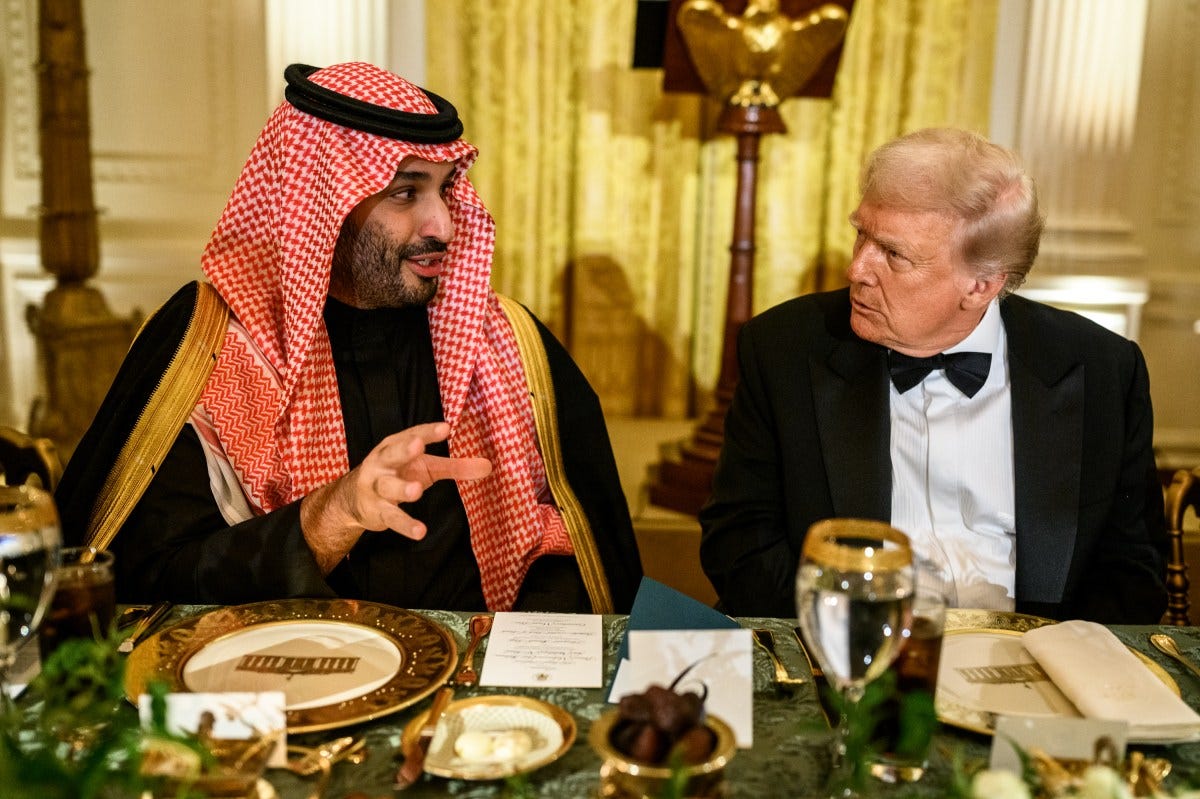
Donald Trump at a dinner for Crown Prince and Prime Minister Mohammed bin Salman Al Saud of Saudi Arabia. (White House)
It’s Monday, May 25, and the bill for American action has arrived at the Saudi door. Last night, Donald Trump reportedly demanded that in exchange for finalizing the current ceasefire deal with Iran—the one desperately needed to reopen the Strait of Hormuz—the Gulf states would have to pay a massive premium: immediate normalization with Israel. According to my sources, the ultimatum was met with literal silence. The Arab leaders were so thoroughly stunned by the audacity of the request that Trump actually had to break the silence with a follow-up: “Are you still there?”
For months, we have watched a narrative form: Israel deceived the United States into a disastrous war that only empowered Iran. This narrative ignores multiple factors, including but not limited to the fact that it was Trump’s choice, Trump did not follow the Israeli plan, and—perhaps most of all—the presence of another major player calling for war: Saudi Crown Prince Mohammed bin Salman.
In late February, The Washington Post reported that the decision to go to war had been reached after encouragement from two key allies: Israel and Saudi Arabia. Throughout the war, they reinforced this support. A few weeks later, when Trump was claiming that the war would be over in a few days, The New York Times reported that both nations heavily encouraged a continuation of the conflict. Prince Mohammed reportedly argued that the United States should consider putting troops in Iran to seize energy infrastructure and force the government out of power.
But things have changed.
The Saudis never expected to put their core energy infrastructure on the line for this conflict, assuming a covert nod to Washington would yield a painless destruction of the Iranian threat. Instead, the smoking ruins of the Ras Tanura refinery, a staggering $33.5 billion first-quarter deficit, and a hull-to-hull backup in the Strait of Hormuz served as a brutal awakening. With the United Arab Emirates stepping aggressively into the vacuum—gladly absorbing the role of America’s primary, hardline Gulf ally—Riyadh is executing a frantic tactical retreat. For the past month and a half, MBS has been beating a different drum: diplomacy. “Okay,” said Trump last night, but constantly shifting positions comes with a cost: normalization.
This is about far more than Trump extracting a quick return on investment. By demanding normalization as the price for a ceasefire, he is forcing the Saudis to grab Israel’s other arm to physically restrain Jerusalem from striking Iran alone.
It underscores a truth that Trump understood and Obama never did: the most effective way to control Israel isn’t to push them away, but to wrap them in a bear hug. By locking Jerusalem into a close alliance, Washington doesn’t just protect them—it places its hand directly over the Israeli trigger finger. Washington needs its hand over that trigger because Israel has little incentive to hold back when the current deal appears to leave Iran in a stronger position than before.
That is the Iranian impression as well. In The Art of the Deal, Trump writes: “The worst thing you can possibly do in a deal is seem desperate to make it. That makes the other guy smell blood, and then you’re dead.” Sensing American eagerness for a diplomatic off-ramp, Tehran has smelled exactly that, aggressively upping its demands before any Memorandum of Understanding can be printed.
Despite draft stipulations requiring a return to free transit, the IRGC is leveraging its tactical position to normalize a permanent, permission-based transit regime in the Strait of Hormuz—boasting that 33 commercial vessels were forced to register and coordinate with the IRGC Navy in a single 24-hour window. Meanwhile, Iran has flatly rejected a Pakistani compromise to defer unresolved issues, flipping the entire sequencing of the talks by refusing any nuclear-related commitments or stockpiling concessions at this stage. Instead, an emboldened Tehran is demanding immediate economic rewards, including the unfreezing of blocked assets, while conditioning the entire agreement on an “all fronts” ceasefire that would effectively force Washington to strip Israel of its freedom of action against Hezbollah in Lebanon.
At the end of the devastating Iran-Iraq War, Ayatollah Ruhollah Khomeini famously declared that accepting peace was like “drinking a poison chalice.” Today, his successor’s successor, Mojtaba Khamenei, is facing no such bitter brew. Instead, it is Benjamin Netanyahu being asked to swallow the poison this time around. The only difference is that Donald Trump is trying to mix in a Saudi sweetener to help the medicine go down.
Family and friends of Israeli soldier Staff Sgt. Noam Hamburger attend his funeral at the Military Cemetery in Atlit. He was killed in a Hezbollah drone strike near the Israeli border with Lebanon. (Sharon Leibel/Flash90)
Picture a lone squad patrolling the jungles of Vietnam. Suddenly, ambush fire erupts from beneath a dense tropical canopy. The soldiers hit the deck, airstrikes are scrambled, the dust settles, and a few more men are dead. It’s the definitive scene etched into the American collective trauma of Vietnam—an endless, attritional slog that systematically bled out the national will to fight. Swap the jungle for the rocky ridges and cedar forests, and you have Israel’s defining nightmare in southern Lebanon. But replace the sudden crack of an assault rifle with the persistent, electric whine of an unjammable drone, and you have the brutal reality on the ground today.
Yesterday, that reality claimed Sgt. Nehoray Leizer, a 19-year-old combat engineer killed in southern Lebanon when an explosives-laden, fiber-optic drone slammed into his armored personnel carrier. Leizer is the 10th IDF soldier to fall since the start of this so-called “ceasefire”—and it is unlikely to stop at 10.
In the diplomatic ether, Tehran is actively weaponizing this bloodshed. Iran is demanding that the emerging U.S.-Iran MOU guarantee an “all fronts” ceasefire, explicitly barring any loopholes for Israeli military operations in Lebanon. President Trump has thus far defended inserting language of the IDF’s right to strike back against “any threat” in the agreement, but that document and five dollars will get you a cup of coffee the second Trump decides Israeli operations are interfering with his Iran negotiations.
The Israeli security establishment has informed Washington that it will outright refuse a return to the prewar status quo, insisting instead on retaining physical control over a 7-to-8 kilometer buffer zone carved inside the Lebanese border. But while that static strip of land might keep anti-tank missiles out of northern Israeli homes, it does nothing to stop the buzz and eventual explosions of drones in the zone itself.
Anyone holding out hope for a heroic, eleventh-hour intervention by the Lebanese Armed Forces to swoop in and disarm Hezbollah is likely to be severely disappointed. If the deal imposes a ceasefire now, Hezbollah will only emerge emboldened. The Lebanese government was far too terrified to confront a battered Hezbollah while the group’s Iranian patron was actively being dismantled. Now, with the very real prospect of an Iranian diplomatic and economic recovery on the horizon, the idea that Beirut will suddenly find the spine to reassert sovereign control over its own territory belongs solely to Western fantasy.
While lamenting the crushing economic and human toll of the conflict last week, Lebanese President Joseph Aoun dramatically vowed to do “the impossible” to stop the fighting. Yet his actual framework for this “impossible” peace is little more than a wishlist of Israeli and American concessions: an IDF withdrawal, a ceasefire, the deployment of the LAF along the border, the return of displaced residents, and a bailout of foreign economic aid.
Aoun claims his duty is “to choose what is least costly, in order to stop the war against Lebanon and its people.” But conspicuously absent from his “impossible” list is the one action that would fundamentally alter the reality on the ground: actually taking on Hezbollah. In the end, Beirut isn’t looking to end the proxy war; they are just asking the West to subsidize the aftermath.
Everything balances on this deal and its immediate aftermath. If the negotiations fail, Israel will launch an offensive to clear the north. But if it succeeds, the war doesn’t end—it merely shifts into a race to define exactly how many bullets and drone strikes the ceasefire can physically bear. Tehran will undoubtedly underwrite Hezbollah’s campaign to violently expunge Israeli forces from their new southern Lebanese buffer zone; that much is for certain. The only lingering question is whether Washington will back Israel’s inevitable response.
Yisrael Beiteinu party chairman MK Avigdor Lieberman leads a faction meeting at the Knesset, 2026. (Yonatan Sindel/Flash90)
The antiquated label of “the Russian vote” masks immigrants from many countries—not just Russia, not just from the 1990s and not only Jews. In the upcoming elections, a new electorate is joining in numbers not seen for many years: perhaps a mandate and a half’s worth of immigrants who left Russia and Ukraine after the outbreak of the war between the two countries in 2022. This will be their very first election campaign.
They join about half a million other voters—roughly 10 mandates—whose voting patterns are more or less familiar and largely align with the rest of the country. Half of them supported the coalition, and half the opposition. Likud and Yisrael Beiteinu secured three to four mandates each.
Will the new immigrants, along with the more veteran ones, abandon the Likud en masse due to its tightening alliance with the ultra-Orthodox, once again proving to be Israel’s true political bellwether?
The question is simple; the answer is complex. On the one hand, Likud is entering the upcoming elections without a single immigrant candidate, for the first time since the 1990s. Yuli Edelstein will part ways with the party over his opposition to the Draft Law, and another Russian MK is expected to be pushed off the list due to crowding. On the other hand, while a portion of post-Soviet immigrants detests the partnership with the ultra-Orthodox, they are even more repelled by a partnership with Arab parties. The swing voters support a heavy hand in the Middle East and disproportionate military responses.
As for that mysterious new mandate, it is completely uncharted territory. The assumption in the political system is that the vast majority will vote for the opposition, whether due to the circumstances of their immigration, the relatively low percentage of those considered Jewish according to Jewish law, or the current government’s neutrality in the Russia-Ukraine conflict.
What is interesting is that investment in the Russian-speaking public is steadily declining. While left-wing NGOs are investing renewed resources in recruiting Russian-speaking audiences, far less effort is evident among the political parties. Lieberman is recruiting only native-born Israelis, while Likud is still suffering from a seven-year-old political trauma. Back in the September 2019 election campaign, right after Lieberman prevented the formation of a government and left the right-wing bloc, Likud invested millions upon millions of shekels trying to convince post-Soviet immigrants to abandon Yisrael Beiteinu. Yet not a single voter was recruited. And this is in an era where there will soon be a Mossad chief who is an immigrant from Russia and perhaps, under extreme circumstances, even a prime minister.
This is an excerpt from my weekly column in Israel Hayom.
English Editor: Ari Tatarka
If you enjoy the newsletter, you can show your support by becoming a paid subscriber—it really helps keep this going. I’m also offering a special monthly briefing for a small group of premium members. I’d love to have you join us—just click below to find out more.
Thanks for reading It’s Noon in Israel! Subscribe for free to receive new posts and support my work.


