It’s Noon in Israel: The Real Story Behind Modi's Israel Visit
Also, an Iran update, Pay-for-Slay continues to the surprise of no one, and more.
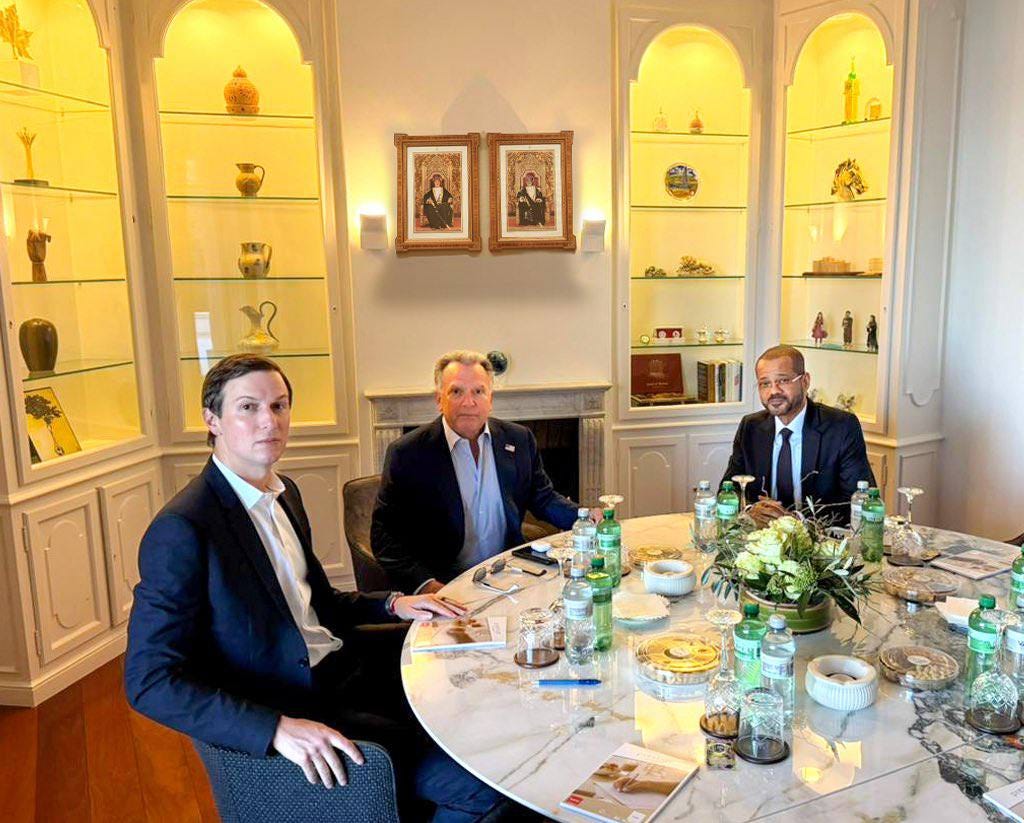
U.S. Special Envoy Steve Witkoff and Donald Trump’s son-in-law Jared Kushner sit down for talks in Geneva today.
It’s Thursday, February 26, and before we begin, a quick Iran update. U.S. Special Envoy Steve Witkoff and Donald Trump’s son-in-law, Jared Kushner, have arrived in Geneva for the second round of negotiations with Iran. The last round of talks at the same table ended with Iran and the mediators boasting of progress, while nothing substantial was achieved.
Meanwhile, Trump has continued to keep the world on edge, with observers searching desperately for signals in his every word. Despite the tens of thousands of articles published over the past two weeks, aside from the increased quantity of military assets stationed in the Middle East, nothing qualitative has since the last round of talks.
The reality remains the same: Trump prefers a diplomatic solution but is perfectly willing to use kinetic force.
This round of talks is the most consequential development since the last one. Let’s see if anything changes.
Now, onto today’s news.
Knesset Speaker Amir Ohana awards Indian Prime Minister Narendra Modi the new Medal of the Knesset. (Noam Moshkovitz/Knesset)
Indian Prime Minister Narendra Modi’s speech to the Knesset was a success. I doubt it was intentional, but Modi before and during his speech he several things about Israel’s politics, economics and society.
Sometimes politics provides a perfect visual metaphor. Protesting the exclusion of the disputed Supreme Court president from Modi’s Knesset address, the opposition planned to boycott the speech. In the end, they only boycotted part of it. The session began and the entirety of the opposition left the chamber. Former Knesset members took the vacant positions to lessen the visual sting of empty seats.
First to reenter the chamber after the Knesset speaker’s introduction, in time for Bibi’s speech, was Blue and White’s Benny Gantz, the candidate who has already announced his willingness to join with Bibi after the next election. After Bibi’s speech came the rest of the opposition. If that doesn’t communicate the rest of the opposition’s opinion of such a coalition, I’m not sure what will.
Outside the sequence of exits and entries, there were seemingly two issues motivating Modi’s visit: security and economics.
The security side is taking shape as an upgrade to the defense agreement, allowing Israel to send higher-tier defense technology to the country that has become its largest defense customer.
The economic side is manifesting in a forthcoming Knesset decision to advance the India–Middle East–Europe Corridor project. This isn’t just empty rhetoric. The decision will commit Israel to building the infrastructure, bureaucracy and diplomatic framework needed to become a key transit corridor between India and Europe. That includes a rail connection to Jordan; increasing the border crossing capacity for vehicles (from about 50,000 to 210,000 trucks annually, potentially more); and building logistics hubs, “dry ports,” storage facilities and freight terminals.
The project will bring in hundreds of millions of dollars in government revenue from transportation alone, not to mention the wider benefits of increased economic activity and lower import costs. But that’s not the only incentive.
Normalization is a large element of the IMEC project. Despite the Saudis’ recent coldness, they are still laying train tracks that would physically bind them to Israel via Jordan.
A train to Jordan may seem like a simple thing, but Israel has never had a rail connection with any of its neighbors. Before Israeli independence, you could hop on a train in Damascus and step out in Amman or Haifa, or take a train in Jaffa and ride along the coast to Beirut. All of the lines were damaged or destroyed during the 1948 War of Independence. Since then, Israel has been cut off diplomatically and physically from its neighbors.
Now let’s get to the speech itself. Before Modi said a single word, simply standing at the speaker’s podium was enough to capture the hearts of Israelis.
Let me emphasize how important the act of speaking to Israelis is.
Israel’s bitterest enemy, Egyptian President Anwar Sadat, spoke to the Knesset in 1977, four years after he had traumatized the country with the Yom Kippur War. Within two years, Israel gave him all of the Sinai, a piece of territory that he himself proved was essential for Israel’s defense by his attack. And it all started with him standing at that podium.
India remains the only Asian country whose leader has addressed the Knesset. That means a lot.
Modi spoke about the longstanding cultural and civilizational ties between India and Israel. That’s not a surprise. These kinds of speeches usually make it sound like every civilization is in an eternal fellowship with every other, but Israel and India do have a special connection.
While the IMEC promises more economic activity, the current India-Israel connection is the Hummus Trail, a series of locations in India populated by Israel’s largest export to the country: post-army Israelis. As Modi remarked:
“When I first visited Israel in 2006, there were a handful of yoga centers in Israel. Today, yoga seems to be practiced in almost every neighborhood!”
That’s trade flowing along the Hummus Trail.
While many topics were touched on, Modi’s introduction was perhaps the most important part:
“I bring with me the greetings of 1.4 billion Indians and a message of friendship, respect and partnership.”
Israelis as a collective are much like Israelis as individuals. If you want to be friends with them, they want to be friends with you. If India is extending a hand, Israel will grasp it without hesitation.
President of the Palestinian Authority Mahmoud Abbas. (PresidentMahmoudAbbas/Facebook)
We all have those habits that, no matter how bad for us and how hard we try, we simply can’t quit. For some people it’s phones, smoking or TV. For the Palestinian Authority, it’s paying terrorists.
Not to say they tried hard.
According to reports, in 2025 almost half a billion shekels were diverted to the families of terrorists. Three hundred ninety-five million shekels were paid to terrorists currently imprisoned, and 92 million shekels to those killed during their crimes. The program, known as pay-for-slay, compensates the families of terrorists in proportion to the severity of their crimes. But it doesn’t stop at payments. If they were employed by the PA when they decided to make a minor career change into terrorism, they still get a portion of their salary. Their families get cheaper government services in health and education. They even have a spend-20-years-in-prison, get-a-car-tax-free deal.
You may have heard that pay-for-slay was canceled. The now-90-year-old head of the Palestinian Authority, Mahmoud Abbas, claimed in February 2025 that he had ended it but had to admit in November that it continued unabated.
This latest report isn’t surprising; if Abbas was trying to hide it, he did a terrible job. Every report since his announcement has made it clear that the program continued as usual. Then again, the foreign donors he was directing the announcement toward don’t have a habit of double-checking.
For Israelis, the only revelation is the final figure.
Pay-for-slay is one of the most consistent services the PA provides. Despite severe financial crises last year, the authority insulated the program from budget cuts.
The truth is that it is so embedded in the Palestinian political narrative that the PA cannot dispense with it without forfeiting what little governing legitimacy it still possesses. Support for the payments among Palestinians is reportedly as high as 91 percent—significantly higher than support for any proposed solution to the conflict.
There is something almost tragic about it. The PA is being offered what it has long claimed to want—a role in governing Gaza—if it simply behaves like a normal government: Stop channeling foreign aid into private accounts, stop educating children to kill Israelis, stop paying terrorists. But it’s incapable of doing so.
Pay-for-slay is a microcosm of a larger issue.
The truth that much of the world doesn’t want to face is that if the PA invested in institutions rather than terrorism, more likely than not Palestine would already be free.
Goods being transported to Gaza. (IDF)
A senior Shin Bet officer has been indicted in what is reportedly the largest Gaza smuggling scandal yet. According to I24’s Avishai Grinzaig, the accused was found with 6.5 million shekels in his possession.
Unfortunately, this is not the first smuggling operation to be exposed. Last week, senior officials allegedly attempted to bribe foreign personnel at the American facility in Kiryat Gat in order to smuggle prohibited goods into the Strip. In another case, 12 people were accused of smuggling goods worth NIS 3.9 million.
Most of the goods involved are relatively mundane—cartons of cigarettes, iPhones, batteries, and spare car parts.
But, the controversy lies less in the items than in the individuals involved. These are senior intelligence officials tasked with protecting the country. The Shin Bet is still carefully rebuilding its credibility after the failures of October 7. Cases like these only make picking up those pieces more difficult.
If you enjoy the newsletter, you can show your support by becoming a paid subscriber—it really helps keep this going. I’m also offering a special monthly briefing for a small group of premium members. I’d love to have you join us—just click below to find out more.


