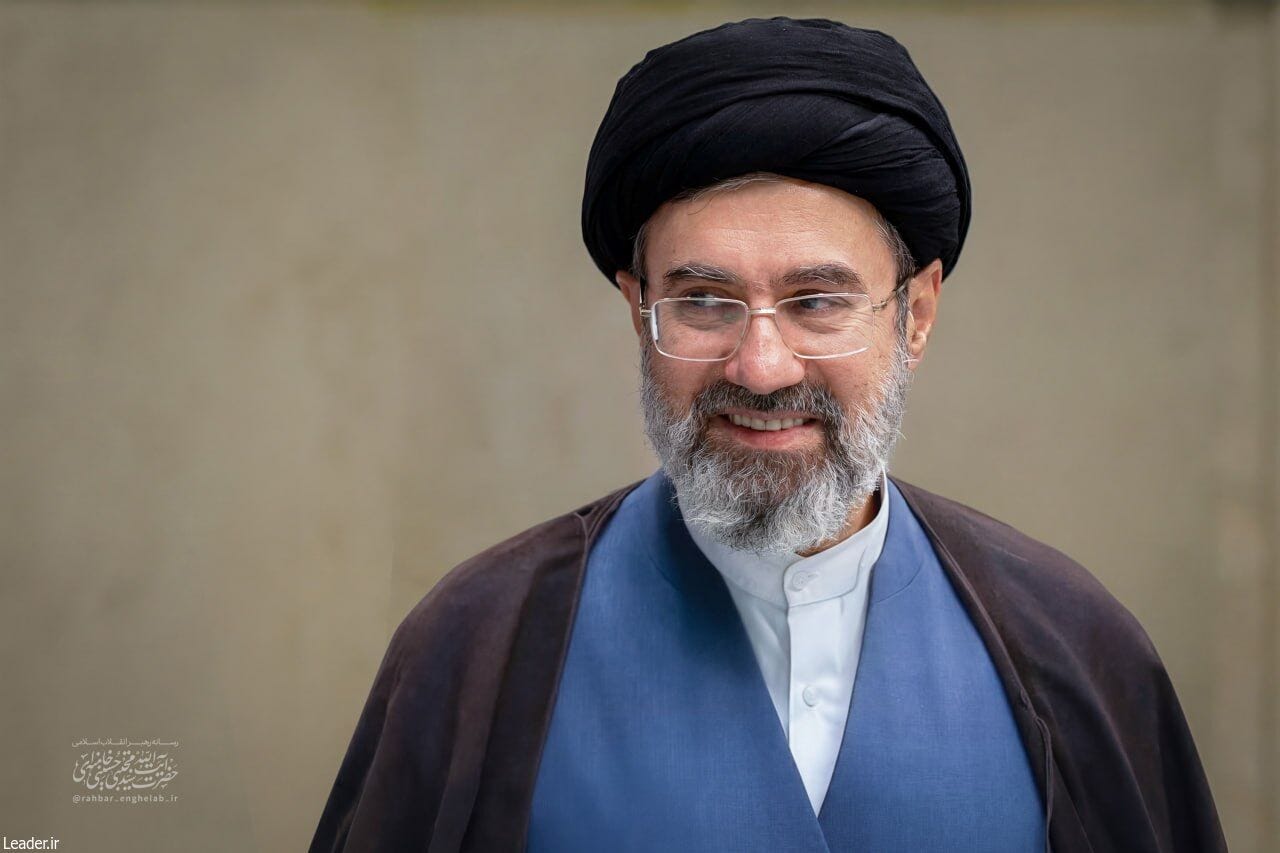
Supreme Leader Mojtaba Khamenei. (Leader.ir)
It’s Monday, August 31, and during the economically turbulent ’60s in Israel a now-infamous joke was first cracked: “They have a new sign up at Lod Airport—Would the last person to leave the country please turn off the lights?” Ultimately the lights in Israel stayed on. But according to a senior intelligence source, amid economic upheaval senior Iranian officials are eyeing their escape from a rapidly deteriorating Islamic Republic.
While my sources report major unrest, expect a resumption of protests in the near future, and note that several officials are considering escape, you don’t need intelligence connections to see the strain on the Islamic Republic.
Mojtaba Khamenei recently issued a statement warning officials against “disappointing speech” and artificial binaries such as “war or negotiation” and “compromise or warmongering.” That is an interesting directive. It appears that, despite the pressure, rather than returning to war or the negotiating table, they see stabilizing the neither-war-nor-peace status quo as the best path for regime survival.
Meanwhile, on the ground, gas stations across Iran are facing miles-long queues, with people waiting for hours only to find the pumps closed after stations run dry. Motorists report engine trouble after refueling and suspect that authorities are cutting supplies with water and excessive methanol to stretch what little fuel remains. The shortages are one symptom of a broader reckoning: the Iranian rial now trades at over 2 million to the dollar, point-to-point inflation runs near 88 percent, and even regime-friendly media concede that most families can no longer afford basic goods. Most frightening to the regime, they can no longer afford the gas subsidy and allotments. They remember how the 2019 gasoline price hike and rationing triggered what was then an unprecedented nationwide uprising, when security forces killed roughly 1,500 unarmed protesters under a total internet blackout. Both the economic distress and the regime’s brutality have grown far more severe since.
Mojtaba’s statement was directed at the regime’s own officials who are increasingly revealing their rapidly deteriorating hand. Government spokeswoman Fatemeh Mohajerani claimed authorities cannot publish some poverty statistics because of “security considerations,” while Ghalibaf warned that the Islamic Republic “will not last” if public hardship persists. Police Chief Ahmad-Reza Radan cautioned that economic decline could fuel renewed unrest. Leaked audio has captured security forces discussing preparations for fuel-related protests, and units are already being deployed preemptively across major cities—with the security services quietly prioritizing their own access to fuel even as ordinary Iranians go without.
Protests are inevitable, and the Islamic Republic is cracking down preemptively to restrict their scale.
It is useful here to recall the initial plan for this war: a six-to-eight-week military campaign followed by a second phase of passive pressure and support for protesters, then—presumably—regime collapse, and, in the distant future, working with the new Iranian entity. The execution has been bumpy, to say the least. Phase one was cut short by the oil-price squeeze; the administration then leapt ahead to phase three, negotiations, while abandoning phase two altogether. But after several months of wandering—and at times moving the wrong direction entirely—we are back to having a plan, and it is working.
In a series of strikes, CENTCOM effectively blinded the Iranians in the Strait and opened a protected passage along the Omani coast, while the Treasury Department—though later than it should have—tightened the economic screws."
But the question is whether they have a plan for the next phase. People will come out into the streets, and when they do, they will meet implacable resistance from a regime intent above all on its own survival—one with a recent track record of massacre. That resistance has to be met by an equally earnest will from the Americans: material support, air cover, and ensuring the internet stays on. It may be eight months late, but Trump still has the opportunity to make good on his promise to “have the back” of the protesters.
The launch of the new Amcha Yisrael party, led by Ofer Winter, ahead of the upcoming Israeli general elections, in Jerusalem, August 25, 2026. (Chaim Goldberg/Flash90)
At the beginning of the Gaza War they promised us that the next elections would be those of the victory generation. That all 120 would go home. The elections came, and instead of new politics, we got, at most, politics “as good as new.” Gadi Eisenkot and Yair Golan have already served as MKs; Naftali Bennett and Yair Lapid, certainly. Achdut leaders Gilad Erdan and Yuli Edelstein likewise, and so have Bayit Tzioni heads Chili Trooper and Yoaz Hendel. And now, just this week, amid the last changes before the lists close, a brand-new party has shown up fresh out of the box, with a leader who wasn’t in politics in the years before the massacre.
This is what Amcha Yisrael Ofer Winter is building on. On that large group in the public that wants the right’s positions but not the right’s leadership. His analysis is that they don’t care whether Winter goes with Netanyahu, as long as there’s a change inside Netanyahu’s coalition. He can break as far right as he likes on the issues, with no fear of losing votes.
Winter’s problem is two right-wing traumas from the past, one old and one new: Geula Cohen and Naftali Bennett. Geula Cohen’s Tehiya Party in 1992 burned votes on the right, and instead of the election ending in a 60-60 tie, Rabin won the 61st seat, on whose edge the Oslo Accords were reached and the streets of Israel filled with suicide bombers. Bennett, like Winter now, refused to fully commit to sitting with Netanyahu, and ended up defecting to the other side and bringing down right-wing rule.
If Winter wants to reach the elections safely, he’ll need to build momentum very fast, and if he doesn’t want to lose votes on the right, he’ll need to commit quickly to sitting only with Netanyahu. The problem is that there’s a certain contradiction between the two moves, because to win back votes that have already crossed the lines, a declaration of loyalty to Netanyahu is not necessarily what will do the trick.
For the interested party himself, it certainly won’t help. Natan Eshel, a Netanyahu confidant—a Jew no longer young, whose entire reason for being is the pouring of poison and rumors of betrayal—convinced the prime minister that Winter has it sewn up with Liberman. Circumstantial evidence joined the suspicion: Winter turned down an explicit offer of a guaranteed slot on the Likud list. The reason, of course, is that he sees himself as prime minister at the very least. Netanyahu can see Winter as a promise; right now, contrary to the view of some of his advisers, he sees him as a clear and present danger.
What will Netanyahu do if, a week from now, it turns out Smotrich isn’t crossing the threshold and Winter is? A merger between Likud and Religious Zionism is being weighed, for all its heavy costs, but the fear there is that it would only give Winter a boost. A technical bloc between Smotrich and Ben Gvir is off the table, given the mutual loathing between the two. And there’s a third option: running all the way, on two separate tickets, on a wholly open front. That ended in tears for Netanyahu in 2019, and the same way for his rivals in 2022. What are the odds it ends differently this time?
This is an excerpt from my weekly column in Israel Hayom.
English Editor: Ari Tatarka
If you enjoy the newsletter, you can show your support by becoming a paid subscriber—it really helps keep this going. I’m also offering a special monthly briefing for a small group of premium members. I’d love to have you join us—just click below to find out more.
Thanks for reading It’s Noon in Israel! Subscribe for free to receive new posts and support my work.


Why do otherwise knowledgeable pundits continue to refer to the current government as “right wing”, when it is wholly dependent on two charedi parties which are not only not “right” but are vocal “we will die and not enlist” antiZionists? And when the supposed “left” contains every one of Netanyahu’s erstwhile right wing allies, whom he systematically sidelined over the years in order to cement his grip? Hopefully Winter has learned the lesson from Ganz’ experience with the “no tricks no shticks” master manipulator.
Yet the useful idiots and the common idiots tell us the war is lost when in fact it has been won despite their claims. They think everything is a video game.