The Right Recognition for the Wrong Reasons
Israel moves to recognize the Armenian Genocide and the agreement in Lebanon starts with a bang.
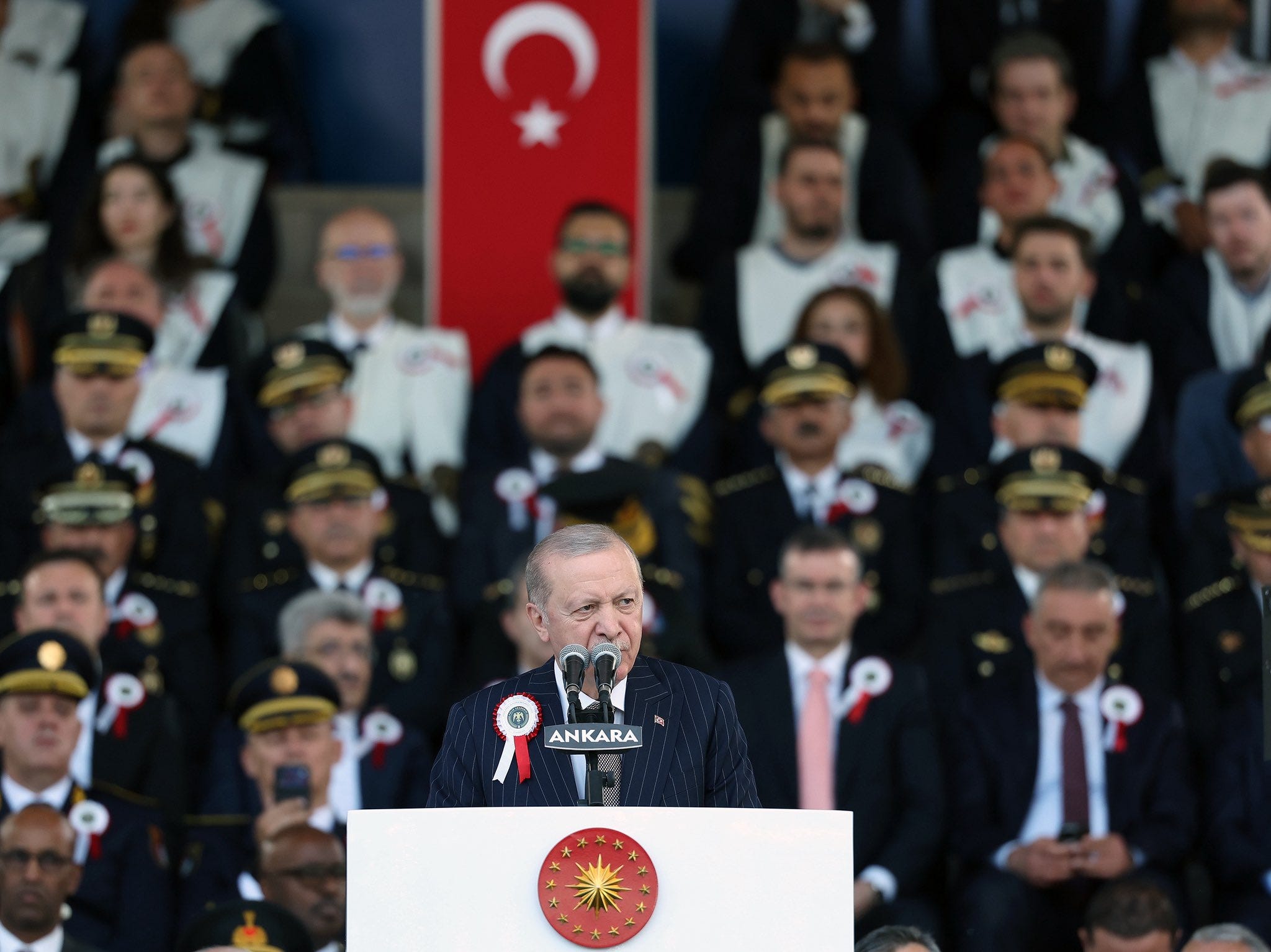
Turkish President Recep Tayyip Erdoğan delivering a speech at the Police Academy Graduation Ceremony in Ankara, June 28. (@trpresidency/X)
It’s Monday, June 29, and of all the interesting and bizarre revelations to emerge in the aftermath of Epic Fury, one of the most striking was that Turkey—NATO’s second-largest military—was apparently inclined to join the conflict on the side of Iran. According to Donald Trump, Turkey’s President Recep Tayyip Erdoğan “was a prime candidate to go into the war with Iran—maybe on the Iran side.”
“I asked him to stay out. He stayed out,” Trump told reporters in the Oval Office.
There was never any sign of a Turkish military buildup for such an attack, so Trump may simply have been going off the Turkish president’s violent rhetoric. Just two days ago Erdoğan openly declared that he and his nation are in a struggle against Zionism, labeling it a “genocidal, occupying, expansionist ideology” that he claims “threatens not only me, not only our party, not only our alliance—it threatens everyone.”
In response, Israel has moved to recognize the Armenian Genocide—a backhanded slap at a Turkish government that still denies its role in massacring the Armenian population during the First World War. (For a great history of the period, check out The Thirty-Year Genocide.) It may sound like an obvious moral call, but it’s worth remembering that for the better part of thirty years Israel was one of the reasons the world dragged its feet. Nobody in Jerusalem actually doubted that the slaughter of 1.5 million Armenians was genocide—they just decided Turkey mattered more. And for a long time it did: Ankara was Israel’s closest friend in the neighborhood and one of only two Muslim-majority allies it had.
In 1997, Israel nominated Ehud Toledano—a respected Ottoman historian—as ambassador to Ankara, assuming the appointment would sail through. Then Turkey balked, citing a 1981 Army Radio segment in which Toledano had supposedly “accused Turkey of massacres,” and refused to accredit him. The absurd part is what that broadcast actually was: he’d been brought on at the last minute to explain Turkey’s side after the Turkish embassy itself declined to send anyone. With the Israel-Turkey alliance entering its golden age of arms deals and intelligence sharing, Jerusalem wasn’t willing to fight over an ambassador—and quietly let the nomination die.
The reflex reached Washington, too, where Israel leaned on pro-Israel lobby groups to keep recognition off the table. When a recognition resolution came before the House Foreign Affairs Committee in 2007, AIPAC, the ADL, and the AJC pressed lawmakers to bury it before it ever reached the floor.
So what changed between then and now? It’s not complicated: Israeli-Turkish relations collapsed. Erdoğan grew militantly anti-Israel and dragged Turkey in an increasingly Islamist direction. By 2021, when the Biden administration recognized the genocide, the move was welcomed by the very same lobby groups that had once opposed it.
We’re now at a low point in the relationship—one that has drifted past diplomatic grandstanding into the surreal. Over the past two years, Ankara has severed bilateral trade and barred Israeli ships from its ports, while Erdoğan floats barely veiled threats of military action, likening a potential move against Israel to his operations in Karabakh and Libya. He has even peddled a “Promised Lands” conspiracy to his own parliament, warning his base that Israel—a country of 9.5 million already bogged down in a multi-front war—is plotting to march on the Anatolian heartland.
Beneath the theater, though, is a real shift: as Iran’s proxy network degrades, Turkey is positioning itself as the region’s new superpower and, reasonably enough, treating Israel as its main rival for dominance across the Levant. Israeli planners warn that a hollowed-out Damascus could slide into a Turkish proxy state, putting Turkey’s military on Israel’s northern doorstep. Ankara is already fielding air defenses in northern Syria that constrain IDF freedom of action and angling to station forces in a postwar Gaza. How Erdoğan plans to square all this with membership in a Western defensive alliance will be interesting to watch—and I’d keep my eye on the NATO summit in Ankara next week.
But back to the recognition.
Unfortunately, none of this is going to win Israel many friends in Yerevan and I don’t blame them. Armenia has not been a close friend for decades, and the relationship has only curdled—Yerevan recalled its ambassador in 2020 over Israeli arms flowing to Azerbaijan, and in June 2024 it formally recognized a Palestinian state.
For his part, Erdoğan hasn’t hesitated to brand every Israeli action as the worst of all crimes: after the strikes in Lebanon, he called Israel’s activity there and in Syria part of a “blood-stained genocide network.” So I understand the impulse to finally name a real crime against humanity, but this is hardly motivated by a higher calling.
My take: the Armenian Genocide deserves recognition on its own terms—not as a card to be played against Ankara. We’d be rightly outraged if anyone treated the Holocaust that way, and after two years of watching exactly that happen, we should know better than to turn another people’s tragedy into a bargaining chip.
Footage of the demolition of a Hezbollah tunnel in southern Lebanon.
The new Israel-Lebanon agreement is starting off with a bang. As part of Operation “Full Stop,” the IDF has destroyed a major Hezbollah tunnel complex beneath the Shiite village of Majdal Zoun in southern Lebanon—one of Iran and Hezbollah’s most significant military assets in the country.
The shaft stretched more than 200 meters and descended over 25 meters underground. Inside were hundreds of weapons, workshops, and several launch tubes built to fire from within the bunker itself, all pointed at Israel.
This wasn’t a quiet demolition. Bringing the network down required hundreds of tons of explosives, and the Upper Galilee Regional Council warned residents in advance to expect a high-intensity blast whose echoes could roll across the entire sector, including the Hula Valley over 30 miles away.
The tunnel was only the heart of a much larger subterranean network. Over the past week, IDF forces captured the sprawling complex it served: a fully operational underground drone airbase built by Iran for Hezbollah beneath the village, roughly 10 kilometers from the Israeli border. Carved nearly 30 meters into the bedrock—and strategically positioned directly beneath the town’s mosque—the sheer scale of the facility left Israeli commanders stunned. Some compared it to Ramat David, Israel’s largest northern airbase; others simply dubbed it Hezbollah’s “Ben Gurion Airport for drones.”
It took a decade of Iranian engineering to build, complete with massive blast doors and dedicated launch shafts designed to open, fire a drone capable of reaching Tel Aviv, and instantly reseal to evade airstrikes. During the opening stretch of the war, this was the very launchpad Hezbollah used to send hundreds of explosive UAVs deep into the Israeli home front. Majdal Zoun sits in the center of the Shiite ridge. Look south and you can see most of the Western Galilee; look north and the Tyre basin opens up before you. When troops breached it, they found more than 50 fully assembled attack drones and eight tons of explosives still waiting inside—each capable of reaching anywhere in Israel once airborne: Haifa, Tel Aviv, Jerusalem, even Eilat.
Following Friday’s agreement, Israel has been given a mandate by the Lebanese government to clear the area. This won’t be the last earthshaking demolition that proves necessary—but come hell or high water, the IDF appears determined to rip Hezbollah out root, branch, and stem.
English Editor: Ari Tatarka
If you enjoy the newsletter, you can show your support by becoming a paid subscriber—it really helps keep this going. I’m also offering a special monthly briefing for a small group of premium members. I’d love to have you join us—just click below to find out more.
Thanks for reading It’s Noon in Israel! Subscribe for free to receive new posts and support my work.


Another example of how Marco Rubio is dismantling the Iranian Regime with Israel as JD Vance pontificates the great success of the administration vis a vis with Iran in our capitulating sham “negotiations.”
Holy scheitz! May Ha Shem co tinue to guide and protect Israel.