The Siege in Southern Lebanon
Also, has Bennett already lost the leadership race?
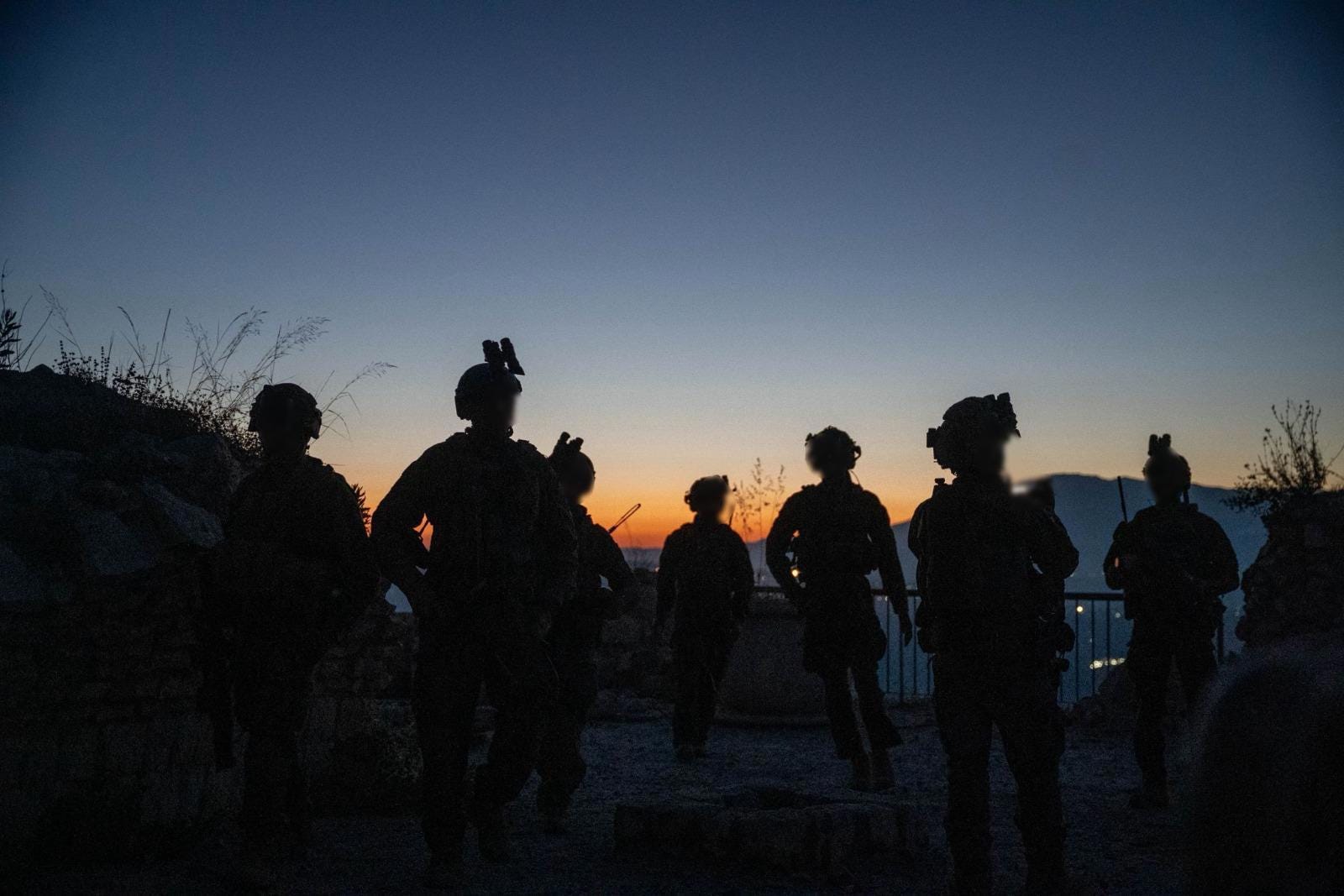
IDF forces near Beufort Ridge in southern Leabnon. (IDF)
It’s Sunday, June 21, and two men could have flown to Geneva for this weekend’s peace talks. Only one would have been arrested on arrival—and it isn’t the one who massacred his own citizens. Despite Friday’s flare-up in Lebanon, an Iranian delegation led by Parliament Speaker Mohammad Baqer Qalibaf and Foreign Minister Abbas Araqchi has landed in Switzerland for talks with the United States. Qalibaf, his hands still wet with the blood of protesters, will be ushered in to meet Vice President JD Vance. Netanyahu, wanted by the ICC, stayed home.
According to CBS, first on the agenda is the conflict between Israel and Hezbollah. That placement is no accident: Iran’s stated purpose is to “demand the fulfillment of the [United States’] obligations,” according to Foreign Ministry spokesman Esmail Baghaei, arguing that Washington has failed to implement the MoU’s first clause—a ceasefire on all fronts, Lebanon included—and that nuclear negotiations cannot even begin until it does. In effect, Tehran is holding the entire process hostage to a Lebanon ceasefire it expects the U.S. to impose on Israel.
Beyond Qalibaf and Araqchi, the delegation includes Central Bank Governor Abdolnaser Hemmati and oil chief Hamid Bord, an inclusion that signals Iran intends to frontload the economic side of the deal: sanctions relief and the release of frozen assets, likely early in the 60-day window to blunt U.S. leverage on the nuclear file later. It’s worth remembering that neither Israel nor the terror group has a seat at the table—in part because, had Benjamin Netanyahu hitched a ride with Qalibaf, it’s the democratically elected leader who would have been arrested on the tarmac, while the speaker who presided over the massacre of his own citizens is ushered in to meet Vice President JD Vance.
On the ground in Lebanon, the IDF is pressing to seize the strategic Ali al-Taher Ridge and the subterranean network beneath it. The IDF assesses the complex to be the “nerve center” of Hezbollah’s Badr Division—the formation regarded as the organization’s primary force on the southern front—with dozens of operatives holed up underground as fighting plays out above and below the surface. The facility is of such vital importance that the organization reportedly planned to blow the Qaraoun Dam and flood the Litani River basin to halt an IDF advance toward it—even at the cost of a national disaster in southern Lebanon. This is a facility unlike anything Israeli soldiers have encountered elsewhere. Built over more than a decade with Iranian funding and planning and carved deep into the rocky terrain across multiple levels, it served as the command post from which Hezbollah directed its fight against IDF forces and its attacks on Israeli territory. The terrain is what makes the difference: unlike in Gaza, where tunnels could be dug back out of the sand, here the rock works against reconstruction—destroy the headquarters, and rebuilding it will be nearly impossible.
That operation has come at a steep price. Overnight Thursday into Friday, four soldiers from the 401st Brigade’s 52nd Battalion were killed when a Hezbollah anti-tank missile struck their tank and an explosive drone penetrated the vehicle and detonated inside. Among the fallen were the battalion commander, Lt. Col. Dor Gedalia Ben Simhon, along with Staff Sgts. Yoav Klein, Liav Kababia, and Nave Habshoosh.
The fighting only intensified from there. Pressing the operation forward, commando forces moved on the ridge overnight Friday into Saturday under a barrage of rockets, mortars, and explosive drones. Sgt. 1st Class Nir Ben Ari was killed in the assault, and 13 other soldiers were wounded, two of them seriously. The volume of incoming has been heavy: Israeli Ambassador to the U.S. Michael Leiter reported Hezbollah fired 147 rockets, 20 drones, and nine anti-tank guided missiles at Israeli forces and into Israel over 24 hours. In response, the IDF unleashed waves of strikes across southern Lebanon through the night and into the morning, hitting dozens of Hezbollah sites and operatives—rocket launchers, weapons depots, and command centers—with Lebanese media reporting at least 27 killed. Netanyahu’s office put the two-day tally at more than 300 Hezbollah targets struck and more than 100 fighters killed.
Tehran seized on the strikes, declaring them a violation of its memorandum of understanding and announcing it was closing the Strait of Hormuz until Israel halts its operations in Lebanon. The move is better read as economic leverage rather than a literal blockade: Iran has worked throughout to keep oil prices high, and simply announcing a closure spooks shippers and lifts prices regardless of whether traffic actually stops. In fact, U.S. Central Command reported that 55 commercial ships had transited the strait; its spokesman flatly insisted “Iran does not control the Strait of Hormuz” and that “traffic continues to flow.” Iran, MoU grievance notwithstanding, still dispatched its senior delegation to Switzerland all the same.
By Saturday afternoon, against the backdrop of those Iranian threats and subsequent American pressure, the order came down for the IDF to stand down. A senior official in the Prime Minister’s Office and the IDF Spokesperson confirmed the military was halting its fire and remained committed to the ceasefire, though it would continue dismantling Hezbollah infrastructure inside its security zone, the Ali al-Taher Ridge included. Netanyahu, for his part, was unambiguous that Israel will remain in the security zone “as long as necessary to defend [Israel’s] northern border,” and his office warned the IDF would continue to strike “forcefully” if Hezbollah keeps firing.
As it stands, Israel has the facility besieged with dozens of Hezbollah forces still trapped inside—entrances surrounded, the rest under aerial overwatch.
In the Israeli memory of Lebanon, the imposing Beaufort Castle was termed the “monster on the mountain,” while the base on Ali al-Taher Ridge was given the relatively benign name of Pumpkin. Twenty years later, Pumpkin, it turns out, has grown a monster of its own—15 stories down.
Chairman of the “Together” party and former Prime Minister Naftali Bennett speaks during a press conference in Tel Aviv, June 15, 2026. (Avshalom Sassoni/Flash90)
Philippe Petit is a French tightrope walker who is remembered by many Jerusalemites for walking on a tightrope over the Valley of Hinnom in 1987. Roughly halfway through, while maintaining exemplary balance, a pigeon landed on the rope, threatening to tilt it and drop the acrobat into the ancient Jerusalem valley. In the end, he made it to the other side.
Thirty-nine years later, on a tightrope of his own toward the Prime Minister’s Office, is Naftali Bennett. It would be a mistake to blame his drop in the polls on the missteps of recent weeks. The pigeon — though he insists he’s a hawk — landed on his rope back in July. Its name is Gadi Eisenkot, the former IDF chief of staff who, like every decorated general before him, walked into politics carrying the centrist hopes of half the country.
For almost two years, even before he had a party, Bennett was the leading candidate in the polls for the premiership. This happened thanks to two groups: the vast majority of his supporters came from opposition voters. The smaller but electorally much more significant part is disappointed coalition voters. The potential right-wing supporters were the incentive for the left-wing supporters to come: they were the bargaining chip he brought to the change camp. The price was a deliberate blurring—like Ariel Sharon in his time, like Ehud Barak, like Gadi Eisenkot today—of positions on controversial issues. Bennett walked very high on the tightrope for a very long time, actually longer than any other candidate in the last generation. Bennett’s dive in the polls, therefore, feels as if it came too early, but actually, it comes very late.
Because the moment Eisenkot broke from Benny Gantz and struck out on his own, everything began to slip. The handful of mandates he took came straight off the left flank of what was already being called “Bennett 2026.” And Bennett faced the familiar danger—the one that finished previous centrists like Gantz, Isaac Herzog and Tzipi Livni—of watching his swing voters evaporate. So he drifted left: a sharper anti-Bibi line, music pitched to those voters, the disqualification of Smotrich and Ben-Gvir, and, at the peak of it, hiring Lior Chorev—a staunch anti-Netanyahu and anti-Trump public figure—and merging with Lapid. Petit turned his torso left to rebalance the frame.
But the result was that the balance from the right was disrupted. That small and significant segment of right-wing voters abandoned him. A poll commissioned last week sought to examine where the Bennett-Lapid bloc was leaking from. It examined what would have happened if the two had split. The result: Bennett would have received 15 mandates and Lapid would not pass the electoral threshold. The leakage is mostly from the left.
And therefore, the conclusion is that there is no point in continuing to walk on the tightrope, nor in trying to chase away the pigeon. This balancing act is over. Lapid, certainly the more successful campaigner of the pair, suggested this week in discussions to stop referring to Eisenkot or attacking him, and simply to offer something else. No voter will be won over by infighting within the bloc regarding suitability for the premiership. The same goes for the delicate—and pointless—balance between right and left.
The assets of the two over Eisenkot that will be increasingly emphasized are experience (not since the days of Sharon and Netanyahu have two prime ministers run on one list), detailed plans from day one in power, and mainly the claim that in such an era there is no time for experiments. They will not present a multiheaded leadership like in “Blue and White” but a team. In the 1980s, those of Philippe Petit, they called it a “hive” in Likud propaganda. Regardless, it also suits a party whose name is “Together.”
This is an excerpt from my weekly column in Israel Hayom.
English Editor: Ari Tatarka
If you enjoy the newsletter, you can show your support by becoming a paid subscriber—it really helps keep this going. I’m also offering a special monthly briefing for a small group of premium members. I’d love to have you join us—just click below to find out more.
Thanks for reading It’s Noon in Israel! Subscribe for free to receive new posts and support my work.


In no way, shape or form, should Israel back down. Not to Hezbollah, not to Iran and not to President Trump. The leaders of Israel MUST read the tea leaves in America that the leftest wing has taken over the Democratic Party and they will push for reduced if not frozen aid to Israel and also to halt the sale of “offensive weapons” to Israel. They cannot wait for the next administration whether it be the leftist Democrats or the anti-Semite Vance/Tucker Carlson wing of the Republican Party. Righteous Republican leaders like Senator Rubio are in the minority and I’m afraid will not win any national political races.
Israel must support its Northern Border to the full extent and if the country has to seek allies and friends outside of the US then so be it. Western Europe is already a hot bed of antisemitism and anti-Israel behavior.
It is simply stunning that the Islamic terrorist regime of Iran, the killers of their own people, hated by their own people are now allies with Trump and Western Europe. The democratically-elected leadership in Israel are now on the wrong side of Trump simply because of the west’s anti-semitism.
It’s a very dangerous time for Israel but most of us in the diaspora support Israel 100%.