The State of Israel vs. October 7
Also, a new offensive in the Gaza Strip?
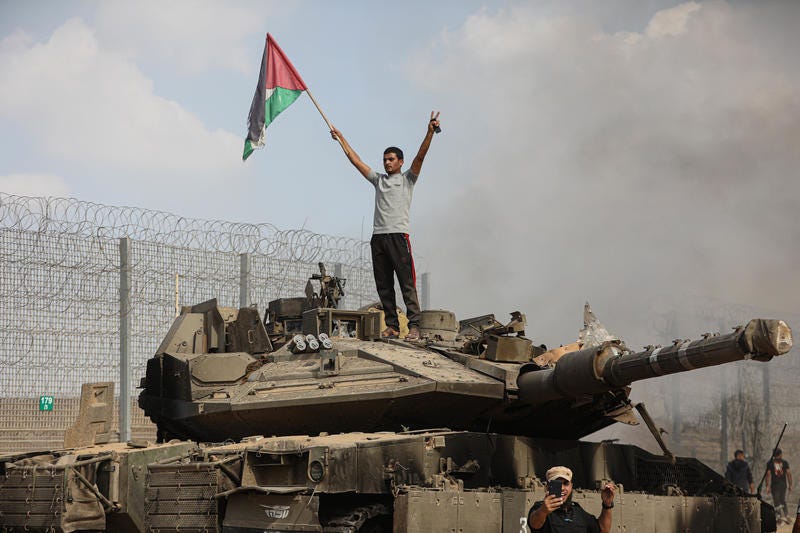
Palestinians stand next to a burning tank inside the border fence, October 7, 2023. (Yousef Mohammed/FLASH90)
It’s Sunday, May 3, and two months ago, the Constitution, Law and Justice Committee convened for a pivotal discussion on one of the most sensitive questions of the post-October 7 era: how will the trials of the perpetrators be conducted? According to a compressive report by Yedioth Ahronoth’s Guy Asif, the committee is currently refining a bill that will serve as the legal, organizational, and moral framework for what is destined to be the largest and most complex judicial event in Israel’s history.
Amidst the legislative debate, the human dimension remains profoundly raw. Carmit Palty-Katzir, a daughter of Kibbutz Nir Oz, offered harrowing testimony to the committee. Her family was shattered: her father was murdered, her mother was kidnapped and died shortly after her release, and her brother, Elad, was murdered in captivity after 99 days. “I walk around with unsolved murder mysteries,” she told the committee, voicing a pain shared by hundreds of families seeking closure. While demanding that the perpetrators face the full severity of the law, she also issued a warning. She argued against the trials devolving into a “media circus” or a “gladiator arena,” urging that the pursuit of truth not be eclipsed by a “stampede toward the death penalty.”
Palty-Katzir’s concerns underscore the dilemmas of the Prosecution of Participants in the October 7 Massacre Events Bill. Having passed its first reading in January, the legislation is now being prepared for its final stages. Yet, even as the Knesset’s summer session approaches, several complex questions remain.
How public should the proceedings be? The judiciary must balance the public’s right to see justice served with the necessity of protecting survivors from secondary trauma.
What standard of evidence should be required? Applying the threshold of “beyond a reasonable doubt” to the scale of a mass massacre leaves a distinct possibility that a known perpetrator could walk free if the case isn’t perfectly airtight.
And then there is the most potent question of all: what punishment is truly appropriate? The prospect of the death penalty—a historical rarity in the Israeli legal system—remains the central point of debate.
When drafting this bill, certain historical examples naturally come to mind: Nuremberg, Tokyo, or the International Criminal Tribunal in The Hague. However, those comparisons only go so far. In those instances, tribunals were established through UN resolutions and international consensus, typically after conflicts had ended. For the October 7 terrorists, there is no international alliance sponsoring the proceedings, and the conflict itself is far from over. The scale is also in an entirely different class. While the Nuremberg trials prosecuted 24 key figures of a defeated state, Israel is preparing to try roughly 350 individuals who acted on behalf of a terrorist organization.
Adolf Eichmann at his trial in 1961.
Within Israel’s own history, the immediate point of reference is the trial of Adolf Eichmann. While the logistics differ—Eichmann was a lone defendant, whereas today there are hundreds—the core objective is identical: the pursuit of justice as a means of constructing a permanent national narrative.
Yes, narrative. The pursuit of justice is paramount, but the story Israel is trying to tell is critical as well. The Eichmann trial was about more than executing a war criminal; it was about establishing a narrative for the young State of Israel and the vindication of Holocaust victims. David Ben-Gurion, the Prime Minister at the time, famously stated that “the trial is the important thing, not the penalty.” He believed the trial was about “how the Jews were slaughtered, and how only the establishment of a Jewish state had enabled Jews to hit back.” Hannah Arendt, the trial’s most famous observer, criticized Ben-Gurion’s role as an “invisible stage manager” for the narrative nature of the trial and claimed that “the trial was built upon what the Jews had suffered, not upon what Eichmann had done.” As MK Yulia Malinovsky, the bill’s initiator, put it, “There is nothing better than a legal proceeding to tell the story.”
The blueprint for the October 7 trials did not emerge from a government cabinet, but rather from a secret subcommittee convened in late 2023. Prompted by Malinovsky, the discussions addressed a stark reality: hundreds of terrorists were in Israeli custody, and the state needed a legal mechanism to handle “the most terrible criminals there are.”
The government was hesitant to engage at first. With 253 hostages held in Gaza and a military campaign in its infancy, there was deep concern that public legal proceedings could jeopardize the safety of captives or complicate active operations. Consequently, what is now one of the most historic laws in Israel’s history began as a private initiative rather than a government-sponsored bill.
The first major question the bill had to answer was who would preside over the trials.
While a civilian District Court seemed logical, experts warned that processing hundreds of defendants and thousands of witnesses would cause the Israeli judicial system to buckle. “The terrorists would have eventually died of old age before the trials ended,” Malinovsky noted. Furthermore, any trial involving a potential death sentence requires a Supreme Court justice on the panel. To run these trials in parallel, Israel would have had to appoint 15 new justices—a political minefield in itself that no one wanted to enter while trying to keep the trials from exploding in their faces.
When it became clear that the civilian courts could not absorb the weight of hundreds of parallel cases, the responsibility shifted to the military. While the IDF didn’t want touch such a controversial process, it was the only viable option. The military possesses the unique ability to draft seasoned prosecutors and judges into reserve service, creating an instant, elite legal force. Furthermore, military infrastructure is inherently designed to manage the high-risk transport and detention of dangerous detainees—a logistical requirement that would paralyze any standard city courthouse.
The next question: where?
The Prison Service lobbied for a site near Ktzi’ot Prison for convenience, while others suggested the Gaza Envelope for its symbolic weight. Ultimately, the decision landed on Jerusalem. Plans are now underway to transform a massive industrial site in Atarot, north of the city, into a sprawling judicial complex. This “hangar city” will house a primary courtroom, multiple halls for parallel hearings, and dedicated viewing areas for the public. The court is expected to operate with an unprecedented focus: five days a week, eight hours a day, with judges dedicated exclusively to these cases. The goal is to begin within a year of the legislation’s passing and conclude the primary proceedings within a few years.
The trials promise to reveal investigative materials far more harrowing than anything yet released to the media. For the first time, victims will take the stand to testify, often face-to-face with the perpetrators. This brings a painful paradox to the forefront: the public’s right to historical truth versus the victims’ right to privacy.
Palty-Katzir expressed a fear shared by many survivors—that the testimony of a terrorist describing the massacre of their loved ones could become a “viral video,” causing secondary trauma to children and families. To preserve the integrity of the historical record while protecting the dignity of survivors, the “Eichmann Model” of unfettered public broadcasting has been modified. Under the current proposal, a dedicated website will serve as the primary portal for the proceedings, though only hearings pre-designated as “open” will be broadcast live. Only after a thorough review will specific segments deemed suitable for public consumption be uploaded to the site.
But there is still the question of the evidentiary standard.
The prosecution faces the historic burden of framing a national narrative, but the primary challenge remains the “resolution” of proof: linking specific defendants to individual victims amidst the chaos of a mass massacre. Investigators have reportedly solved this issue by creating an exhaustive mapping system that catalogs every detainee by their military unit and infiltration point, cross-referencing their confessions with terabytes of bodycam footage, digital media, and forensic scene reconstructions.
By matching “concealed details” from interrogations—such as the specific layout of a home or a victim’s unique physical markers—with photographic evidence from the field, the state claims it can now link the majority of suspects to specific acts of violence.
(If you want to read more about the investigation, click here)
MK Simcha Rothman leads a Constitution, Law and Justice Committee meeting at the Knesset. (Yonatan Sindel/Flash90)
The current proposed charges range from war crimes and harming state sovereignty to crimes against the Jewish people and genocide. While some offenses allow for life imprisonment, a conviction for genocide under the proposed law would carry a mandatory death penalty. While MK Simcha Rothman, chairman of the committee drafting the bill, argues that the massacres clearly constitute genocide, some legal professionals warn that to secure a conviction, the state must prove a “special intent” to annihilate the Jewish people.
Legally, this requires demonstrating that a specific operative was not only a participant in the violence but was personally motivated by a desire to destroy the group and was aware of the high-level plan orchestrated by leadership. Without explicit evidence—such as personal writings or digital messages—an acquittal could inadvertently provide a propaganda victory for those denying Hamas’s genocidal intent.
To mitigate this risk, the Justice Ministry has recommended using a largely dormant section of the 1950s Penal Law: the offense of harming state sovereignty. This crime carries a sentence of life imprisonment or death. Crucially, the evidentiary threshold is significantly lower than that of genocide; any armed infiltration across a sovereign border during a coordinated attack inherently constitutes a blow to the state’s sovereignty. By utilizing this existing statute, prosecutors can ensure severe sentencing while bypassing the nearly impossible task of proving the specific psychological state of every individual detainee.
Beyond the specific charge of genocide, the prosecution will utilize a “basket of offenses” to ensure that every participant is held accountable based on their specific involvement. This legal range scales from mass terror acts and armed infiltration—offenses that carry life imprisonment—to capital crimes like genocide and harming state sovereignty.
One of the most sensitive questions remains: who will defend the terrorists?
Famously, no one in Israel would defend Eichmann; his lawyer, Dr. Robert Servatius, had to be brought in from overseas and required constant security after facing numerous death threats. To avoid the perception of a “show trial” and maintain international legitimacy, the defendants must have adequate representation; however, according to the bill the Public Defender’s Office will not be involved. While the court may appoint private counsel or lawyers from the territories, the funding for these services will be offset from Palestinian Authority funds rather than the Israeli treasury.
Still unanswered is the most controversial question of them all: what is the appropriate punishment?
For Rothman, the goal is clear: “everyone who was a partner to this event is in the category of committing the crime of genocide and his sentence should be death.” To him, any outcome that doesn’t lead to the gallows is a “failure of the system.” Malinovsky shares this expectation. “It’s clear that this is what will happen in the end,” she says, but adds: “That is not what I am acting for. People are looking for blood, I am looking for justice.”
The law has yet to pass, but Israel is bracing for a trial unprecedented in its history. Justice is a complicated pursuit, and while capturing it is the aspiration of every trial, the process itself is just as critical. After reading one of the longest articles in the history of It’s Noon in Israel, I hope it is clear that the state is approaching this with the gravity it demands.
IDF Chief of Staff Eyal Zamir visiting forces in the Gaza Strip in February. (IDF)
With the northern and Iranian fronts stalled, senior IDF officials are pushing to renew fighting in the Gaza Strip. The sentiment among some in the general staff is straightforward: “The best time to decisively defeat Hamas is now.”
Over the past few months, mediators have hosted multiple rounds of talks with Hamas leadership in Cairo. In every single one, Hamas has dug in its heels, refusing to implement the second phase of the ceasefire and begin disarming. With the most recent proposal rejected on April 14, senior military officials are stressing that the ultimate objective—ending Hamas’s rule in Gaza—has to be achieved, whether through diplomacy or force.
We are already seeing movement on the ground. In recent days, the IDF has thinned its forces in southern Lebanon, shifting regular brigades down to the Gaza sector and into Judea and Samaria. The Southern Command has its operational plans locked and loaded; they are simply waiting on a green light from the political echelon to resume the fighting.
Even without a major offensive, the IDF has been ramping up pressure, eliminating nearly 100 terrorists in the Strip over the last few weeks. And the map hasn’t been totally static since the October 2025 ceasefire. The IDF has slowly pushed the “Yellow Line” westward, expanding its control to roughly 59 percent of the Strip’s territory, up from just 53 percent when the agreement was settled.
The big question hanging over a renewed offensive is manpower. Can the IDF execute a broad ground maneuver without triggering another massive reserve call-up? It’s a heavy ask. The burden on reservists is already immense—even now in 2026, they are serving an average of about 80 days a year.
The security cabinet reportedly is scheduled to discuss renewing the war in Gaza later today.
My take: Israel won’t launch a major operation right now. The strain on the reservists, and the stakes in the broader region are too high. The Americans are still confident the negotiations will eventually pan out. Israel is confident that when they don’t, Washington will finally give them the green light to finish the job.
English Editor: Ari Tatarka
If you enjoy the newsletter, you can show your support by becoming a paid subscriber—it really helps keep this going. I’m also offering a special monthly briefing for a small group of premium members. I’d love to have you join us—just click below to find out more.
Thanks for reading It’s Noon in Israel! Subscribe for free to receive new posts and support my work.


Can someone explain how perpetrators of terrorist attacks that killed Israelis have been dealt with under the legal system. And what that provides for the perpetrators of October 7 to be brought to justice
Tragically this is not the first time that Israelis have been killed and even massacred.
October 7 seems like it only differs in scale and not intent or outcome from the long history of decades of terrorist attacks coming from over a border
Military tribunal + firing squad.
This risks turning into a circus that will not only set up Oct 7 murderers to be released in a future hostage deal, but also animate all the would-be Jew killers around the world. It will condemn many more Jews to be killed in the future.