Commandment IV: Don’t Say the A Word
A deep dive into Israel’s most controversial parties.
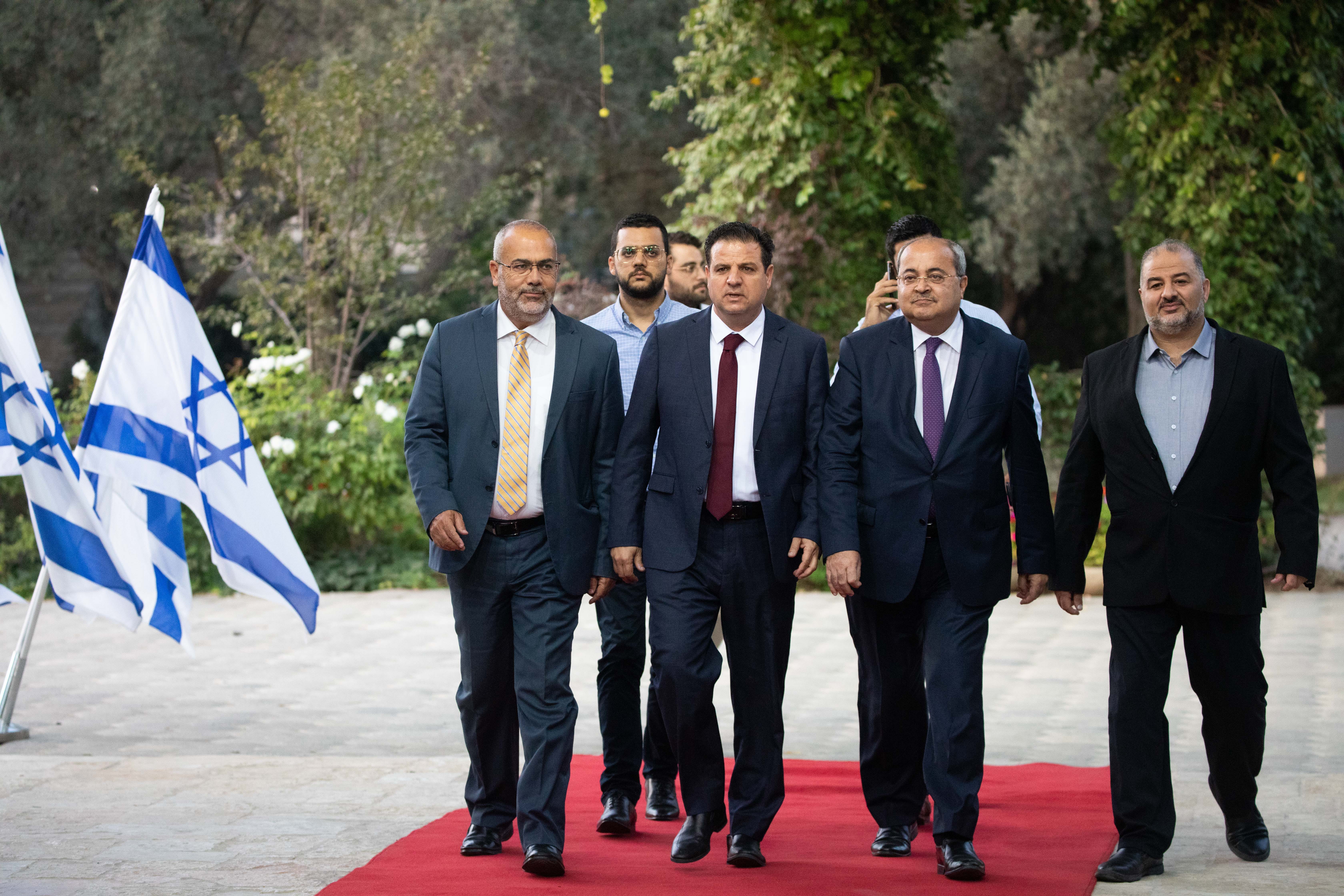
Members of the Arab Joint List arrive for a meeting with Israeli president Reuven Rivlin at the President's Residence in Jerusalem on September 22, 2019. (Yonatan Sindel/Flash90)
It’s Wednesday, August 19, and “don’t join this government,” Shas leader Aryeh Deri begged. “We will reach 61 seats and can establish this government, and you’ll get whatever you want.”
“Why should I believe you?” Ra’am’s Mansour Abbas responded.
Netanyahu’s ally replied: “You have my word that you’ll have exclusivity within the Interior Ministry in all issues relating to the Arab sector.”
In those heady days of constant elections in 2021, the most powerful man in the Jewish state was an Arab Islamist. Both coalitions lacked the magical number of 61, and no Jewish party was defecting from one bloc to the other, leaving the most moderate Arab party, the Islamist Ra’am, as the ultimate kingmaker.
Weeks earlier, Abbas had walked into a bizarre meeting: the head of the political arm of the Islamist movement sitting across from one of Religious Zionism’s most senior rabbis, Chaim Druckman. Abbas came looking for a seat in the coalition—though only in an unofficial capacity. He didn’t want the baggage of ministerial posts or complicity in settlement policy, which would be inevitable in Netanyahu’s right-wing government. “They want to build in the settlements? So what does that have to do with me?” he told Druckman. But he wanted to be part of a Netanyahu government all the same. Even a backroom handshake from Netanyahu could do what no one else could: legitimize him and his party as a partner on the right. It was the culmination of Abbas’s career-long project to bring his party into the Israeli mainstream.
Druckman shared the objective. To break the election deadlock, he needed to clear the way for the Religious Zionist party to sit in a coalition relying on an Arab party. They struck a deal: Abbas would release a statement denouncing terror, and, more challenging, Druckman would convince the other Religious Zionist leaders and in turn, win over Bezalel Smotrich.
The future of the Israeli government would be decided in Druckman’s small home in the religious village of Merkaz Shapira. Druckman laid out the case for Abbas’s moderation, but in a feat of oration, Smotrich dominated the room for two hours, speaking so forcefully that he flipped the rabbis’ consensus. There would be no sitting with Ra’am, not even indirectly.
Abbas reached an agreement with Naftali Bennett instead, and Deri’s last-minute appeals fell on deaf ears.
Both attempts at seduction were an aberration in the state’s long history with the parties of its largest minority. From the foundation of the state, Arab parties have been strategic allies, enemies, mistresses, and—for a brief period in 2022—official partners. Whether lurking behind Gadi Eisenkot’s face, as a recent AI video alleged, or simply occupying a not-so-quiet corner of the Knesset chamber, the Arab presence is one of the most decisive and controversial forces in Israeli politics, though almost always indirectly.
At the core of the tension is a simple reality: Arab citizens may be a minority in a larger country, but they are a demographic pillar in the region. While they have often acted as a domestic minority, they have just as frequently found themselves tethered to a larger, competing national project.
Do they prefer being citizens in a Jewish state, or advancing their own national project? The answer has shifted markedly across nearly eight decades of statehood, and it is shifting still. Which leaves the question: what comes next?
Let’s start at the beginning.
May 14, 1948. The country’s ear is pressed to the radio. The country’s first Prime Minister, David Ben-Gurion, has just proclaimed the establishment—after thousands of years of yearning—of a Jewish state. Jerusalem will be its capital, he declares, despite the fact that the city is under siege and on the verge of starvation. He then turns to the people that state is, ostensibly, at war with, appealing to the new Arab inhabitants of the State of Israel “to preserve peace and participate in the upbuilding of the State on the basis of full and equal citizenship and due representation in all its provisional and permanent institutions.”
By the time the fighting ended more than a year later, around 150,000 Arabs remained inside the new state. During the conflict and in its aftermath, one concern predominated: a fifth column. Israel was surrounded by hostile states, and infiltration was already becoming a severe problem. The immediate answer was military government—a regime that dictated where Arabs could live, where they could move, and what they could say.
Yet they were still residents of the fledgling state, and the declaration, only a year old, had committed it to the “complete equality of social and political rights to all its citizens,” implicitly including the most fundamental right among them: the vote.
The Military governor of Rafah with Arab Notables. (GPO/Fritz Cohen)
Security officials and military governors pushed hard against it, invoking the specter of a fifth column. But Ben-Gurion, ever the ideologue, overruled them. It was “inconceivable,” he argued, “to start the State’s political life with discrimination on national grounds.” It certainly didn’t hurt that Mapai’s strategists estimated Ben-Gurion’s own party stood to win 80 percent of the Arab vote if the ballot were extended.
The question for the party was how best to harvest it. Mapai wanted no fifth column inside its own ranks, and the Arabs of the early state—tribal, and deeply wary of the Zionist establishment—were as likely to spoil a ballot out of spite as to hand it over.
The solution was ventriloquism: rival satellite lists, each tailored to a local clientele, all ultimately answering to Mapai. Three ran in 1951. The largest, the Democratic List for Israeli Arabs, was led by Seif el-Din el-Zoubi and took three seats; Faras Hamdan ran Agriculture and Development and won one; a third, the similarly optimistically named Progress and Work party, took the last.
The friction inherent in this system was immediate. One day, supporters of Zoubi’s “Democratic List” made the fatal mistake of rolling into a coffee shop in Baqa al-Gharbiyya to campaign. Enraged that a rival Mapai-affiliated group was trespassing on his turf, Hamdan and his cronies barged in and physically beat Zoubi’s men out of the cafe. Hamdan himself allegedly led the beatdown, capped off by shouting over the broken coffee cups that he was the sole government in Baqa, and no other party would set foot in his town.
They would eventually sit side by side in the same government.
Arab Israeli Catholic Scouts march in Nazareth on Israel’s Independence Day, 1954, demonstrating their support of the state. (GPO)
The Arabs were not particularly enamored with Mapai’s dreams of Labor Zionism; their votes were largely bought with benefits and permits dutifully provided by the “apolitical” military government. Arabs had two options: vote Labor and get a kickback, or vote for the only anti-Zionist party, the communists, out of protest.
For the early years of the state, a majority opted for the bribe. From the First Knesset in 1949 through 1977, every single Israeli government included the satellite Arab parties. For the state’s first 28 years, Arabs had more representation in Israel’s government than the right did.
The satellite lists orbited the government faithfully—more than once voting to keep military rule over their own voters. They were dutifully rewarded for it, though in hindsight the arrangement was hardly a masterstroke on Labor’s part. Unsurprisingly, an electorate that had just watched its own representatives vote for its disenfranchisement grew less inclined to back a satellite party, funneling its votes to the communists instead.
Ben-Gurion, meanwhile, had finally stepped down after a long and consequential premiership, handing the office to the quiet Levi Eshkol. Behind the thickset glasses and the Yiddish accent sat an unusually sharp mind.
When a foreign journalist asked whether Israel’s Arabs could ever be loyal to the state, Eshkol reached for Ezekiel’s metaphor: “The fathers have eaten sour grapes, and the children’s teeth are set on edge—but it depends on the teeth of the children.” In short: their parents were against us; let’s see what their children do.
Military rule had been loosening for years, but only shortly after the 1966 elections did the new prime minister announce it would soon end altogether. On the same day he made that decision, Eshkol also lengthened military service by four months—the first move, he said, to give the Arabs equality; the second, to promote deterrence.
Deterrence was needed. Gamal Abdel Nasser, the leader of Egypt and the standard-bearer of pan-Arabism, was again preparing for war. The soft-spoken Eshkol had last worn a uniform in the First World War and was ill-cast as a wartime prime minister. His stuttering radio address on the eve of war spread nationwide hysteria, though in the end, it hardly mattered. The Six-Day War ended with Israel tripling the territory under its control: the Sinai, the Golan Heights, and—most consequentially for its Arab citizens—Gaza, Judea, and Samaria.
Arab notables, still orbiting the left wing, heralded the just and righteous victory. The great reckoning had come and gone in six days, and the ledger read in the state’s favor: pan-Arabism lay blackened and smoldering in the Sinai, the Arab citizens had not sabotaged the state from within, and Israel was ascendant, eagerly waiting for a telephone call from Arab leaders that would not come for years. But, for the first time since 1948, Israel’s Arabs were back in contact with the populations of the new territories, and through them, with the burgeoning Palestinian national movement.
Still, the old satellite arrangement limped on, slowly bleeding support, until the Upheaval of 1977—when Likud broke 29 years of Mapai’s monopoly. The satellite lists collapsed with it, melting away entirely by 1981, and in their place, the Arab public, turning steadily more nationalist, shifted its allegiance to the communist-led Hadash.
Lenin famously insisted that “Marxism cannot be reconciled with nationalism, be it even of the ‘most just,’ ‘purest,’ most refined and civilized brand.” He was evidently unaware of the Palestinian exception. Hadash’s 1977 platform called for a state along the 1967 lines and demanded “national” equality—a phrase that hovered somewhere between recognition as a national minority inside Israel and outright Palestinian nationalism.
The First Intifada in Gaza Strip, December 1987. (GPO)
Nationalism by Palestinians, for Palestinians, would have to wait until an Israeli army truck ploughed into a line of cars carrying laborers home toward the Jabalya refugee camp in Gaza. The locals, certain it was reprisal for a stabbing in Gaza days earlier, rioted. The First Intifada had begun—and Israel’s Arabs, after decades of quiet Palestinianization, surged to join it, downing tools and filling the streets in solidarity.
Weeks later, sitting Labor MK Abdulwahab Darawshe stood at a Nazareth rally and, seemingly on the spot, quit the party that had carried him into the Knesset. He founded the first independent Arab party—no Zionist patron above it, no Jewish partner beside it—and staked it on a single proposition: that “Arab citizens are an inseparable part of the Palestinian Arab people and citizens of the State of Israel.” The slogan said it plainly: an Arab vote for an Arab party. The taboo on a Palestinian state had been broken four years earlier. The Progressive List, a joint Arab-Jewish party, had run on “Vote Fa—(the letter F)—for Filastin,” and while they would quickly fade into irrelevance, they set a standard for future platforms. Since that election, a vote for an Arab party was a vote for Palestine, regardless of the letter.
But they were still in the margins of Israeli politics. Arab parties were, as one campaign poster claimed, “Waiting for Rabin.”
Yitzhak Rabin—the man who had conquered the territories in 1967—was now ready to give them up. The defense minister who had ordered the army to “break arms and legs” in the First Intifada went to Nazareth in 1992 and promised to “eradicate discrimination” against Arab Israelis. After his attempt to stop the rioting by force failed, Rabin was ready to negotiate with the Palestinians. On the campaign trail, he promised not to talk to PLO chief Yasser Arafat, and he was probably sincere, but he did not give enough thought to how he could honor both promises simultaneously: negotiating with the Palestinians while boycotting the head of the PLO.
In the following election, Rabin’s Labor took 44 seats and the pro-peace Meretz 12; together they reached 56, four short. The five Arab members—three from Hadash, and two from Darawshe’s party—supplied the rest. Together they made 61.
Still, Rabin kept them waiting. The ex-general wanted a peace for the Jewish state; a process dependent on Arab parties that pushed for the former while rejecting the latter would not be reassuring for the majority of Israel’s population. So Rabin refused to formalize the relationship, initiating the long Israeli political tradition of keeping the Arab party as mistress rather than wife—lending support from the outside in exchange for policy shifts and concessions, without any official coalition ties.
Rabin attempted to circumvent the PLO to keep his promise of not talking to Arafat, though by that time the PLO had taken control on the ground, and every other representative was simply a proxy. Rabin was forced to swallow a bitter pill, shaking hands with the architect of the terror campaign against Israel over the past three decades. Still, when Oslo I was brought to the Knesset, it passed by a comfortable majority—61 to 50—with all the Arab members voting in favor.
While the preamble of the agreement referred to one party as “representing the Palestinian people,” the articles themselves applied only to the “Palestinian people in the West Bank and the Gaza Strip.” What about the Arab Israelis? Transfer was whispered about now and then, but they had no intention of leaving. Were they going to be loyal Israeli citizens, or focus on supporting the new Palestinian state?
For the moment, the focus remained on Oslo, which bus bombings and endless terror attacks had put on life support. The Second Oslo Accords were brought to the Knesset in 1995; even with Arab support, a minor revolt in Rabin’s own Labor party meant two defectors from the opposition were needed. Gonen Segev and Alex Goldfarb agreed to provide the decisive votes—but the latter only after he was promised a Mitsubishi and a driver, along with a deputy minister’s post. It gifted the Israeli right a lasting quip: that Oslo “passed on the tip of a Mitsubishi.”
The favorite counterfactual in American fiction is a Nazi victory in the Second World War. In Israel, it’s a living Rabin. On November 4, 1995, after a peace rally where he sang the anthem of the decade—the Song of Peace—the prime minister was shot dead by Yigal Amir, a law student determined to stop Oslo. The lyric sheet was still folded in his pocket. Israelis have never stopped asking the question: had he lived, would he have carried Oslo through? Would he even have survived the next election? What isn’t in doubt is that the murder gave the process a martyr—and, thereby, a second wind.
The Israeli Arab community canonized Rabin—the man willing to make peace, stopped by the barrel of Israeli intolerance. Every Arab party and municipality ran mourning notices in the papers; condolences poured in to the family and the government. Rabin dead became a more popular figure among Israel’s Arabs than Arafat alive, a status he still enjoys today. Arab Israelis’ most popular martyr remains a Jew.
Rabin’s sacrifice was not enough to carry his successor, Shimon Peres, over the line. The young leader of Likud, Benjamin Netanyahu, edged him out by a razor’s margin—Israelis, the line goes, went to sleep with Peres and woke up with Netanyahu. Netanyahu had run on “a secure peace,” and Arab parties in open sympathy with the PLO were no part of it.
Still, 1996 was the year Arab Israelis truly joined Israeli democracy—by mastering its most sacred rite: the endless, petty party feud. The new two-ballot system let them vote for a prime minister with one hand and a sect with the other. Alongside the veteran Hadash came the United Arab List, Balad, and Ta’al. Arab seats climbed from five to nine. Yet across all platforms—though ranging in intensity—one thing held constant: Palestinian nationalism.
They weren’t the first nationalists to find themselves in a supposedly occupying nation’s parliament. Irish republicans swept the 1918 election; they refused the oath, refused Westminster, and refused their salaries—opting instead to sit in the unofficial Irish parliament. Israel’s Arab nationalists chose the opposite: take the seat, take the salary, and use the state’s own microphone to contest the state’s foundation.
Though not all factions agreed to take that route. Israel’s branch of the Muslim Brotherhood reached the crossroads in 1996, and it split in two. The northern branch committed itself to resistance and was eventually banned for links to Hamas. The southern branch, more concerned with running clinics than waging politics, made a different choice: it joined Darawshe’s secular Arab Democratic Party to form the United Arab List—Ra’am, as it’s transliterated.
Balad emerged the same year as the mirror image. Led by Azmi Bishara, a Nazareth intellectual, it was more interested in ideas than infrastructure. The Islamists wanted clinics; Bishara wanted—and coined—a now-famous phrase: “a state of all its citizens.” He initially joined with Hadash until personal feuds severed their alliance before their first election.
And then there was Ta’al, which was never much more than Ahmad Tibi himself—Arafat’s former adviser, and for a time his voice in the Knesset. A vote for Tibi was understood plainly enough as a vote for Arafat; by Tibi’s own account, his every move was made on Arafat’s instructions. He ran alone in 1996, gathered a couple of thousand votes, took the hint, and has spent every election since folded into somebody else’s list.
Netanyahu’s first government collapsed after barely three years, and the 1999 race came down to Netanyahu against Ehud Barak. Barak ran on his security credentials. The famous photograph from the 1972 Sabena hijacking—Barak disguised as an aircraft technician in white coveralls, moments before he and his Sayeret Matkal commandos stormed the plane and killed its hijackers—was everywhere. Only in Israel does the leader of the peace camp try to gain popularity with such warlike images. Only in Israel can a candidate chase the Arab vote and in the same breath boast about how many Arabs he has killed in uniform.
There was a third candidate: Azmi Bishara, the first Arab ever to run for prime minister, and the most popular Arab politician in the country, commanding 17 percent of the Arab vote. Still, Barak, sweating days from the election, begged Bishara to withdraw, promising him that in exchange for dropping out of the race, his government would improve the prison conditions of convicted terrorists. Bishara accepted, and for the sake of peace, Arab voters gave the candidate of One Israel—as Labor was rebranded for the 1999 election—nearly 100 percent support. Ehud Barak defeated Netanyahu with a colossal 12-point lead.
But winning is only half the battle; Barak still had to form a government. He had three options: reach an understanding with the ultra-Orthodox Shas; build a unity government with Likud, whose hawkishness on the peace process would hobble any deal; or form a narrow secular government dependent on the small Arab parties. The crowds packing Rabin Square for the victory celebration had already made their choice: “Anyone but Shas! Anyone but Shas!”
Barak heard the crowds—and ignored them. “I could have formed a government that would have addressed domestic affairs, a unity government with the Likud,” he explained 20 years later. “But we were three years past the deadline for a permanent settlement [with the Palestinians], and Clinton had a year and a half to go.” Arab parties, at such a sensitive time, were not a real consideration—much to their frustration.
A few weeks before the historic summit at Camp David, Meretz walked out of the government—its last day in a coalition for more than 20 years. Shas, the National Religious Party, and Natan Sharansky’s Yisrael BaAliyah soon followed, terrified of the concessions Barak was rumored to be making. Still, what he was offering wasn’t enough. As Tibi would later put it, the minimum the Palestinians would accept had never met the maximum the Israelis would give. The prime minister came back from Camp David without a coalition—and without peace.
Palestinian rioters confronting security forces, at “Ayosh” Junction, near Ramallah. (IDF)
The Second Intifada, which erupted in September 2000 on the orders of Israel’s onetime peace partner Yasser Arafat, drowned what was left of Barak’s government and his achievements in blood and fire. Two reservists who took a wrong turn into Ramallah were lynched in a Palestinian police station, one hurled from the window to the crowd below. Inside Israel, riots pitted Arab citizens throwing stones against police firing live rounds. Before the snap election, the army had loosed something close to a million bullets, and 68 fresh graves had been dug. By the time the IDF beat the flames down, more than 1,000 more Israelis would pay with their lives for the experiment.
It was as if tens of thousands of Japanese Americans had answered Pearl Harbor by turning on their neighbors. On the second day of Rosh Hashanah, October 1, 2000, Arab Israelis rose in sympathy with the uprising across the Green Line. For 10 days, rioters blocked the arteries of the Galilee, severing Jewish towns from one another and sending holiday families to bar their doors against neighbors. In Nazareth, the marchers chanted that with their souls and their blood they would redeem Palestine; in Jaffa and Haifa—the models of coexistence—shop windows were broken. When the shooting stopped, 13 Arab citizens were dead, and Barak, forever apologizing to the flood that was drowning him, offered his condolences to the rioters and appointed Justice Theodor Or to establish what the state had done to earn them. Or’s verdict, three years in the writing, was that Israel had been neglectful and discriminatory and had never granted its Arabs an equal share—an elegant diagnosis, with the dissonance that the sector had never been more prosperous, better schooled, or more fully enfranchised than in the decade it chose to riot. Several hundred would participate in the terror campaign that haunted the country in the following years.
In the winter 2001 election, Barak set two dismal records at once: the widest defeat in Israeli history—about 25 points—and the shortest tenure, relieving Moshe Sharett of that title.
The following election resurrected a man of Israel’s more warlike past: Ariel Sharon. The general who had famously surrounded the Egyptians with a daring crossing of the Suez in the Yom Kippur War had not dulled with age. While his campaign ads depicted a kindly grandfather driving a tractor around his ranch and carrying a sheep over his shoulders, his associate Reuven Adler put it bluntly: “What Israelis wanted was to thump the Arabs and pull out of the territories,” and Sharon was more than happy to oblige.
Ariel Sharon had spent the Rabin years warning anyone who would listen that a government leaning on Arab votes was no government at all—that the men propping up the peace camp were, in his telling, half-loyal at best and enemies of the Zionist state at worst, seemingly validated by Arab-Israeli sympathy for the Intifada. He was not going to walk the same path, so when it came to assembling a coalition, he stuck to the center. In any case, the Arab parties had spared him the trouble—by 2001, they had headed in a direction no Jewish politician could follow.
While the Intifada was blowing up buses, the Arab parties opened a parliamentary front, their members competing to see who could go furthest. Bishara called Ariel Sharon “the murderer of Sabra and Shatila” and cast the Likud leader as worse than Hitler and Mussolini. Ahmad Tibi branded Chief of Staff Shaul Mofaz a “fascist” “responsible for murder” and called the prime minister “a bloodsucking dictator.” Ra’am’s leader, Abd al-Malik Dahamshe, compared Sharon to Slobodan Milošević, demanded he be tried for war crimes, and personally wrote to the Nobel committee asking it to strip Shimon Peres of his prize for joining Sharon’s unity government.
Imagine, for a moment, members of Congress organizing solidarity trips to Taliban Afghanistan; issuing a call to arms against Bush; branding his administration an “anthrax government,” its soldiers “sexual deviants,” and its policemen “murderers”; wishing the “best of health” to Osama bin Laden and suggesting that the Nobel Prize Committee should award al-Qaeda a peace prize; and then praising 9/11—all while terrorist attacks are still occurring across the country.
Yet, with few exceptions, their constituents never repudiated them. That silence is why Jewish Israelis read the speeches from the podium as a mirror of the street, which was similarly roiling. Not helping matters was Ra’am leader Abd al-Malik Dahamshe’s reassurance to the Israeli public that only “20 to 25 percent of Israeli Arabs want to destroy Israel and kill the Jews.”
The star of the show was Balad leader Azmi Bishara—Israel’s own Jane Fonda, if Fonda had sat in a Viet Cong AA gun as a sitting member of Congress. In 2001, Bishara attended a memorial service marking the first anniversary of the death of Syrian president Hafez al-Assad, alongside such notables as Hezbollah secretary-general Nasrallah, Iranian vice-president Hasan Habibi, Hamas militants, and leaders of radical Palestinian organizations based in Syria. When his turn to speak arrived, Bishara stood up and urged the audience to “unite against the warmongering Sharon government.”
The message on offer was not Palestinian-Israeli. It was Palestinian, never Israeli. As Bishara himself put it: “I am an Arab and a Palestinian. Israel’s victory is my tragedy.”
Getting from the Knesset to the High Court is simple: head north along Eliezer Kaplan Street, continue past the great bronze Menorah and the Wohl Rose Garden, and you’re there—10 minutes on foot. What is yet to be figured out is how to send a message from one location to the other. Again and again the Knesset legislated to keep the avowed enemies of the Jewish state off its ballot; again and again the Court declined to receive the message.
The mechanism began in 1985 as a way to bar anti-democratic or racist lists from running, and it hardened by stages. In 1992 lawmakers made explicit the twin standard of a “Jewish and democratic state” and extended disqualification from lists to individual candidates. In 2002, they added what likely should have been common sense: supporting the armed struggle of an enemy state or a terror organization.
The Court had no trouble applying the racism clause—it struck down Meir Kahane and his successive reincarnations without ceremony. It was anti-Zionism where the message cut out. There the Court built itself a second, far higher bar: to disqualify on the Jewish-state or armed-struggle grounds, it demanded “clear, unambiguous and persuasive” proof of aims that were dominant, systematic, and actively pursued—in practice, something close to a finished plan to bring the state down by force. No such test of practicality, it ruled, applied to the racism clause.
The first attempt on the Arab lists came in 1999, when petitioners moved to bar Azmi Bishara over his slogan of “a state of all its citizens”—and got nowhere. By 2003 the file against him had thickened considerably: he had praised Hezbollah from the podium, travelled to an enemy state, and voiced support for the armed struggle against Israel. The elections committee disqualified both Bishara and Balad. The Court reinstated them, reasoning that the incitement was incidental to the body of their speech—that a man could happen to call the enemy’s victory sweet in the context of a larger speech and remain, for legal purposes, a loyal candidate.
And so it went. Ahmad Tibi, greeting the Gaza security chief Muhammad Dahlan at the height of the Second Intifada, told the room, “It is an obligation to fight against the conqueror.” Ra’am’s Abd al-Malik Dahamshe, asked on Palestinian television whether the quarrel with Israel was over borders or over its existence, answered that “we exaggerate when we use the term ‘peace’… we are talking about Hudna”—a ceasefire, not a peace. Sailing with the Gaza flotilla in 2010; calling the kidnappers and murderers of three boys in 2015 “not terrorists”—nothing, it turned out, could disqualify anyone, unless you were a Jewish racist.
Former Israeli Supreme Court President Aharon Barak attends the Herzliya conference at the Reichman University in Herzliya, July 1, 2026. (Avshalom Sassoni/Flash90)
High Court President Aharon Barak framed this as restraint, citing his vision of a “participatory democracy”—holding that it was far better to keep political enemies inside the tent than to drive them toward non-democratic means. The bet was that a radical granted a seat and a salary would eventually be tamed by the house he had joined.
It produced the exact opposite result. A bar no one can cross is no bar at all, and the Arab parties saw the incentives Barak had created: nothing said from the podium would ever cost them a seat, but rhetoric that radicalized and energized their base might just win them one. While the Court had once disqualified Kahane on the grounds that his activities systematically incited hatred, hostility, and discrimination against Arab citizens, it overlooked the reality that Arab politicians could produce the same effect.
After crushing the Intifada with an iron fist, Sharon staged the grand act of his late career: the man who had helped conquer the territories was now withdrawing from them, starting with Gaza. In the October 26, 2004 vote, the Arab parties split over Sharon’s unilateral solution, preferring a negotiated settlement instead. Two Ra’am members voted in favor, while three Hadash MKs and three Balad MKs abstained.
There is a reason why, of all crimes, kidnapping stands beside murder and adultery in the Ten Commandments. In the wake of the withdrawal, two kidnappings would alter the trajectory of Israel. The first came months after Sharon’s stroke, early in his successor Ehud Olmert’s term, when Gilad Shalit was dragged into Gaza—an event whose ultimate impact would not be fully realized until October 7. The second, shortly after on the northern border, left soldiers dead and two abducted, triggering the Second Lebanon War against a newly emerging threat: Hezbollah.
Israeli Arab Knesset member Azmi Bishara, 2001. (Flash90)
If it walks like a duck and quacks like a duck, it probably supports terrorism. It turns out that Azmi Bishara—the man who told the crowd “we have tasted the sweet taste of victory” when Hezbollah conquered southern Lebanon—had, to the surprise of few, been working with Hezbollah. When a security investigation opened after the war, Bishara, apparently sick of “this right-wing, fascist, racist orchestra,” fled across the Jordanian border and landed where all supporters of terror eventually do: Qatar. He resigned from the Knesset in April 2007 from abroad.
Even as the godfather of the “state of all its citizens” sat under investigation for treason, Arab intellectual life was in full motion. Between December 2006 and May 2007, four position papers appeared on the civic and national status of the Arabs in Israel: “The Future Vision of the Palestinian Arabs in Israel,” “An Equal Constitution for All,” “The Democratic Constitution,” and, most notorious of the set, “The Haifa Declaration.”
The message of all four was essentially the same: Israel cannot be both Jewish and democratic, and the Arab citizens demanded the latter. The framing is not far from what you might hear on a Columbia University campus today. Israel is cast as “a settlement project initiated by the Zionist-Jewish elite in Europe and implemented with the help of colonial powers”—conceived, in other words, in sin—a state that “committed massacres against our people, turned most of us into refugees, totally erased our villages, and drove out most inhabitants…of our cities,” and whose present order is branded worse than apartheid. But absolution was on offer: abolish every Jewish characteristic of the state, including the flag, the anthem, and the national symbols; institute the right of return and compensation for 1948; and, of course, establish a Palestinian state alongside this new “state of all its citizens”—a one-and-a-half-state solution, in effect.
Shin Bet director Yuval Diskin burst into Ehud Olmert’s office warning of “a strategic danger to the existence of the state,” the vision documents clutched in hand. The public reaction wasn’t much better: Haaretz’s Avraham Tal commented that the documents amounted to a declaration of war against Israeli society, and the veteran military correspondent Ze’ev Schiff opined that it set back the progress of the Arab fight for equality. While it was upending Jewish conversation, less than a fifth of the Arab public had even heard of the Future Vision—though once its demands were described to them, a majority endorsed them.
Relations only worsened after Hamas seized Gaza and began firing rockets, as security crises predictably deepened domestic distrust. When Olmert launched Operation Cast Lead in late 2008, Arab towns across Israel erupted in near-daily demonstrations, with 80 to 90 percent of Arab citizens firmly opposed to the operation. Beating Columbia University to the punch again, Ahmad Tibi labeled the operation a genocide, while other MKs accused the government of drinking Palestinian blood. In nearly every Gaza conflict that followed—until October 7—this pattern of street protests and incendiary rhetoric repeated itself.
Coming right on the heels of Operation Cast Lead, the 2009 elections drew predictions that Arab turnout would plummet from despair. Instead, Arab voters showed up at their usual rates, driven to the polls by the Gaza campaign, the legal war over banning their parties, and the sharp rise of the new Arab bogeyman, Avigdor Lieberman.
Every Soviet internal passport contained the infamous “fifth line”—the immutable natsional’nost’ that separated citizenship from ethnic identity. Lieberman, viewing Israeli demographics through a Soviet lens, believed national security required making the country’s Arab minority simply Arabs, not Palestinians. That logic underpinned his proposal three years earlier to swap the “Triangle”—a border region inside Israel populated by roughly 300,000 Arab citizens—placing them within a future Palestinian state. After the Bishara fiasco and the Arab-Israeli reaction to Cast Lead, the Russian-born politician surged to 15 seats, becoming the kingmaker of the election on the slogan “No loyalty, no citizenship—only Lieberman understands Arabic.”
His ideas ranged from a mandatory oath of allegiance to compulsory national service and punishing schools that mourned Israel’s founding. Ironically, his most successful moderating policy was entirely accidental.
In 2014, he championed the Governance Law, raising the electoral threshold from 2 percent to 3.25 percent. The stated aim was to tame Israel’s endless coalition chaos by forcing fewer, stronger parties; the actual effect, in time, was more chaos. But the immediate effect was the one Lieberman least intended.
Leader of the Joint Arab list, Ayman Odeh (C) seen at the weekly Joint Arab list meeting at the Knesset, June 29, 2015. (Miriam Alster/Flash90)
What happens when a communist, an Islamist, and a nationalist are forced to run together for the Knesset? The surprising answer is: the third-largest party. Faced with annihilation below the new threshold, the Arab factions swallowed their considerable differences, merged into the Joint List, and delivered the then largest Arab electoral showing in Israeli history—13 seats.
Netanyahu grasped the danger at once. His infamous 2015 warning that “the Arabs are flocking to the polls in droves” was crude, but it was not wrong. Israeli Arabs had long told pollsters they preferred a single united bloc, and once it was on the ballot, they came out to support it in record numbers.
Ironically, the ideological consolidation of the Arab-Israeli political sector did not fuel radicalization—quite the opposite. The Arab public had already begun to moderate as it advanced educationally and economically, and, like the rest of Israeli society, was ideologically exhausted by the turmoil of the early 2000s. Forced to compete for a single, unified electorate rather than safe ideological niches, politicians had no choice but to follow their voters toward the center. While it did not turn Arab citizens into Zionists, it shifted their focus overwhelmingly inward—toward domestic, civil, and economic concerns rather than the Palestinian conflict. By mid-2016, 60 to 70 percent of the Arab public prioritized local economic advancement and civil equality over a wider geopolitical solution, while over 80 percent explicitly disapproved of terrorist advocacy by their own representatives.
Avigdor Lieberman is again to blame for the next shift—this time by refusing to unify with Netanyahu, sending Israel into a series of four elections in two years. The three elections of 2019–2020 played out like a dramatic romance movie. It opened on a happy relationship where everything seemed fine—until Ahmad Tibi’s eyes began to wander.
When polling crowned him the most popular Arab leader, Tibi demanded the top spot on the list. Rebuffed by the other factions, he pulled his Ta’al party out of the alliance. He was playing a game of brinkmanship, banking on a last-minute reconciliation, but he couldn’t pull up in time. The split widened, and the four parties limped into the April 2019 elections as two rival slates—Hadash-Ta’al and Ra’am-Balad—winning just 10 seats between them, down from their previous 13.
But, true to the genre, they were back together a few months later. By the September election, the relationship was restored to its idyllic heights: a reunited Joint List won 13 seats, becoming the Knesset’s third-largest faction. What followed was the boldest bet an Arab politician had made in a generation. Hadash leader Ayman Odeh walked into the President’s Residence and recommended Benny Gantz for prime minister—the first time an Arab party had backed a mainstream Zionist candidate since the Rabin era. Pressing Gantz to reciprocate, Odeh declared, “I’m calling on Benny Gantz to be brave, just like Yitzhak Rabin was in 1993.” Odeh was making a calculated play for the mainstream, betting that a desperate Gantz would oblige to secure a majority.
Not everyone in the alliance approved, however. Balad, maintaining its ideological rigidity, boycotted the meeting with President Rivlin, outright rejecting “General Benny Gantz” over his Zionist ideology and military record.
By March 2020, the romance reached its peak. The Joint List was ambitious, courting Jewish votes with the simple and direct slogan: “I’m a partner.” The goal was to win 20,000 Jewish votes. They likely surpassed it as the list surged to a record 15 seats, an unprecedented achievement for Arab parties, one or two seats of which came thanks to Jewish votes. Also helpful was Netanyahu’s campaign, which had made the Joint List the central target, papering the country with billboards that reduced the entire race to a single ultimatum: “Bibi or Tibi.”
Yet despite the grand gestures, ultimately Gantz refused their advances. Blue and White was not willing to rely on a party that still technically wanted to change the flag Blue and White itself was named for, especially while the pandemic was still raging in the country. The right wing of his party and a significant portion of his voters would not stand for it. In the end, when it came to “Bibi or Tibi,” Gantz chose Bibi, forming a short-lived unity government.
Odeh’s bet came up empty. The voters who had gotten their hopes up found them dashed once again, their parties constrained by their anti-Zionist commitments. Mansour Abbas was tired of life in the opposition and sick of ideological politics, and he fractured the list for good. He was ready to do whatever it took to become the first independent Arab party to sign a coalition agreement and formally enter an Israeli government. So he ended the movie with the Joint List doing the healthy thing and splitting up. Arab turnout plummeted again in 2021, and overall Arab seats fell to ten, Abbas barely surviving with just four seats.
Which brings us back to the opening scene: Abbas rebuffing Deri, citing a lack of trust. Ironically, what Abbas did trust was that his future partner would break his promise.
Naftali Bennett overlooks polling data with his American strategist, George Birnbaum, 2021.
Days before the 2021 election, Naftali Bennett publicly declared, “I will not sit in a government with Mansour Abbas or Arab parties”—signing a live-TV pledge promising not to form a coalition with Yair Lapid or rely on anti-Zionist Arab support. But the temptation to oust his former boss was too great: Bennett brought Abbas’s party into a governing coalition for the first time in Israeli history. In doing so, he invited relentless right-wing pressure that fractured his own Yamina party. Even Abbas’s declaration—unprecedented for an Arab party leader—that “Israel was born as a Jewish state and will remain so” wasn’t enough.
The right-to-left alliance shattered when core national-security issues came to a vote: Arab coalition MKs refused to support the critical renewal of the West Bank Emergency Regulations, which extend Israeli civil law to settlers.
The Change government collapsed as right-wingers defected, sending its members scattering in all directions: Bennett into a freezer for the next two years, most of his Yamina party into Likud, and Mansour Abbas back into the opposition. So far as his strategy of moderation was concerned, it was a success: in the next election, Ra’am expanded its strength to five seats and became the largest Arab party. The Jewish reaction was more mixed—large majorities have remained against an Arab party in the coalition, standing at 71.5 percent in recent polls.
One cannot ignore the effect of October 7.
Nearly 30 Muslim citizens were murdered by Hamas, in defiance of its own fatwa against it: Amer Abu-Sabila, a Bedouin father killed trying to drive a widow and her daughters to safety; Awad Darawshe, the Iksal paramedic who stayed treating the wounded at the Nova festival until he was murdered; Yosef al-Ziadna, who saved dozens of festivalgoers while losing his own relatives, four of them dragged into Gaza as hostages.
Arab-Israeli identification with Israel surged to 70 percent from just 48 percent earlier that same year. Yet, almost half of Arab Israelis thought Israel’s actions in Gaza were unjustified, while around two-thirds of them believed the IDF didn’t try to avoid civilian casualties. As it always does when Israel’s sense of security is shattered, the fear of a fifth column followed close behind—manifesting in a crackdown on Arab-Israeli speech and protest.
Abbas was the first Arab leader to condemn the attack, doing so by noon on October 7, before the scale was even clear, calling the events “unfortunate, tragic, and obscene.” He called on Hamas to release the hostages on Islamic grounds, became the first Arab leader to meet the hostage families, and watched the atrocity footage to feel the victims’ pain.
Ayman Odeh opted for the other path. While he condemned Hamas’ atrocities, he chose to spend most of his time attacking Israel for any and all of its actions in Gaza. Balad avoided condemnation of Hamas altogether, instead trying to organize an anti-war demonstration in Nazareth a month into the conflict—one Abbas denounced as inappropriate and unrepresentative of Arab society.
But there are limits to even the moderate party. Within weeks of the attack, the Knesset’s Ethics Committee had sanctioned two Arab MKs over October 7—Ra’am’s Iman Khatib-Yassin, found to have played down the atrocities, and Hadash-Ta’al’s Aida Touma-Sliman, for branding the army’s response a war crime. Abbas pressured Khatib-Yassin, a member of his own party, to resign; she apologized but kept her seat, as Abbas was unable to wield enough influence within the party. Abbas himself was similarly limited, claiming that he couldn’t call Hamas a terror organization—in his own words, for fear of assassination.
Ra'am party head MK Mansour Abbas leads a faction meeting, at the Knesset, June 29, 2026. (Chaim Goldberg/Flash90)
Where does that leave us today?
Politics is the battle of competing visions; coalition politics is about reconciling a number of them. But some visions are too different to reconcile. Liberal and religious Jews would happily fight to the death over the correct balance of Jewish and democratic before losing either one—because the Jewish character itself is not up for debate. Perhaps in a more secure country, people who oppose the fundamental nature of the state could comfortably sit beside those committed to upholding it. Not in Israel. If the options are framed as zero-sum—inequality in their national home, or the loss of their national home—they will choose inequality every time. That framing will fail.
As a famous poem put it, Israel is a nation that lives between sword and scythe—or, to put it in a more direct way, fear and hope. This applies to the country’s relationship with its Arab citizens: hopes for integration, present since the earliest days of Zionism, have often been balanced against the threat the Arab minority posed to the national project.
If Arabs want to be part of Israeli politics and society, they have to evoke hope in Israeli society, not fear. For most of recent Israeli history, they have conjured only the latter. From the inflammatory rhetoric of their leaders and support for Israel’s enemies to actual treason, they have given the right plenty of material to scaremonger about. But there is a more moderate path.
Mansour Abbas is trying to present Arab Israelis as non-Zionist but still-loyal citizens who need attention—not a competing and antagonistic nation. He has been hampered by his party’s own ideological commitments and history, but as we speak he is planning to induct the first Jewish member of his party after having officially broken from the Muslim Brotherhood in 2025.
Will it be enough to finally bring him into not only this coalition, but the coalitions to follow? Will his constituency follow him, and will he gain new adherents? Or is the Arab population not looking for that moderation?
That remains to be seen.
English Editor: Ari Tatarka
If you enjoy the newsletter, you can show your support by becoming a paid subscriber—it really helps keep this going. I’m also offering a special monthly briefing for a small group of premium members. I’d love to have you join us—just click below to find out more.
Thanks for reading It’s Noon in Israel! Subscribe for free to receive new posts and support my work.


