The Time War
Also, the IDF rights a wrong.
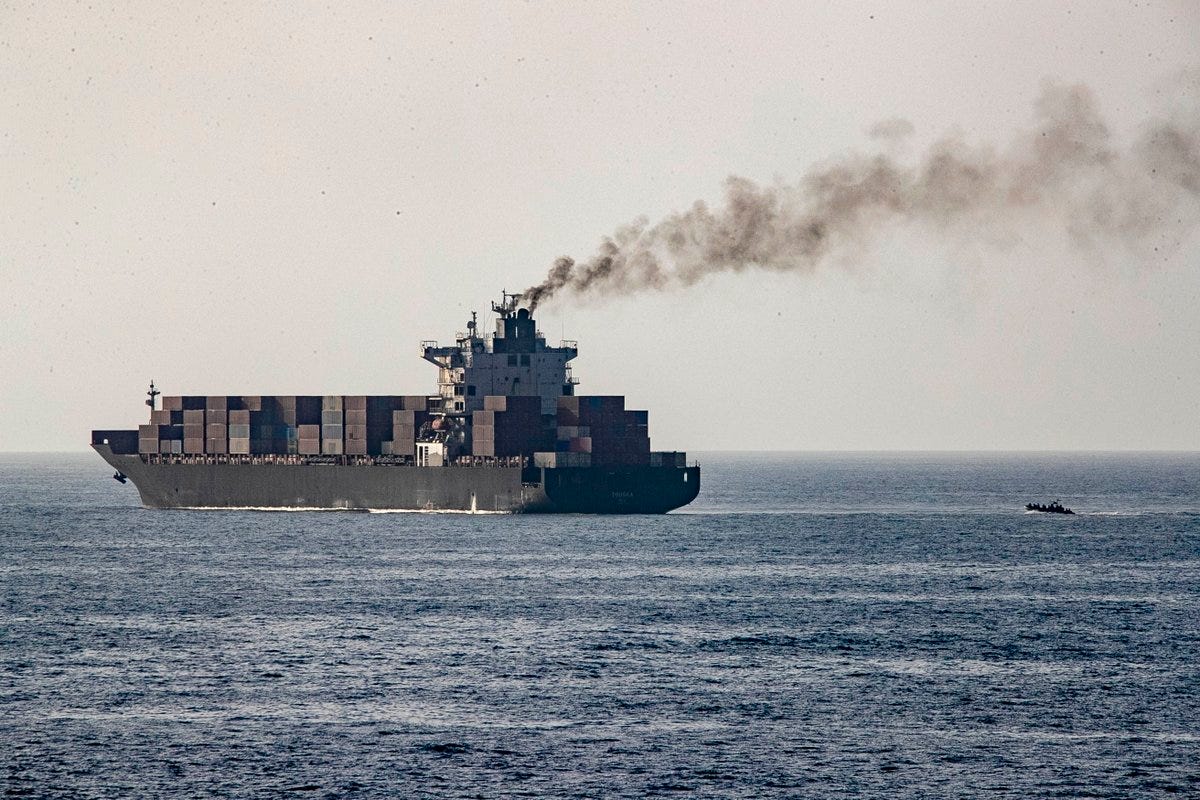
U.S. forces patrol the Arabian Sea as the Iranian-flagged vessel’s container cargo is searched after U.S. Marines boarded and seized the ship when it attempted to violate the U.S. naval blockade. (CENTCOM/X)
It’s Thursday, April 23, and the war with Iran is no longer about oil or gas; it is a battle over a single resource: time. The question that will determine the fate of the Middle East is who controls the clock, who can afford to wait, and who is simply out of time?
Currently, the Ayatollahs boast that their dictatorial regime will allow them to hold out indefinitely, while the closure of the Strait of Hormuz imposes an expiration date on U.S. aggression. Meanwhile, Trump claims to be in an equally comfortable position: Iranian ports are blockaded, some commercial ships are still navigating the strait despite the closure, and fresh U.S. military assets are on their way.
The question is, who’s bluffing?
The reality is both. But Iran’s position is significantly weaker.
Every American president sits on a ticking clock, and with the midterm elections approaching, Trump has less time than most. But Iran is bleeding an estimated $400 million a day to the blockade. It’s true that the U.S. is also sustaining high costs to forward-deploy its forces, alongside the strategic opportunity cost of their absence in other theaters. The difference is that Washington can afford it: the Iranian annual budget sits around $56 billion; the U.S. budget is over $6 trillion.
The U.S. blockade of the Strait of Hormuz. (CENTCOM/X)
It all comes down to the blockade. Rather than risk casualties to seize Kharg Island or force immediate results through an aerial campaign, the U.S. military can cruise safely out of range in the Arabian Sea, intercept the occasional breakout vessel, and simply wait for economic isolation to do its work.
While Washington holds the front door closed, Tehran’s most crucial ally is starting to push them harder from behind. Xi Jinping is fighting a clock of his own as China’s oil reserves rapidly dry up. The New York Times reported earlier this month that Iran accepted the Pakistani-mediated ceasefire following a last-minute intervention by China, which asked Iran “to show flexibility and defuse tensions.” But that was the rhetoric of a China that had an extra half-month of oil reserves compared to today. I doubt their words will be as soft now.
The Iranians certainly believe the blockade is effective. Iranian Parliament Speaker Ghalibaf recently compared the strategy to the bombing campaign and demanded its cessation as a precondition for continuing the talks in Islamabad.
Tehran has another, separate crisis draining its time reserves. As a senior Pakistani source recently confirmed to the U.S., a significant rift has paralyzed the regime. On one side are the Revolutionary Guards and the Khatam al-Anbiya Headquarters, representing the uncompromising extreme; on the other is the civil-political echelon led by Ghalibaf. Presiding above this fracture is the severely injured Mojtaba Khamenei, whom both sides defer to as the final authority. Because of his grievous wounds and the constant threat of Israeli assassination, simply communicating with the supreme leader has become a lengthy, complex logistical nightmare.
Tehran has four options to change the board, and none of them are good.
Option one: renew the war. This is the threat they have been teasing by refusing to formally extend the ceasefire. With their diminished stockpiles, they would likely aim for the highest-return targets: the vulnerable oil and gas facilities in the neighboring Arab Gulf states, hoping to worsen the energy crisis and force regional leaders to pressure Washington. The risk with continuing the war is that it continues the war. Israel’s finger is twitching on the trigger, and with 210,000 tons of American military muscle steaming toward them in the form of the George H.W. Bush Carrier Strike Group, the juice is likely not worth the massive black eye the squeeze will invite.
Option two: proxy escalation. After all the effort Iran expended securing a ceasefire in Lebanon, Hezbollah’s button is unlikely to be pressed. However, Iran could increase pressure indirectly through Shiite militias in Iraq and the Houthis in Yemen, targeting Gulf oil facilities and choking off the Bab el-Mandeb Strait. But if the Houthis were unwilling to seriously join the fight when most U.S. assets were engaged with Iran, the chances they go it alone against an available and increasing U.S. military presence appear low.
Option three: capitulation. Tehran could swallow its pride and return to the negotiating table in Islamabad while the naval blockade remains actively in place. While this is the safest option physically, it is devastating reputationally. It requires a massive public humiliation for a regime that swore it would never negotiate under blockade.
Option four: do nothing. They can do nothing, maintain the stalemate, and hope that plummeting U.S. poll numbers and the global energy squeeze force President Trump to soften his demands. This involves the slow suffocation of their own economy while they wait for their opponent to tap out. Like all humans, the regime suffers from status quo bias—an inherent preference for the devil they know over the outcome they don’t. But that bias only lasts until the status quo becomes untenable. With a collapsing economy, that threshold may be crossed in a matter of weeks.
Jerusalem can live with any of these four scenarios, though it prefers the first or the last. From an Israeli perspective, the events of yesterday—when the Iranians failed to show up for negotiations and Trump announced the continuation of the ceasefire—were the best outcome. Why? Because Trump signaled an ironclad refusal to fold on the nuclear question. It guarantees that Tehran remains trapped in a vice, squeezed simultaneously by the American naval blockade and crippling international sanctions.
The ultimate nightmare for Israel’s defense establishment is a rushed diplomatic off-ramp—an agreement only slightly stronger than the 2015 JCPOA that ultimately unfreezes billions in assets. That massive influx of cash is exactly what the Ayatollahs need to buy domestic peace, reconstitute their missile stockpiles, and restore Hezbollah and the Houthis.
For decades, the regional doctrine of Israel’s adversaries has rested on a single, enduring premise: We have patience, and time will eventually deliver what we want. But Israel has fundamentally shifted its approach, abandoning a mentality of merely maintaining the status quo to assert control over the long game across all its borders.
The West, however, is not Israel. America and Europe still suffer from the tyranny of the immediate. Much like Israel in the past, Western leaders have rushed into deeply flawed diplomatic agreements despite battlefield victories simply because they demanded results immediately.
Iran assumed it could exploit this Western impatience by closing the Strait of Hormuz. By holding the global economy hostage, Tehran believed it controlled the clock. But then Trump executed a stunning reversal: He blockaded the blockade. Now, Tehran’s time is running out, and the regime is simply hoping Washington will fall into old habits. To win, all Trump needs to do is wait.
A statue of Jesus that the IDF delivered to the Christian village of Debel in southern Lebanon, to replace one destroyed by a soldier. (IDF)
For the first time in the history of the IDF, a part of the defense budget had to be devoted to buying a statue of Jesus. But it was the right thing to do.
The first point is the most obvious: it is a blatant moral failure to desecrate another faith's holy items. As a matter of history Jews should know how that feels. The conduct of an IDF soldier destroying a statue of Jesus in southern Lebanon is entirely unacceptable, particularly for a military operating as an occupying force.
But if morality didn't stop this soldier's actions, I should think practicality would.
If you were to ask any Jew to identify the single most lethal antisemitic trope in history, the answer would undoubtedly be the accusation of being "Christ killers." Knowing that history, how any Jewish soldier could think that taking a sledgehammer to a statue of Jesus—and filming it—was in any way a good idea simply baffles me.
Thankfully, out of both moral necessity and practical reality, the IDF has taken swift action. The soldier who smashed the statue, along with the soldier who photographed the act, have been dismissed from combat duty and sentenced to jail. Six other troops who were present at the scene and did not act to stop the incident or report it are also under investigation. The IDF has also organized a replacement for the broken statue, which it has returned to the village.
The unfortunate truth is that soldiers will inevitably do destructive, foolish things. That cannot always be prevented. The ultimate measure of an army’s morality is not whether bad actors exist within its ranks—it is how the system holds them accountable.
English Editor: Ari Tatarka
If you enjoy the newsletter, you can show your support by becoming a paid subscriber—it really helps keep this going. I’m also offering a special monthly briefing for a small group of premium members. I’d love to have you join us—just click below to find out more.
Thanks for reading It’s Noon in Israel! Subscribe for free to receive new posts and support my work.


Again, a nitpick. Whatever else it may be, I’m fairly confident that the statue of Jesus is neither a “relic” nor an “icon”, each term having a specific meaning inapplicable to a simple statue. Sometimes a statue is just a statue.
I imagine that some intrepid reporter will interview the soldier and uncover his “motive”. The IDF did the right thing in the way it promptly remedied the situation.
The larger issue is what the U.S. and Israel can do to tease the Lebanese state from the clutches of Hezbollah. One can only hope that the resolution is performance-linked and not the usual “Israel gives up something tangible and hard won for promises that are reversible at whim.”
And that smashing of the statute got more press than the slaughter of christians by islamists in Africa ever got. Never mind the disrespect shown, the fact that they even filmed it , then posted it, means they are too stupid for words.
And it is interesting that suddenly Jews are supposed to forget the last 2 thousand years of persecution, and genocide at the hands of christians because some of them are now Israel's friends. Meanwhile, we have seen that judenhass mindset reemerge in Europe in the last few years with abundance and glee..