Total Surrender
The Iran deal is hurtling toward signing, leaving Netanyahu's political future gasping in its wake.
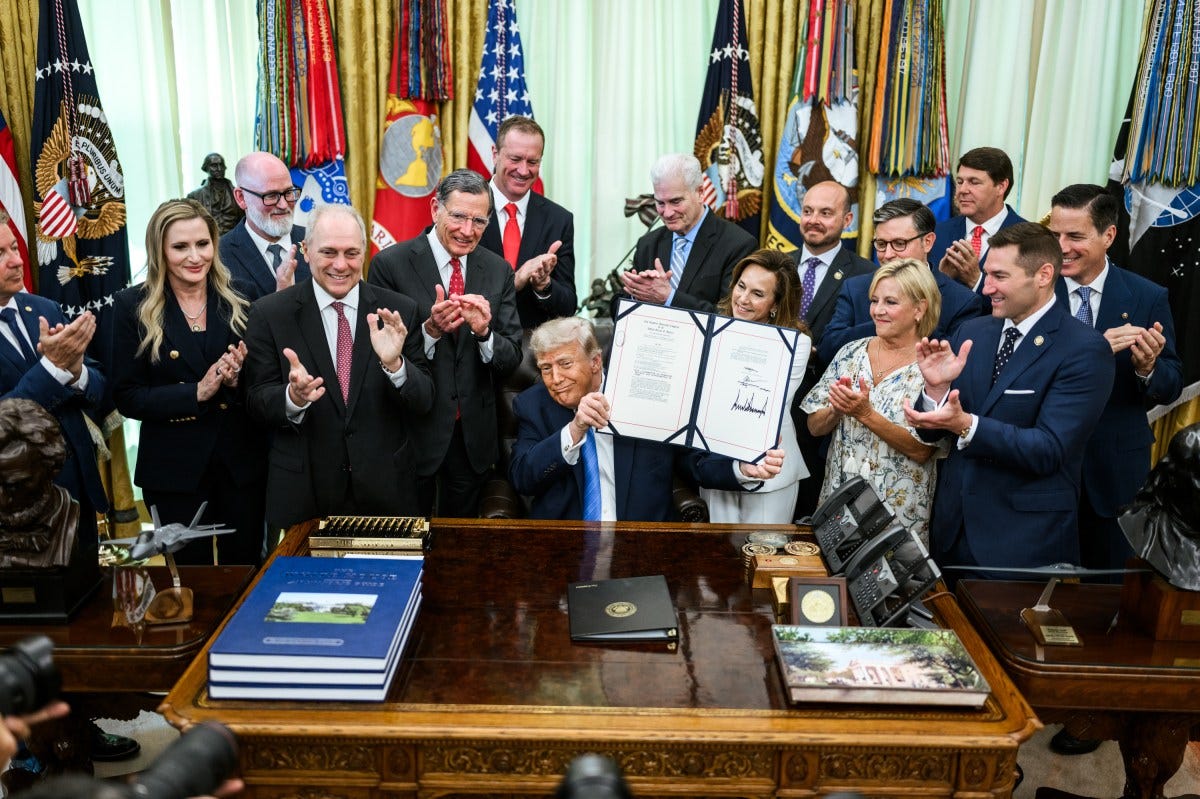
Donald Trump signing the Secure America Act in the Oval Office. (White House)
It’s Monday, June 15, and after Donald Trump declared the agreement finalized last night, I recalled a line from Henry Kissinger: “It may be dangerous to be America's enemy, but to be America's friend is fatal.”
The details are yet to be confirmed, but here is what the deal appears to be as of now.
It begins with an immediate, multi-front ceasefire—including Lebanon—and the lifting of the U.S. naval blockade on Iranian ports in exchange for Iran “opening” the Strait of Hormuz. Iran is demanding an initial payment of $12 billion before the strait is opened, and is unlikely to be denied, judging by the hunger for a deal in Trump’s eyes.
A significant ambiguity remains over the strait, however. While Trump claims the opening will be “toll-free,” Iranian officials have previously indicated they may still impose fees or retain regulatory control—effectively securing a major Iranian war aim, with American assent lending it legitimacy. The deal also stipulates that within 60 days of its scheduled June 19 signing in Geneva, the two nations will begin follow-on talks addressing the termination of all U.S. sanctions, the nuclear issue and Iran’s economic reconstruction.
The framework appears to diverge significantly from earlier U.S. positions. Trump, who once insisted on the destruction of all Iranian nuclear facilities and zero uranium enrichment, told The New York Times that Iran would now be permitted low-level enrichment—meaning “zero enrichment” will not even be making it to the negotiating table. The IRGC-affiliated Tasnim News Agency, for its part, framed the deal as a “tactical pause in the war rather than a final settlement,” warning that “many more concessions would be needed” for any future agreement and that Iran’s experience with U.S. bad faith makes one “unlikely.” Tehran is giving little ground elsewhere too: against the U.S. demand for a 20-year enrichment ban, it is countering with a mere five-year pause, and it is maneuvering to unlock at least some of its frozen assets early in the MOU process—easing U.S. leverage and securing vital economic relief before the core nuclear negotiations even begin.
Trump has declared that should those negotiations fail, the U.S. would return to war—which deserves to be taken as seriously as every other time he’s said it in the last 68 days.
So, to summarize: Iran gets its ports unblocked, sanctions relief and de facto recognition of its sovereignty over the Strait of Hormuz—in exchange for complying with the original ceasefire, restoring freedom of commerce and ceasing its random acts of violence. In the nuclear negotiations to follow, it will not be required to halt its program completely; only lower its enrichment, and only for somewhere between five years and, at the very most, twenty.
The American position in a word: surrender.
Likud billboard on the Income Tax building in Jerusalem. (Likud)
That leaves Benjamin “Total Victory” Netanyahu in an awkward position. Out of necessity and ambition, he hitched his cart to Trump’s—and now, with Trump driving headlong toward the cliff, he has to figure out how to unhitch before they both go over.
This is a radical departure from even a few weeks ago. The assumption then was that Trump would be a decisive factor in Netanyahu’s election prospects: there was talk of Trump receiving the Israel Prize, of a pre-election visit—a victory lap on Gaza and Iran, capped with a glowing endorsement. Suffice it to say that now looks doubtful, though Trump is still promising to be a decisive factor, just not in the way Netanyahu hoped. There is also the matter of the pardon, and the support Trump threw behind Netanyahu. The total effect is unclear, but it will undoubtedly weigh on President Isaac Herzog’s decision-making.
Netanyahu is facing the biggest challenge of his 30 years of dealing with U.S. presidents. He cannot repeat his 2015 gambit—going to the House under Obama’s nose to torpedo his nuclear deal. Partly that’s because Trump would likely be far more vindictive than Obama, but this is a Republican House in a time in which Republicans are not willing to dissent from the leader. Even if it weren’t a Republican House, Hakeem Jeffries is not about to reprise John Boehner’s invitation. Given the Democratic Party’s current feelings toward the prime minister, they might sooner invite Mojtaba Khamenei. With Obama, Clinton or Biden, Netanyahu always had Capitol Hill to retreat to when the White House turned cold. Now he is trapped in the Oval Office with “Israel’s best friend.”
A political cartoon reimagining the Binding of Isaac, casting Donald Trump as Abraham leading a worried Benjamin Netanyahu as Isaac. Netanyahu’s question—“Where is the lamb for the sacrifice?” (Amos Biderman)
Netanyahu’s real problem is less a bad ceasefire in Iran than the continued fire from Lebanon. As a senior cabinet minister put it to me: Iran is Trump’s problem, and it is his right to go there and make a deal—but Lebanon is ours.
Yesterday morning, Hezbollah brazenly broke last week’s ceasefire, firing on the north; Israel responded in kind, striking a headquarters in the group’s Dahieh stronghold. That prompted a “what the f— are you doing?” from Trump for the second week running, with the added complaint that Bibi possesses “no discretion at all.” Ironic.
But focusing on the reaction ignores the motivation for the act itself. There are two possibilities. Either Hezbollah turned on its patron, declaring that “this deal isn’t good for me, I want to blow it up,” which is highly unlikely, or the Iranians are after something. That something is to force Israel into a corner where it has to hit the Dahieh. If Israel doesn’t strike, the equation is cemented: Hezbollah can attack and Beirut stays untouched. If Israel does strike, Trump turns on Israel—which is exactly what happened. It is an Iranian attempt—with American backing—to write a return to the October 6 lines into the agreement, and so far it seems to be succeeding. It remains unclear exactly what the agreement demands in Lebanon. It could be a simple ceasefire—one that easily regresses into the status quo, tit-for-tat exchanges—or it could mean a full withdrawal of IDF forces from Lebanese territory. The former leaves the door open for Iran to drag its feet in negotiations, pointing the finger at Israel and trying to shove it under the wheels of Trump’s diplomacy. Israel, for its part, has already made its position on the latter prospect clear: Defense Minister Israel Katz declared that “the IDF will remain in the security zones in Lebanon, Syria, and Gaza—without a time limit.”
If this is the moment of truth, there is only one correct answer to the prime minister’s test: stand up to Trump. As the senior cabinet minister put it, “This is our war, forced upon us, and we must not accept the Iranian equation”—even at the cost of a “sharp confrontation with the president of the United States.” Quite simply, Israel cannot allow its security to be dictated from Washington, and the prime minister who allows that to happen will not be prime minister for long.
If anything, that offers Netanyahu a glimmer of hope: perhaps he can pull off an unprecedented political about-face, rebranding from expert handler of the American ally—Trump’s best friend—into his most intractable opponent. Suddenly, Gadi Eisenkot’s shaky English might be less of a liability—when the topics are this unappealing to discuss, who needs a silver tongue?
The opposition, naturally, grants Netanyahu no such reinvention—only blame. Opposition Leader Yair Lapid has called the deal a “total failure”; Democrats Leader Yair Golan declared that Netanyahu “lied,” delivering “one of the gravest strategic failures Israel has known.” So, to the opposition I pose a challenge: give me the date—the single day on which you would have decided differently. Would you not have launched the operation a year ago, when Iran was mere weeks from a bomb? Or, more recently, would you have urged forbearance, when Trump was offering the help of the world’s most powerful military? Our collective disappointment comes from the belief that this time the story was finally, fully over—and yes, that expectation is the fault of Netanyahu’s grandiose promise of “total victory.” But look at the material outcomes rather than the rhetoric. Militarily, Israel is plainly stronger than it was a year ago; strategically, its position has only grown more complex. Both are true at once—which the opposition’s populist criticism refuses to acknowledge. The vague insinuation that the two Yairs would make better Trump handlers than Netanyahu belies the conclusion of the past five months: no one can control Trump.
Then again, commentary nowadays tends to have a short expiration date—tomorrow may bring the whole deal crashing down and the strikes back with it. However, if not, Israel and Netanyahu, America’s closest friends, are facing a potentially fatal challenge.
English Editor: Ari Tatarka
If you enjoy the newsletter, you can show your support by becoming a paid subscriber—it really helps keep this going. I’m also offering a special monthly briefing for a small group of premium members. I’d love to have you join us—just click below to find out more.
Thanks for reading It’s Noon in Israel! Subscribe for free to receive new posts and support my work.


One more important lesson comes to mind:
Put not your trust in princes, nor in the son of man, in whom there is no salvation."This is a well-known verse from the Hebrew Bible (Book of Psalms, Chapter 146, Verse 3). It serves as a reminder to rely on the divine rather than placing ultimate faith in mortal leaders, as humans lack the power to truly save or deliver you.
"Yair Lapid has called the deal a “total failure” "
That takes some nerve from the PM who "negotiated" the oil and gas dispute with Lebanon, that is Hezbollah, in 2022.
In exchange for the disputed oil and gas concessions, Israel got absolutely nothing. Iran got a potentially self-financing Hezbollah.
That 2022 deal marks Yair Lapid as completely unqualified to be PM ever again.