Trump Considers War
Also, Israelis don't want national unity and I can prove it.
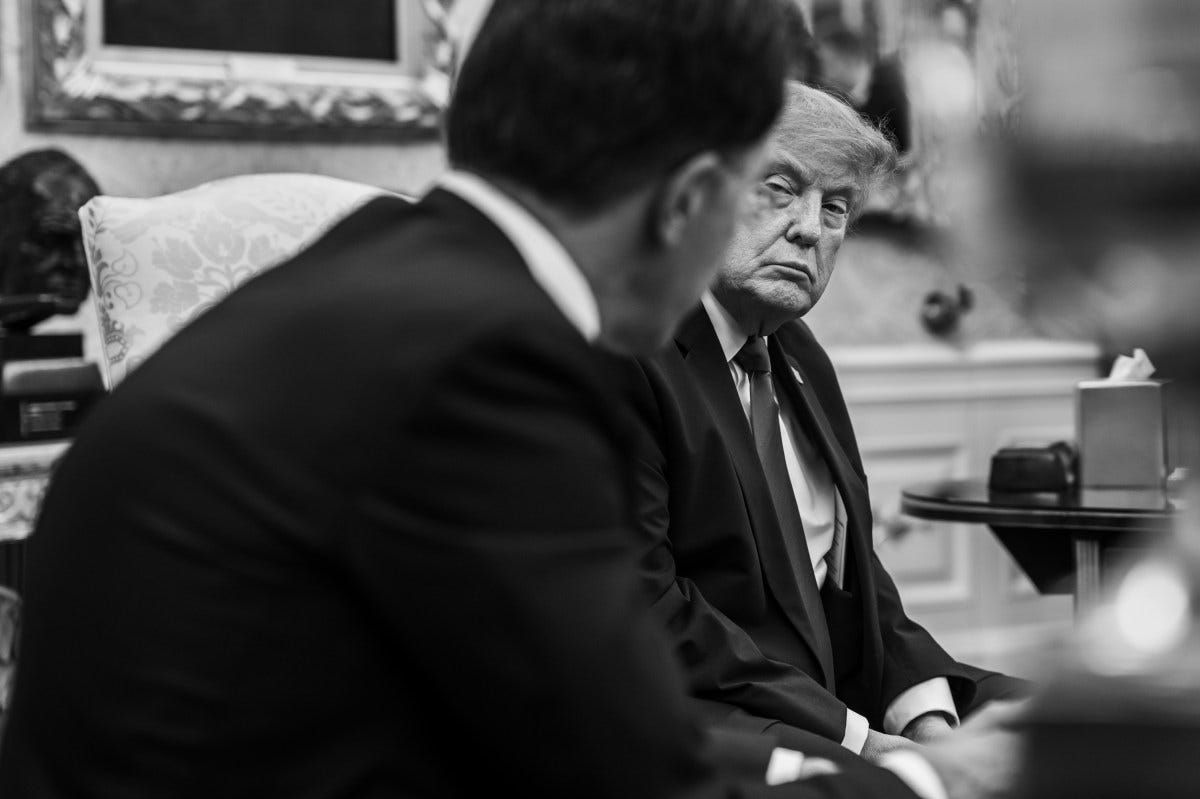
Donald Trump meets with Secretary General of NATO Mark Rutte last week. (White House)
It’s Wednesday, July 1, and the godfather of neoconservatism, Irving Kristol, famously defined a conservative as “a liberal who has been mugged by reality.” An Iran hawk is made the same way. According to The Wall Street Journal, Donald Trump reviewed military options for a full-scale war against Iran to “finish the job,” but has decided, for now, not to move forward.
The report says Trump is concerned that renewed military conflict could hurt the chances of a diplomatic resolution and of dismantling Iran’s nuclear program, and that he’s shown willingness to let indirect talks in Qatar run past the August 18 deadline. He is said to be fine with continuing limited strikes on Iranian targets if Tehran violates the current temporary deal—as it already has, repeatedly.
How are those negotiations going?
Not well. It seems JD Vance’s “historic” face-to-face achievement was a one-off. Washington has been quietly downgraded from talking to the Great Satan to negotiating with the Little Satan instead—a senior Qatari official confirmed that U.S. envoys Steve Witkoff and Jared Kushner met Qatari officials in Doha, but there are currently no high-level U.S.-Iran meetings scheduled.
Faced with Iran publicly denying that peace talks even exist, Vance is denying reality right back, insisting it’s merely a “Persian negotiating tactic.” He’s not wrong that rejectionism is a tactic—he’s just wrong about what it’s negotiating for. Iran’s Foreign Ministry spokesman, Esmail Baghaei, confirmed the delegation will skip U.S. officials entirely, meeting only the Qataris in Doha to talk about unfreezing Iran’s own assets. The tactic isn’t stalling for a better peace. It’s stalling for a better payment: extract the MoU concessions first, discuss the nuclear file never.
Iranian officials have shown no willingness to meet U.S. nuclear demands, focusing instead on asserting control over the Strait of Hormuz. Iran says it will impose its “sovereignty and new policy” there regardless of whether it reaches an agreement with Oman, calling the strait a purely internal matter. Reports differ on the nature of the proposed transit fees—Iran calls them mandatory, a regional diplomat calls them voluntary, and Oman’s foreign minister rejects fees outright but leaves room for “maritime service” mechanisms such as safety and pollution measures. Regardless of that distinction, Iran seems set on asserting authority over the waterway: it has already indicated that ships paying “security fees” and following IRGC protocols would get priority transit, while others face delays.
Iran will not make a deal the U.S. can accept. That’s the reality. The only question left is how many more “historic” handshakes, Doha detours, and denied peace talks it takes before that reality mugs Vance the way it mugged every liberal Kristol had in mind.
Israelis protest against the unity government outside the Knesset in Jerusalem on June 10, 2021. (Yonatan Sindel/FLASH90)
“We must know how to compromise”—we drill this sentiment into our children constantly. But do we always set a personal example? Not necessarily. There’s a gap between what we like to say about ourselves and reality. The same holds for the “unity” trend of the 2026 elections—or, in Netanyahu’s own words on Saturday night, a “broad national government.”
Most of the public (43-30 percent)—and an even larger majority among Jews (47-26 percent)—support forming a broad national government after the elections. Within the coalition there is very wide support (61-13 percent), while the opposition is against it (48-33 percent), presumably because Netanyahu himself is the one calling for it.
But this is only theoretical support. When it comes down to the specific, painful concessions each camp would need to make to form such a government, the willingness drops. Among right-wing voters, 30 percent would settle for only a partial judicial reform, 22 percent for evacuating outposts—but the share who oppose any concession at all is double that. In other words: a broad national government in which Eisenkot, Liberman, or Bennett aren’t just kept out of the driver’s seat—they’re the spare tire in the trunk.
The picture is similar on the opposition side: 21 percent would settle for partial Haredi conscription, 22 percent for a state commission of inquiry into the October 7 massacre, and 46 percent aren’t willing to concede anything at all. There, the fantasy is a unity government with the other side (but without the Haredim, since they dodge the draft; without Smotrich and Ben Gvir, since they’re messianic; and without Bibi—because he’s Bibi).
This is also the great test facing all the party fragments and politicians scraping the bottom of the political major league who are now trying somehow to connect and clear the electoral threshold on the strength of a party promising exactly this—a broad national government. Perhaps that’s why all the champions of unity haven’t even managed, so far, to unite among themselves.
This is an excerpt from my weekly column in Israel Hayom.
English Editor: Ari Tatarka
If you enjoy the newsletter, you can show your support by becoming a paid subscriber—it really helps keep this going. I’m also offering a special monthly briefing for a small group of premium members. I’d love to have you join us—just click below to find out more.
Thanks for reading It’s Noon in Israel! Subscribe for free to receive new posts and support my work.


An example of JD Vance's simplistic avoidance of reality is his summary of Iran - UAE discussions:
“The Emiratis — by far the most hawkish, by far the most pro-Israel country in the [Gulf Cooperation Council] — they’re having conversations with the Iranians that have never happened before, including with the IRGC, about various types of economic incentives — ‘Here’s what we’d need to see to make your country investable’ — and the Iranians come back and say, ‘Okay, yeah, we’re willing to do all those things,’” Vance said.
Really? IRGC controls over 40% of Iran's economy and they're willing to address that to make the country investable?
https://headlineusa.com/vance-says-iran-agreed-to-establish-a-direct-line-between-the-irgc-and-the-us-military/