Trump Declares Memorandum of Understanding “Dead”
The short diplomatic peace appears to be over, Pete Hegseth cancels his trip to Israel, and more.
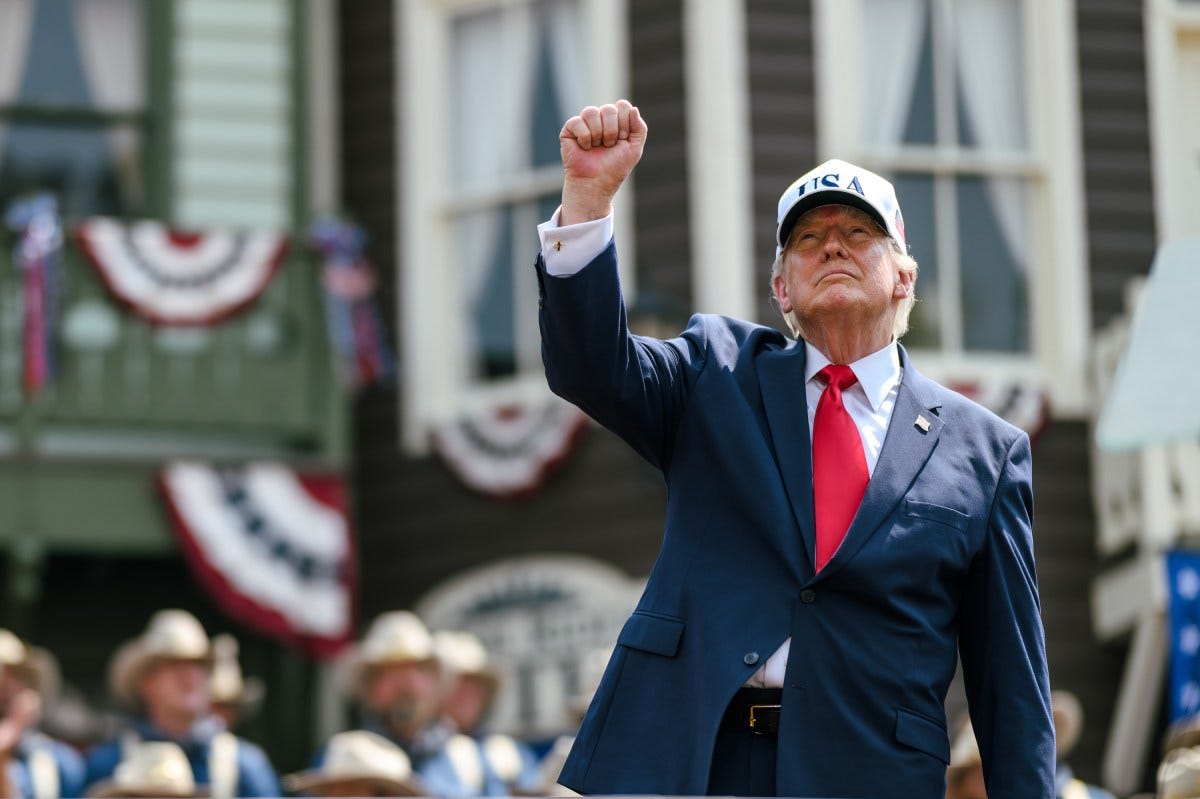
Donald Trump delivers remarks at the Theodore Roosevelt Presidential Library opening last week. (White House)
It’s Wednesday, July 8, and it seems we’ll have to slip a page and a half into Supreme Leader Ali Khamenei’s coffin on it’s funeral procession, after Trump declared in a press conference this morning that, in his opinion, “the memorandum of understanding...is dead.” RIP. It was only 21 days old.
The causes of death of the two are the same: Iranian hubris. The supreme leader believed the Israeli and American threats were empty and was buried, and his successor believed the U.S. was so desperate that the MoU could survive Iran’s numerous violations. Until they pushed too far.
The fatal sequence began on Monday, when Iranian missiles struck two tankers—one carrying Qatari gas off the Omani coast, the other a Saudi-flagged oil carrier inside the Strait of Hormuz itself. On Tuesday, a drone went after a third. The vessels’ offense: transiting the strait without Tehran’s blessing. The U.S. answered last night, first revoking the waiver that allowed Iranian oil to be sold around the world, then striking more than 70 military targets around the strait. By this morning, Iran’s armed forces claimed to have hit 85 U.S. military sites in Bahrain and Kuwait.
Despite the dramatic declaration, don’t expect the status quo to change significantly. The midterms have not been rescheduled, the global economy has not outgrown the strait, and Trump does not believe returning to war will net him the results he wants in the time he wants it.
The statement was less a policy shift than a confirmation that the contemporary Middle East is defined by a single word: uncertainty. It joins a long list of such confirmations—the sudden end of the war, the sudden announcement of the MoU, the sudden outbreak of the war in the first place. Even as I write this, a miraculous resurrection of the agreement is only one Truth Social post away. One can hardly stay aloof while watching the fate of a region swing this violently, but at this point, “surprise” is no longer the accurate word.
As far as I’m concerned, this is a return to April’s status quo: no peace and no war. For Israel, that is the second-favorite position on the board—the favorite, a war actively grinding the regime down, is over for now. But a pause is not a rewind. With the oil waiver revoked and the sanctions back on, Tehran is frozen in its beaten position, with no hope of unfrozen assets bridging its fatal liquidity gap. Jerusalem can wait, hoping the regime buckles under its own internal pressures. And while it waits, it can keep dismembering the proxies, whose patron is in no condition to come to their aid.
As for the strait, during the war, Iran set up a toll booth. In response, the Gulf states and the Americans quietly paved a bypass, routing traffic along the Omani side of the waterway and slipping millions of barrels of oil past the barrier. If the diplomacy is dead, expect the U.S. to double down on the Omani lane—and Iran to do everything it can to force traffic back through the booth.
This week, Iranian media reported that the UAE had proposed a plan to the International Maritime Organization to manage the strait—a plan backed by eight unnamed Emirati “allies” and promptly rejected by Tehran, which claimed it lacked “legal basis” and exceeded the IMO Council’s technical mandate. No details of the plan have surfaced, and no regional or Western outlet has confirmed it exists. But the same regime-affiliated outlets followed up with a statement from an “informed” source: all transit through the strait must be in accordance with Iranian arrangements. Tehran has likewise objected to a recent Omani proposal under which shipping companies would voluntarily pay fees to use the strait.
Now that Iran no longer has to pretend to abide by the MoU, expect no more empty overtures toward joint management. Expect declarations to the effect that sailing the strait will be like driving through Tehran: on Iranian roads, under Iranian rules.
The U.S. will respond to this morning’s attacks, but Iran priced that in the moment it launched. This isn’t brinkmanship built on a bet that Washington won’t shoot back. It’s Tehran’s strategy from the war: pit America’s economic tolerance against Iran’s pain tolerance, and wait for Washington to conclude that paying the toll is cheaper than the drama of collecting it. To Tehran’s credit, that bet has paid off before, but this time they may have overplayed their hand.
Secretary of War Pete Hegseth visiting U.S. forces during Operation Epic Fury, April 2026. (@PeteHegseth/X)
The death of the MoU has claimed a further casualty: Secretary of War Pete Hegseth’s planned trip to Israel. The secretary is likely sitting shiva at the Pentagon and preparing the U.S. response, his trip’s two agenda items rendered obsolete after the first—Iran—overshadowed the second: Turkey.
Given we have already addressed the first, let’s look at the second. At the NATO summit in Ankara, Trump announced he was lifting the sanctions imposed on Turkey over its purchase of Russian S-400 air defense systems. “It’s time. We don’t want to sanction friends,” he told reporters before meeting Erdogan, adding that his secretaries of State and Treasury were working out the details. Asked whether the S-400s still worried him, he waved the question off: “I have no concerns about anything having to do with Turkey.” The relationship, he said, was probably better than it has ever been—Turkey “in many ways, much more loyal than other countries that we think would be loyal.” For those wondering whom he had in mind, he said this hours before sitting down with the rest of NATO’s heads of state.
The F-35, Trump said, is “certainly something we will consider.” Erdogan, for his part, said Ankara had been “promised five jets” in earlier talks and that “Mr. Trump always keeps his promises.” I would remind Erdogan that he is himself the beneficiary of several broken promises in northern Syria—but I digress.
Benjamin Netanyahu, to no one’s surprise, came out against the sale again after the friendly press conference, saying he had raised with Trump his concern that it could upset the regional balance of power and that, whatever the president’s relationship with Erdogan, Turkey is not a “friendly state.”
If Trump is truly set on selling advanced fighters to Islamists, Israel and its supporters are his greatest obstacle—and Hegseth’s planned trip resembled the continuation of a long American tradition: bribing the Israelis into silence while Washington arms their rivals.
The tradition stretches back to Reagan’s sale of AWACS aircraft to Riyadh, pushed through over Jerusalem’s furious objections and smoothed over afterward with the first U.S.-Israel Strategic Cooperation MOU. Obama compensated for the JCPOA with the record $38 billion MOU of 2016. And the last time Trump sold F-35s in the region—to Abu Dhabi after the Abraham Accords—Israel’s objections evaporated once Washington signed a formal commitment to preserve its qualitative military edge.
Israel’s next 10-year MOU is up for negotiation, and was likely on the table for his trip before Trump upended it. But don’t let the lucrative outcomes fool you: There were always plenty of sticks mixed in with the carrots—no president appreciates resistance to his plans, least of all resistance channeled through his own party in Congress. Hegseth will return, undoubtedly bearing carrots, but more than a few sticks as well.
For a more detailed breakdown of the F-35 sale, check out yesterday’s newsletter.
Prime Minister Benjamin Netanyahu and his wife, Sara, address their supporters as the results of the Israeli general election are announced at the party headquarters in Tel Aviv, April 9, 2019. (Yonatan Sindel/Flash90)
After countless polls indicating that Netanyahu is headed for defeat in these elections—or, at best, a narrow draw—one might have expected despair, dejection, and apathy among Netanyahu’s voters and, in mirror image, optimism, enthusiasm for the fight, and peak motivation among his opponents.
But this week’s poll shows precisely the opposite. Among coalition voters, 75 percent believe their camp will win the election at the end of October; among opposition voters, only 45 percent do.
How can this be? Years of bitter disappointments on one side, and happy surprises when the real votes were counted on the other? Is it even good for Netanyahu that his camp is convinced victory is already in its pocket? Perhaps optimism is really complacency—”our situation has never been better.” As we may recall, the prime minister scored his greatest victories precisely when he persuaded his supporters that things were dire and defeat was at the door if they didn’t rush to the polls.
Or perhaps something else is at work here, something that isn’t about polls or Netanyahu at all, but about the human soul. The breakdown shows that the higher the level of religiosity, the higher the optimism—and vice versa. Netanyahu’s camp contains far more religious and Haredi voters. That is also why, among the Arab public—itself more religious—the share of those certain their camp will win is higher than among voters on the Israeli left, even though, as everyone knows, no Tibi-Abbas government is anywhere on the horizon. One camp sings the chart-topping faith anthem “Tamid Ohev Oti”—God “will make it better and better for me”; the other answers with Shalom Hanoch’s 1985 secular classic: “The Messiah hasn’t come—he isn’t even phoning.”
This is an excerpt from my weekly column in Israel Hayom.
English Editor: Ari Tatarka
If you enjoy the newsletter, you can show your support by becoming a paid subscriber—it really helps keep this going. I’m also offering a special monthly briefing for a small group of premium members. I’d love to have you join us—just click below to find out more.
Thanks for reading It’s Noon in Israel! Subscribe for free to receive new posts and support my work.


