Trump Gets Ghosted
Also, Gazans vote for the first time since 2006, Israel's viral impersonator, and more.
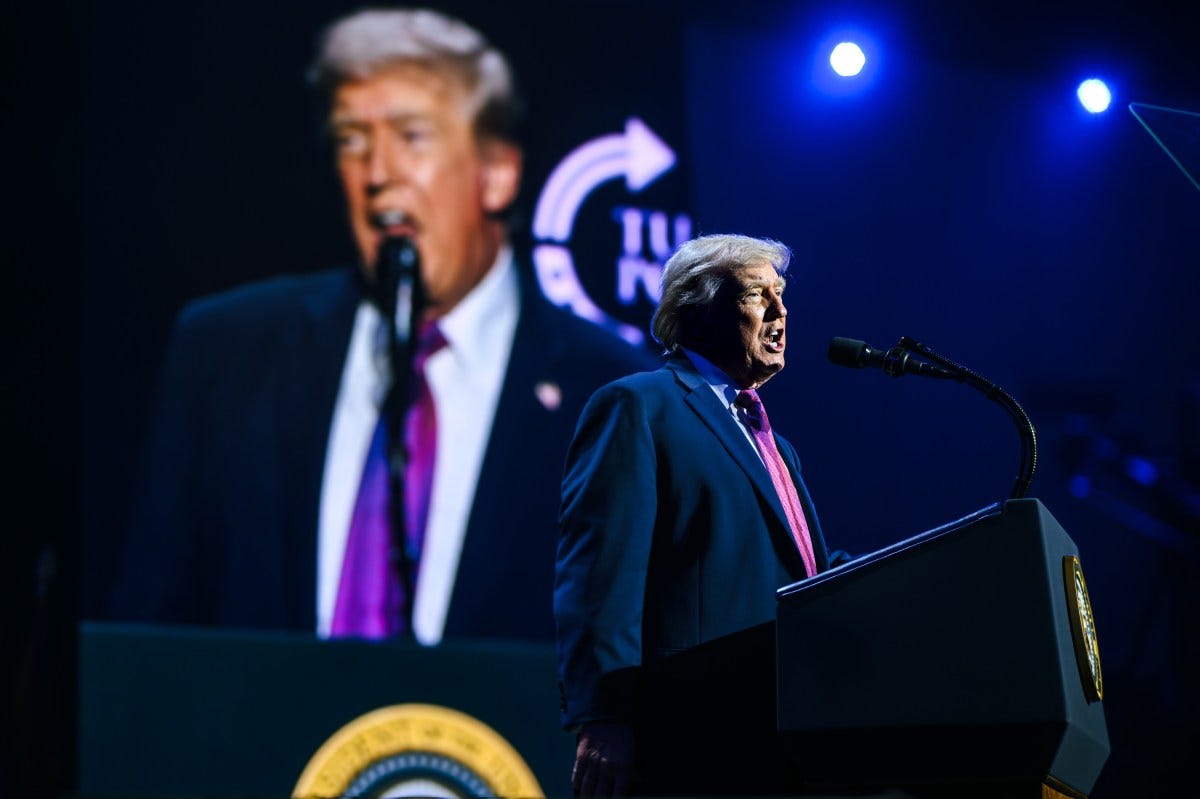
Donald Trump delivers remarks at a Turning Point USA event in Phoenix, Arizona. (White House)
It’s Sunday, April 26, and Iran has scorned Trump’s negotiations after Iranian Foreign Minister Abbas Araghchi departed Pakistan Saturday without meeting U.S. officials. Add that to another attempted assassination, and Trump is not having a good start to his week.
Speaking to Fox News, Trump—considerate of Steve Witkoff’s and Vice President J.D. Vance’s increasing jet lag—said, “They can call us anytime they want, but you’re not going to be making any more 18-hour flights to sit around talking about nothing.”
The ostensible reason for Araghchi’s early departure is that Iran will not engage in negotiations with the U.S. while the blockade is ongoing. More interesting than the demand is the demander: Araghchi, a member of the more flexible civilian leadership, is parroting the IRGC talking points: zero flexibility, maximalist demands, and preconditions to delay or constrain talks. Iranian media reinforced this approach by framing Araghchi’s regional tour as part of a broader strategy to prioritize engagement with mediators and strategic partners—such as Pakistan, Oman, and Russia—rather than an effort at direct negotiations with the U.S.
Meanwhile, Israel is struggling to hide a smile.
From Jerusalem’s perspective, this is the optimal outcome. It preserves the status quo of Iran as a sanctioned pariah state—a non-nuclear North Korea of the Middle East. Israel’s greatest fear is a negotiated settlement that leaves Iran’s ballistic missiles, nuclear infrastructure, and proxy networks intact. In their eyes, even if such an agreement materializes, a collared lion is still more dangerous than a caged one.
Now, Trump is caught in a geopolitical tug-of-war. One faction in his ear urges restraint, warning of spiking energy prices and the dangers of overextension. The other faction demands a definitive end to the stalemate: finish the job, cripple Iran’s energy facilities, and deliver the decisive blow Washington has historically avoided. In Israel, the prevailing belief is that Trump’s strategy will be closer to the latter faction: a targeted strike to prove his seriousness, or perhaps a green light to continue the operation.
Ultimately, refusing to show up to the negotiating table may prove to be one of the most disastrous decisions in the history of the Islamic Republic. After all, for all his talk of hell, it contains no fury like Trump scorned.
Palestinian Authority President Mahmoud Abbas casting his ballot on Saturday.
“Do Gazans support Hamas?” It is one of the most contentious questions of the past two and a half years. If you believe they do, your primary piece of evidence is almost certainly the Hamas victory in the 2006 Palestinian elections. If you take the opposite side, your counter is likely demographic: that election is older than most of the people currently living in the Strip.
Today, we may have a chance to clarify this disagreement.
On Saturday, the Palestinian Authority conducted municipal elections in Gaza, giving Gazans in Hamas-controlled Deir el-Balah their first opportunity to vote since 2006. While Hamas refused to formally endorse candidates or set up its own list—citing disagreements with the PA—several pro-Hamas candidates still ran in the election. Furthermore, despite their official boycott, the terror group stationed its armed militias at the voting sites to supposedly protect “electoral integrity.”
But the real question is: why now?
Mahmoud Abbas is 90 years old, the second-oldest head of state in the world, and currently in the 21st year of his four-year term. He has promised national elections at least six major times in the past. Has the spirit of democracy finally taken hold, or has Alzheimer’s?
Let’s clarify: these are municipal, not national, elections. Abbas is far from the rooftop he would inevitably be thrown from in a Hamas-run West Bank.
But Abbas and the PA aren’t interested in managing Gazan sanitation or infrastructure; they want a backdoor into post-war Gaza. Israel has handily rejected direct PA involvement in post-war reconstruction, and the new technocratic council meant to manage Gaza—despite being populated by many ex-PA administrators—remains technically outside Ramallah’s control. These municipal elections are simply a wedge designed to let PA influence leak in.
There is another question: why isn’t Hamas officially participating?
Hamas is executing a low-risk, high-reward strategy. By officially boycotting, they maintain their resistance credentials, refusing to bend to the PA’s prerequisite of recognizing Israel. More importantly, they insulate themselves from the political fallout of a potential loss. By unofficially backing proxy candidates while providing the armed security apparatus for the polling centers, they maintain absolute control over the environment without putting their official brand on the ballot. If their proxies win, Hamas claims a popular mandate, demonstrating they survived the war with their base intact. If the proxies lose, they simply write off the election as a flawed, illegitimate PA stunt.
Of the 1.5 million registered voters in Judea and Samaria, turnout reached 40.62 percent. Meanwhile, among the 70,000 eligible voters in Gaza’s Deir el-Balah, participation was significantly lower, sitting at just 21.2 percent. The results are expected to be announced today.
Given the paltry turnout and the armed “electoral security” stationed at the voting booths, this is far from the definitive referendum speculators were hoping for. So, do Gazans actually support Hamas? That will remain a question answered in the minds of observers, not by municipal elections.
Eyal Tzionov, a TikTok personality who dresses up as the Sephardic chief rabbi, sits in the audience of Israel’s annual Independence Day torch-lighting on Mount Herzl. (Screenshot/YouTube)
There is nothing Israeli social media loves more than thrusting a background character at a national ceremony into the limelight. Usually, the collective fixation lands on such diverse characters as an attractive flag bearer, an attractive barista, or an attractive security guard. But at last week’s Independence Day ceremony, a far more familiar face went viral.
During the annual Independence Day torch-lighting ceremony last Tuesday night, a bearded man dressed in the distinctive robes and turban of the Sephardic Chief Rabbi of Israel took his seat next to other audience members on Jerusalem’s Mount Herzl.
When one of the torch-lighters—army reservist and rabbinical judge Avraham Zarbiv—gave a speech dedicating the honor to the country’s rabbinical court system, the cameras filming the live event panned to the man in the audience, apparently believing him to be Sephardic Chief Rabbi David Yosef.
Sephardic Chief Rabbi David Yosef attends the inauguration ceremony of the od a newly elected rabbi. (Michael Giladi/Flash90)
But the esteemed rabbi was not, in fact, in the crowd. The man the cameras landed on was Eyal Tzionov, a TikToker bedecked in the Chief Rabbi’s iconic outfit, who offered a look of profound solemnity to the millions of watching Israelis. The cameramen were not the only ones fooled; several members of the crowd were seen approaching Tzionov during the event, earnestly entreating him for a blessing. Among those duped was the husband of Science and Technology Minister Gila Gamliel.
For an equivalent, imagine a Pope impersonator showing up to a presidential inauguration. Although, given recent presidential spats with the Vatican, that specific scenario might end a bit differently.
Every week on Inside Call Me Back, we pull back the curtain and have the conversations we typically have after the cameras stop rolling. This week, that is where Dan Senor, Nadav Eyal, and I discussed the Mossad’s alleged promise to President Trump: that the Iranian regime was on the verge of collapse—an assessment that supposedly led him to launch Operation Epic Fury.
To check out the sneak peek click here.
English Editor: Ari Tatarka
If you enjoy the newsletter, you can show your support by becoming a paid subscriber—it really helps keep this going. I’m also offering a special monthly briefing for a small group of premium members. I’d love to have you join us—just click below to find out more.
Thanks for reading It’s Noon in Israel! Subscribe for free to receive new posts and support my work.


Happy birthday Israel. Many, many happy returns. Wishing you and your people a long and prosperous future.
Victory then peace. 🇮🇱
Abbas is not a Head of State. Buy rather the Chairman of the Palestinian Authority.