A Tale of Two Insurgencies
Also, Netanyahu strengthens his governmental ghetto.
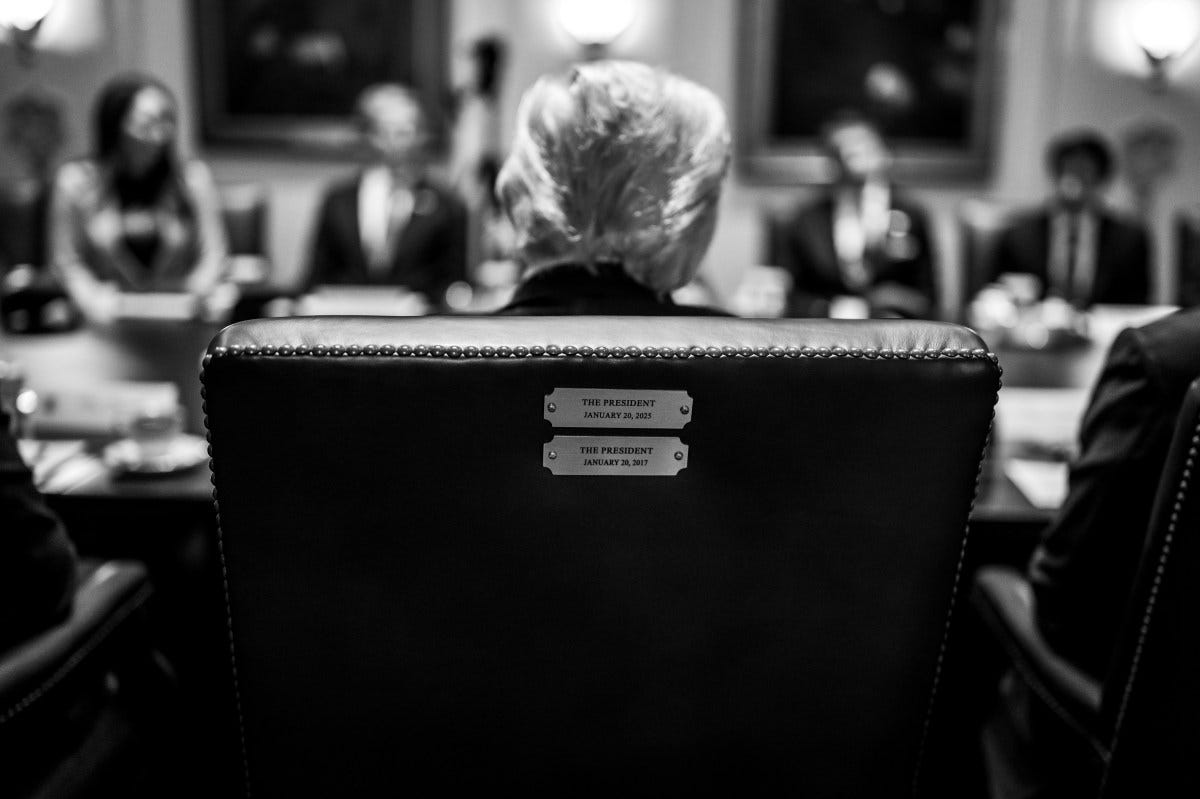
Donald Trump in a cabinet meeting last week. (White House)
It’s Thursday, June 4, and Iran wasn’t prepared for Trump-speed diplomacy. On Monday, with Israel gearing up to strike Beirut, Iran thought it had found the perfect loophole: It attempted to stall its own talks by suddenly demanding a peace deal in Lebanon first. It was a genius maneuver on paper. If it failed, Israel would look like the intransigent warmongers that Iran—and half of America—wants it to be. If it succeeded, Iran’s most vital proxy, Hezbollah, would be preserved. Either way, navigating the fallout would buy Tehran precious time.
But before it could even play that card to the fullest, the ground shifted. A partial ceasefire was already locked in by Monday night. By Tuesday, Israeli and Lebanese delegations were already sitting down together in Washington, and by Wednesday, they had hammered out “pilot zones,” where the Lebanese military would assume control and strictly ban Hezbollah.
Just like that, Iran’s roadblock should have evaporated. Donald Trump essentially dusted off his hands, sat back down at the negotiating table, looked the Iranians straight in the eye, and asked: “So, are we doing this?”
What Trump actually said yesterday was that negotiations are “going very well actually,” adding that a potential deal “might not happen… [or] it could happen over the weekend.” Tehran, terrified by the rapid speed of progress, has flatly denied that any progress has been made. Despite the ostensible change on the ground in Lebanon with the tenuous ceasefire, Iran is still pushing forward with its plan from Sunday: Delay.
Yesterday, Iranian Foreign Minister Abbas Araghchi told Hezbollah-affiliated media that Iran and Lebanon are “linked” and that the conflict with the United States and Israel will not end unless Israeli forces withdraw from southern Lebanon completely. It is a strange demand, given that the IDF’s presence wasn’t an insurmountable barrier to negotiations during the first two months of the process. Waiting for an unconditional withdrawal means waiting for the day Benjamin Netanyahu willingly commits political suicide and surrenders the premiership—which, in Israel, is just another way of saying it is never going to happen.
And that is precisely the point, buy time.
The two fronts are linked by more than just diplomacy; they are driven by the same playbook. Just as Hezbollah inflicts steady casualties to erode Israeli public support for the war, Iran is running its own parallel insurgency to break American resolve. By dragging out the conflict and inflicting mounting costs on the global economy, Tehran hopes to exhaust Washington’s patience.
Yet, there are key tactical differences. While Hezbollah knows it cannot convince Netanyahu to withdraw and therefore targets the Israeli population’s political will, Tehran believes it can bleed out Trump’s patience directly. By protracting the timeline, Iran aims to exhaust the president into lowering his demands on the nuclear file. Finally, where Hezbollah fights for territorial consolidation on the ground, Iran is using the delay to quietly cement de facto control over the Strait of Hormuz.
Much like a classic insurgency, Tehran’s goal is to turn local Gulf populations and governments against the American presence. By explicitly warning Gulf states, as it did this week after attacking Kuwait, that hosting U.S. forces makes their territory a target, Iran is using heavy-handed violence to drive a wedge between Washington and its regional allies.
The truth is, Iran has been running this exact playbook since the 1979 revolution: bolstering its proxy networks, inflicting mounting costs on the American military, and coercing regional acceptance of its hegemony. The current escalation in the Strait of Hormuz is just the latest, most aggressive phase of a decades-long strategy—all in service of a single, ultimate objective: expelling the United States from the Middle East.
But Iran isn’t the only player in for the long haul. While Jerusalem is far from thrilled that the security of its northern border has been tethered to the Iran talks, Tehran’s current intransigence and ever-increasing prerequisites might actually be the perfect vaccine against another flawed JCPOA.
The Israeli security establishment holds a much higher assessment of Trump’s resolve than the Iranians do. They are deeply skeptical that he will simply throw his hands up in frustration and settle for the nuclear equivalent of a participation trophy—just to get a deal done.
All insurgent campaigns rely on one foundational premise: that the enemy’s political will must break first. If Trump’s reserves of patience are deeper than Tehran calculates, Iran’s entire strategy collapses. Its maritime insurgency is incurring a devastating economic cost. If Washington doesn’t blink, Tehran isn’t waiting Trump out—it is just bleeding itself dry.
Israeli Prime Minister Benjamin Netanyahu walks outside his office at the Knesset, June 3, 2026. (Yonatan Sindel/Flash90)
“We need to understand how Netanyahu views the defense establishment and the judicial system,” his late chief of staff, Uri Elitzur, once said. “As far as he is concerned, these are two rival political parties, with thirty seats each. He can’t stand them, but he has to work with them.”
At a certain point, the “judicial party” crossed over to the opposition from Netanyahu’s perspective and indicted him. With the defense establishment, he clashed over and over again. But you appointed the heads, people told him. Netanyahu believed he always chose the lesser of two evils: Mofaz over Vilnai for Chief of Staff, Gantz, Eisenkot. It didn’t help that all the recent Chiefs of Staff stood against him, whether at the ballot box or in the public squares.
It is against this backdrop that we must view Netanyahu’s appointments over the past week. Towards the end of his sixth term, after thirty years, and heading into an election campaign where most polls show him lagging significantly behind, he is appointing people to the most sensitive positions in both systems who are inherently, not retrospectively, his people: On Monday, Shmuel Ben Ezra, a Haredi-Zionist father of 12 who excelled in the Shin Bet, was appointed head of the National Security Council. On Tuesday, his military secretary, Roman Gofman, took office as head of the Mossad. On Wednesday—State Comptroller Michael Rabello, his lawyer in public petitions against Netanyahu and the government. Last month it was Doron Cohen, a Likud member, who was appointed as Civil Service Commissioner, and David Zini has already been serving as head of the Shin Bet for six months.
This will directly impact the next term. For years, Netanyahu felt he was facing adversarial and hostile systems. A “Deep Shtetl”, as they like to call it in Likud circles. If another prime minister is elected—Bennett, Eisenkot, or Lieberman—they are expected to feel similar sentiments. Whether they are sitting on the committee of intelligence chiefs, receiving a draft report from the comptroller, or seeking to approve an appointment. Everyone has their own Deep State.
This is an excerpt from my weekly column in Israel Hayom
What is the status of the ceasefire? What is the future of Israel’s operation in Lebanon? And what are the implications for Netanyahu’s election prospects? I spoke with Dan Senor and Nadav Eyal on the latest episode of the Call Me Back podcast to discuss all of this and much more.
To listen click here.
English Editor: Ari Tatarka
If you enjoy the newsletter, you can show your support by becoming a paid subscriber—it really helps keep this going. I’m also offering a special monthly briefing for a small group of premium members. I’d love to have you join us—just click below to find out more.
Thanks for reading It’s Noon in Israel! Subscribe for free to receive new posts and support my work.


It should surprise no one in Israel when the country joins the long list of entities and people who have been screwed over by Trump. Just as some of the many contractors who were foolish enough to go to work on some of his building projects back in the day.