Turkey Ascending
Trump reportedly ready to sell F-35s to Turkey, the opposition’s Tour de France strategy, and more.
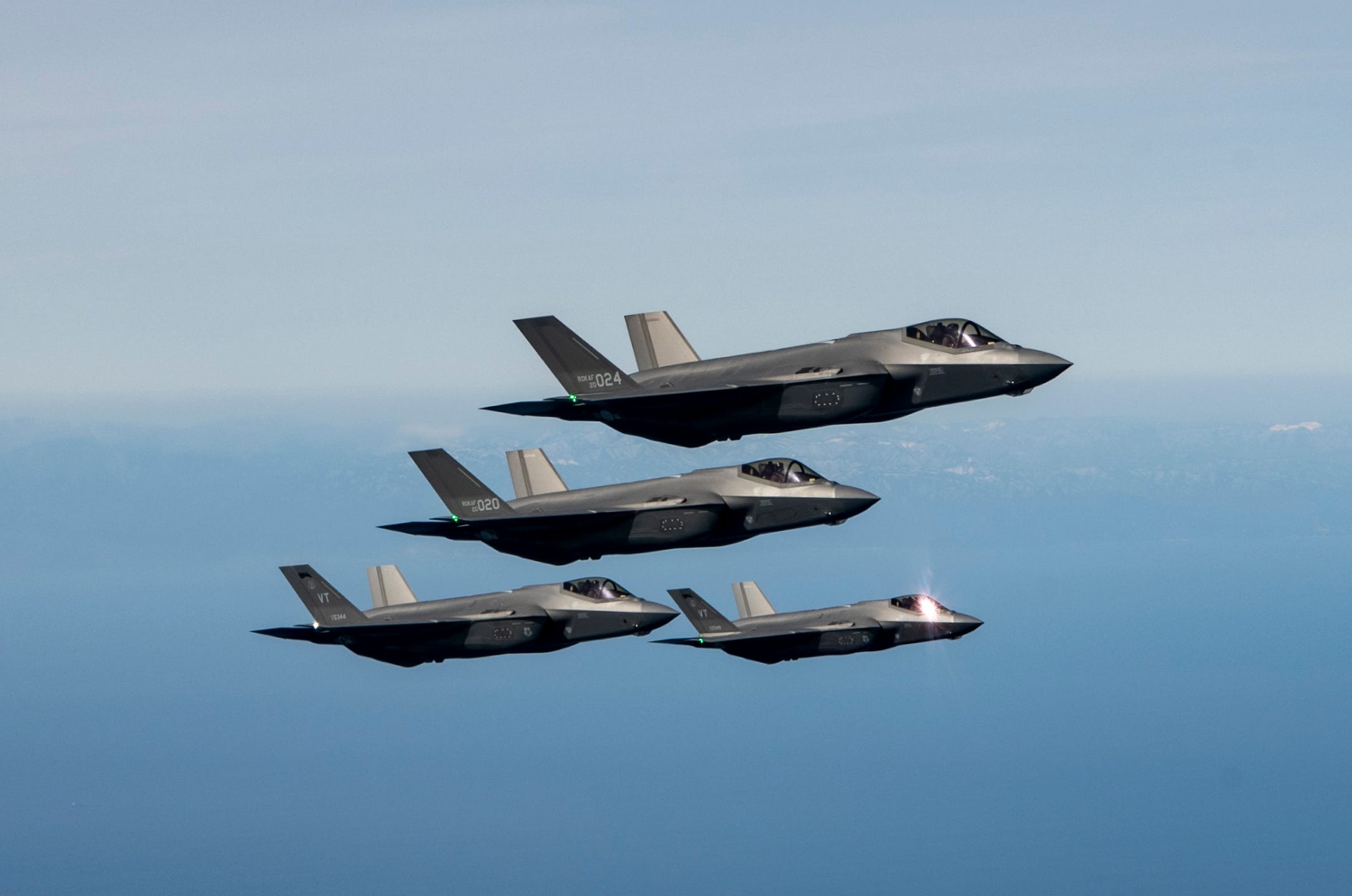
Exercise Freedom Shield 25, F-35 Lightning II fighters from the USAF & Republic of Korea operated together, 2025. (@usairforce/X)
It’s Tuesday, July 7, and I was raised with the belief that trust isn’t given—it’s earned. When Turkey, a NATO ally, lost the U.S.’s trust in 2019 by purchasing Russian S-400 air defenses, it was rightfully banned from receiving F-35s due to the risk of allowing Moscow to collect sensitive data on the fighter’s stealth signature. Now, according to The New York Times, Trump is likely to reopen the sale to Ankara, and for the life of me I can’t imagine how the Turks earned it.
Since 2019, they have kept every last unit of their S-400s—up to 200 missiles, many still in their shipping containers. They have remained the only NATO member that refuses to sanction Russia over Ukraine. They have hosted Hamas leadership in Istanbul and laundered billions for Iran, while Erdogan openly threatens Israel with destruction and, in Benjamin Netanyahu’s words this week, “talks openly about conquering Jerusalem.” They continue to occupy half of Cyprus—a fellow EU member—and to menace Greece, another one. Not to mention, this is the same country Trump himself claims he had to stop from joining Iran in the last conflict.
If trust isn’t earned, it seems it can be bought. The salesman on the account is Tom Barrack, the billionaire real estate investor, longtime Trump friend and ambassador to Ankara. Barrack doesn’t talk about Turkey’s conduct; he talks about the deal. The seven-year ban his own boss imposed? “Insane,” he says. The legal requirement that Turkey actually give up its Russian missiles? A technicality to be workshopped—the S-400s are inactive, he assures us, so possession is just paperwork. This is, in his own words, “classic Trump deal-making.” And when trust itself came up, Barrack showed us exactly what the word weighs in his ledger: Describing the Israel-Hezbollah ceasefire, America’s ambassador announced that “everybody has been equally untrustworthy.”
Netanyahu appears to have known about the impending sale and tried his best to derail it. During an interview with Fox yesterday, Netanyahu, unprompted, launched into an attack on selling the technology to “a regime infected by the Muslim Brotherhood, an extreme movement that hates America and chants ‘Death to America.’”
There was already early warning of this turn in late June, when the administration notified Congress of its intent to proceed with the sale of F110 engines to power Turkey’s indigenous fifth-generation fighter, the Kaan. Speaking alongside Vice President JD Vance, the president signaled he was prepared to make Erdogan “very happy” on both the engines and potentially on readmitting Turkey to the F-35 program.
A “very happy” Erdogan sends a chill down my spine; thankfully, Congress is poised to ruin his mood. The law bars F-35 transfers so long as Turkey possesses the S-400, so the administration is hunting for a workaround: hand the systems to some unnamed third party (a mechanism, one official admits, that hasn’t been worked out), or pull a few key parts and declare them “inoperable.”
And then there’s Israel. U.S. law obligates Washington to preserve its qualitative military edge, the guarantee that Israel outflies every rival in the region. Handing the region’s premier stealth fighter to Israel’s next regional rival certainly undermines that supremacy. To preserve the gap, Israel may receive further access or compensation of that nature.
Even if Erdogan gets his announcement at this week’s NATO summit, the sale itself must survive a one-to-two-year gauntlet: some legal sleight of hand to make the S-400s “disappear,” lifting sanctions that remain in place, formal notification to Congress, and bypassing resolutions of disapproval lawmakers are already promising. Then Turkey joins the back of Lockheed’s queue, where recent customers have waited four to five years from contract to first delivery, meaning that beyond the handful of jets Turkey paid for in 2019, which are collecting dust in U.S. storage, no new F-35 is likely to fly over Anatolia before 2030. That gives Israel time—time it can use to throw up roadblocks for Turkey and to get itself into the F-47 program.
Benjamin Netanyahu (second from left), Israeli Defense Minister Moshe “Boogie” Ya’alon (second from right), incoming IDF Chief of Staff Gadi Eisenkot (right), and outgoing IDF Chief of Staff Benny Gantz at a change-of-command ceremony at the Prime Minister’s Office in Jerusalem, 2015. (Miriam Alster/Flash90)
The chief of staff handover ceremony in January 2019 caught Netanyahu in the middle of a grueling election campaign. His main rival, Benny Gantz, was already emerging. The prime minister, always looking to the future, found himself in a dilemma: how, on the one hand, to part warmly from Chief of Staff Gadi Eisenkot and, on the other hand, not grant him an election campaign ad a few years down the line if he decided to run. Yes, this is not fiction. No one believed then that Eisenkot was cut out for politics or interested in running in the future, but Netanyahu had already been burned by seven of the eight previous chiefs of staff who ran against him, and he had no intention of handing free ammunition to the eighth on the list.
With an incoming chief of staff on his right, an outgoing chief of staff on his left, and three former chiefs of staff running against him in the elections, Netanyahu said: “We did this together. It wasn’t that there were background noises or pressures. We made objective decisions, and I want to thank you for that. Thank you, Gadi.”
Therefore, there is a certain gap between Netanyahu’s forecast and Eisenkot’s work plan, which could be called the “Tour de France” strategy. In a cycling race, the riders take care of the team leader. They ride ahead of him most of the way, shielding him from the headwind and allowing him to save energy. This way, he can emerge in the final kilometer, relatively fresh, and win. The thesis was exactly this: Netanyahu would focus all the negativity, all the ads, all the sarcasm, and all the poison on Naftali Bennett. In the home stretch, fresh and without a headwind, Eisenkot would emerge from behind, take the lead in the bloc, and win the premiership. Thus, the man Netanyahu identified as a threat seven years ago would manage to dodge his arrows until it was too late.
The main problem is that in the “Tour de Israel” there are no organized teams that choose a leader and take care of him, but rather riders trying to slash each other’s tires. Bennett launched a crazy sprint hundreds of kilometers before the finish line and quickly lost the lead. This means that Netanyahu already knows who his main rival in the elections is. See for yourselves how critical this is: The pilot phase of Likud’s campaign ads is taking place on the X account of Yonatan Urich, the prime minister’s adviser. The first wave mocked Eisenkot and attacked him head-on. The results showed that this only annoys undecided voters. Therefore, now the second stage has arrived (“he has no government without the Arabs”), and the third is already on the way (“he is a good guy but weak on Iran”). If we were in the final week of an election campaign, it would already be too late to pivot. Now the entire summer and the holidays are still ahead of us. It’s Netanyahu against Eisenkot, and Eisenkot against Netanyahu, and it’s still unclear who will wear the yellow jersey.
This is an excerpt from my weekly column in Israel Hayom.
The Temple Mount photographed from Machaerus Fortress in Jordan. (Muhammad Frasini)
Two thousand years ago, on a windswept hilltop east of the Dead Sea, goats sneezed. The culprit, according to Rabbi Eleazar ben Dalgai in the Talmud, was the incense of the Temple in Jerusalem—50 kilometers away, across what is now an international border, on the other side of a sea. That was, admittedly, a very powerful scent.
And even without the heady incense, the capital of the State of Israel remains within viewing distance of its neighbor. Just yesterday, standing on the ruins of that ancient fortress, a Palestinian photographer aimed his lens west and zoomed in on a panoramic view of Jerusalem.
The fortress is Machaerus, built by the Jewish king Alexander Jannaeus, who feared attack from the east, and rebuilt in splendor by Herod the Great. It was here, Josephus tells us, that John the Baptist was “sent a prisoner... and was there put to death”—the only ancient source to name the place of his execution.
The view from this hilltop works in every direction. Look south from the summit and you can make out the palace fortress of Herodium; across the Dead Sea, Masada. It is no coincidence that Josephus names precisely these three—“Herodium, and Masada, and Machaerus”—as the last fortresses holding out after Jerusalem fell to Rome in 70 CE. They were built to see one another, and to fall together—which, ultimately, they did.
That chain of hilltops was the ancient answer to an ancient predicament: a small country with nowhere to retreat, defending itself with sightlines instead of distance. Two thousand years later, the predicament is unchanged, and without wading into the complexities surrounding Palestinian statehood, it is worth noting the obvious: No Israeli is eager to bring enemies from sniffing distance into spitting distance of the country’s eternal capital.
English Editor: Ari Tatarka
If you enjoy the newsletter, you can show your support by becoming a paid subscriber—it really helps keep this going. I’m also offering a special monthly briefing for a small group of premium members. I’d love to have you join us—just click below to find out more.
Thanks for reading It’s Noon in Israel! Subscribe for free to receive new posts and support my work.


🇹🇷 Türkiye is undoubtedly an existential threat to 🇮🇱 Israel while 🇮🇷 Iran remains a deadly danger to Israels existence. Underwriting the threat is Donald J Trump. The time is coming when Trumps usefulness is outweighed by his undisciplined foreign policy decisions.
I have written extensively on the Turkey-Trump danger to Israel on our site achduthalev.org.
NATO member Greece will also be opposed to the sale of F-35s to Turkey. Strongly allied to Greece in the Mediterranean is France.
Those are more solid supports to block the sale than invoking the US law that requires Israel's qualitative superiority to be maintained, as there's no telling if the next Congress and an upset President Trump will overturn it.
Failing that, the F35s helmet display, which provides the pilot will all critical information during flight, is made by Israel's Elbit. Perhaps Mossad can add the finishing touches, now that it's out of the pager business ...