Two Wars Forward, One Deal Back
On the one-year anniversary of Operation Rising Lion, we must ask: What did Israel gain?
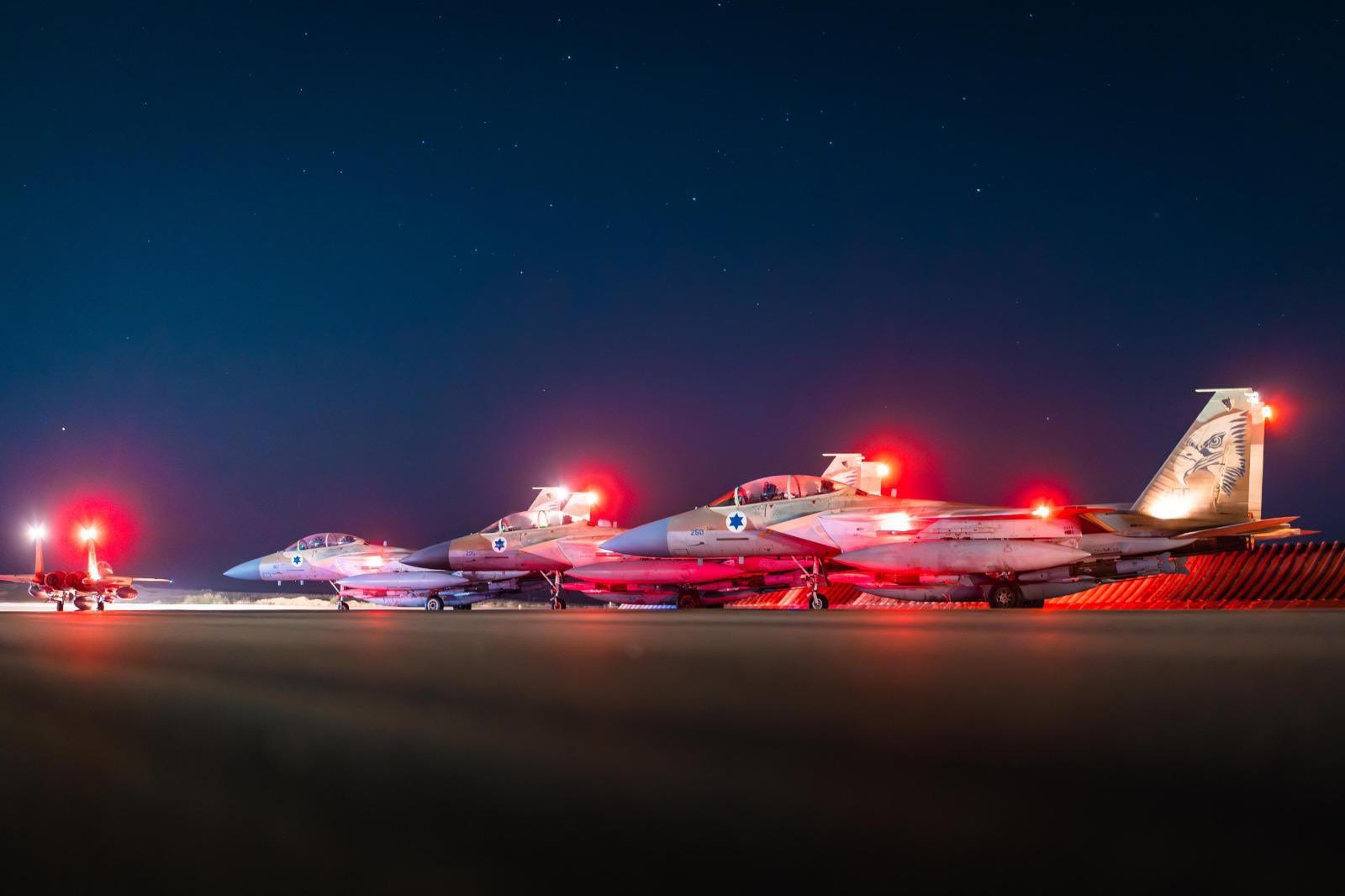
IAF fighters preparing for a sortie over Iran, June 2025. (IDF)
It’s Sunday, June 14, and exactly one year and a day ago, more than 200 Israeli fighter jets tore through Iranian skies, striking over 100 military and nuclear sites and eliminating more than 20 of the regime’s most senior commanders in the first hour. What followed was twelve days of relentless, largely lopsided war, with Israeli air power systematically dismantling the Iranian nuclear apparatus. Yet all eyes stayed fixed on a single target: the deeply buried Fordow enrichment facility, beyond the reach of any Israeli bomb. Then came the Hollywood finish—seven American B-2 stealth bombers, “Flight of the Valkyries” all but playing in the background, dropped fourteen 30,000-pound GBU-57 bunker-busters from 50,000 feet, collapsing the underground fortress and ending the war in a single dramatic blow. Benjamin Netanyahu declared it a “historic victory, which will stand for generations.”
That historic achievement would be matched only seven months later, when Operations Roaring Lion and Epic Fury began. On the morning of February 28, the U.S. and Israel launched nearly 900 joint strikes in the first twelve hours alone, hitting more than 1,000 targets within the first day. A synchronized wave of over 100 American aircraft—alongside more than 200 from the Israeli Air Force—struck Iran’s air defenses, missile sites and naval bases. In a stunning decapitation strike, the opening salvo killed Supreme Leader Ali Khamenei and dozens of other top officials before they could slip into hiding. U.S. Defense Secretary Pete Hegseth called it a “clear, devastating, decisive mission” that would ensure Iran “will never have nuclear weapons.”
Now, on the first anniversary of that first campaign, and as we confront a deal that threatens to undo much of what was achieved, we must ask: are we in a better place than we were on June 13, 2025?
On the nuclear front, the answer is a definitive yes. Before the June 2025 strikes, Iran could produce enough weapons-grade uranium for 11 nuclear weapons within a month—and enough for another 11 over the following four. Following the operation, CIA Director John Ratcliffe said the strikes had set Iran back “by years,” while Israeli estimates placed the timeline at two to three. While Operation Roaring Lion focused largely on regime and missile targets, it is estimated to have delayed the nuclear program by a further few months. While the complete annihilation or surrender of the nuclear program would have been the best outcome, without the operations, we would be counting month 11 of a nuclear regime.
IDF infographic following Operation Rising Lion. (IDF)
On ballistic missiles, the picture is similar. Across the 2025–2026 coalition campaigns, Iran’s missile program suffered unprecedented tactical destruction. Before the conflict, intelligence projected that Iran’s arsenal would swell to 8,000 missiles within four years—rendering its nuclear program untouchable behind a shield of air-defense-overwhelming firepower. The June 2025 strikes destroyed more than 70 percent of deployed launchers and cut the stockpile to roughly 1,500. But during the seven-month ceasefire, Iran went to great lengths to produce 125 missiles a month, rebuilding to 2,500 advanced weapons by early 2026. The 40-day campaign of Operations Roaring Lion and Epic Fury then ground active production to near zero, collapsed the entrance tunnels of the vast Khorramabad underground base, and hunted down more than 190 additional mobile launchers—pushing the combined total past 440 destroyed. By the IDF’s accounting, more than 60 percent of Iran’s missile launchers and 70 to 85 percent of its overall offensive capabilities and defense-industrial base have been degraded or destroyed. Scattered intelligence suggests a large number survive, buried and intact—but the production lines that would replenish them lie in ruins.
Before turning to the negatives, it is worth noting that, unlike the tangible gains, almost none of these liabilities emerge from material facts on the ground. The damage the region absorbed was relatively minor beside what was inflicted on Iran. The only thing that could make the negatives as concrete as the gains is a bad deal.
Donald Trump at the beginning of Operation Epic Fury. (White House)
As it stands, the American shot—promised since the Obama years as the answer if Iran ever crossed the weaponization line—has now been fired. Given the current outcome, it appears unlikely to be fired again, by this president or any other. Under a good agreement, that scarcely matters: the gains are locked in, and a second strike is unnecessary. A bad deal is what turns it into a liability. It would recast the entire operation as an embarrassing capitulation to a far weaker power—another war the U.S. proved unable to follow through on, and so will not risk repeating. That would turn Iran into what every anti-war voice in the U.S. believed it to be: another Iraq.
The same holds for the Strait of Hormuz. As its nuclear leverage collapsed, Iran’s ability to threaten a fifth of the world’s oil became its trump card—but the campaign degraded the naval and air assets that gave the threat teeth. The United States could restore freedom of navigation to a significant degree simply by escorting shipping, as it briefly did under Project Freedom. What keeps the strait contested is therefore not Iranian capability but American choice, compounded by the possibility of an agreement that formalizes Tehran’s hold. Here too, the outcome turns on the deal: a good one constrains and enforces, neutralizing the threat; a bad one ratifies Iran’s de facto control, returning a weapon already proven to be devastating against U.S. operations.
The larger geopolitical picture rests on the deal as well. In the immediate aftermath of Operation Roaring Lion—when American resolve against Iran looked unshakable and the smoke was still rising from damaged Gulf infrastructure—a new axis against Tehran, with Israel at its center, briefly seemed within reach. Reporting during and after the operation revealed not only Saudi and Israeli voices in unison on confronting Iran, but several Gulf states whose aircraft had flown the same skies. Yet as Trump’s resolve waned, so did theirs—each capital recalculating that renewed aggression would only invite heavier damage to its own infrastructure. A good deal that locks in American deterrence keeps that expectation alive, and with it the chance of a durable regional front. A bad one—one that signals retreat—sends every Gulf capital back behind its own walls, hedging against an Iran they no longer trust the U.S. to contain. Israel will stay indispensable to the Gulf, yet fixed in the role of mistress—relied upon in private, never claimed in public—even as Iran is openly courted.
A U.S. Sailor monitors a commercial vessel in the Gulf of Oman on May 21, 2026. (CENTCOM)
That brings us to the underlying question: What is in the deal?
That remains unclear—seemingly even to the agreement’s parties themselves.
What both sides actually agree on amounts to little: a 60-day ceasefire and a commitment to negotiate over the nuclear file. Why they believe 60 days is sufficient, after 67 days of diplomatic stalemate yielding zero progress is beyond me. But other than the timeframe, it is hard to find a single point of genuine alignment. Washington expects the Strait of Hormuz to reopen immediately and toll-free—Trump insisting that “the strait must be open with no fees or Iranian management”—while Tehran has entirely different plans. Iranian Foreign Minister Abbas Araghchi rejected the term “tolls” but defended charging “service fees” for passage. The framework for the 60 days is just as discordant. Against the U.S. demand for the complete removal of Iran’s nuclear material and a 20-year enrichment ban, Iran is countering with a mere five-year pause. In fact, Iranian state media is openly casting the agreement as a “tactical pause in the war rather than a final settlement”—and Tehran is maneuvering to unlock at least some of its frozen assets early in the MOU process, easing U.S. leverage and securing vital economic relief before the core nuclear negotiations even begin.
IDF forces in southern Lebanon. (IDF)
Most troubling for Israel, the U.S. has yet to challenge the first item in the Iranian Foreign Ministry’s readout: the claim that Lebanon falls under the 60-day ceasefire. After months of laboring to keep the two fronts apart, the MOU threatens to weld them together. And as with every recent ceasefire in the Middle East, the question is who is being made to hold their fire. The way the wind is now blowing, that looks to be Israel.
This morning, likely emboldened by the terrible deal, Hezbollah fired on northern communities in blatant violation of last week’s agreement. Government ministers have already invoked the equation set after the exchange: if the north is hit, Hezbollah’s stronghold of Dahiyeh follows. It is not hard to imagine this week unfolding like the last—Israel responds in kind, and an Iran emboldened by Trump’s hunger for a deal either strikes Israel directly or falls back on its April playbook, declaring the Strait closed until Israel halts its campaign in southern Lebanon. Cue the angry Truth Social post demanding Israel stand down.
There is a chance it all plays out exactly as it did last week—Trump once again disillusioned by Iranian intransigence, aborts the deal and returns to military operations. Yet, as evidenced by Iran continuing to fire on shipping in the strait, the closer he gets, the more determined Trump seems to push forward regardless of Iran’s obvious aggression.
What we are witnessing may become Trump’s version of withdrawing from Afghanistan. Afraid of domestic backlash, fixated on the agreement and visibly allergic to reentering combat, the U.S. has made itself a lame duck, handing its adversaries free rein. I suspect that if Trump goes through with this deal, the result will be the same: any progress achieved at the cost of American blood and treasure will be reversed, American prestige in the region will be weakened, and the president’s image will never recover. Trump must be aware of this fact, hence it is still too early to label the war lost.
With this grim possibility on the horizon, we must ask again: are we better off than we were one year ago? Iran’s military industry is in ruins, its leadership is devastated and genocidal ambitions have been significantly delayed, hence the answer remains a definitive yes.
English Editor: Ari Tatarka
If you enjoy the newsletter, you can show your support by becoming a paid subscriber—it really helps keep this going. I’m also offering a special monthly briefing for a small group of premium members. I’d love to have you join us—just click below to find out more.
Thanks for reading It’s Noon in Israel! Subscribe for free to receive new posts and support my work.


