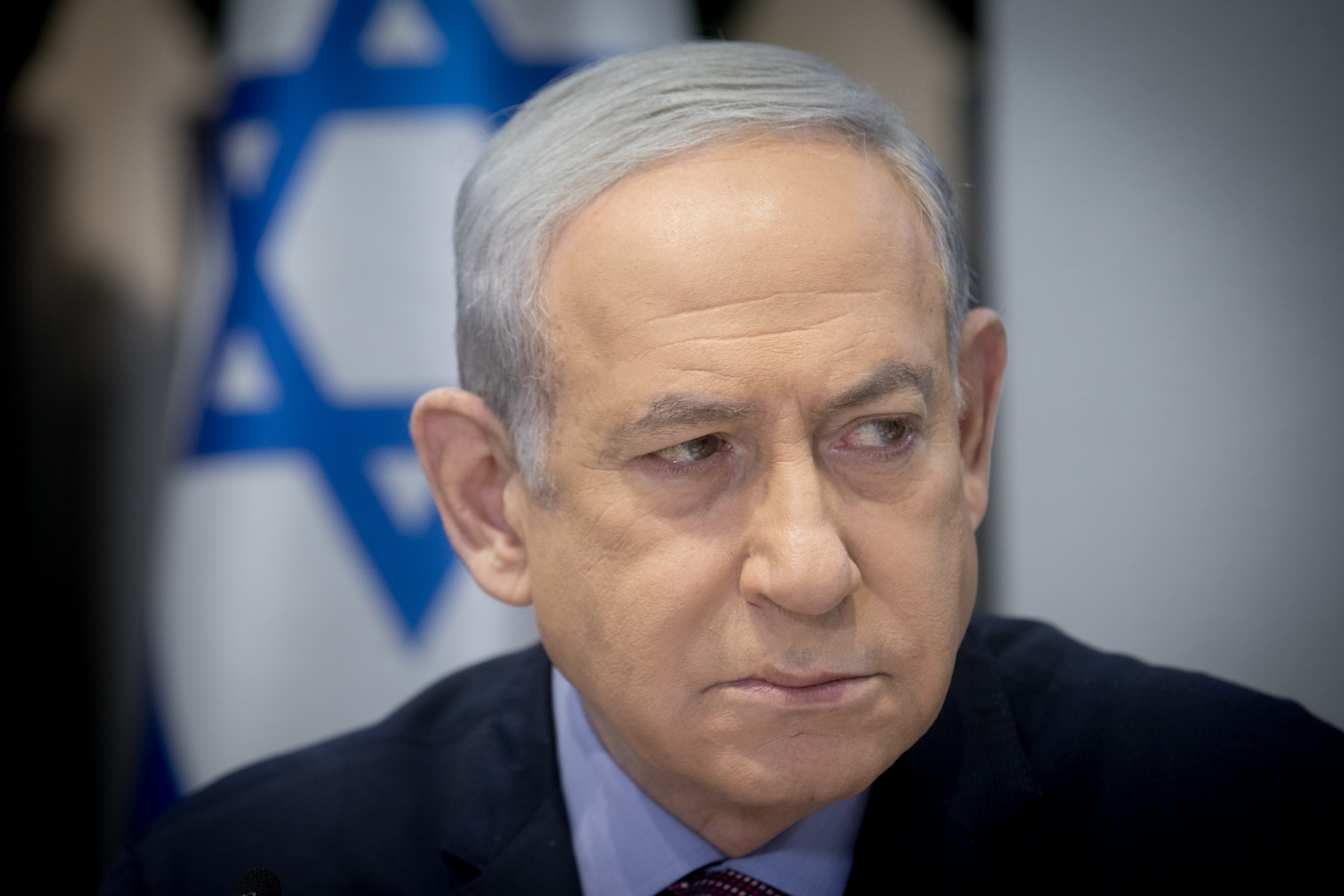
Israeli Prime Minister Benjamin Netanyahu leads a government conference at Hakirya base in Tel Aviv on December 31, 2023. (Miriam Alster/Flash90)
It’s Wednesday, September 9, and three years ago, roughly 10 days before the October 7 massacre, the president of the United Arab Emirates, Mohammed bin Zayed, telephoned Netanyahu. Over 45 minutes, the president warned the prime minister that Yahya Sinwar was preparing something big, what he called a “zilzal”, an earthquake. Netanyahu took it relatively calmly, told bin Zayed he expected Hamas to move in the West Bank, and assured him Israel was ready for anything. He did not pass the warning to the head of the Shin Bet, the Mossad or the chief of staff. A parallel warning from Egypt’s intelligence chief, around the same time, was similarly received and disregarded.
That’s according to a Haaretz report drawn from a forthcoming book by Shlomi Eldar and Ruti Yuval. The Prime Minister’s Office called the report an “absolute lie,” alleging that there was no conversation or warning. The PMO asked for a similar denial from the Emiratis, who instead simply issued a “no comment”—they seem to enjoy stirring the Israeli pot.
But let’s assume every word of this dramatic report is correct—who cares?
People excited by more ammunition to fire at Netanyahu forget that the problem was never a lack of information. The Hamas plan—kibbutzim, hostages, GoPros and all—was captured the year before; three months before the attack, an army analyst warned her superiors that Hamas had rehearsed precisely that over a full day. At the fence, the observation-post soldiers, the infamous tatzpitaniyot, had spent months reporting the drills but were similarly ignored. Most illustrative of all, on the night itself, the Shin Bet detected dozens of Israeli SIM cards activated simultaneously inside Gaza—and made the decision to send in the Tequila team—a small counterterror element meant to repel small raids, not an invasion.
The fundamental problem was never a lack of signs, but a lack of understanding.
The overused but precise term for this is conceptzia—a rigid, overriding paradigm, shared by political and military leadership, that traps them into thinking the status quo is immutable. Before October 7 it referred to the prevailing atmosphere preceding the surprise attack of the 1973 Yom Kippur War.
Those familiar with the history might recall that 11 days before that war, King Hussein of Jordan did significantly more than call: He helicoptered in secret to a Mossad safe house near Tel Aviv and met Golda Meir, warning her that Egypt and Syria were planning a joint attack. The day before the war, Israel learned that Moscow—patron of both Syria and Egypt—was pulling the families of its officers out of Damascus and Cairo—and did nothing. Meanwhile, a junior intelligence officer in Southern Command put in writing that the Egyptian deployment was preparation for a real war, not a drill. Israel’s leadership read the reports and then dismissed them—after all, Egypt wouldn’t dare attack the militarily dominant Israel; besides, why risk escalation or a false alarm, especially when mobilizing the reserves would paralyze the economy?
In 2023, Israel had even more information, and faced virtually no cost to blunt the threat. Any of the security chiefs could have picked up a phone at any point and told a battalion: listen, something is moving, get ready, there might be a war tomorrow. Not one did, including Netanyahu.
So spare me the search for the single leader who ignored the obvious signs or the one warning that would have changed history. From the chief of staff to the prime minister, all were trapped in a conceptual prison guarded by their own presumptions and upkept by groupthink that none escaped.
Donald Trump and his national security team meet in the Situation Room of the White House at the beginning of Operation Epic Fury, February 2026. (White House)
My friend, the journalist Elliot Kaufman has recently published an excellent book called In the War Room, recounting the inside story of Israel’s fight against Hamas and the Iranian Axis. He has generously allowed me to publish one of its most interesting sections. To read the full, fascinating text, click here.
When Israel attacked Iran on June 13, 2025, in what would become the 12-Day War, the Trump administration was wary. It hadn’t given Israel a red light—itself a major diplomatic achievement for Jerusalem—but Secretary of State Marco Rubio released a statement saying Israel had taken “unilateral action” and warning Iran not to retaliate against the US. “We are not involved,” Rubio said.
But as the war played out, Trump made clear that Israel’s success was drawing him closer to acting. Iran’s missile salvos were becoming smaller. Its system of command and control had been disrupted, its skies were open, and all its assets were vulnerable.
Around three days into the operation, Gen. Erik Kurilla, the chief of US Central Command, called IDF Chief of Staff Eyal Zamir. “How many drones have you lost?” the American asked.
Zamir responded concisely: “None.” The US general was stunned.
Zamir summed up Israel’s achievement to those close to him: “We did assassinations in Tehran exactly like in Gaza and Lebanon.” Now, Israel’s top general wanted to convince his US counterparts to help finish the job. “They didn’t understand how we were achieving so much,” the IDF chief said. “But eventually doubt turned to curiosity, which turned to ‘let’s join the party.’”
Israel had already taken most of the risk. Ron Dermer, Prime Minister Netanyahu’s right-hand man, made the effective argument to the White House that its intervention would no longer be a matter of starting a war, but of ending it.
“This campaign can take five days or 50,” a senior Israeli official told us. The isolationists were losing the argument in America as their dire predictions had failed to materialize. Where were the “thousands of American deaths at bases throughout the Middle East” that Tucker Carlson had predicted? Where was the “$30 gasoline” that “could collapse our economy”?
Until Trump saw Israel’s military success, he did not commit. After that, he wanted in. It helped that 80 percent of Iran’s antiaircraft missiles in the relevant areas had been destroyed by Israel.
Early on June 18, Trump announced he would give Iran two weeks to cut a deal before he decided whether to strike Fordow, Iran’s deep-underground nuclear site that Israel had yet to touch. Was this Tehran’s chance to save its nuclear program for another day? It seemed like it. But later that evening, Trump secretly told Netanyahu that he had already decided to attack.
Trump would come through for Israel on Iran. Netanyahu’s biggest bet of all had paid off.
On June 20, a Trump official showed us a map of Israel’s strikes on Iran. The more recent ones were heavily concentrated, clearing a flight path to the Fordow nuclear facility, he noted.
That same day came a crucial meeting, the contents of which have not been fully reported until now. Zamir went to the Israeli “pit” command center to talk with Netanyahu, Dermer, a few top IDF officials and Defense Minister Israel Katz. They were on a call with Vice President JD Vance and Gen. Dan Caine, chairman of the US Joint Chiefs. Netanyahu made initial comments and then turned it over to Zamir to convince Vance.
Zamir’s presentation built up to a key point: “We are already flying over Fordow freely,” he told the vice president. “There is a straight-line aerial lane open.” This was a generational opportunity. America would never get a cleaner shot.
Vance asked a few more questions, but he had heard all he needed. Given the flight time of America’s B-2 bombers, they were likely ordered into the air not long after this call.
When Vance later came to Israel on October 24, 2025, he asked to meet Zamir and said he remembered what the IDF chief had told him on that phone call. This was the first time a US vice president had ever come to an IDF chief’s office to thank him personally.
English Editor: Ari Tatarka
If you enjoy the newsletter, you can show your support by becoming a paid subscriber—it really helps keep this going. I’m also offering a special monthly briefing for a small group of premium members. I’d love to have you join us—just click below to find out more.
Thanks for reading It’s Noon in Israel! Subscribe for free to receive new posts and support my work.


Great contextual journalism.
“So spare me the search for the single leader who ignored the obvious signs or the one warning that would have changed history. From the chief of staff to the prime minister, all were trapped in a conceptual prison guarded by their own presumptions and upkept by groupthink that none escaped.”
True. Yet only one leader has up until now refused to accept ANY responsibility.