
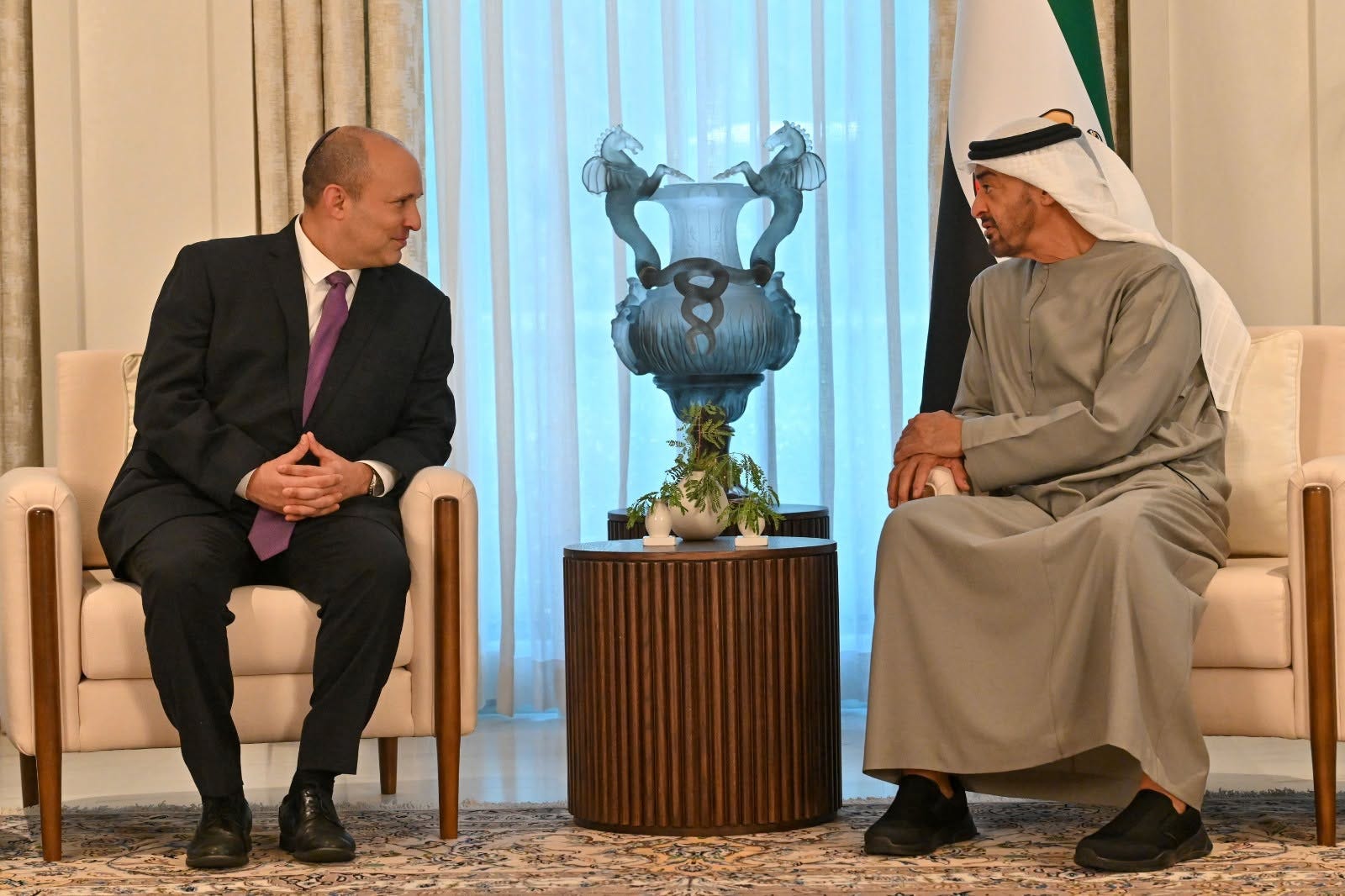
Prime Minister Naftali Bennett meets with United Arab Emirates President Sheikh Mohammed Bin Zayed, 2022. (Kobi Gideon, GPO)
It’s Monday, September 28, and two news stories on Israeli-Emirati relations made the rounds last week: the first was an accusation by Shlomi Eldar and Ruthie Yuval that Benjamin Netanyahu was forewarned about October 7 by MBZ; the other was the UAE not joining the Arab world’s walkout during the prime minister’s United Nations speech. Despite how some are framing it, Netanyahu’s trip to Abu Dhabi had everything to do with the latter and nothing to do with the former.
When the accusation that MBZ had called Netanyahu a week and a half before October 7 surfaced, the UAE released an intentionally ambiguous statement neither confirming nor denying. Only after the claim was revealed to have some holes did it come out and deny the phone call entirely. The reason for its hesitancy is not an abundance of hostility to Netanyahu. It is simply that the Emiratis have no interest in offering any one Israeli candidate their endorsement. In a model of how an alliance should function, they met with all of their potential interlocutors, including Naftali Bennett and Aryeh Deri, the Shas party leader. According to a senior Emirati official, they detest electioneering.
They do bear a small grudge against Bibi for a previous indiscretion, according to the same official. In the official’s telling, immediately following normalization in 2020, an Israeli leak revealed that the accord came with an F-35 deal, which the prime minister, still in the midst of repeated rounds of elections, quickly declared his opposition to. The Emiratis were frustrated both by the politically influenced response and by the leak itself. It is a familiar dynamic between autocracies and democracies: the former longs for consistency and can easily take a long view, while the latter’s timelines are four years at best.
But frustration does not translate into a boycott, as their presence in the United Nations on Thursday indicates. The Iran war placed the Emirates in an Israel-like position: the closest American ally in its immediate vicinity and, consequently, bearing the brunt of Iranian hostility. Unlike Saudi Arabia, the UAE does not see itself in a comfortable position to triangulate, appeasing the Iranians with one hand while seeking American aid with the other. Unlike the Saudis, it has essentially one chokepoint, the Strait of Hormuz, which Iran has held largely shut since February. There is no safe future for the Emirates if the Iranian regime survives, a strategic position it shares with Israel.
The visit had nothing to do with elections and everything to do with a shared enemy and what is fast becoming one of the region’s most important alliances.
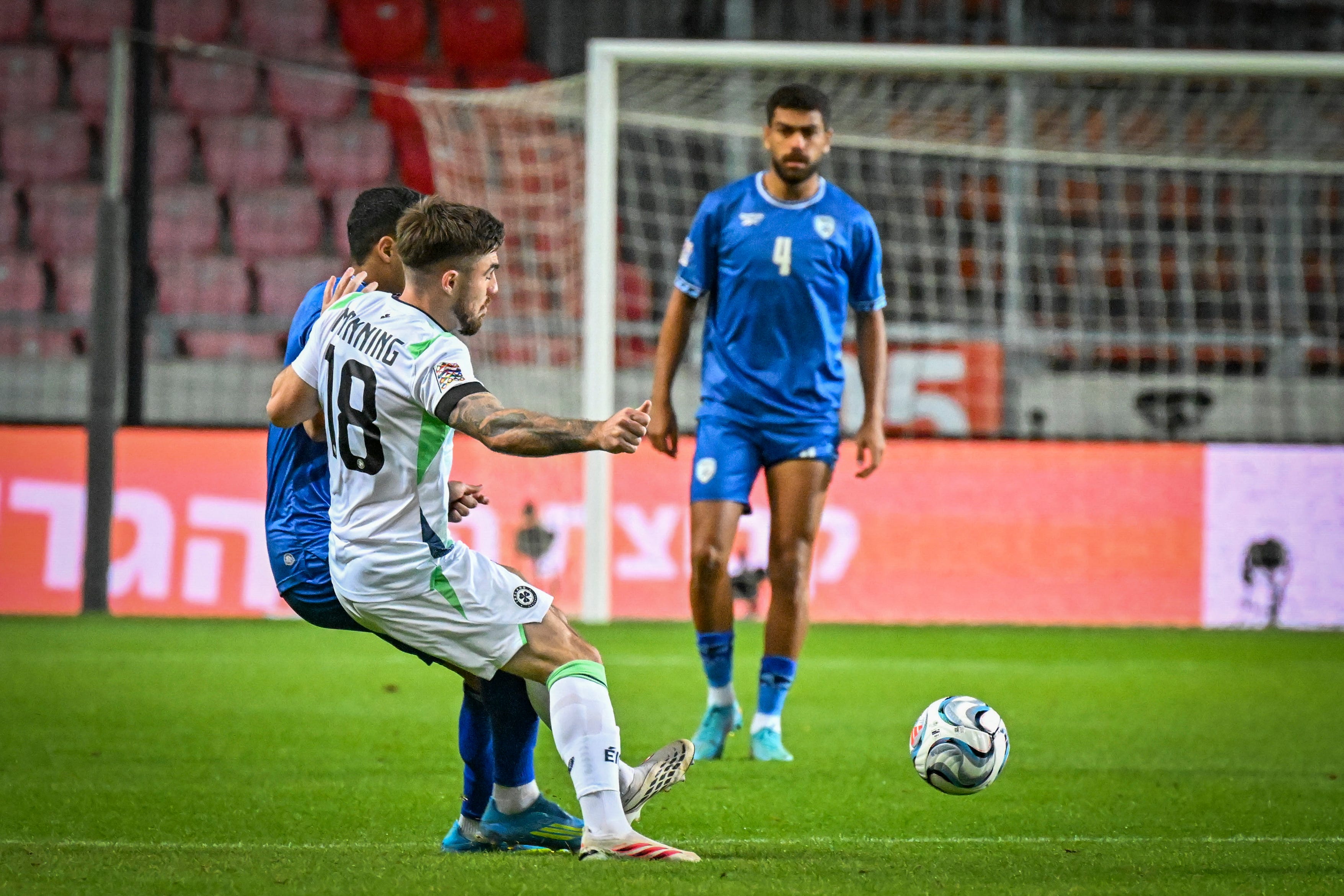
The UEFA Nations League soccer match between Israel and the Republic of Ireland at Nagyerdei Stadium in Debrecen, Hungary, September 27, 2026. (Flash90)
The “beautiful game” was made significantly less so by Irish actions on Sunday. The Irish national team agonized over whether to deign to play Israel at all, considering participation tantamount to supporting “genocide.” When game day arrived, the players arrived sporting black armbands and bowed their heads during the Israeli national anthem. To be fair, this is not the only time Ireland has gotten confused at the intersection of Jews, sports and genocide.
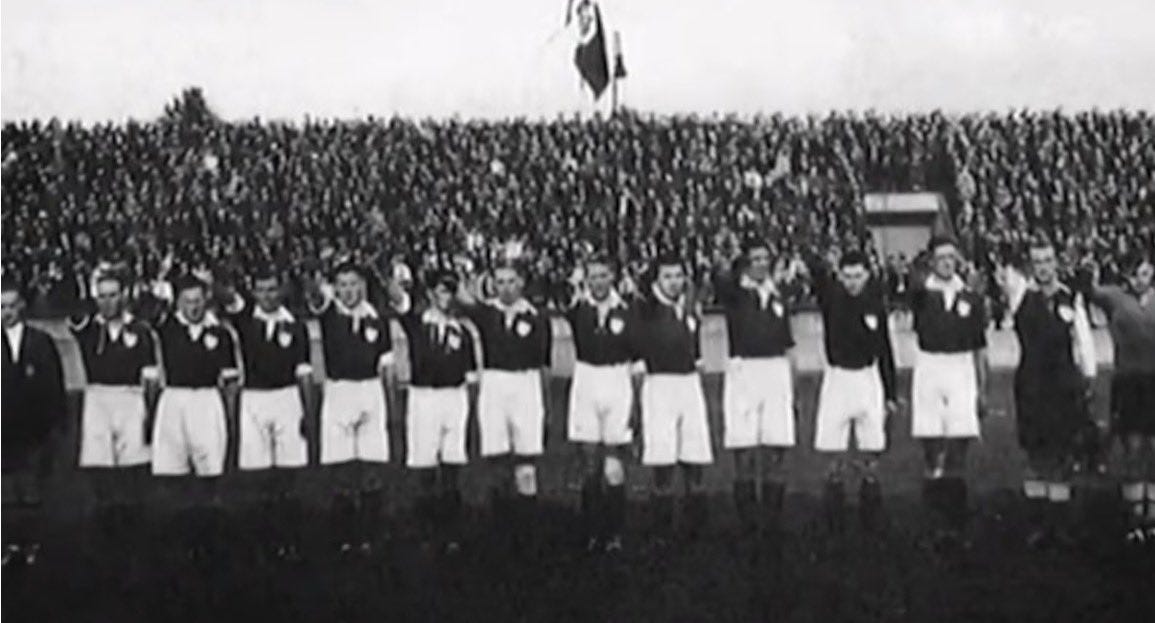
Ireland’s football team giving the Nazi salute in 1939.
In 1939, with war looming, Ireland’s national team went to Bremen for a friendly match, dutifully raising the Nazi salute to the Third Reich’s anthem. It was Ireland’s last international before the war. But six years and tens of millions of lives later, including 6 million Jews, Ireland still offered condolences to Germany after Adolf Hitler’s death.
Nearly 90 years later, Irish President Catherine Connolly still has trouble recognizing people with genocidal intent, calling Hamas “part of the fabric of the Palestinian people” while labeling Israel a “terrorist state.” Her predecessor, Michael D. Higgins, was similarly deaf to Irish history, taking the opportunity at two separate Holocaust commemorations to rail against the State of Israel. That’s not to mention the great moral stand the Irish government made in reopening the Tehran embassy in 2024.
Like a country-sized college campus, Ireland views Israel through a lens of anti-colonialism, with Israel playing the role of the British and the Palestinians the Irish. Ironic, given Israel’s historical and more recent relationship with British colonialism. The Irish parliament, according to former Irish justice and defense minister Alan Shatter, gave more time to the Israel-Gaza war than to Ukraine or housing between October 2023 and March 2026, and the Irish government has been at the bleeding edge of EU actions against Israel.
Though that is a competitive position of late, as previously mentioned, their once-hated occupiers, the British, are taking the lead on broader sanctions on Judea and Samaria, while neither the Irish nor the British can match the Dutch passion for sanctions, with customs officers reportedly stopping and searching Israeli passengers for wine, dates and olives.
On Saturday, following Ireland’s ultimate decision to play the match, the Israel Football Association declared, “Football has won today.” Unfortunately, Israel did not win the game that followed, losing 3-0.
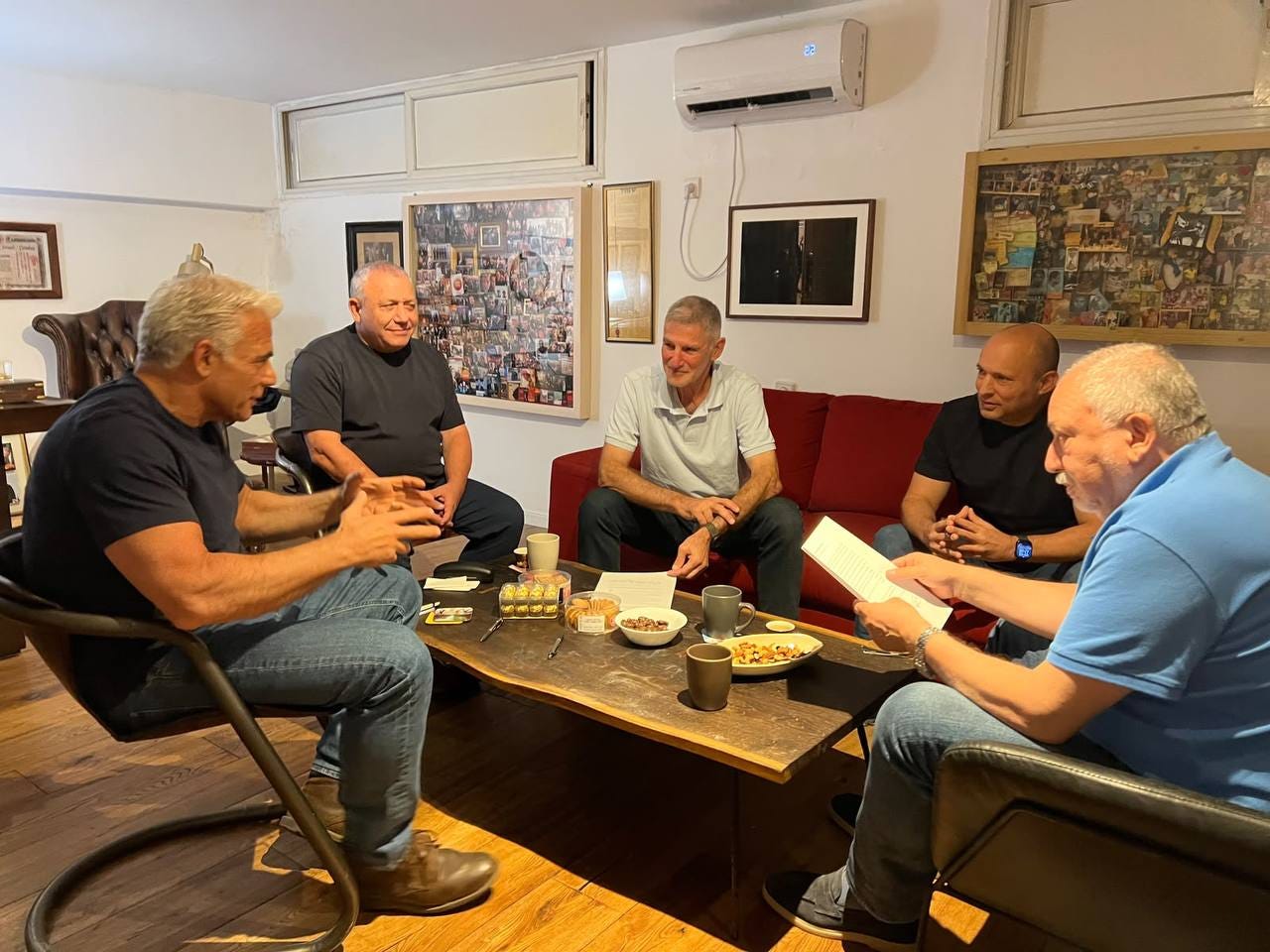
Leaders of the Change Bloc—Yair Lapid, Gadi Eisenkot, Yair Golan, Naftali Bennett and Avigdor Liberman—meet in Lapid’s home on Saturday night.
The reconciliation meetings and group dynamics within the Change Bloc haven’t helped much so far. In fact, the gaps are only widening as election day approaches. Democrat’s chairman Yair Golan wants a government with the Islamist Ra’am; Gadi Eisenkot is banking on their abstention; Avigdor Liberman is proposing to disqualify them from running. “Eisenkot would do well to make clear to the public who his partners will be on election day,” he wrote last week.
The bloc’s contraction pushed Eisenkot toward a move usually reserved for the final weekend before an election: millions of texts declaring that the race at the top is tight and that every vote for Yashar will decide who becomes prime minister. Bennett, Golan and Liberman boiled over. You can’t talk partnership and then discover you’re in the heart of Africa, inside a pot, surrounded by a cannibal tribe chopping vegetables for the salad beside you.
Eisenkot’s campaign is ready to swear it wasn’t thinking of itself, only of the odds of replacing Netanyahu. A huge poll it commissioned last week tested what happens if voters come to believe that Yashar and Likud are running neck and neck to finish as the largest party. In that case, Eisenkot jumps to 37 seats, while Bennett-Lapid’s Together party and Liberman’s Yisrael Beiteinu are crushed to five seats each, as voters flock to Yashar to help it beat Likud. But the bonus is that in that scenario Winter’s party fails to cross the threshold, and the Change Bloc swings from a one-seat deficit to a four-seat lead.
Except Liberman and Bennett weren’t convinced. In keeping with the spirit of the times, they’ve decided that playing collateral damage doesn’t suit them. In any case, they believe you don’t make a move of such consequence off the back of one poll.
Everyone’s motives are suspect here—Eisenkot’s included. After all, he isn’t volunteering to donate seats to others; he’s soliciting seats for himself. His rivals aren’t above suspicion either. Lapid, for instance, told Channel 12 this week that “ever since people started talking about the largest party, the bloc has only been sliding”—as if he’d forgotten that his own push to be the largest party in the last election ended with the bloc falling short of a majority.
This is an excerpt from my weekly column in Israel Hayom.
English Editor: Ari Tatarka
If you enjoy the newsletter, you can show your support by becoming a paid subscriber—it really helps keep this going. I’m also offering a special monthly briefing for a small group of premium members. I’d love to have you join us—just click below to find out more.
Thanks for reading It’s Noon in Israel! Subscribe for free to receive new posts and support my work.


The Irish continue to Prove they were never capable of self rule. I’ll never spend my dollars in that shithole of a country.
Why is Bennet meeting does he want sell out Israel to the Arabs again