The U.S. Strikes Back
U.S. strikes on Iran continue overnight and the ultra-Orthodox seek a constitutional draft exemption.
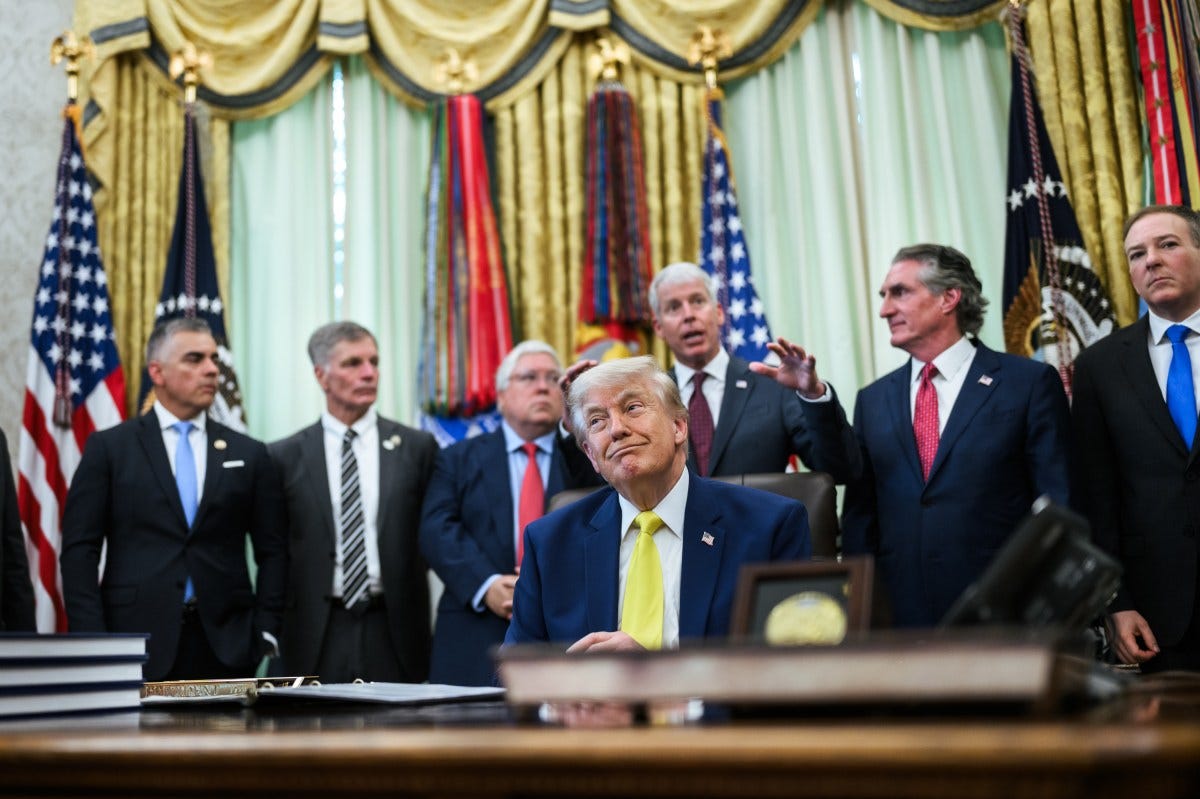
Donald Trump makes an announcement on coal in the White House, July 2026. (White House)
It’s Thursday, June 11, and Donald Trump appears to be changing tack. For the second night in a row, the U.S. military launched what it called “self-defense strikes” against Iran—strikes Trump seemed to imply were punishment for Iran taking “too long to make a deal.” In response, the Islamic Republic retaliated against bases in Jordan, Bahrain and Kuwait.
According to U.S. Central Command, the latest strikes targeted Iran’s military surveillance, communication systems and air defense sites. Iranian media confirmed explosions across the country’s south near the Strait of Hormuz—the same region where U.S. forces struck similar assets just on Tuesday. So far, the most devastating card in the American target bank, Iran’s energy infrastructure, remains notably untouched. Washington is instead methodically degrading Tehran’s capabilities around the strait—to what end, exactly, remains an open question.
Two months in, Trump appears to have finally learned to speak Persian. As the supposedly “moderate” Iranian Parliament Speaker Mohammad Bagher Ghalibaf bluntly stated this week, military force and diplomacy are complementary tools—violence creates favorable conditions on the ground, allowing diplomats to extract “legal, political and economic achievements” at the table. Iranian Foreign Minister Abbas Araghchi literally wrote the manual on this bazaar-style negotiation. In his 2025 book, The Power of Negotiation, Araghchi advocates for continuous, grueling “repetition” of demands until the opponent “gets numb” and surrenders, noting that “he who gets tired and bored quickly will lose.”
Both approaches have been on full display over the past two months. The endless offers and retractions at the negotiating table, paired with the constant pricks of military strikes against regional allies and global shipping, were designed to drain Trump’s patience through a thousand small cuts.
The strategy appeared perilously close to working. In May, the announcement of a “largely negotiated” deal—offering upfront financial relief in exchange for 60 days of nuclear talks—nearly gave Republican hawks a collective heart attack. Trump ultimately pulled back, but the strategy seemed to be gaining traction again this week when he echoed Biden’s infamous “don’t,” urging Israel to turn the other cheek to an Iranian attack. Critics feared Trump was about to follow his billionaire confidants off the cliff, placing his trust in an extremist Middle Eastern regime. Worn down by Araghchi’s relentless bazaar-style bargaining, Trump looked ready to fold—ignoring his own warning from The Art of the Deal: “The worst thing you can possibly do in a deal is seem desperate to make it.”
And yet. There is a distinct possibility that both we and the Iranians misread the board by overlooking another line from that same book: “I never get too attached to one deal or one approach. I keep a lot of balls in the air.”
Hopefully, Trump has developed an attachment to this new kinetic approach. As evidence of its effectiveness, note that for the second night running, Israel remains free of Iranian retaliation—the IRGC opting instead to strike back against American attacks on nearly every regional base except the one belonging to the U.S.’s closest ally. Their calculus is straightforward: shoot at those who don’t shoot back.
Since Iran crossed Trump’s red line in January, he has been walking a high wire, stretched between forcing regime collapse on one side and securing a diplomatic settlement on the other. He opened with a swift pivot toward diplomacy. Then came an unexpected lurch toward destruction, oscillating between threats of devastating force and economic reassurances. Then, abruptly, he froze. With the far side of the wire seeming impossibly distant, he has hung suspended over the abyss for two months. Today’s strikes suggest he may finally be moving again—though toward what, nobody can say. As with most such performances, it is we, the audience, not the presidential acrobat, whose hearts are in our throats at every tremor. The performer himself betrays nothing. With Trump especially, that inscrutability may be the whole act.
Ultra-Orthodox Jewish protesters demonstrate outside the police station in Jerusalem, June 10, 2026. (Noam Revkin Fenton/Flash90)
As part of a 3,000-year-old literary tradition, most Jews would agree that “Torah study is a foundational value in the heritage of the Jewish people.” Where the Basic Law: Torah Study, which passed its first reading last night, loses everyone except the ultra-Orthodox is by making a sudden leap into draft dodging. The bill claims that “those who have undertaken Torah study for an extended period shall be deemed ... as persons who are performing meaningful service for the State.”
To fully understand the implications of this move, we must first explain what a Basic Law is.
Lacking a formal constitution, Israel relies on a constellation of Basic Laws to define the state’s fundamentals, yet they fall short in two important ways.
In the U.S., altering the Constitution demands a two-thirds supermajority in Congress followed by ratification from three-fourths of the states. In Israel, however, there is no official procedure governing how Basic Laws are amended—no special constitutional process is required. Technically, with a quorum of 10 in the Knesset, a single “yes” vote against nine abstentions is enough to alter the fundamental nature of the state.
The second deficiency is more recent. The courts do not feel bound to interpret, or even defer to, Basic Laws. In 2024, the Supreme Court struck down Basic Law: The Judiciary that sought to alter their jurisdiction on the grounds that some supra-constitutional authority exists to determine what should or should not belong in a constitution.
The result is a system where Basic Laws are neither Basic nor Laws. They fail the test of being Basic, as any temporary political coalition can amend the state’s foundation with a simple majority. And they fail the test of being Laws, as the Supreme Court has demonstrated it treats even these supposedly supreme texts as optional—and subject to cancellation.
So that brings us back to the law in question: Basic Law: Torah Study.
One of the bill’s key sponsors, ultra-Orthodox party Shas leader Arye Deri, once said he wouldn’t legislate the Ten Commandments for fear that the Israeli Supreme Court would find a way to render them secular and progressive. Apparently, he has had a change of heart. Why?
According to Deri himself, the bill would be a “historic declaration of the supreme value of Torah and the contribution of Torah scholars to the people of Israel and its security.” The mention of security is the tell. Strip away the religious framing and what remains is draft avoidance dressed up as a constitutional amendment.
Will it work? Absolutely not. The Supreme Court will strike it down before the ink is dry.
So why bother? Elections are approaching, and after four years of coalition membership, the ultra-Orthodox have nothing concrete to show their constituency on its single biggest concern: the draft. Ultra-Orthodox voters are incredibly loyal; they won’t be defecting to Naftali Bennett, but disillusionment is nonpartisan. If the political leadership is seen as impotent, people won’t interrupt their profoundly important Torah study to go vote. Deri and Netanyahu need bodies at the ballot box, and the amendment is the price of admission.
The process hit an early snag with Religious Zionism—the one part of the coalition that takes both Torah study and army service seriously. They balked at language that appeared to place yeshiva students on equal footing with IDF soldiers. After a dramatic overnight session of the Ministerial Committee for Legislation, negotiators produced revised wording that preserved the law’s core intent while dropping the direct equivalence that would have enraged the broader public.
The truth is that most of the government dislikes the law in substance but finds it very useful in practice. Religious Zionism gets to serve its base and has already logged the amendment as an achievement on its website. The Haredim get to pretend they are delivering. The opposition gets to pretend it is fighting an existential battle against theocracy. Even the court gets its own PR, an opportunity to reassure its supporters that it remains the last line of defense against an out-of-control government. Everyone plays their role, the curtain falls, and nothing actually changes.
English Editor: Ari Tatarka
If you enjoy the newsletter, you can show your support by becoming a paid subscriber—it really helps keep this going. I’m also offering a special monthly briefing for a small group of premium members. I’d love to have you join us—just click below to find out more.
Thanks for reading It’s Noon in Israel! Subscribe for free to receive new posts and support my work.


I don’t understand what Trump is doing? The US needs to hit oil fields, power plants, and bring the hammer down on the Iranian economy. For once, stop playing politics and take down the Iranian Republic Guard once and for all.
For the second night in a row, the U.S. military launched what it called “self-defense strikes” against Iran
About damn Time!