It’s Noon in Israel: Why Did Israel Delay the U.S. Strike?
Also, armories' worth of weapons fly over the Egyptian border, and a peek at the next generation of air defense.
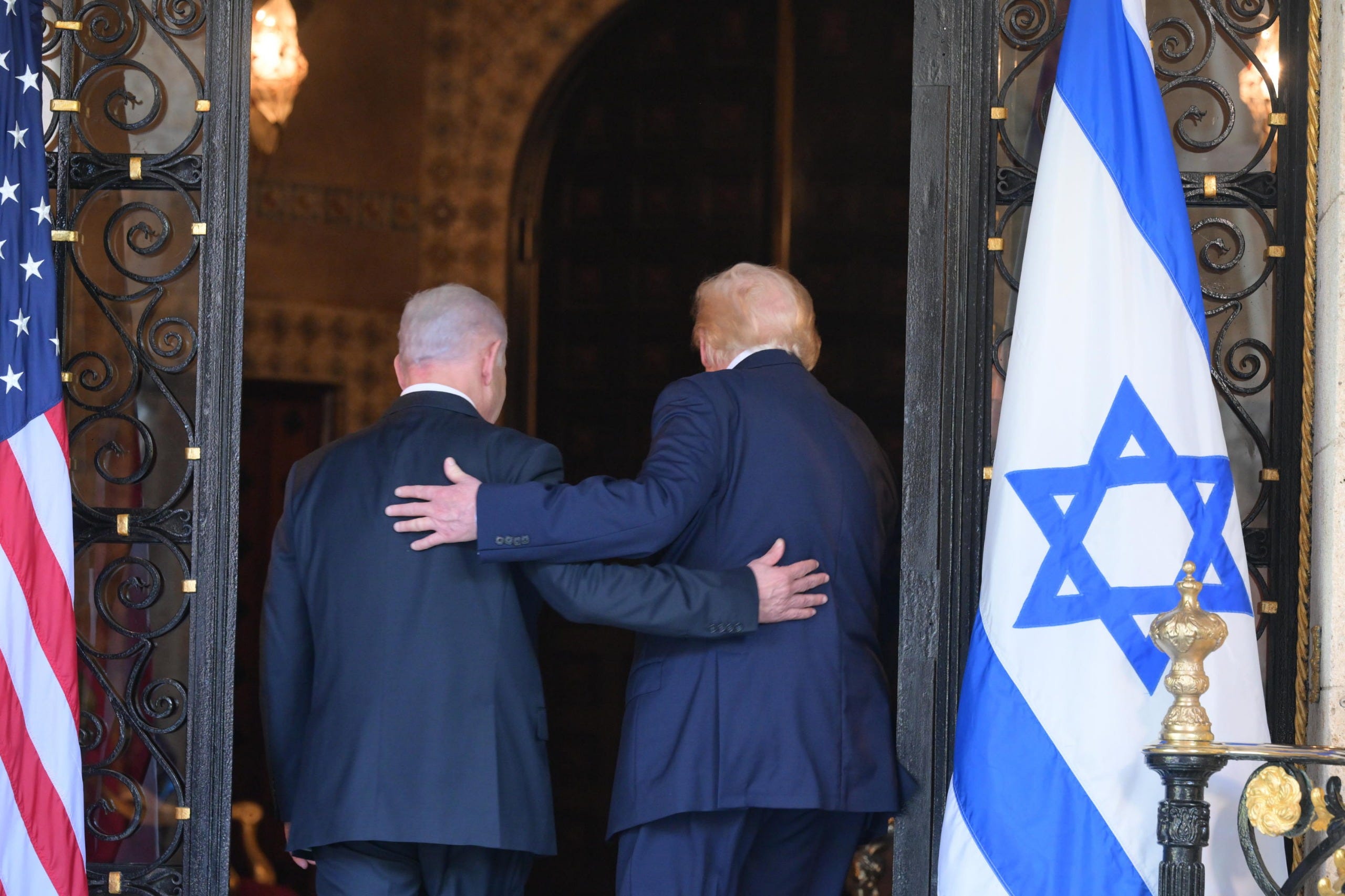
Benjamin Netanyahu and Donald Trump during thier meeting in Decmeber. (whitehouse.gov)
It’s Friday, January 16, and Benjamin Netanyahu has reportedly asked Donald Trump to delay an attack on Iran, citing Israel’s lack of preparedness. That’s according to the New York Times—and if true, it’s fascinating for several reasons.
First, there’s the sheer strangeness of it all: Netanyahu is asking to end U.S. military aid and Trump is refusing. Meanwhile, Trump wants to strike Iran, and Netanyahu is asking him to wait.
But the delay request, if true, reveals three possibilities:
Israel doesn’t have enough interceptors.
That’s the most obvious answer, and it makes some sense, but not much. Even if stocks are low, it would be worth it for Israel to risk a few hits if the strike topples the regime.The planned American response is small or symbolic and therefore too limited to make a real impact.
In that case, Israel’s request might be a call to scale it up. According to reports, the head of Mossad—who landed in Washington this morning for meetings with U.S. officials—believes this to be the case.It’s all part of a deception and testing operation—forcing Iran to mobilize its defenses, reveal positions, and exhaust resources against a strike that may never come.
What it most certainly is not is any mercy for the bloodthirsty ayatollahs or lack of support for the brave protestors bieng massacred.
But there is another country in the region whose reaction to the possibility of the strike has been particularly interesting: Qatar.
You might remember that back in June, Qatar—or more precisely, the U.S. air base in Qatar—was targeted by the Iranians in response to the destruction of Fordow. While the attack was half-hearted and easily countered, one would think that after having missiles rain down on their territory, the Qataris wouldn’t be wishing the regime to live until 120, as we say in Israel.
But according to every Middle Eastern source I’ve spoken to, Qatar has been in a state of near hysteria in recent days over the possibility of a U.S. strike on Iran.
Why?
Well, Qatar is like a law firm that thrives on conflict—happy endings are bad for business.
When the fight is between Hamas and Israel, they’re the mediators. And when it’s between the West and Iran, they’re still the mediators. Besides a sympathy born out of hatred for Israel and similar Islamist tendencies, they simply don’t want to see their role shoved into irrelevance by a thriving Iran.
Despite the concerns of the chaos-supporting lawyers, Trump will likely strike. No known dates as to when, but he does have a tendency to take action over weekends.
M16 assault rifles and ammunition recovered from a drone smuggling operation along the Israel-Egypt border in April 2025. (IDF)
After many months of delay, the IDF has a name for the aerial highway along the Egyptian border: “a large-scale campaign to arm the area.” It was a late recognition—a natural awakening—after enormous quantities of weapons were transferred into the State of Israel. The current pace is still insane: two tons of ammunition per month.
The affair is as mysterious as it is vast. The main party responsible on the Egyptian side of the border (or, as the IDF diplomatically calls it, “the western border”) has not yet been identified. But recently, Southern Command issued an order to treat every smuggling attempt as a security incident unless proven otherwise.
The absurdity is that the drones seen crossing the border toward Israel were purchased in Israel. After all, there are none in Gaza, and in Egypt it is forbidden to purchase a drone weighing more than a quarter of a kilo. Only in Israel is the law not enforced, and buyers not registered.
Behind the operation are Bedouin with blue ID cards, unlimited money and access to technology. Their drone skills surpass those of any parallel unit in the army, and the absurdity is that although the event is defined as a security incident, the perpetrators are Israeli citizens, which limits the ability to act against them.
The assumption in the IDF is that the Iranians are operating this vast network. There is simply no way to explain who would need such quantities for personal criminal consumption.
Where is it going? For a long time, there was an attempt to determine whether the weapons end up in the hands of crime families in the Triangle, terrorists in Judea and Samaria, or Hamas killers in Gaza. But in practice, it doesn’t matter. If the goal is to undermine stability, any answer is correct and desirable for the Iranians.
In any case, Operation Guardian of the Walls in 2021 already proved that the line between criminal and nationalist activity is blurred and porous—about as porous as the Israel–Egypt border.
For now, it is doubtful that the weapons are reaching Judea and Samaria, where rifle prices remain high. Some of it is certainly going to Gaza. Two months ago, a drone en route from Israel to Sinai was intercepted. Soldiers found advanced diving equipment on it. Clearly, the goal was to smuggle weapons into Gaza.
Why not directly from Israel to Gaza? Because that way, even if the smugglers are caught, they can claim it is criminal activity rather than a security offense. As is well known, the criminal activity of Arab crime families is not at the center of law enforcement attention.
This is an excerpt from my weekly column in Israel Hayom.
To read on my website click here
Screenshot from the test video of the Arrow 4 posted on the IDF youtube channel. (IDF)
A video of a test flight of Israel’s latest weapon system was released before being quietly deleted. While not as flashy or sci-fi as the Iron Beam laser defense system, the Arrow 4 marks a major leap forward for Israel’s missile defense and its military industry.
Why was it taken down?
Well, the video first appeared on a private channel on YouTube in December and was then shared on a Persian-language account on X before quickly being taken down on YouTube.
It’s still unclear how or why the footage was released, but the Defense Ministry, which oversees the Arrow’s development, doesn’t seem concerned about a leak.
Now that that’s out of the way—let’s talk about the new system.
The Arrow 4, like its predecessor, the Arrow 3, is an interceptor designed to counter ballistic missiles. The difference lies in what it’s built to intercept. Arrow 3 intercepts missiles in space; Arrow 4 also goes to space, but can also destroy maneuverable and hypersonic threats within the atmosphere.
If the Arrow 3 is a scalpel—sharp and precise—the Arrow 4 is a chef’s knife, built to handle whatever’s thrown at it.
And while the Iranians aren’t looking too strong right now, a few months ago, they were pouring everything they had into advancing their missile program. In hindsight, and at the time, that was a bad investment—not just because their economy collapsed, but also because Israel’s newest interceptor might just have rendered much of that effort obsolete.
The Arrow 4 began development in 2017 and is expected to enter production later this year. Like the Arrow 3 and the Iron Dome, it was developed in collaboration with the United States.
While American funding is always welcome, the Arrow is another reason why Israel is eager to wean itself off U.S. aid. U.S. dollars come with U.S. strings—Israel needs prior approval before selling the system to any third party.
That’s a shame, because the Arrow 4 is the only interceptor of its generation on the market. There are going to be plenty of buyers for the first intercept system designed for the new generation of hypersonic missiles.
But if there’s one country I feel bad for—besides Iran—it’s Germany.
Last month, Berlin began receiving the Arrow 3 as part of the largest military purchase in Israel’s history. But they just spent $4.6 billion on the iPhone 16—right as the promo for the 17 dropped.
Still, I’m sure Israel will be more than happy to sell them the new model. Israel’s defense industry is opening for business—and with the Arrow 4 added to its merchandise, there will be no shortage of buyers.
Shabbat Shalom!
We will be back on Sunday.
If you enjoy the newsletter, you can show your support by becoming a paid subscriber—it really helps keep this going. I’m also offering a special monthly briefing for a small group of premium members. I’d love to have you join us—just click below to find out more.


I had seen a headline, I think it was in either the Times of Israel or Israel Live News that along with Qatar it was Saudi Arabia and Oman pushing the US not to strike. Have you heard anything along those lines? And if so, what would their interests be?
Also do you know anything about Trump’s statement saying Iran had put a stop to killing of protesters? I assume he had a much bigger reason for saying/believing that than he let on
You want to know where the Bedouin are getting money? From the Israeli government. The Bedouin have several wives (actually sex slaves as these young girls have no choice) who produce many children and receive gov funda every month. Don't see any reporters covering that story.