Why Israel Won’t Move Forward on Gaza
Also, Eisenkot’s victory plan—and its dissenters.
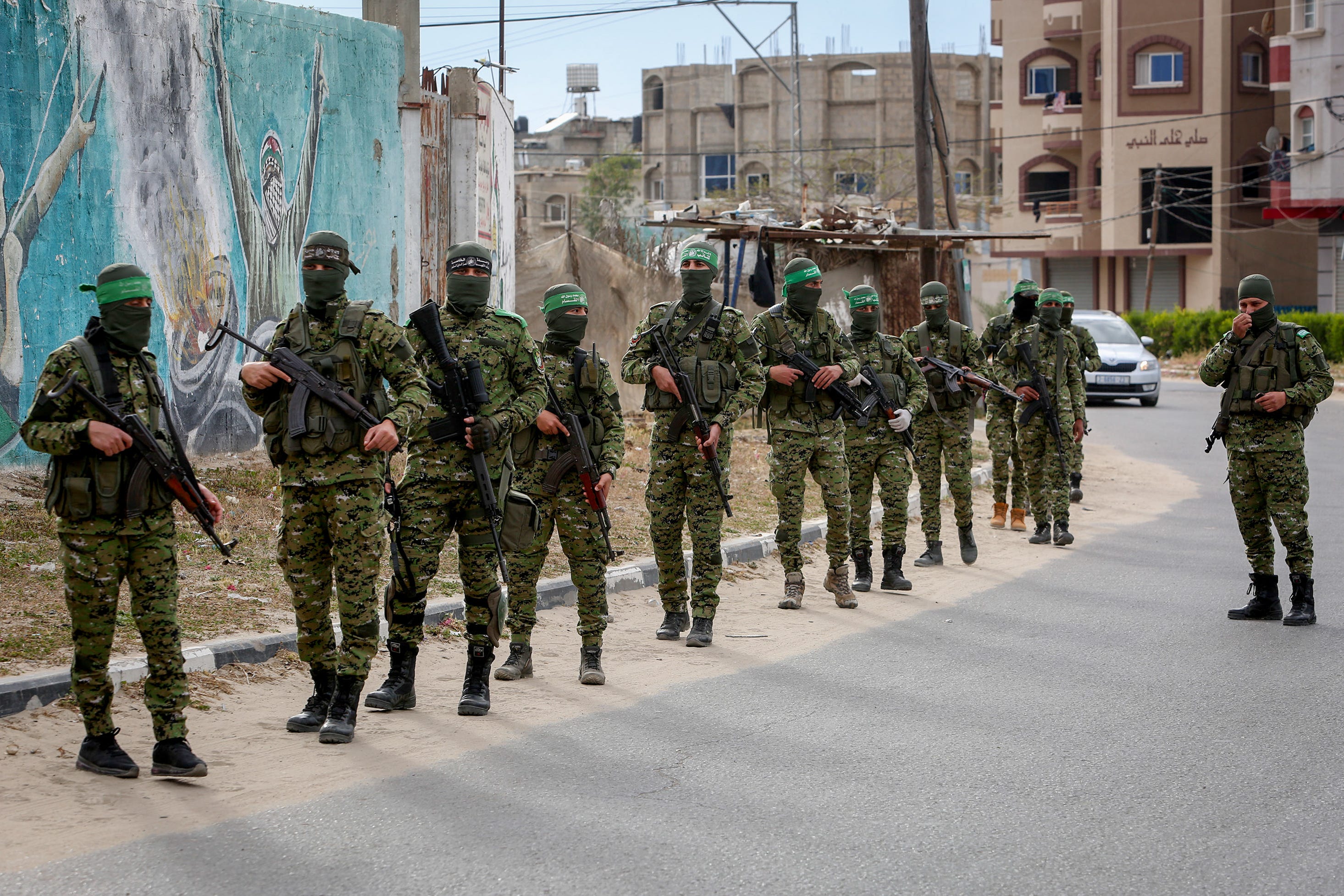
Palestinian members of Izz ad-Din al-Qassam Brigades, the armed wing of the Hamas movement seen during a patrol in Rafah, in the southern Gaza Strip on April 27, 2020. (Abed Rahim Khatib/Flash90)
It’s Monday, August 3, and “these are the results of eight months of negotiations aimed at demilitarizing Gaza. Why continue the targeted killings now and give them an excuse to back out?” The senior American official seems genuinely surprised by Israel’s recent strikes on Hamas targets. By his account, Israel had agreed to the terms—including a halt to the targeted assassinations—so that Hamas would be bound to the next step: handing over its weapons.
“This further isolates Israel in the Middle East. Every mediating country now reads it as proof that Bibi doesn’t keep his word, or doesn’t want peace.” And, per the source: “He killed three innocent children, making Israel look like bloodthirsty savages.”
I admire the optimism of a reading in which Israel hasn’t already been called exactly that, and considerably worse, since October 8. He is not the first official to cast Israel’s security actions as the barrier to peace while the other side is publicly ambivalent or worse—Hamas itself said this week, “We didn’t say disarmament, we didn’t say handing over the weapons, and we didn’t agree on any Israeli involvement.” If the plan holds and Hamas surrenders its arms as the peace board insists it will, this is the best shot at lasting quiet for Israel’s south that Israel is ever likely to get. Killing three more Hamas officials is thinking small when the disarmament of Hamas is on the table.
Israel has three problems.
The first is the fine print. The deal mandates the surrender of heavy weapons and the disabling of tunnels, but it leaves “personal” arms to be regulated under “Palestinian law”—which Israel is convinced means, in practice, a blanket waiver: Hamas keeps its rifles with a technocrat-approved stamp. The agreement stipulates that all weapons held by the Hamas-run police pass to the U.S.-backed technocratic committee, though that could simply be a matter of paperwork in changing their affiliation.
This is Israel’s worst case: Hamas gives up the governing face of Gaza but keeps its grip, while the technocratic veneer buys international legitimacy and ties Israel’s hands. The fact that “personal arms” receive special attention is suspect, as when it comes to running Gaza, Kalashnikovs matter far more than tunnels or rockets. Kan has already reported that Hamas spent the weekend making sure its men will have “personal arms” when the time comes.
The second is the withdrawal. Per the BBC, the plan requires Israel to pull back to the yellow line within 24 hours of accepting it—surrendering around 20 percent of the strip it currently holds. Israel’s preferred sequence is the reverse: disarmament first, withdrawal second. Give up ground before that, and you give up leverage over Hamas.
The third, and the one underwriting the other two: Israel does not trust Hamas.
Then there is the less technical concern. Israel is under 90 days from an election, and radical, potentially dangerous steps for peace are somehow even less palatable now than before. This election is a game of inches, and inches surrendered in Gaza translate easily into inches surrendered in the Knesset. Ironically, it is the left that is waiting for Netanyahu to slip on one of the fronts—so it can attack him from the right.
As I told the senior American official, if anyone is going to give Israel tough talk about the moves peace requires, it won’t be an Israeli politician.
His counter-argument deserves its due. Nobody believes words—they believe actions—and justifying dramatic moves for peace comes easier against a backdrop of progress. That progress is impossible if Israel keeps working against the deal, and the working-against, the source argues, is what costs Israel its credibility in the region. Gaza, he adds, is where the sharpest shift in global antisemitism and anti-Israel sentiment began. Neither will turn until the picture coming out of Gaza does.
My take: Israel should not be the reason this plan fails. As long as Israel’s actions remain reversible, they should proceed. Though the odds of anything moving in election season are slim.
Leader of the Democrats party Yair Golan and Ra'am party head MK Mansour Abbas attend a conference at Givat Haviva, January 6, 2026. (Tal Gal/Flash90)
Gadi Eisenkot’s plan to form a government rests on a logical foundation: at the moment of truth, the Arab MKs will not be able to go home if they vote against the chance to topple the Netanyahu–Ben Gvir coalition. So there is no need for negotiations—not even telepathy. They will abstain, and that will be that.
There is one striking precedent: the Knesset vote on the 2004 Disengagement. Ra’am, the Islamist Arab party, voted in favor, while the more nationalist Hadash, Ta’al, and Balad threatened to vote against, because of the forceful, anti-Palestinian way the move was marketed. But when Netanyahu and his colleagues threatened, for a moment, to oppose it, the Arabs dropped their opposition, and by abstaining allowed the move to pass. And just as they then preferred to evacuate the settlers from their homes despite their principled opposition to a unilateral move, so now too they will prefer to evacuate Bezalel Smotrich and Itamar Ben Gvir from their seats, despite their principled opposition to any Zionist government.
But to the extent that Eisenkot wants a government that lasts, this is where the trouble will start. As is well known, not all Arabs are the same. Mansour Abbas of Ra’am wants a share of governing. He is aiming for a ministerial post in the next government. So he will demand something in return for votes in the Knesset. “Either we are in favor, or we are against,” he keeps saying. And if Ra’am is for something, the other parties will be against. As you may recall, they worked to bring down Bennett and Lapid’s 2022 “change government,” because they could not stand the fact that the budgets ran through Ra’am, whom they loathe. These gaps are the reason the Joint List, the Arab parties’ united ticket, fell apart five years ago, and the main reason it has not re-formed this round, despite all the promises.
The re-establishment of the Hadash–Ta’al–Balad triple alliance complicates matters for Eisenkot. It distances him from the chance of reaching 61 Zionist mandates—a governing majority that leans on no Arab party—and puts back into play Balad, the fanatical Palestinian-nationalist party, several of whose Knesset representatives in the past ended up in prison or fled abroad from the reach of the law. The chance it will help sustain any Zionist government over time is nonexistent. Whether it has two representatives or three could decide the fate of the next Knesset, far earlier than anyone imagines.
This is an excerpt from my weekly column in Israel Hayom.
English Editor: Ari Tatarka
If you enjoy the newsletter, you can show your support by becoming a paid subscriber—it really helps keep this going. I’m also offering a special monthly briefing for a small group of premium members. I’d love to have you join us—just click below to find out more.
Thanks for reading It’s Noon in Israel! Subscribe for free to receive new posts and support my work.


The world already hates us and the world has been anti-Semitic since before the burning of the Second Temple. Thus, Israel should not give up an inch of the Gaza security zone unless there is a definition and agreement of exactly what are “personal” arms (weapons), and then that we see proof Hamas is turning in its armaments.
The chairman of the Board of Peace is a Russian. Do you trust anything he says? He is Hamas' ally. He is not there to make Trump look good, or bring peace. He is there to help Hamas survive. Israel needs to do what she needs to do for her own people. She owes nothing to nobody at this point other than them.