Why Trump Gave Saudi Arabia the Nuke
Also, the Palestinian Authority has claimed to have ended "Pay for Slay," again.
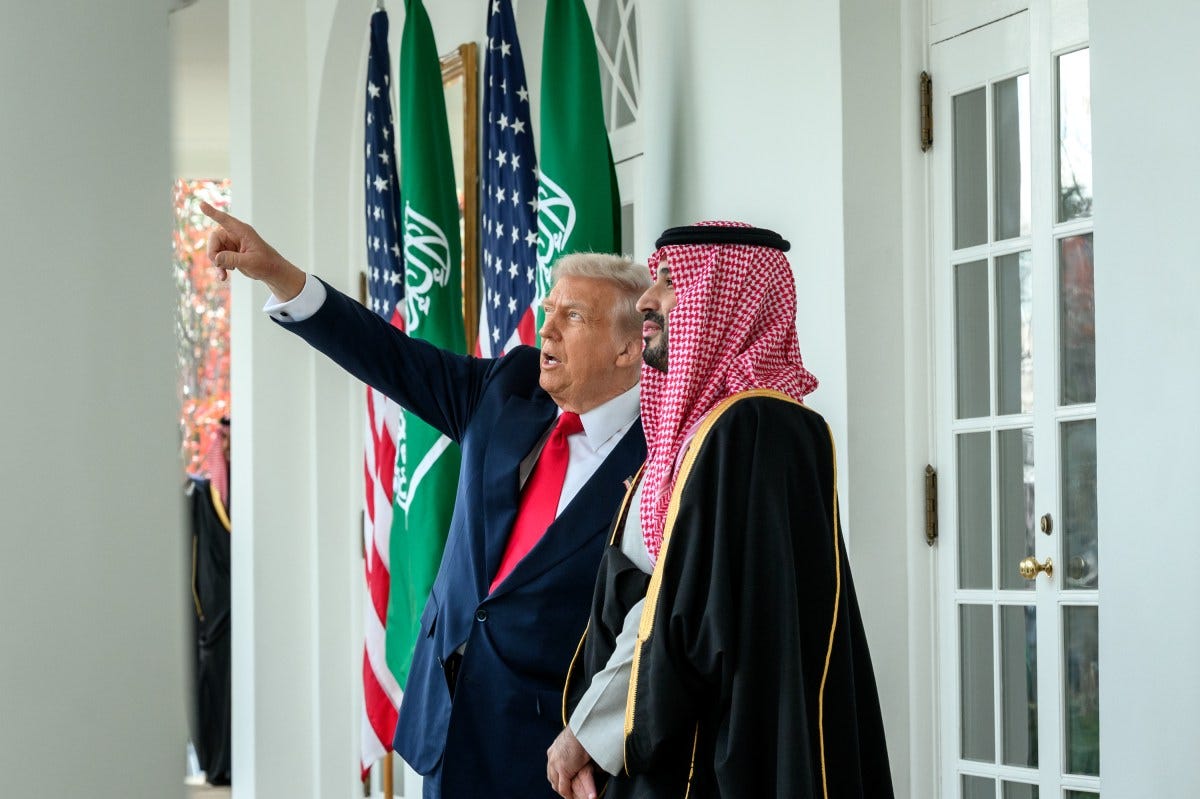
Donald Trump participates in a bilateral meeting with Crown Prince and Prime Minister Mohammed bin Salman Al Saud of Saudi Arabia. (White House)
It’s Wednesday, July 22, and rattled by Operation Rising Lion and Midnight Hammer last June, Saudi Arabia went looking for a deterrent. Pakistan, still bruised from its May 2025 confrontation with India, was looking for the same thing. The arrangement was mutually beneficial: Islamabad acquired a wealthy patron, Riyadh signaled it could diversify away from Washington, and Pakistan’s defense minister declared that his country’s nuclear program would be made available to the kingdom if needed.
Then came February 2026, and Iranian missiles and drones began landing throughout the kingdom. Riyadh invoked the pact. Islamabad sent a foreign minister to deliver a stern warning to Tehran and flew a squadron of fighters to a Saudi air base. The lesson was not subtle. Pakistan would not be the new guarantor, and a nuclear guarantee secured by diplomacy is a considerably weaker deterrent than one whose button sits under your own finger.
That is the context for today’s Wall Street Journal report that Trump has approved a 30-year agreement providing Saudi Arabia with a civilian nuclear program and potentially opening the door to uranium enrichment on Saudi soil.
The obvious truth is that Saudi Arabia needs nuclear power like a drowning man needs water. But Mohammed bin Salman revealed the real game in 2018: If Tehran got a bomb, the kingdom would follow as soon as possible. Throughout its long campaign for nuclear power, Saudi Arabia conceded nothing to the industry’s “gold standard,” a binding commitment not to enrich uranium or reprocess spent nuclear fuel domestically.
The nuclear campaign is a symptom, not a cause. Riyadh concluded years ago that the American security guarantee is unreliable, regardless of who holds the White House. On September 14, 2019, cruise missiles and drones took roughly half of Saudi production offline in a single morning. Washington attributed the attack to Iran, moved some air defense assets into the kingdom, and did nothing further. Biden completed the lesson from the opposite direction. On February 4, 2021, in his first major foreign policy address, he ended American support for the coalition’s offensive operations in Yemen, including arms sales, and the following day the State Department moved to delist the Houthis.
In the Middle East that existed before October 7, 2023, Biden’s team pursued an agreement they saw as a signature achievement: a Strategic Alliance Agreement obliging the United States to defend the kingdom against external attack, bundled with Saudi demands for acceptance of a civilian nuclear program, advanced American weaponry, and—as the crown jewel for Riyadh’s domestic audience—normalization. The framework required Senate ratification, and negotiations seemed nearly complete. Then came October 7.
The Saudis then sought the same arrangement without the normalization component, hoping to separate the security guarantee from the Palestinian question. They ran into the late great Senator Lindsey Graham, the arrangement’s most energetic Republican champion, who did the arithmetic out loud in May 2024: If there is a mutual defense agreement negotiated in the form of a treaty, it needs 67 votes in the Senate to become binding. Without normalizing the Israeli-Saudi relationship, “there would be very few votes for a mutual defense agreement between the U.S. and Saudi Arabia.” In short: no Israel means no deal.
All that changed with Trump. He detached the nuclear file from normalization entirely, having already signed an executive order in May 2025 directing the State Department to promote nuclear exports. In November 2025, Washington and Riyadh signed a Joint Declaration on the Completion of Negotiations on Civil Nuclear Cooperation, alongside an F-35 package. Now they have an agreement for U.S. firms to construct a uranium enrichment facility in Saudi Arabia if a joint American-Saudi study concludes that such a project is justified.
This is a sly middle finger to the UAE, which was forced into accepting complete enrichment restrictions in its own nuclear cooperation agreement with Washington before constructing the Barakah nuclear power plant—not to mention that it was a stalwart ally in the recent war while Saudi Arabia ended Project Freedom by refusing to allow the U.S. to operate from its territory.
Trump is a compartmental thinker. It has served Israel before—the Abraham Accords worked precisely because he declined to treat the Palestinian question as the gate through which everything else must pass. It has also cost Israel. In May 2025, he asked Syrian President Ahmed al-Sharaa to normalize relations with Jerusalem in exchange for sanctions relief, then lifted the sanctions anyway, squandering the leverage and ending the Israeli-Syrian talks that were ongoing.
The upside of the same habit is that this deal may not represent his hedge on a nuclear Middle East. Trump is not reconciled to Iran getting the bomb. This is not the nuclear equivalent of his statements last month about it being “unfair” to deny Iran ballistic missiles if Saudi Arabia has them. He is simply doing a deal he thinks is good for the United States—American vendors, American reactors, Russian and Chinese competitors locked out of the market.
Nor is all hope lost for normalization. Israel still has much to offer Saudi Arabia, but taking one of the largest carrots off the table does make an agreement significantly more difficult. In the future, one would hope the dealmaker in chief remembers the value of leverage.
Palestinian Authority President Mahmoud Abbas addresses Fatah’s 8th General Conference in Ramallah. (President Mahmoud Abbas/Facebook)
Fool me once, shame on you. Fool me twice, shame on me. But if you keep fooling me, eventually I will simply accept it, because I have larger ideological commitments. That is the general approach of the international community to the Palestinian Authority—and one that the PA has learned to exploit.
Ramallah is currently asking that community to believe, based on a document it commissioned and only partially released, that it has dismantled Pay-for-Slay, the welfare system paying Palestinians in proportion to the sentences they received for attacking Israelis. The difficulty is threefold: It made the same claim 14 months ago and was caught; that failure was itself the fourth attempt; and each attempt followed the same playbook—create a new institution, obscure the mechanism, and hope the international community mistakes style for substance.
Start with 2014. Under mounting donor pressure, Abbas issued a presidential order removing prisoner payments from the PA’s Ministry of Prisoners’ Affairs and assigning them to a newly created PLO Commission for Detainees and Ex-Detainees Affairs. The Authority could now tell Washington and Brussels, accurately, that its government no longer paid terrorists. Nothing else changed. The official in charge, Issa Karake, moved from minister to commission head without interrupting his work.
Why create a new institution rather than reform the old one? Ziyad Abu Ayn, the former deputy minister for prisoners’ affairs, supplied the answer in June 2014. The “national interest” required the change, he said, because donor countries “have established dozens of investigative committees focusing on the issue of their funds that are transferred from the PA to the prisoners.” In other words, the donors were catching on. A new body can claim ignorance of its predecessor’s records, and new ledgers can be kept separate from old ones.
Two further promises followed. In 2020, Abbas floated reform as an inducement to the incoming Biden administration. In 2024, the Authority reportedly finalized a reform package during negotiations with the outgoing Biden administration—then declined to implement it, holding it back as an opening bid for the incoming Trump administration.
Which brings us to February 2025, when Abbas signed a decree abolishing the sentence-linked scheme. In its place came a means-tested system run by a newly created body: the Palestinian National Economic Empowerment Institution. Déjà vu, anyone?
Washington, thankfully, was skeptical from the outset. Then, in November 2025, a subsequent round of payments went out under the old mechanism anyway, and the European Commission acknowledged publicly that it assessed that payments to prisoners’ families were continuing under the previous scheme. Abbas fired his finance minister, as if he were the problem.
That is the context in which the Authority hired Alvarez & Marsal, a consultancy with a global reputation and no obvious incentive to deceive. Earlier this month, Ramallah announced the audit had confirmed the reform was working. Washington replied that it would like to read it. Last week, Ramallah released the summary.
The auditors found that the reform had largely succeeded in separating the new assistance program from the old prisoner payments. They also identified the November 2025 illicit payments and noted they had not received the documentation needed to verify that the old channels are permanently closed.
Washington has alleged that payments continue as fabricated wages, pensions, or cash—entirely possible and incredibly difficult to prove given the lack of a paper trail.
The Authority also continues rewarding released prisoners with public employment and tax benefits, which don’t count as terror payments but function like them.
It is also highly suspicious that the beneficiaries—tens of thousands of Palestinians whose families depend on Pay-for-Slay payments—have accepted this sudden reform in silence. No major uproar. No organized resistance from recipients.
Let’s apply Occam’s razor. Either the Palestinian Authority reformed a system tens of thousands of Palestinians depend on, implemented it in silence without resistance, paid out under the old mechanism in November by accident, commissioned an independent audit, and then concealed the findings—all coincidence—or it is doing what it has always done: lying about change to extract international support.
Which requires fewer assumptions?
Due to tomorrow's fast, we will be taking a break. We will be back on Friday.
English Editor: Ari Tatarka
If you enjoy the newsletter, you can show your support by becoming a paid subscriber—it really helps keep this going. I’m also offering a special monthly briefing for a small group of premium members. I’d love to have you join us—just click below to find out more.
Thanks for reading It’s Noon in Israel! Subscribe for free to receive new posts and support my work.


😂 the US has many problems, one beingTrumps corruption. The article is good as always, thank you.
The U.S. has a real credibility problem and one day its gonna bite them in the ass.