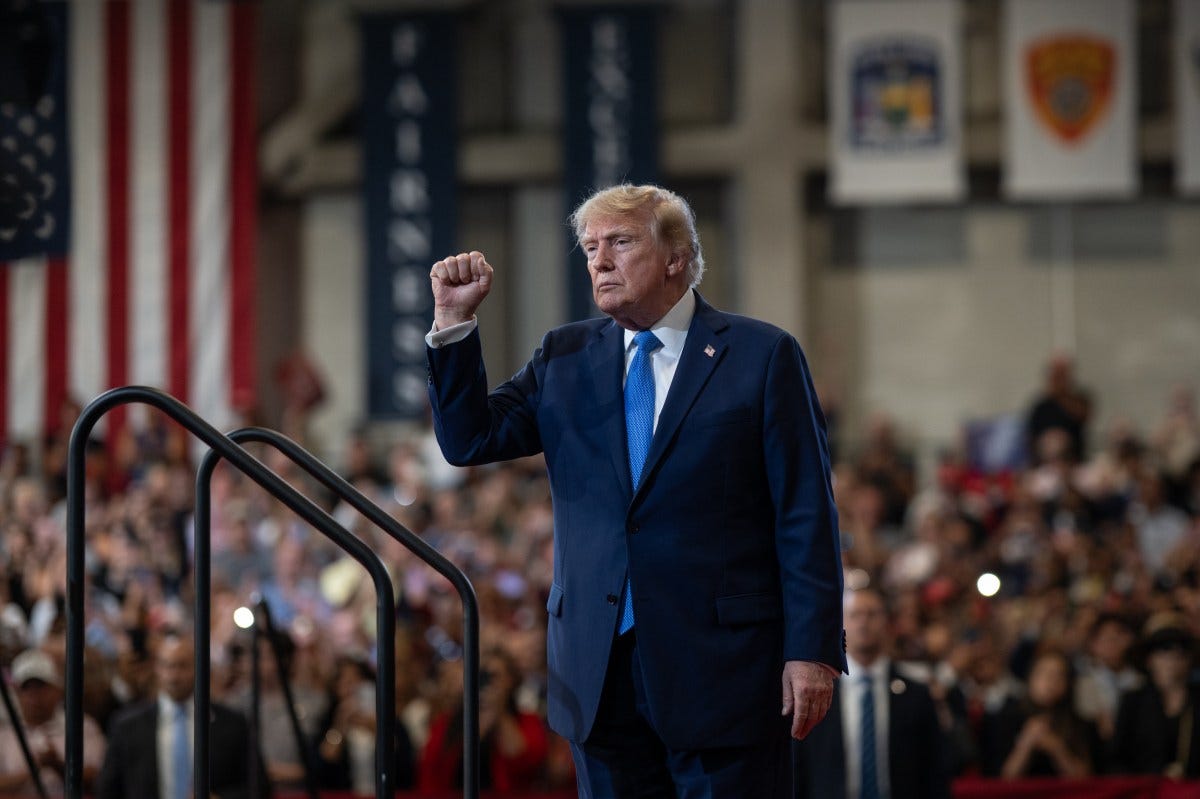
Donald Trump delivers remarks at the David S. Mack Center for Training and Intelligence in Garden City, New York. (White House)
It’s Tuesday, August 25, and with the digital ink on the MOU barely dry, Al Jazeera asked whether the U.S. was “really preparing to drop Israel.” That alarm faded, only for the Washington Post to report a widening rift, and commentators in Washington spoke of a “moment of truth” for the president on his Israeli counterpart after Netanyahu rejected Trump’s 15-point plan in Gaza. Last year, Shlomo Ben-Ami, a former Israeli foreign minister, declared that Trump had already dumped Netanyahu. And yet every time the relationship has come down to the wire, Trump has chosen Israel. In the confrontation with Turkey, he appears to be doing so again.
Tom Barrack, the U.S. ambassador to Turkey, has for some time shown the symptoms of clientitis, the occupational affliction of ambassadors and consuls whose manifestations include adopting the host country’s perspective, taking up its case against its rivals, and drifting from their own government’s policy on its behalf.
In an interview with Mario Nawfal last week, Barrack claimed Israel “still” occupies the Golan Heights, contradicting the Trump administration’s stated position. He later withdrew the remark, but it fit a larger pattern that worries Jerusalem. He has pushed for Turkey’s readmission to the F-35 program, been notably ambivalent about Turkish military encroachment in Syria, and lobbied for Syrian sanctions relief that quashed the budding normalization talks between Syria and Israel. “He is not necessarily against Israel; he simply does not see it through Israeli eyes,” as one security source put it. Netanyahu’s own objection, according to those sources, runs deeper: He believes “Barrack is behind Trump’s support for Syrian President Ahmed al-Sharaa,” and connects him to Erdogan.
After last week’s confrontation over the planned deployment of Turkish forces at a Syrian airfield, the matter seems to be coming to a head.
According to Laura Loomer, Barrack has been summoned back to Washington this week for “consultations,” which she glossed, in State Department lingo, as the term for having your “ass handed to you.” She claims the mood at Foggy Bottom has curdled to the point of wanting him gone. Türkiye Today reads it very differently. When Israeli objections have run up against “Trump’s and his man’s own read of Türkiye and Syria,” the paper argues, “the president has sided with his envoy.” In its telling, the White House sees the Barrack-Israel clash as a tactical dispute rather than a strategic rupture, and is backing Barrack to keep Israel’s moves from derailing Washington’s broader stabilization plan.
If I had a nickel for every time an adversary framed Israel as the barrier to regional prosperity, only for the U.S. to eventually see through the false promise, I wouldn’t have to write this newsletter. That isn’t to say, as Tucker Carlson inevitably will, that an Israel conspiracy runs American foreign policy. It’s that, as his friend JD Vance has put it, the two countries have “many shared interests” which include: a weakened Iran, an alliance of moderate Arab states anchored to Washington and its strongest regional partner in Israel, and a Turkey whose neo-Ottoman ambitions are contained rather than indulged.
Turkish President Recep Tayyip Erdoğan at the Turkish Gendarmerie and Coast Guard Academy graduation ceremony. (@RTErdogan/X)
Because for all its NATO membership, Turkey is an authoritarian state with a dismal human rights record that hosts Hamas’s political leadership and bankrolls Syrian factions grown from al-Qaeda’s roots, al-Sharaa’s own included. It is antagonistic enough toward Israel that, by Trump’s own account, Erdogan was “a prime candidate” to enter the Iran war on the Iranian side, staying out only when Trump asked. It occupies northern Cyprus in defiance of international law, tests the alliance it belongs to by fielding Russian S-400s, and stonewalls the entry of countries to the alliance on Russia’s behalf.
A strong Turkey is a counterweight to American influence in the region, not a multiplier of it. It is worth remembering that when Riyadh went looking to hedge its bets against Washington, the bloc it ended up in, the Mecca pact sealed this month, put Turkey at its center.
Who knows: Maybe this time Türkiye Today has it correct; perhaps when it comes to Barrack, Trump will opt against Israel. What I do know is that every previous time we seemed to reach this crossroads, he took the path more traveled, the one that leads to Israel, even if he wandered down a few detours along the way.
The scene on the beach when the ring was found.
Last week, Tal Amselem took her family to the Sea of Galilee. Before wading in, she slipped off her three rings and asked her young daughter to carry them up the beach to her mother, sitting a few meters away, for safekeeping.
They were nearly home when Tal asked for the rings back. Her mother handed her only two. The engagement ring was gone. “I thought I was going to faint,” she said.
Tal is the widow of Avichai Amselem, a reservist killed in battle for Israeli territory on October 9, having rushed out to defend the country following the October 7 attacks.
In tears, she called Eitan, a metal detectorist, who told her to stop crying and promised the ring would be back in her hands within the hour. She also called her uncles, who turned around and drove back to the lake. By the time they arrived, the whole beach was on its feet.
Eitan put out a call, and soon around 15 detectorists had gathered. Not long after, a young man named Amir Shor, who had come with his mother and his detector, found the ring in the water. It had apparently slipped from her daughter’s hand moments after Tal handed it over. Another volunteer drove all the way from Ma’alot, over an hour away, a reservist due back on duty who’d had tickets to a show that day; his partner told him to skip the performance and go help.
“Since Avichai was killed, my girls and I have been held from every direction,” Tal said. “I know that for any help I need, however small, I only have to ask and everyone comes running. What a rare people.”
English Editor: Ari Tatarka
If you enjoy the newsletter, you can show your support by becoming a paid subscriber—it really helps keep this going. I’m also offering a special monthly briefing for a small group of premium members. I’d love to have you join us—just click below to find out more.
Thanks for reading It’s Noon in Israel! Subscribe for free to receive new posts and support my work.


President Trump, when push comes to shove, has always sided with the one democracy in the Middle East and Asia, Israel. However, I hope the Israeli government is smart enough to know that in two years, when Trump is out of office, that kind of support will not exist. We already know the state department has had a history of both antisemitism (it recommended that President Roosevelt do nothing about the Nazi concentration camps) and Israel. But now we also have the anti-Semitic Democratic Socialist Party gaining seats in Congress and some right-wing Republicans taking the Tucker Carlson hateful view.
My hope is that Secretary Marco Rubio wins the Republican nomination and ultimately the national election. However, Israel should not count on that.
For Israel, Turkey with Edrogen at its helm, is only a drip away from Iran’s IRGC in its malign activity. Egypt knows this. Jordan knows this. The Emarti’s know this. Trump’s Narcissistic tendency tends to believe he can win over every bad actor with sweet talk, charm, and bashing their enemies who happen to be American friends, especially Israel and Ukraine, the indispensable bulwark allies to American leadership in the world.