The Judges Say Drop It Already
Judges recommend dropping the bribery charge against the prime minister again, and the Board of Peace spins it's wheels.
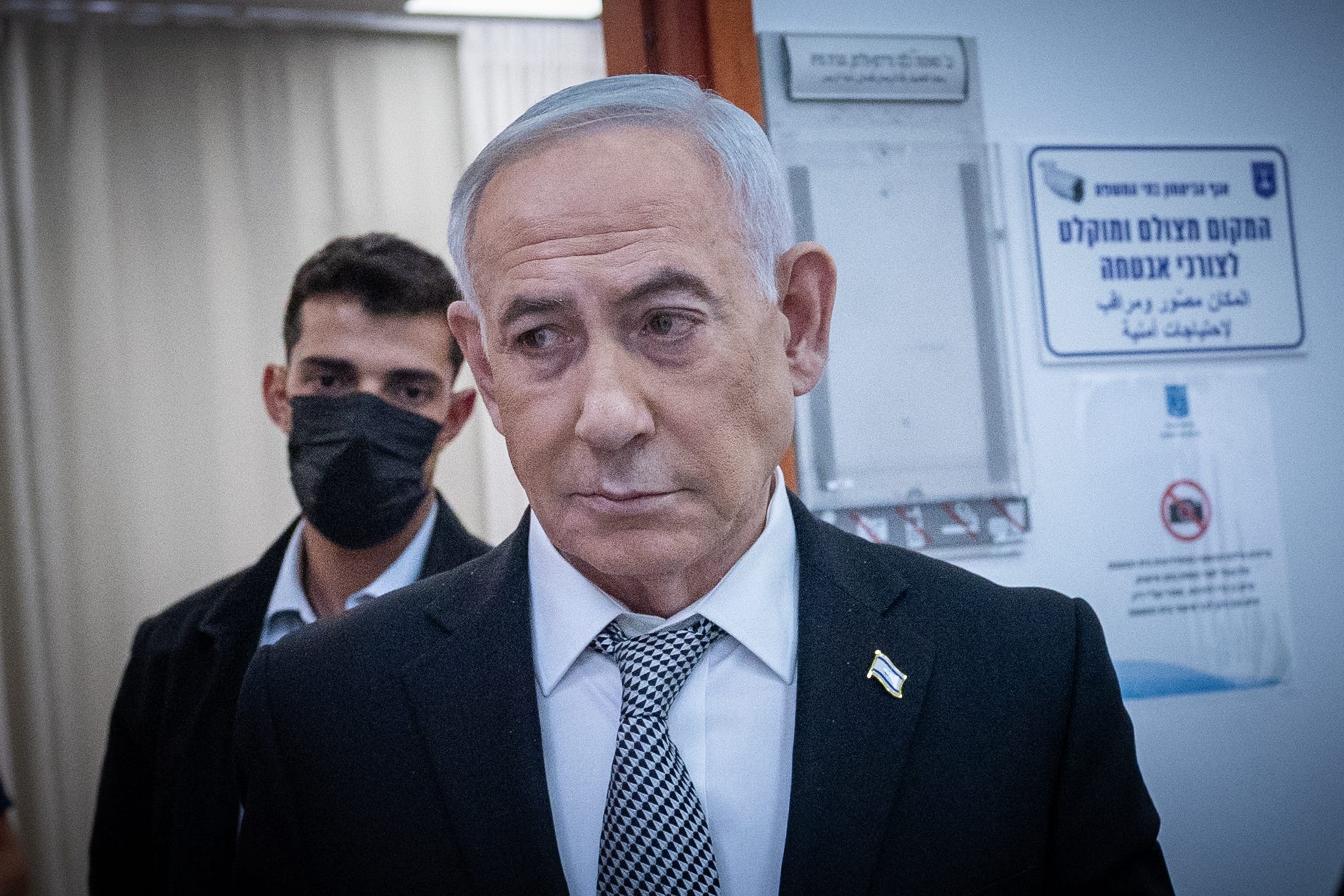
Israeli prime minister Benjamin Netanyahu seen after a court hearing in his trial, at the District Court in Jerusalem on June 29, 2026. (Yonatan Sindel/Flash90)
It’s Tuesday, June 30 and the day the investigation against Netanyahu began was one of the greatest days of my life: my son was born. Now he’s less than two years away from his bar mitzvah, and it looks like he’ll become a Jewish man before Netanyahu becomes a free one.
After his testimony ended last week, for the second time in three years, the panel of judges overseeing Netanyahu’s corruption trial told prosecutors what they apparently do not want to hear: the central bribery charge against the premier is not worth pursuing.
During a hearing at the Jerusalem District Court yesterday—convened to debate whether to expand the trial to five sessions a week—the three-judge panel reiterated a recommendation it first issued in June 2023, advising the prosecution to drop the bribery count on the grounds that it would be difficult to prove and would only drag the proceedings out further. “Our position, as expressed in June 2023, remains unchanged,” lead judge Rivka Friedman-Feldman told the court, adding that the panel had not intended to revisit the issue but did so after both sides raised it.
What makes the renewed statement weightier than the first is its timing. The original recommendation came before the defense had called a single witness. Back in June 2023, the judges took both sides into chambers and said plainly that the bribery count in Case 4000 could not be sustained, urging the state to withdraw it. The prosecution refused—betting it could resurrect the charge by breaking Netanyahu on the stand during the defense phase. A convenient narrative took hold, echoed even by retired Supreme Court President Aharon Barak and others: that the defendant’s own testimony would be his undoing. It wasn’t. After some 98 hearings and hundreds of hours of cross-examination, Netanyahu did not incriminate himself, and the gamble collapsed. With no further testimony or evidence left to introduce, the judges’ return this week to the exact position they staked out three years ago carries a blunt meaning: the prosecution’s last avenue to prove bribery has closed. The bench is simply unconvinced.
The bribery charge sits within Case 4000, the Bezeq-Walla affair, and is the most serious of the three cases against Netanyahu. Prosecutors allege that as communications minister he advanced regulatory decisions benefiting the telecommunications company Bezeq’s controlling shareholder, Shaul Elovitch, by hundreds of millions of shekels—some 1.8 billion shekels, roughly $500 million, between 2012 and 2017—in exchange for favorable coverage from Elovitch’s Walla news site. The indictment described the arrangement as a relationship “based on give and take.” Netanyahu, Elovitch, and Elovitch’s wife, Iris, all deny wrongdoing.
The bribery charge was contentious from the outset, even within the office that filed it. The decision to indict was said to have divided Attorney General Avichai Mandelblit’s team, with some prosecution officials pressing for a bribery charge and others warning it would not hold. Mandelblit himself was reportedly among the doubters, weighing whether to charge the prime minister at all. Reports before the indictment indicated the count would be watered down and narrowed, and Mandelblit took the unusual step of reopening the case files for clarification after the defense’s pre-indictment arguments. He ultimately included the charge, calling the overall decision “a difficult and sad day” made “with a heavy heart but also with a whole heart,” and insisting that where the evidence carried “a reasonable likelihood of conviction,” indicting was his legal duty rather than a choice.
Former Attorney General Avichai Mandelblit arrives for a court hearing at the Tel Aviv District Court, Sept. 15, 2024. (Avshalom Sassoni/Flash90)
As it turns out, his assessment was wrong. If, back then, Mandelblit had gone with what he had—Case 1000 and Case 2000—the trial would have ended years ago, we would even have finished with the inevitable appeal to the Supreme Court.
Still, the consequences of withdrawing the charge now would be significant but bounded. Removing bribery would leave the lesser fraud and breach-of-trust charges intact across all three cases, so the trial itself would continue. But the defense argues the practical effect would be dramatic. Chief defense attorney Amit Hadad told the court that keeping the charge in place would require calling hundreds of witnesses, warning there would be “no chance” of finishing by March 2028—the deadline tied to Friedman-Feldman’s mandatory retirement at age 70, well after my son has read from the Torah. There is indeed “no chance” the trial wraps by 2028. Add the lengthy decision-making process and the inevitable appeal to the Supreme Court by one side or the other following any verdict, and I’d put the end date somewhere around 2032 — just in time for my son to receive his draft notice.
But they won’t give up on bribery, because along with shortening the proceedings, dropping the count would strip away the only accusation that threatens Netanyahu’s ability to remain in office. It would, in effect, collapse the prosecution’s central theory of corruption while leaving the murkier, harder-to-define breach-of-trust allegations standing.
The failure to accept reality has a name—in fact, two. The bribery theory was flimsy from the day Avichai Mandelblit signed off on it—a problematic legal construction stitched together over the objections of people inside his own office who saw it would not hold. His successor, Attorney General Gali Baharav-Miara, inherited a charge the court had already told her could not be proved and pressed on regardless. She could have spared the system dozens of sessions, hundreds of days of litigation, and the spectacle of a prime minister marched through endless cross-examination on a count the bench had already written off. She chose not to—not because the evidence, or some abstract notion of justice, demanded it, but because letting the charge die would mean conceding that the most consequential corruption prosecution in Israeli history was built on sand.
That is the real scandal. A charge that everyone including the judges, and the prosecution’s own witnesses recognizes as unprovable is nonetheless kept alive for years.
For now, the bribery charge remains formally on the docket, and at this point a third signal from the bench won’t make much of a difference. But if the count is finally struck—or collapses in what seems an inevitable acquittal—the only open question will be why it took the better part of a decade to reach an obvious conclusion. I think I know the answer, and it does not bode well for the health of Israeli society.
Donald Trump signing the Board of Peace charter. (White House)
More than six months after Donald Trump’s U.S.-led Board of Peace was signed into being at Davos, the body charged with rebuilding Gaza and replacing Hamas is rich in plans and short on the one thing that would let it act: a way in.
Its representatives gathered this week at a resort in Cyprus for what an Arab diplomat and a Palestinian official described to The Times of Israel as a chance to “recalibrate” after a rocky start—though an official insisted the meeting was routine and the process broadly on track. The session followed a previously unreported workshop in the Egyptian coastal town of Ain Sokhna, attended by the full roster of the National Committee for the Administration of Gaza, the dozen-plus Palestinian technocrats meant to govern the Strip. Six months after they were unveiled, they are “managing” it from a hotel in Cairo.
Unsurprisingly, the core barrier to progress is disarmament. The Board’s Gaza envoy, Nickolay Mladenov, blames Hamas’s refusal to give up its weapons. The disarmament plan presented in March lays out an eight-month sequence: the NCAG takes security control, Israel pulls back heavy weapons, an international force deploys, and Israeli troops leave only once Gaza is “verified” free of arms. Hamas has shifted from flat rejection toward offering to surrender its police weapons and remaining heavy arms first—but the tens of thousands of AK-47s held by its military wing remain the sticking point. Translation: they are happy to hand over governance so long as they remain the real power in the Strip.
Mediators told The Times of Israel they could eventually coax a “yes, but” from Hamas; the open question is whether Washington would treat that as enough to lean on Israel.
The vacuum has birthed a “Plan B”: building “temporary communities” in the Israeli-occupied “green zone,” beginning on the ruins of Rafah. It’s a gamble—unclear whether Palestinians will agree to move to the Israeli-held side of the Strip, or whether the NCAG would forfeit its legitimacy by governing under occupation.
Even after six months—and what I’m sure was a lovely retreat in Cyprus—the facts on the ground in Gaza have barely changed. Recent events have certainly not been conducive to progress. Of the $17 billion pledged at a February donor conference, only a sliver has landed. Everyone was distracted by the small matter of the Iran war, and the Gulf states suddenly were faced with higher spending priorities. The war has also shifted the government’s—and, more importantly, Trump’s—attention away from the Strip. Virtually all of the diplomatic progress on the Gaza front has come from Trump’s sheer force of will, and short of Hamas blocking a major shipping route, I wouldn’t forecast a major redirection toward Gaza any time soon.
English Editor: Ari Tatarka
If you enjoy the newsletter, you can show your support by becoming a paid subscriber—it really helps keep this going. I’m also offering a special monthly briefing for a small group of premium members. I’d love to have you join us—just click below to find out more.
Thanks for reading It’s Noon in Israel! Subscribe for free to receive new posts and support my work.


Let Bibi Netanyahu free from the ongoing frustration of this lengthy and irresolvable trial. Who has given more or worked harder for the good of Israel? Surely not this legal assault crew who burdens your Prime Minister with fruitless arguments.
How Do Wars End? By one side defeating the other. This war has been going on for 78 years. We (The West) keep trying to Negotiate an end, Neither side has been allowed to WIN.