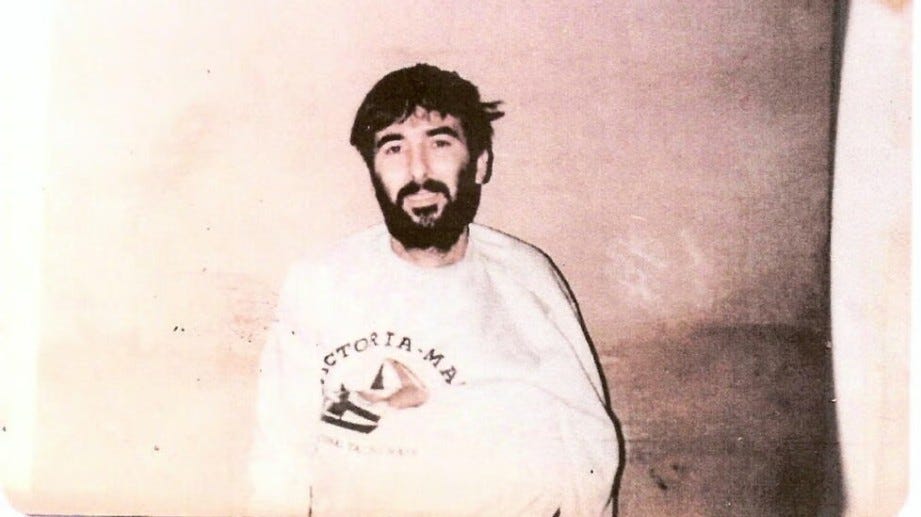
Mossad Kidnaps Ex-Lebanese Security Official
Also, Army Radio officially disbanded by the cabinet, Israel’s media suppression law extended, and more.
Ron Arad
It’s Wednesday, December 24, and the Mossad has been busy in Lebanon. According to the Saudi paper Al Arabiya, Israeli agents abducted an ex-Lebanese security official, Ahmed Shukr.
You might recognize the last name. He’s the cousin of Fuad Shukr—Hezbollah’s chief of staff, the man who had a $5 million bounty on his head until he was taken out by Israel last year after the massacre of 12 Druze children in Majdal Shams.
But how do the dots connect? Why take Ahmed?
It all comes down to one man: Israeli air force navigator Ron Arad.
In 1986, Arad’s plane sustained damage over Lebanon, forcing him and the pilot to eject. While the pilot managed to hide and was eventually rescued, Ron was abducted by the Shiite Amal movement. Negotiations for his release broke down—and the trail went cold. For nearly four decades, Israel has been searching for answers.
For Israelis, Ron is more than another hostage; he is the hostage.
Last week, the father of Ran Gvili—the last remaining hostage in Gaza—told Kan 11, “We pray, of course, that he will not be another Ron Arad.” It wasn’t the first time Ron’s name surfaced during this war.
But that brings us back to Ahmed.
According to the report, there is information indicating that Hassan Shukr, Ahmed’s brother, was a fighter in a group led by Mustafa Dirani. Dirani headed the military wing of the organization that captured Ron. But the trail doesn’t stop there. Ahmed’s cousin, Fuad, lived in the very house where Ron Arad was last known to have been. It seems Ron’s kidnapping may have been a family enterprise.
According to the report, Mossad agents—with the help of two Swedish nationals—extracted Shukr by sea or air to Israel, where he is believed to be under interrogation.
Now, as surprising and impressive as this alleged operation sounds, it’s really just standard Mossad.
So, let’s go back to Ron Arad.
According to one senior Israeli security official, “There has never been a man in the history of mankind who saw so many efforts invested into locating and liberating him.”
Shukr wouldn’t even be the first man abducted in the search for Ron Arad. He’s at least the third—maybe the fourth, if you believe reports that Israel snatched a former Iranian general in Syria back in 2021.
In the 1990s, Israel reportedly offered Iran $10 billion in exchange for information about Ron. Ten billion. To their sworn enemy—the regime publicly bent on Israel’s destruction.
Israel’s obsession with bringing its people home is legendary. But Ron Arad’s story shows the depth of that obsession—and this latest operation is just the newest chapter in a 40-year saga of bringing them home.
Defense Minister Israel Katz in the “Houthi operation room” in October. (@Israel_katz/X)
Army Radio is going off the air. Defense Minister Israel Katz’s decision to shut down the station in November, was made official yesterday by a unanimous Cabinet vote. But is the decision final? And what is Israel losing?
Also known as Galei Tzahal, Army Radio (where I spent my military service) is one of a very small family of national radio stations in the country. In Israel, there are ten national stations, two run by the army and the rest by the government.
Katz isn’t the first to try to make it nine. Israeli officials—both in and outside the military—have pushed to either close Galei Tzahal or remove it from the army’s purview, for the simple reason that it’s problematic for an IDF station to be broadcasting the news, let alone sharing partisan opinions on national issues.
Katz’s motivations are largely political; he believes the station is too left-wing and even hinted that its political bias “harms the war effort and morale.” He has a point. Even the head of the Democrats party, Yair Golan, called for the station to be shut down in 2020, albeit not due to its alleged political bias.
That effort didn’t stop Golan from calling the attempt to shut it down “a fast-tracked regime coup and a brutal attack on democratic institutions, including the media.” Opposition Leader Yair Lapid derided it as “yet another attempt to change the rules of the game by a government anxious about criticism and aware it will lose in the elections.”
Yes, Army Radio has bias. But Golan’s and Lapid’s claims that the government’s real goal here is to silence criticism of its policies should not be dismissed out of hand.
But let’s not get too hasty; no government decision in Israel is final until the judges have their say. The court is expected to receive petitions next week, and the outcome is unpredictable. The fate of Army Radio rests on which judges will sit on the bench.
But is there another solution? If you ask me, it’s simple: competition. Establish national commercial radio stations. Right now, Israel’s radio market resembles North Korea’s: the government’s radio competes with the military’s radio. But that doesn’t have to be the case, and here’s where we can take inspiration from Golan’s 2020 suggestion. If Galei Tzahal were shut down, he wrote, “the funds could be invested in improving public broadcasting, and the IDF would be removed from the political debate.”
IDF soldiers hand an Al Jazeera reporter a military order directing the closure of his Ramallah office during a raid of the bureau on September 22, 2024. (Screen capture/X)
Media suppression in Israel has been extended until the end of 2027. Yesterday, the Knesset announced that the law that allows the prime minister to shut down foreign media outlets if they present a security threat has been extended.
So—does this mean Israeli freedom of the press is in danger?
Not really. This law was written with one name in mind.
Ask yourself: Which media outlet promotes radical Islamism across the Middle East and is run by a hostile government?
Correct. Our old friend, Al Jazeera.
In May 2024, under the emergency version of the law, Israel banned the Qatari network from operating within its borders—including in Judea and Samaria. Police entered its offices, seized broadcast equipment, and pulled the plug. The move wasn’t controversial in Israel; it was unanimous across the security establishment.
Why? Because Al Jazeera wasn’t just reporting. It was broadcasting live positions of IDF staging zones during combat operations. And, as later confirmed, at least six of its “journalists” in Gaza were also part-time Hamas operatives.
That’s all to say, nineteen months later, Israel has no interest in letting the network back on air.
How do I know it’s about security and not media censorship? If it were, you might expect other critical outlets to have been targeted too. CNN, The Guardian, The Washington Post—all still report freely from Tel Aviv, Jerusalem, and the border. Some have been brutally critical of Israel’s wartime conduct. No one shut them down.
The only other channel hit by the ban? Al Mayadeen.
It’s a Beirut-based network founded by a former Al Jazeera anchor who thought Al Jazeera was too harsh on the Assad regime. That’s right—too harsh on the regime that used chemical weapons on its own citizens. Since then, the outlet has become a full-throated Hezbollah mouthpiece, praising terrorists and peddling antisemitic conspiracies.
And here’s the thing—this isn’t uniquely Israeli.
Back in 2010, the U.S. banned Gaza’s Al-Aqsa Television, a Hamas-run channel.
France and Germany both banned Al-Manar, Hezbollah’s broadcast arm, in the mid-2000s.
It’s not about press freedom; it’s about security.
I agree with Communications Minister Shlomo Karhi: “Terrorist channels are out of bounds, in normal times as well as under a state of emergency.”


