Somaliland Recognized: What’s in it for Israel?
Also, clarifying QatarGate, and the grim reality of Palestinian Christmas.
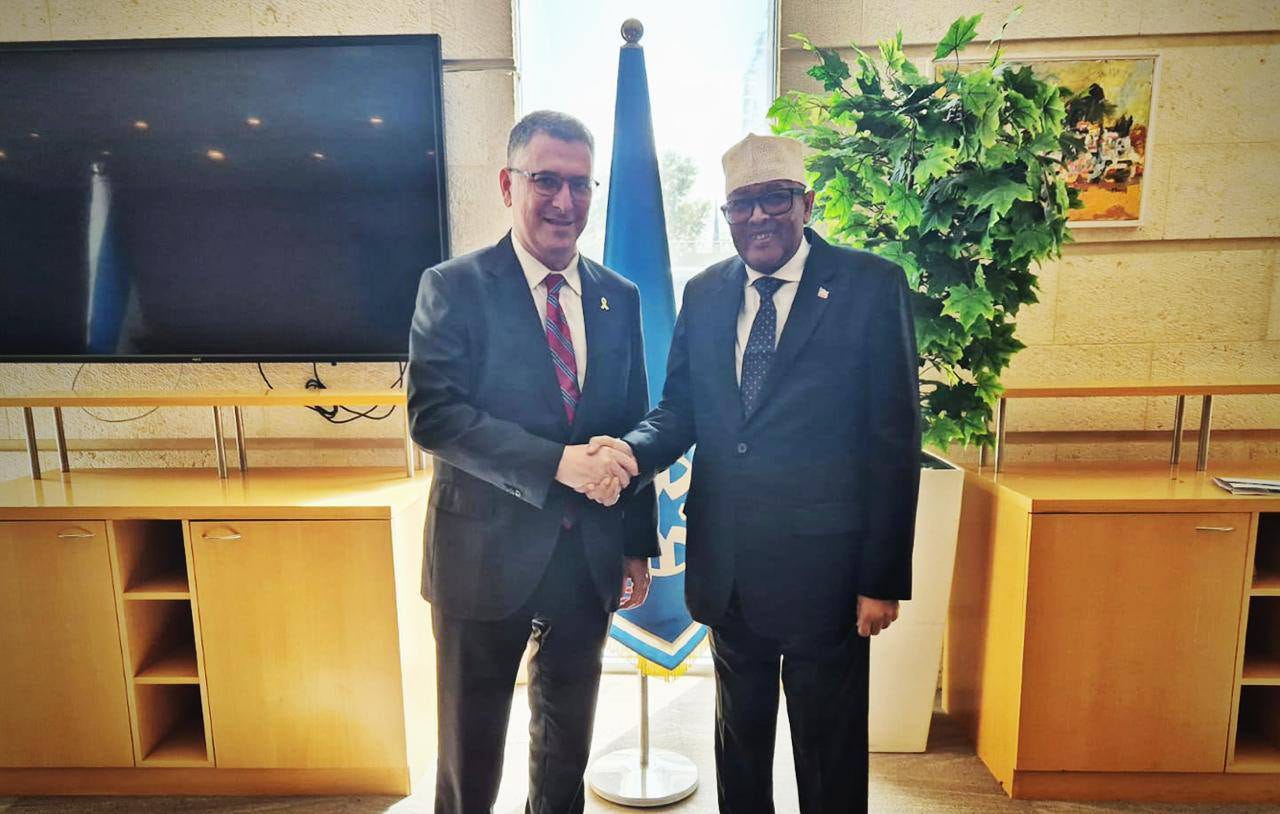
Somaliland’s President Abdirahman Mohamed Abdullahi and the Israeli Foreign Minister Gideon Sa’ar. (Israel Foreign Ministry)
It’s Sunday, December 28, and people seem to have short memories. When Israel recognized Somaliland this past Friday, you could practically hear the question being asked: “What’s Somaliland?”
That’s the second time this year. The first time was in March, when Trump announced the Gaza Riviera plan, and the small nation was rumored to be in negotiation to accept several hundred thousand Gazans in exchange for recognition.
But let’s give everyone a reminder.
Somaliland is a self-governing territory in the Horn of Africa that declared independence from Somalia in 1991 and has operated as a de facto state ever since. It has its own government, elections, currency and security forces, but is still not internationally recognized as a sovereign country.
But as of Friday, it now boasts a grand total of one recognition — from a country that isn’t exactly universally accepted itself. Still, the Somalilanders were excited nonetheless.
So is this it? Is the Riviera plan back on?
Unlikely, but there is a quid pro quo.
If you look at a map of the Horn of Africa, you’ll see that across the Gulf of Aden lies Yemen. That country, too, has its own separatist state. But where Somaliland is a functioning — if flawed — democracy, Yemen’s is an oppressive Islamist regime that managed to choke off global shipping for two years: the Iranian-backed movement known as the Houthis.
We haven’t heard much from them recently. They’ve gone quiet since the cease-fire — but Israel’s attention hasn’t drifted. Out of all the Iranian-backed forces that attacked Israel after October 7, the Houthis were both the most surprising and, in some ways, the most effective.
Israel has already struck the Houthis several times, including a major August operation that reportedly killed several senior leaders, including the group’s so-called prime minister.
But each of those strikes is no small feat: each one requires either sending Israeli naval assets deep into the Red Sea to launch expensive precision missiles or flying fighters 2,000 miles from home—demanding complex midair refueling and exposing the aircraft to significant risk.
Here is where the speculation begins.
Imagine if, hypothetically, they could strike from somewhere closer—say, a local airport such as Somaliland’s Berbera facility. That would place them only about 300 miles away. Convenient, no?
Of course, to host advanced drones or fighters, you’d need proper infrastructure—hardened shelters, underground hangars, secure logistics. Just the sort of construction that open-source analysts have recently spotted in the area. Pure coincidence, I’m sure.
Satellite images showing construction at Berbera Airport. (AbuAliExpress)
After all, those hangars must be for Somaliland’s own air force—the one with zero fighters and zero UAVs. Well, if they aren’t using it, maybe in exchange for access to those facilities, Israel might be willing to become the first country to recognize the small African democracy.
All of this is pure speculation, of course.
But there is one contrast I would like to mention: It seems when Israel recognizes a country, it does it to fight terrorism, not reward it.
Prime Minister Benjamin Netanyahu with Yonatan Urich and Yisrael Einhorn a few days before the elections, April 1, 2019 (Courtesy)
The decision to recruit Eli Feldstein to the Prime Minister’s Office was made by Yonatan Urich. In the second week of October 2023, Benjamin Netanyahu had slightly more urgent matters on his mind than hiring an assistant spokesman. But the general direction was clear: someone who would speak with the military correspondents through a semi-official channel, based on the assumption that if there is 100 percent responsibility for the failure, then the larger the share that falls on the chief of staff’s shoulders, the less will weigh on the prime minister’s.
Feldstein was, ostensibly, the perfect candidate: well-connected in the IDF, with astonishing familiarity with the internal politics of the senior officer corps, knowing exactly where the information caches were hidden that would continue to trouble the chief of staff for a long time. It was no accident that senior General Staff officials were alarmed when they heard of his appointment.
Journalists not knowing until the affair exploded that they were being fed Qatari messages is one thing. No less intriguing is the fact that deep into the war, many of us did not know that Feldstein was working for the Prime Minister’s Office at all. The employment arrangement was crooked in substance and defective in its paperwork.
Urich paid the full price for this employment. After several days of shifting explanations, he produced a shocking version: the money I received in the chain from Qatar was a substitute for payment from the Prime Minister’s Office, with Urich’s knowledge. That was the moment the affair threatened to shake Netanyahu’s position. After all, if his ties with Qatar are so close that it functions as his petty cash fund, the implication is that fanatic messaging is influencing national security inside the Prime Minister’s Office.
That version collapsed long ago and finally died this week with the publication of Feldstein’s correspondence by Avishai Grinzaig. This was not a fictitious employment by Netanyahu but a deal between the adviser and Qatar: money in exchange for PR. The question is Urich’s knowledge. The entire argument that he was “in the loop” inside the office (not during the 2022 World Cup) rests on a single refined phrase — “shitting cubes” — which he used in response to a text from Feldstein containing a briefing that helped Qatar. The slang term means something approximating “ok, got it”. More will be required to tie him to the dark deal. He will also be required to explain, in parallel, whether he worked for Qatar abroad during the war as alleged — a claim his associates deny.
The most fascinating figure in the affair is Urich, not Feldstein. He is the adviser behind the move that turned Netanyahu, in the eyes of his voters, into the leader of a movement, and he is signed onto a record of six election campaigns with thirty mandates or more. Urich exits them with three indictments, in what appears to be targeted treatment by law enforcement: the Filber harassment affair, the Bild leak, and Qatargate. These proceedings will conclude in the mid-2030s, while in the meantime he is barred from contact with Netanyahu and can at most work within the Likud. Does anyone know a way to run a prime-ministerial candidate by telepathy?
His temporary departure coincides with Ron Dermer’s permanent exit. When people talk about Netanyahu’s inner circle, these two were the environment: one handled the diplomatic flank for the prime minister, the other the communications front. Netanyahu is entering a year of diplomatic decisions and a political election year without either of them. One is in business, not answering the phone; the other is under investigation, unable to call.
This is an excerpt from my weekly column in Israel Hayom.
To read this article on my website click here
Nazereth lit up for Christmas in 2018 (Elal)
For the first time in two years, the Church of the Nativity in Bethlehem was lit by Christmas decorations. The scene was joyful, the coverage even more so.
International outlets rushed to celebrate the “return of Christmas to Bethlehem.” Palestinians recovering Christmas from the Israeli Grinch is a great story. It gives “peace among all mankind” energy, while scratching an anti-Semitic stereotype of anti-Christian Jews.
But underneath the holiday movie is a story of oppression and persecution that is entirely Palestinian.
For every one Christian celebrating in the place of Jesus’s birth, there are nine Muslims. A census from 2017 shows that the city, which was once upwards of 86 percent Christian in 1950, is now just 10 percent. Of that 67-year period, Israel only controlled the city for 28 years. They handed a majority-Christian city to the Palestinian Authority in 1995; then its Christian population dropped.
This isn’t a coincidence. Multiple reports by groups such as Open Doors, Aid to the Church in Need, and testimonies from Palestinian Christian clergy describe patterns that are disturbingly consistent: intimidation, coerced land sales, harassment of Christian women, forced Islamization in family-law disputes, vandalism of churches, and physical assaults that rarely see justice.
Last week, while Christmas trees were being lit in Bethlehem, in Jenin—another city controlled by the PA—they were set on fire by Muslim extremists. At the same time, just a few miles away from the celebrations in Bethlehem, in the town of Beit Jala, Christians hid their celebrations out of fear of religious violence from local Muslims.
It begs the question: Why the lack of attention?
Why, when a stray tank shell tragically struck a church in Gaza, did the world explode with rage? When the Christian population of Gaza dwindled from 5,000 to just 1,000 by October 2023—while the rest of the population almost doubled—we hardly heard a thing.
If they want to focus on Israel, I would be happy to.
Christian Arabs in Israel have the highest educational attainment of any religious group in the country. They are overrepresented in medicine, law, academia and technology. Christians serve as judges, diplomats, IDF officers and members of parliament. Churches operate freely. Holy sites are protected by law.
Last week, the Israel Central Bureau of Statistics released a report showing Israel’s Christian population had grown 0.7%.
Shockingly, that moderate growth is unparalleled in the region.
If there’s one thing that sums up this entire story, it is this fact: In the entire Middle East—500 million people, 17 countries—a region that was once 20 percent Christian, only one single country has seen its Christian population increase, and it isn’t Palestine.


