The Ayatollahs Plan Their Escape
Also, Hamas’s new strategy, and the Attorney General’s newest attack on democracy.
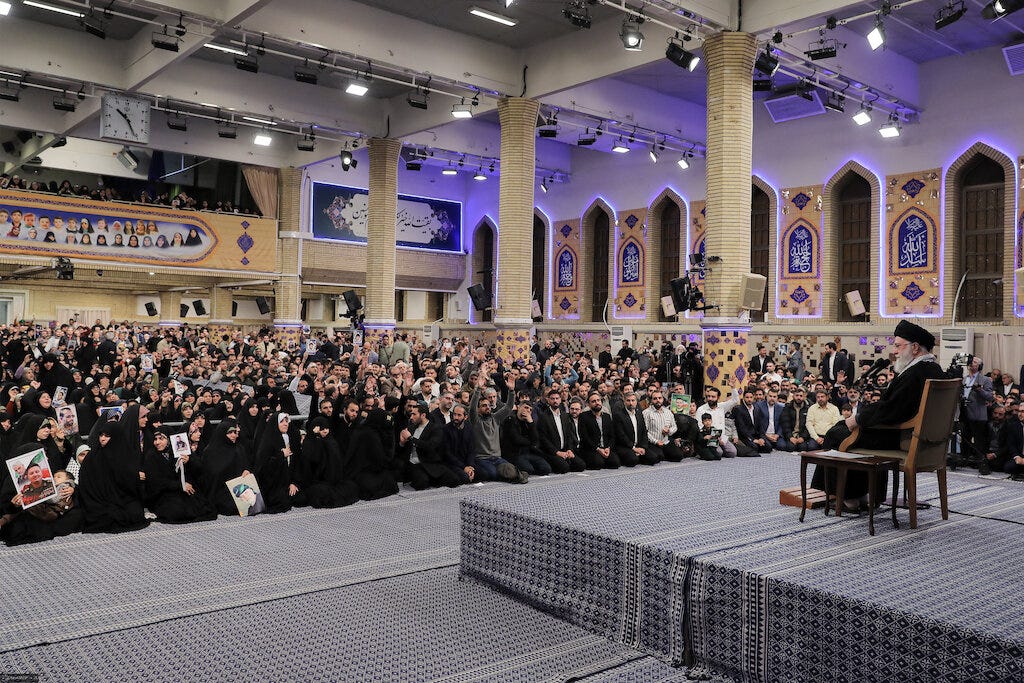
Supreme Leader Ali Khamenei meeting with the families of IRGC “martyrs” on Saturday. (Khamenei.ir)
It’s Monday, January 5, and a day after regime change in Venezuela, Donald Trump has his eye on Iran. Yesterday he commented:
“We’re watching it very closely. If they start killing people as they have in the past, I think they’re going to get hit very hard by the United States.”
He said something similar last week—but after the events of this weekend, Trumpian bravado is now a pants-wetting threat. After Venezuela’s Nicolás Maduro was captured by the United States, you could practically hear the question—“Are we next?”—echoing from Tehran all the way to Jerusalem.
So how nervous is Tehran? Well, according to The Times, Supreme Leader Ali Khamenei may be preparing what one might call a “Russian goodbye.” You know—the discreet evacuation route offered by Moscow to collapsing strongmen. (Think a “French goodbye,” but for Middle Eastern dictators.)
That’s a big step, but let’s be honest: it beats being picked up by Delta Force.
This isn’t the first time such rumors have circulated. The last was during the June war, when the regime found itself cornered by Israel. This time, the threat is seemingly just as potent—but it isn’t foreign; it’s domestic.
Meanwhile, in Jerusalem, a very different kind of discussion is unfolding. Last week, senior officials were still talking about hitting Iran again to blunt the ballistic missile threat. The conversation surrounded potential U.S. support and the potential ramifications of a renewed war.
This week, the tone has shifted. The new question: Should Israel sit this one out?
From Israel’s perspective, this is the first time in decades organic regime change seems possible. And the best way to help it may be by doing nothing at all.
Why? Because every time the Mossad or a cabinet minister hints at “helping” Iranian protesters, it hands the mullahs the perfect quote to justify a brutal crackdown on the “foreign” protests. It’s the same excuse the regime used to suppress protests and execute hundreds of dissidents after the war in June—without evidence—and one they’d happily use again if given the chance.
Yesterday, Netanyahu came out with a relatively passive statement affirming Israel’s identification with the Iranian people’s struggle.
Don’t worry, the regime has already tried to twist it. Their foreign ministry came out today to accuse the “Zionist regime” of seeking to exploit the protests to “sow division and undermine our national unity.” Khamenei, in his sole statement addressing the protests on Saturday, made a similar claim—alleging that demonstrators were caused by forces “incited or hired by the enemy.”
In short: Israel needs to get out of the way.
As Khamenei himself said, the claim that foreign forces are driving the protests—“This is what matters most.”
A tunnel in Rafah. (IDF Spokesman)
Somewhat like in the recent Torah portions of Exodus, Hamas—like Pharaoh—understands that the party is over. That after the seven good years (or seventeen, in their case), the bad years arrive. To survive, they must change. Like a polar bear entering hibernation, knowing that what matters now is simply staying alive. Hamas, one of the most adaptive organizations in the world, is completing its transition from a governing authority to a guerrilla organization and then into a dormant underground movement.
The transition began in April 2024, when mourning was declared over the destruction of its military wing—its bases, missiles, and leadership. After mourning came acceptance. The goal is singular: Hamas must survive.
Hostages? We’ll return them all and not cause too much trouble. Israel and the U.S. object to certain figures we want to appoint to a committee? Fine—we’ll bring others. Israel tries to provoke us into responding? No problem, we’ll sit quietly. There are 150 operatives in Rafah who could reignite everything? Fine, we’ll give them up. A multinational force? We’ll oppose it at first; if that fails, no big deal—Plan B is that the force won’t enter Gaza but will instead guard the Yellow Line. Do whatever it takes to survive.
All in the name of keeping things quiet. They know Israel has long been addicted to quiet, and they’re not convinced the detox program of the past two years will hold. They’re betting that Trump wants achievements, not noise. So they maneuver indirectly on weapons, work intensively with Egypt, Turkey and Qatar to keep them on their side. They prefer causing Israel trouble in international forums rather than harming soldiers right now. Raise more money, secure more donations, rebuild quietly.
There is another thing almost completely ignored in Israel: Hamas has been in an internal election period. This is part of its attempt to present itself to the world as a legitimate, democratic movement. Khalil al-Hayya and his camp ran against Khaled Mashal and his faction. It is no coincidence that Mashal was recently filmed delivering a fiery speech that in no way reflects the conciliatory posture of the man at odds with Iran.
Europeans, of course, buy these stories. Americans raise an eyebrow but want quiet. And Israel, for its part, is currently more focused on Iran and Syria than on Gaza. From Hamas’s perspective, it’s a perfect time to survive.
How do you change that? Through a military operation that uproots the organization’s weapons at the root—certainly not by withdrawing from the Yellow Line. “There is a plan,” Netanyahu said this week in Florida, repeating: “There is a plan.” When will it be implemented, as long as the president still believes in disarmament? On that, the answer was more evasive: “What’s the rush?”
This is an excerpt from my weekly column in Israel Hayom.
To read the article on my website click here
Attorney General Gali Barhav Miara and National Security Minister Ben Gvir (Knesset.gov.il)
Attorney General Gali Baharav-Miara is demanding the dismissal of National Security Minister Itamar Ben-Gvir. Now, anyone could probably guess that she would try if they got a vague description of the two figures—but the way Baharav-Miara is pursing it is unprecedentedly undemocratic.
Last week, Baharav-Miara filed a claim of abuse of power against Ben-Gvir in the High Court. As part of that filing, she asked the court to demand an explanation from Netanyahu as to why Ben-Gvir hasn’t already been dismissed.
You might be thinking: Wait, don’t they have to prove something before a minister can be removed?
Well, in Israel, the presumption of innocence apparently evaporates once you’re an elected official. Just having something filed against you can now force your removal.
Does that mean the judiciary can effectively impeach ministers at will?
Pretty much.
But let’s rewind for a moment.
Back in 1993, Aryeh Deri—then (and still) the head of the Shas Party—was indicted on corruption charges. Before his trial even concluded, the Supreme Court ruled that his continued service as a cabinet minister was “unreasonable” and ordered his dismissal. That decision created what’s now called the Deri Doctrine: a precedent allowing criminal proceedings alone—without conviction—to justify removing an elected official from office.
Now that sounds insane. Because, frankly, it is.
As my friend Yonatan Green puts it in his excellent new book Rogue Justice: The Rise of Judicial Supremacy in Israel:
“Deri is a colossal aberration of democracy, of the rule of law, of the separation of powers, and of criminal justice. There is nothing remotely similar to it in the legal system of any civilized nation on earth... Without any basis in statute or text, the Supreme Court assumed for itself the power to dictate to the Prime Minister when to dismiss (or eventually, to refrain from appointing) a Cabinet Minister, based solely on the subjective judgment of a handful of senior prosecutors... It is a severe violation of the presumption of innocence and of criminal due process.”
But Baharav-Miara is taking it even further. The accusation is three days old—there’s been no investigation, no indictment, and not even a claim of criminal conduct.
In the United States, cabinet officials can only be removed through impeachment by the House and conviction in the Senate—a long, evidence-based process with hearings, votes, and ultimately a supermajority in the Senate. In Israel, apparently there’s no impeachment, no parliamentary review, no trial. One petition to the High Court can now upend an elected minister’s career overnight.
Yesterday, Netanyahu made it clear he won’t fire Ben-Gvir over the petition, triggering a tense exchange with Deputy Attorney General Gil Limon.
Now, whatever you think of Ben-Gvir and his fitness for a cabinet position, I think we can all agree on one thing: a minister shouldn’t be removed by judicial suspicion.
And as Yonatan describes the precedent that allows for this insanity:
“Deri truly places Israel at odds with consecrated principles of liberal democratic government. In the simplest terms, the effect of Deri is the unsupervised and uninhibited power of a few senior prosecutors to dismiss most serving politicians from office. Its existence is intolerable enough even were it not for the undeniable evidence of widespread abuse. The many other theoretical and practical objections to the Deri Doctrine pale in comparison with this single consequence.”
Baharav-Miara summed it up quite well in her file against Ben-Gvir: “This situation results in a real violation of basic democratic values.”
To buy Yonatan’s incredible book click here
If you enjoy the newsletter, you can show your support through Buy Me a Coffee—it really helps keep this going. I’m also offering a special monthly briefing for a small group of premium members. I’d love to have you join us—just click below to find out more.


Have you ever tried to kill a large snake? It isn't easy. Killing the IRGC would be very difficult from the air.