The Race for Lebanon’s Future
Also, Israel’s women fall behind Russia, a new friend in South America, and more.
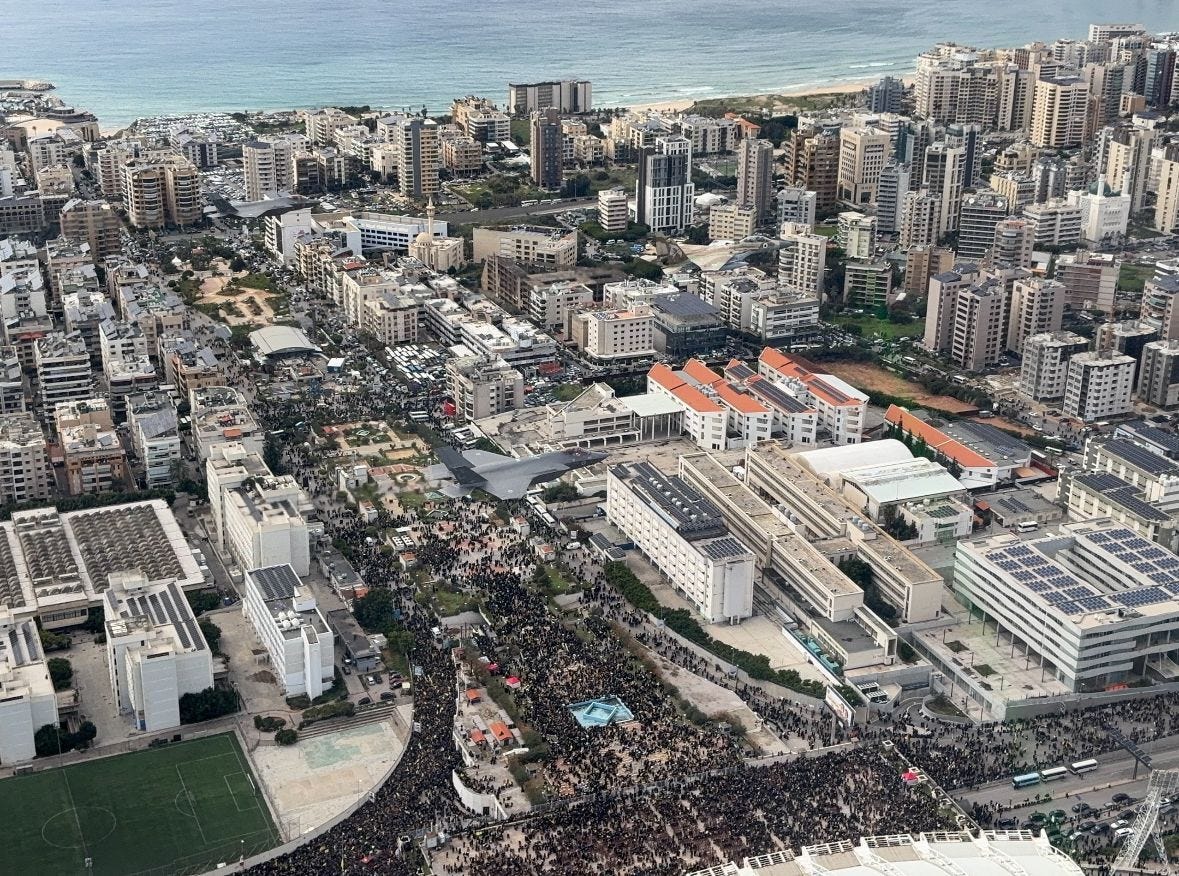
Israeli Air Force fighter jets fly over the funeral ceremony for Hezbollah leader Hassan Nasrallah in Beirut, February 23, 2025. (IDF)
It’s Friday, December 26, and if Hezbollah was at level 100 on October 6, 2023, it reached the ceasefire on November 27 2024, at roughly level 20. And its condition at the end of 2025? A slight improvement — somewhere around 25.
In the first two months after the war ended, Hezbollah was unable to staff platoon- and company-level command positions. The blow to its firepower capabilities was not only physical but systemic: the concept of dispersing and concealing the rocket and missile array collapsed. The same applies to the Radwan Force, which will not be able to storm northern communities due to the new buffer zone and the destruction of its bases in Shiite villages near the border.
The time since has therefore been used for rethinking. One conclusion is not to respond to Israeli strikes. In Israel this is interpreted as weakness on the part of an organization that for years deterred Israel and operated in Lebanon as if it owned the place. That is the truth — but not the whole truth. Hezbollah also refrains from responding because it understands that at the end of each week it is still stronger than it was the week before. So why give Israel a pretext for a broader attack?
Weakening Hezbollah is only one side of the equation. The other is strengthening the Lebanese state. Israel excels at doing its part, but it will never be able to eliminate the organization on its own. The reason for Lebanon’s weakness is Lebanese trauma. The Israeli “never again” is the Holocaust; the Lebanese equivalent, by contrast, is the civil war that destroyed the state. Hezbollah’s threat of war is deterrent enough. What threatens the Lebanese are Kalashnikovs, not rockets — and those the IDF cannot destroy.
So what is to be done? The story is also a race between bad money and good money. In the year since the ceasefire, despite efforts to block it, a billion dollars smuggled by Iran has nevertheless entered Lebanon, all of it devoted to rebuilding Hezbollah. And the good money? A quarter of a billion Western dollars has reached the country, but it is locked in a special fund that will be released only once anti-corruption conditions are met. At present, for example, the Lebanese army can operate only half its forces at any given time. Earning starvation wages of about $100, most soldiers work week-on, week-off — in the army and on side jobs — just to survive. Raise their salaries, and force strength would double overnight. If the United States and its regional allies want to close the story, they need to open their wallets.
This is an excerpt from my weekly column in Israeli Hayom
To read on my website click here
Female soldiers operate a tank in the Negev Desert, in an undated photograph. (Israel Defense Forces)
“Women’s rights are on a sharp decline in Israel. Advocates blame Netanyahu’s far-right government.” That’s a punchy headline from CNN. Too bad it isn’t true.
According to the article, Israel’s position on the Women, Peace and Security Index has plummeted. Israel now ranks 84th of 181 countries—behind Albania, Russia and Saudi Arabia. Before the current government came into power three years ago, it ranked 27th.
So, that’s it then—an open-and-shut case?
Not exactly. Let’s dig into what the index measures.
The categories include political violence against women, maternal mortality, women in parliament—those kinds of metrics. Reasonable enough.
According to statistician Ariel Karlinsky’s analysis of the index, across most of these, Israel’s position saw moderate ups or downs in 2025, still roughly in line with other OECD countries. Nothing extraordinary.
So how, exactly, does Israel end up ranked worse than Saudi Arabia?
Because of one metric: the percentage of women living within 50 kilometers of an armed conflict. Israel’s score? A tidy 99.6 percent.
It looks like Israel’s geography is sexist.
Israel is tiny. With Hezbollah to the north and Hamas to the south, the real surprise isn’t that 99.6 percent of Israeli women live within 50 kilometers—it’s that 0.4 percent manage to avoid it.
I’d advise any Israeli woman tempted to book a flight to Riyadh or Moscow in search of female liberation to take a second look at the statistics before packing her bags.
That advice applies to zero people because it’s incredibly obvious that Israel is not a sexist dystopia.
And that’s the real story here. Not that people criticize the government—that’s par for the course—but that no one at CNN paused to ask: “Wait, if Israel is ranked below Saudi Arabia, could there be a problem with these numbers?”
Sure, the network’s piece gives a passing nod to the conflict variable buried in the index methodology, but it’s treated like an afterthought. The rest of the article focuses on religious courts and women’s representation in government—important issues, to be sure—but the framing is not a discussion piece on religious policy. And that is certainly not what the people waving the article, accusing Israel of sexism as well as genocide and apartheid are going to focus on.
The obvious lack of truth to Israel’s ranking begs the question: Is CNN being cynical—or have its editors gotten so used to attacking Israel that any accusation seems plausible?
Honduran President-elect Nasri “Tito” Asfura with supporters in November. (titoasfura.hn)
A new friend of Israel rises in South America. Honduran President-elect Nasri “Tito” Asfura made a symbolic visit to the residence of Israel’s ambassador to Honduras the day after his electoral victory. The new President-elect has stated that he looking to strengthen ties and economic cooperation with the Jewish State.
Despite being the fourth country to recognize Jerusalem back in 2021, Honduras’ last left-wing government recalled its ambassador from Israel in protest of the humanitarian situation in Gaza and declined to formally recognize Israel’s ambassador in Honduras. Asfura’s visit to the ambassador yesterday implies he won’t remain unrecognized for much longer.
Asfura joins a growing club of Israel-supporting leaders in the region: Paraguay’s Santiago Peña and Argentina’s enthusiastic philo-Semite Javier Milei.
What’s might be called unique about Asfura is his Palestinian ancestry. His parents migrated to Honduras in the 1940s, fleeing conflict. In fact, both candidates in the Honduran election were of Palestinian Christian background—yet it was the pro-Israel one who emerged victorious.
Asfura didn’t wait long to show it. Within hours of his win, he was on the phone with Israel’s Foreign Minister Gideon Sa’ar, discussing ways to strengthen bilateral ties.
Just like that, another light appears in South America. Let’s hope it isn’t the last.
Pope Leo XIV giving the Christmas address. (Screen grab used in accordance with Section 27a of the copyright law)
During his Christmas address, Pope Leo XIV quoted the words of a Jew. I know—obvious—but not just the Jew whose birthday he was celebrating. The pope chose a line from “Peace Upon You” by the Israeli poet Yehudah Amichai—the only quotation in the entire address not drawn from Christian scripture, and, impressively, delivered in the original Hebrew.
So, who is Yehudah Amichai?
He’s widely regarded as Israel’s greatest modern poet. A veteran of World War II, Israel’s War of Independence, the Sinai Campaign and the Yom Kippur War, Amichai was a man shaped by conflict but devoted to peace. His poetry—full of plain words and powerful imagery—circled again and again around that fragile hope.
The pope quoted one of his most beautiful lines, his desire for “peace without the noise of clashing swords. Let it be light above us, like lazy white foam.”
According to the pope, he chose Amichai’s verse to “express God’s will for peace and reconciliation.”
As Amichai puts it:
“Let it come
like wildflowers,
suddenly, because the field
must have it: wildpeace. “
Shabbat Shalom—and Merry Christmas to all who celebrate.
We will be back on Sunday.


