Venezuela Was First Will Iran Be Second?
Also, the three men who made Israel’s current politics, and the challenges facing the economy in 2026.
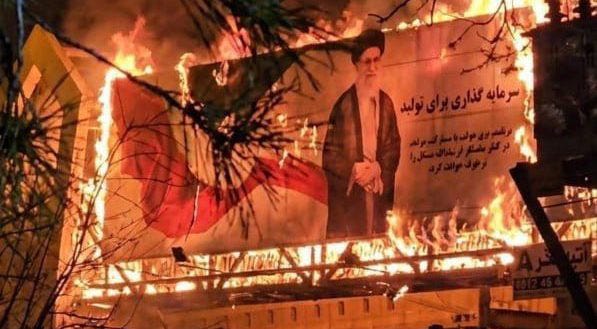
A bilboard of Ayatollah Ali Khamene burning in Iran yesterday.
It’s Sunday, January 4, and in the popular Netflix series Squid Game, the very first challenge is a childhood classic: Red Light, Green Light. Players are told they have five minutes to cross a field, and they can only move when the giant doll says, “Green Light.” When she says “Red Light”—anyone caught moving is eliminated.
At first, everyone treats it like a joke. Nervous laughter, playful shoves. Then the man at the front twitches during a red light—and is shot. The field goes silent, and in that split second, everyone understands: this isn’t a game anymore.
Now imagine Venezuela’s dictator Nicolás Maduro as the first contestant. With his operation over the weekend, Donald Trump just showed the world that he has rules, and he isn’t playing a game.
One player in particular is terrified: Iran.
You might even say that Iran was the first player in that scene. They ignored Trump and found a midnight hammer turning their nuclear facilities to rubble. That was another example of what diplomats might refer to as “strategic calibration”—and the rest of us as an “oh-shit moment.”
It seems Trump liked the reaction to that first strike, because he’s exporting that strategy from the Middle East to the rest of the world.
The operation occurred over Shabbat, so I didn’t have my phone. But even from Israel, I could practically hear the question being asked in Tehran: “Are we next?”
But first, some context.
The last time an American administration actively set out to replace a regime in the Middle East, it was right at Iran’s back door. The U.S. invasion of Iraq in 2003 ended with the arrest—and eventual hanging—of Saddam Hussein. Unfortunately, that war helped Iran twice over.
First, the West—through what in hindsight can only be described as strategic folly (that Israel warned them about)—eliminated Tehran’s most dangerous regional enemy. Saddam’s Iraq had been draining Iran’s blood, money and attention for decades. Once that rival was gone, Tehran was free to refocus its energy on confronting what it affectionately calls “the little devil” and “the great devil”: Israel and the United States.
Second, the chaos and trauma of Iraq’s regime change turned the very concept into a political taboo. If, as Aaron Sorkin once joked in The West Wing, “recession” was the R-word that couldn’t be uttered at the Treasury, then “regime change” became the R-word at the State Department.
How far off the agenda was it? Well, last Tuesday—in the press conference with Benjamin Netanyahu—Donald Trump explicitly said that regime change in Iran is not an objective.
That begs the question: Was that statement genuine—or misdirection?
Either way, Iran doesn’t have a habit of taking Trump seriously. They didn’t believe him when he gave it 60 days to negotiate. On day 61, Israel struck and destroyed Iran’s nuclear facilities. This week, they ignored him when he said he would intervene if they harmed peaceful protesters. Several are dead and people are waiting for the consequences.
The question now is whether Iran will listen the third time.
A quote attributed to Vladimir Lenin goes something like, “There are decades when weeks happen, and there are weeks when decades happen.” Well, this week isn’t over.
Benjamin Netanyahu, Aryeh Deri and Avigdor Lieberman. (knesset.gov.il)
The start of a new civil year is a good time to ask why almost no one uses the term “the Twenties” to describe the wild decade we have just crossed the midpoint of. Perhaps the phrase still conjures images, for older generations, of trench coats, silent films and the Weimar Republic.
In any case, this week marked the end of the first quarter of the 21st century. Local historians will likely define its politics as the era of the death throes of the Israeli left.
On New Year’s Eve 25 years ago, Ehud Barak was prime minister, Yossi Beilin a senior minister, Meretz a central coalition partner, and the main agenda—after a full withdrawal from Lebanon—was negotiations toward full withdrawal from the Golan and near-total withdrawal from Judea, Samaria and Gaza. A quarter century later, no prime minister who defines himself as left-wing has been elected; the “Labor” and “Meretz” brands have vanished; and the IDF holds extensive territory in Syria, Lebanon and Gaza.
Only six Knesset members from that era remain. But with all due respect to Moshe Gafni, Ahmed Tibi, Meir Porush, Yuli Edelstein and even Israel Katz, this quarter-century increasingly looks like the story of a love–hate triangle among three figures who have shaped the right and the state itself—and who are still with us: Avigdor Lieberman, Aryeh Deri and Benjamin Netanyahu.
Had the three known how to live in peace, Israeli politics would have been a dull affair with a predictable ending for more than a decade. The left would have been marginal, and the center a fifth wheel in right-wing governments.
But the complex relationship among the three inadvertently produced an entirely new political system. In the early 2000s, Shas sat in a left-wing government, Deri was in prison, Netanyahu was in business, and Lieberman was synonymous with the far-right fringe. Today, Shas is firmly right-wing, Deri is the number-one partner, Netanyahu is allied with the ultra-Orthodox, and Lieberman is as far from the coalition as possible.
The most consequential political move of the past quarter-century was Lieberman’s dramatic decision in May 2019 to block the formation of a government and drag the entire country into a cycle of elections that, in some sense, has never truly ended.
Was it driven by growing distance from the ultra-Orthodox and the religious drift of Likud? Or by the quotes attributed to Lieberman at the time, published by Dana Weiss: “Netanyahu crossed every red line. In 2019, seven complaints were filed against me and my children with the police, prosecutors and tax authorities. I am convinced Netanyahu was behind all of it. In my moral code, that is a sin for which there is no forgiveness, not even on Yom Kippur. Stop sending emissaries on Likud’s behalf—the idea that I’ll sit with Netanyahu is a hopeless illusion.”
An intriguing question—assuming one can unscramble yolk and white after they’ve been turned into an omelet. Every politician mixes personal and ideological motives. In any case, what does it matter now, after a quarter million voters followed Lieberman into partnership with Yair Lapid and Yair Golan on a civic platform rather than with Goldknopf and Smotrich on a nationalist one?
The more important, forward-looking question is this: Assuming most polls prove accurate, and assuming this will indeed be Netanyahu’s final term, could Lieberman nevertheless return to the bloc and almost automatically take a leading position in the race to head the right the day after? Lieberman himself insists there is no chance whatsoever. But his associates are fiercely divided. Some are convinced—genuinely—that he will return, because a promising future on the right is preferable to donating mandates to yet another fragile government dependent on the left and perhaps the Arabs. And there are those who think that the man who once stunned everyone might yet do so again—in the opposite direction.
This is an excerpt from my weekly column in Israel Hayom
To read this article on my website click here
Israel’s economy is still a miracle—but not without serious cracks. A new report from the Taub Center for Social Policy Studies warns about challenges facing the economy in 2026.
Here are some of the main factors in the report:
War spending has raised government debt and deficits.
The economy is growing again, but growth per capita remains slow.
Israel’s high cost of living is only getting worse.
High-tech has been driving growth but it can’t sustain the whole economy.
Let’s dive in.
Israel entered the war with a remarkably strong fiscal structure, which allowed it to absorb a surge in defense spending without an immediate crisis. But that cushion is shrinking. In just two years, the debt-to-GDP ratio has jumped by 10 percent, and the defense budget has doubled. That’s not just expensive for the state—it’s costly for everyone. Higher borrowing needs mean higher interest rates, and the government ends up competing with the private sector for capital.
As for growth, last week I wrote about Israel’s economic growth and its rising population. The two are closely linked—but not in the way optimists might hope. Israel’s economy grew about 3 percent in 2025, an impressive headline number. The population grew roughly 1 percent, a record low but still positive.
On paper, that leaves solid per capita growth. But here’s the catch: it’s recovery. The economy is still catching up after negative per capita growth in 2024, when overall GDP rose slightly but fell per capita. Israel is still climbing out of a hole.
Then there’s the cost of living. Israelis don’t need the Taub Center to tell them life here is expensive. But hearing it’s 29 percent more than the OECD average still stings. Consumption per capita remains low, showing that real incomes have eroded and households remain cautious. Much of the blame for high prices lies in a bureaucracy thick with legacy regulations—a gift from Israel’s socialist past that refuses to be disposed of.
And then there’s the crown jewel: high-tech. The industry accounts for 20 percent of GDP, 40 percent of economic growth since 2018, and 60 percent of exports. The problem is that it’s only 10 percent of employment. That creates a cascade of other problems: a lopsided economy dependent on one sector, widening inequality, and a state budget increasingly hooked on high-tech tax revenues. Meanwhile, the sector’s productivity hides the deep lack of productivity in the rest of the economy.
The report doesn’t dwell on it, but the long-term challenge also looms large. As one senior official at the Bank of Israel put it, “I can sum up Israel’s future economic challenges in three words: Haredim, Haredim, Haredim.”
Nevertheless, there may still be room for optimism. According to the author, “If the best scenario materializes, the economy will be able to meet the security challenge without harming the civilian services provided by the government.”
Now, I cover government—“the best scenario” isn’t exactly its specialty.
At a talk on Israel’s economic future, I sat and watched three experienced government economists preach deregulation. After a while, the fourth man finally asked what everyone was thinking: “So why didn’t you do it?” The answer wasn’t as clear as their recommendations.
But my optimism doesn’t come from the state. It comes from the people. Israelis have a way of doing what their governments can’t—adapting, improvising, and building despite the odds.
If you enjoy the newsletter, you can show your support through Buy Me a Coffee—it really helps keep this going. I’m also offering a special monthly briefing for a small group of premium members. I’d love to have you join us—just click below to find out more.


Building housing would both help with the debt (increased tax revenues) and lower the cost of living (less pressure on rising rents and home costs).