War With Iran Is Back on the Agenda
Also, the opposition braces for partial defeat, Hanukkah candles burn where Nazi flags once flew, and more.
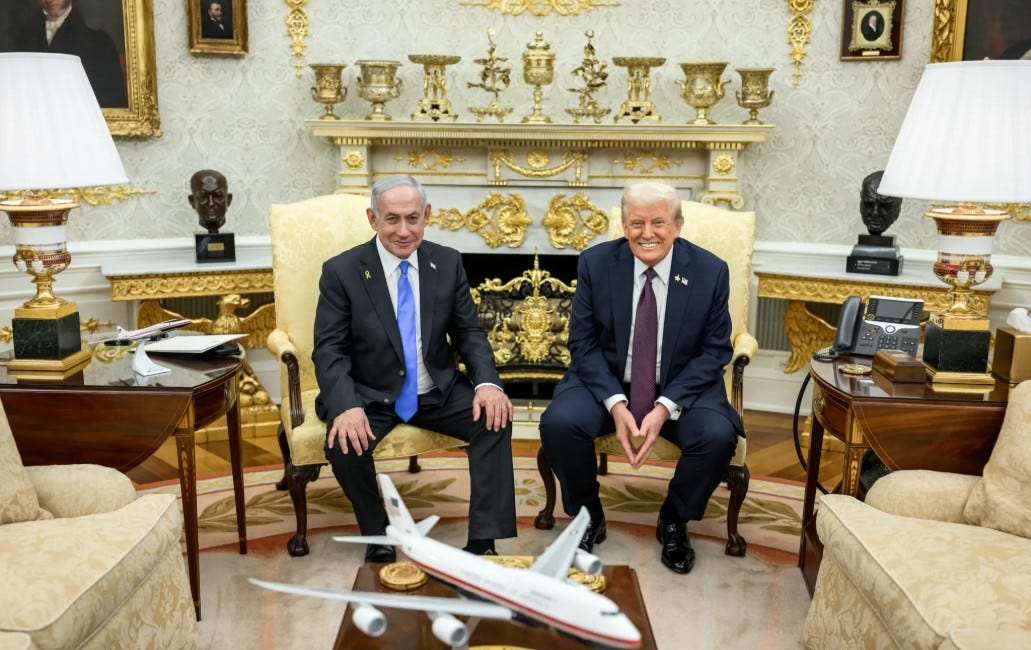
Benjamin Netanyahu meeting with Donald Trump in September (White House/Daniel Torok)
It’s Sunday, December 21, and war with Iran is on the agenda again. According to sources, Benjamin Netanyahu will be presenting Donald Trump with plans for another Iran strike during their meeting next week.
This meeting will also be about Israel and the U.S. reconciling their contrasting visions on Iran. Trump has said it clearly enough: America will not allow Iran to obtain nuclear weapons.
But Israel noticed what he didn’t say—namely, anything about conventional weapons, especially the increasing number of ballistic missiles aimed at Israel.
How threatening are these missiles?
So threatening that in his video announcing the launch of Operation Rising Lion, Netanyahu named not one but two existential dangers: the nuclear threat—expected—and the threat of thousands of ballistic missiles—less so.
During the war in June, while everyone was waiting for the coup de grâce—a dramatic knockout blow to the underground nuclear facility at Fordow—Israel was busy dealing with the other existential threat. By all accounts, it was a highly successful operation: production lines leveled, more than seventy percent of Iran’s missile launchers destroyed, and roughly half of its missiles either eliminated or rendered useless.
What has happened since then?
Well, as far as we know, the Iranians have not acted at all on the nuclear front. They haven’t even tried to excavate the enriched material buried in the rubble of Fordow.
But on the ballistic missile front? That’s a different story. Tehran is pushing ahead. Why? Maybe because they believe it projects strength. Or maybe, as Netanyahu keeps warning, because they see it as an existential lever against Israel.
But let’s ask a question I don’t have an answer to.
What’s the plan?
There are two options.
Either a joint strike, like the one that ended the 12-day war, or a green light for Israel to go back in alone, with the U.S. providing support for defending from the Iranian response.
The first option feels far-fetched. The Americans have no appetite for getting tangled in any drawn-out conflict—least of all in the Middle East. Either way, Israel will need the defense assistance. The war may have drained Iran’s missile stockpiles, but it was just as exhausting for Israel’s interceptors.
But that’s not the only question.
There’s a fierce debate inside the Israeli Cabinet and the IDF right now: Is it even possible or desirable to launch periodic attacks to blunt Iran’s edge?
Unlike the nuclear project, Iran’s ballistic missile program can’t be set back years with one dramatic strike. Missiles are far easier to produce—and, unlike with their nuclear program, Iran doesn’t even need to pretend it isn’t building missiles.
Also, helping with missile production are Iran’s allies—chiefly China—who are far more comfortable rebuilding missiles than sharing the recipe for nuclear weapons. Even after a second strike, that calculus won’t change.
So, the fundamental question remains: Is it really sustainable to come back periodically for another round? Each time, bringing missiles raining down on Israeli cities, canceling all flights, and shaking the economy?
Israel used to have a “mowing the grass” doctrine in Gaza—short, periodic operations meant to manage, not solve, the threat. But that only led to flare-ups every few years. If they try mowing the Iranian grass, it could be every six months.
There’s no decision in Jerusalem. No decision in Washington.
Everything now waits for Trump and Netanyahu’s meeting next week.
Ben Caspit and I interviewing Gadi Eisenkot on Channel 12 last Saturday night. (Channel 12)
It seems the opposition doesn’t believe it will win a majority. So what’s next?
Gadi Eisenkot offered his solution last Saturday night when I interviewed him on Channel 12, hinting that if such were the election results, he would work to form a minority government with the abstention of the Arab parties.
Everyone was furious. Naftali Bennett was angry but refrained from public comment, yet his week of silence speaks volumes. The last thing he wants is a campaign focused on Arabs instead of the ultra-Orthodox. He certainly doesn’t want to be dragged into another promise not to sit with Abbas, which would immediately transform the election into a campaign on his credibility. Avigdor Lieberman was angry, declaring he would not agree to such a government. Yair Golan was also angry, but for a different reason—he supports Ra’am being a full coalition partner.
The most surprising anger came from Abbas himself. Before the formation of the last “Change Government” in 2021, Ra’am’s leader set a rule: Either we vote in favor, or we vote against. He understood well that abstention is a free gift, but voting in favor has a price. He certainly doesn’t want to find himself lumped in with the other Arab parties who reject any partnership. He wants to be a legitimate partner, not a mistress.
Eisenkot has no regrets and hasn’t taken back his statement. Maybe it wasn’t planned, but the scenario he described has been discussed for a long time. In the Change Bloc, some now believe that Netanyahu has a very high chance of forming an obstruction bloc. The office of prime minister provides near-total control over the national agenda. Combined with the expected political boost from Trump, a senior source in the Change Bloc says it becomes almost impossible to keep public attention focused on ultra-Orthodox draft evasion.
Yes, he says, there’s no doubt we’ll pay a price if we form a government with Arab abstention. But in the immediate elections that would follow, whatever we lose from forming that government, we would gain by setting the public agenda, while Netanyahu would be an opposition member with no control. Besides, he added, why should Netanyahu set the rules of what’s allowed and what isn’t?
This is an excerpt from my weekly column in Israel Hayom
To read the column on my website, click here.
March of the Living light candles in the square once dominated by the Nazis. (March of the Living)
Where Nazi flags once flew, Hanukkah lights now burn. Last night, the March of the Living movement held a ceremony in the German city of Tübingen.
Tübingen, a small university town in southern Germany, was once a leading center for research on the so-called “Jewish question.” It was here that the theory of “racial hygiene”—a pseudoscientific justification for the Holocaust—was studied and promoted.
In the town center Nazis once held rallies. Today, in that same square, it’s historic buildings untouched by the past eighty years, people light Hanukkah candles.
It reminds me of another photo of Germany from that era: a menorah on a windowsill, facing a Nazi flag hanging from a building across the street.
On the back of that photo, the owner of the menorah, Rachel Posner, wrote a short poem:
“‘Death to Judah,’ so the flag says.
‘Judah will live forever,’ so the light answers.”
That was the message then—and it’s still the message now.


