Who Wants to Invade Lebanon?
Also, another casualty at a Haredi protest, and a diplomatic visit marks Israel’s new century.
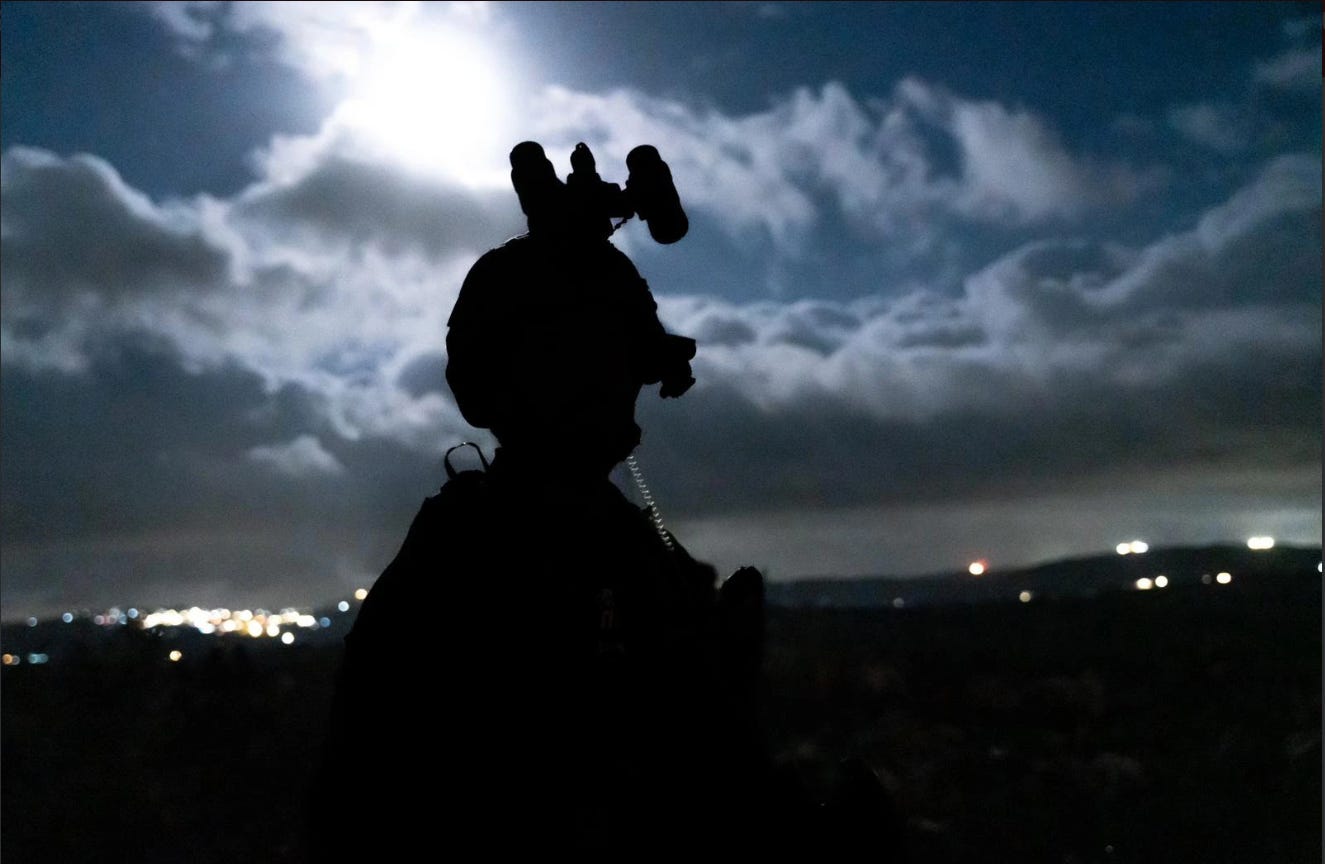
IDF soldier stationed in Lebanon. (IDF)
It’s Wednesday, January 7, and has Benjamin Netanyahu received the green light from Donald Trump for Israeli action in Lebanon? Well, if we’re talking about transportation metaphors, it’s not that he received a green light—it’s that Trump is honking the horn behind him, telling him to move forward.
The American approach to Lebanon follows the Trump doctrine: set a deadline, and if it’s missed—expect consequences. It’s the same playbook used with Iran after sixty days of failed negotiations, and with Venezuela’s Nicolás Maduro, who was given time to flee but didn’t. In this case, both the Lebanese government and Hezbollah missed their moment—and as far as Trump is concerned, the bill is now due.
But what is Israel thinking?
Well, there are quite a few who argue that it isn’t in Israel’s strategic interest to play enforcer, given all the consequences of another round.
Above all, these voices fear a renewed sense among northern communities that the security situation has deteriorated. Despite the objective reality being better than it’s been in decades, many northern residents hesitate to return, and the region remains economically devastated.
And for what benefit? Hezbollah is far from the power it once was. Even if Israel acts decisively and turns this into another successful operation—Northern Arrow 2—if today Hezbollah stands at 20–25 percent of its former strength, another operation could make that 10, at the low price of Israel’s north.
That’s not the only cost to the operation.
Every Israeli war draws on multiple reserves: ammunition, weapons, international backing, and—most importantly—public support.
For much of the last war, Israel had plenty of the latter, but was running low on the rest. Now, thanks to the Trump administration, Jerusalem has no shortage of the first three. But after two years of fighting, the fourth—public support—is running thin.
It isn’t gone, but fragile. If Israelis are convinced an operation is necessary, they’ll rally behind it. The question is: where does Israel want to spend that capital?
On Gaza, where the perpetrators of October 7 are still entrenched?
On Iran, which poses a far greater strategic threat?
Or on Lebanon, where a battered Hezbollah is still trying to teach itself to walk again?
Don’t forget, the collapse of public support is what caused Israel to pull out of Lebanon in 2000, allowing Hezbollah to take over in the first place.
Today, Hezbollah is not a threat. It doesn’t dare attack. Its rehabilitation, if it can even be called that, is slow. Meanwhile, Israel is prolonging that recovery by metaphorically continually smashing its broken bones—and literally, by bombing anywhere in Lebanon with impunity.
Another point against another operation is that it’s impossible to push Hezbollah to its last Kalashnikov unless Israel is willing to put boots on the ground in Lebanon—the northern Beqaa Valley and Beirut itself—to pull the group up by its roots.
A quick reminder: Israel tried that in the 1980s. Asking Israelis to do it again would be like asking Americans to march back into Saigon—a guaranteed trigger for national PTSD.
As you can guess, the scales don’t tip in Northern Arrow 2’s favor.
Whether American pressure changes that—we’ll soon find out.
Panic as one of the protestors is hit by a bus. (Courtesy)
Another haredi protest ends in tragedy. Last night, an anti-draft protest organized by the Jerusalem Faction ended in tragedy. Demonstrators had surrounded a bus, yelling and spitting, when it suddenly accelerated, hitting one of the protesters and dragging him underneath. He later died of his injuries.
This marks the second major protest against the new draft bill to end grimly. The last, in October, ended with the suicide of a young man who jumped from a construction site.
While the loss of life is a tragedy, it’s important to understand the nature of the protest—and the group behind it.
The Jerusalem Faction is the ultra-Orthodox equivalent of the Hilltop Youth in Judea and Samaria: a marginal, defiant movement that rejects both traditional rabbinic authority and the authority of the state, and that has been increasingly involved in violent incidents. The comparison is ironic—one group rejects the establishment for lacking Zionism, the other for having too much of it.
There’s another key difference: while the Hilltop Youth target both Palestinians and Israelis, the Jerusalem Faction’s fury is directed inward—primarily at secular Israeli authorities.
Which brings us to last night.
The Jerusalem Faction staged a protest against the government’s prospective Haredi draft legislation. They blocked Bar-Ilan Street, a major thoroughfare connecting several ultra-Orthodox neighborhoods in Jerusalem. As the rally escalated, a breakaway group began to riot—setting trash bins on fire, throwing objects and eggs at police and Border Police, attacking journalists, and, in the incident that led to the fatality, surrounding and damaging buses.
This isn’t the first time Bar-Ilan Street has seen such unrest. The Jerusalem Faction first rose to prominence in the 1990s with a wave of violent protests—dubbed the “Haredi Intifada”—over the street being open to traffic on Shabbat. More recently, it was the site of their campaign against the Jerusalem light rail. That protest caused more than $100 million in damage and delayed the project by two years. The justification? The trains were not gender-segregated.
But last night’s protest revealed something new. The Faction, which usually struggles to draw more than a few hundred supporters, brought out thousands.
Why? Because the draft issue may be the most significant battle the Haredi community has ever fought. A late-2024 poll showed that 94 percent of Haredim oppose mandatory military service. On the other side, support for increased Haredi enlistment among the general public sits in the mid-80s—making it one of the most contentious issues heading into this year’s elections.
The whole scene is starting to resemble the climax of a political drama—with a pinch of Les Misérables. The Haredim are manning the barricades, the draft law inches through committee, and this evening (Israel time), the Council of Torah Sages of Agudat Yisrael is expected to announce their next move.
Stay tuned for the ending.
Israel’s Foreign Minister Gideon Sa’ar meeting with Somaliland’s President Abdirahman Mohamed Abdullahi and other officials.(@AmbMohamedHagi/X)
Somaliland receives its first-ever official diplomatic visit—and it’s from Israel’s Foreign Minister Gideon Sa’ar. A game changer for both the small African democracy and Israel.
Let’s unpack that.
Israel was the first country to recognize Somaliland. For Somaliland, this visit is the herald of more to come. Some countries immediately come to mind. Ethiopia, for instance, has long hinted that it wouldn’t be the first to recognize its northern neighbor—but it wouldn’t be the third either.
And there are plenty of nations with representatives already in the capital of Hargeisa who might now consider giving those representatives an ambassadorial promotion. Meanwhile, whispers in Washington may lead the Somalilanders to believe that the most important recognition of all may not be far behind.
But back to my area of expertise.
The Israeli delegation spoke at length about bilateral ties—economic, diplomatic, and most importantly, military. If the rumors (and satellite pictures) are to be believed, Somaliland’s Berbera Airport could soon mark Israel’s first foreign military base. The location seems to be an effort to increase their effectiveness against the Houthis in Yemen.
If there’s one thing this war has revealed, it’s that after successfully fighting a seven-front war and subduing a country five times its size, Israel has achieved regional power status. And what do regional powers do? They expand.
Israel is flexing its diplomatic muscle as the first country to recognize a new nation. It’s acting in theaters far from its own borders—the Horn of Africa, already the stage of a proxy conflict between Saudi Arabia and Turkey, just gained a new player at the table. And most of all, the most iconic symbol of expansion—a military base—is now planted on foreign soil.
America’s first base was in Cuba in 1903. That small foothold heralded what, in retrospect, could only be called the American Century.
Without giving too much to the antisemites—it’s still early in the 21st century. The naming rights are still up for grabs, at least regionally.
If you enjoy the newsletter, you can show your support through Buy Me a Coffee—it really helps keep this going. I’m also offering a special monthly briefing for a small group of premium members. I’d love to have you join us—just click below to find out more.


Lebanon does not recognize Israel. But Israel recognizes Lebanon, even Hezbollahstan, where the Lebanese state has no control.
Haredim do not recognize the secular state of Israel. But Israel recognizes haredim, gives them welfare, pays for yeshivas, and exempts their sons from the army.
Lack of reciprocity (cooperate-defect in game theory) is not sustainable. And it's not a good look if Israel expects any level of respect in the international arena.
The person killed by the bus was not a protester. The protests took place in a Haredi neighborhood. The bus hit a boy who was walking in the neighborhood. It was a block away from where the bus was surrounded.