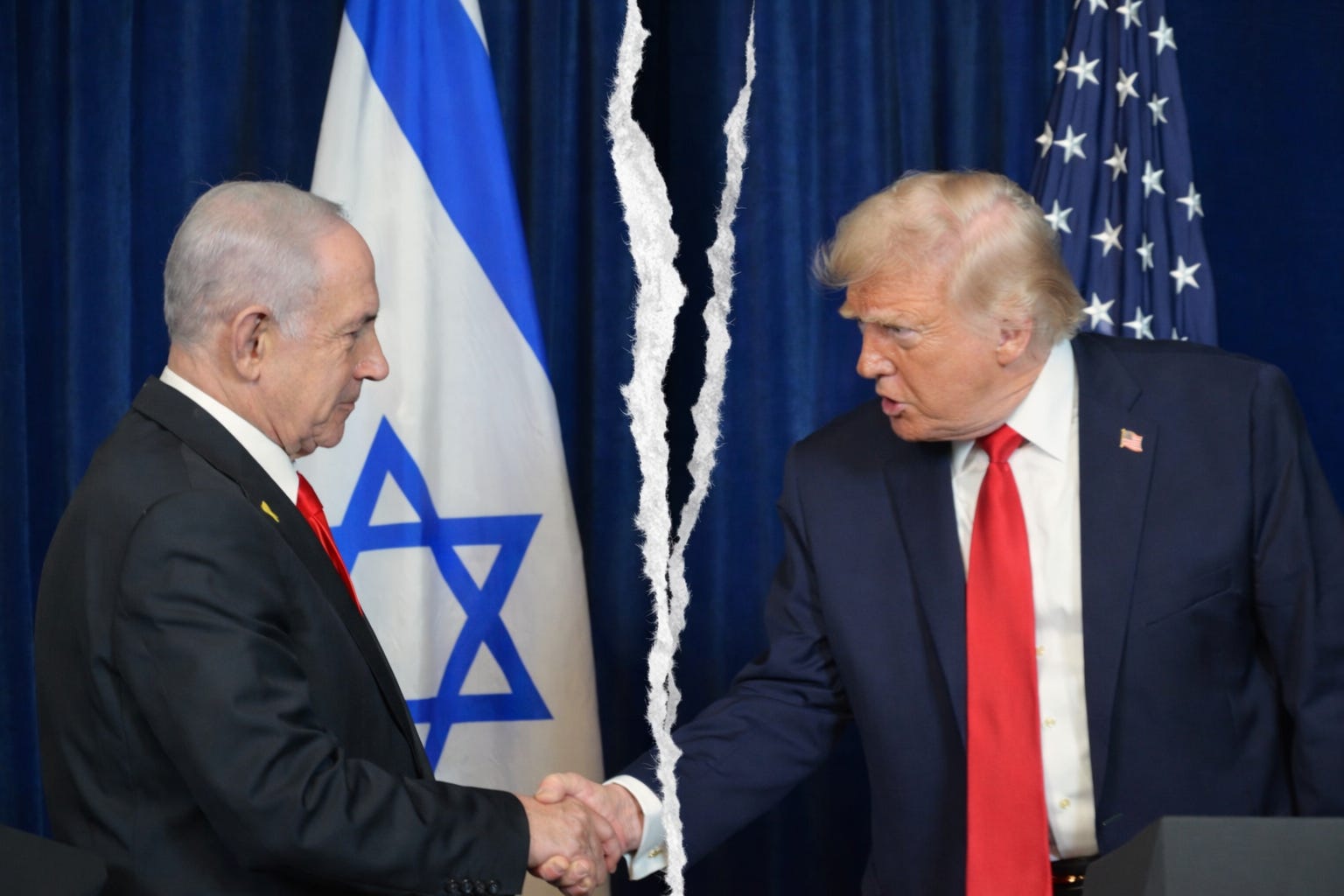
It’s Noon in Israel: Has Bibi Finally Had It With Trump?
Also, Israel looses a music legend, and my post-Shabbat teleportation.
Benjamin Netanyahu shaking hands with Donald Trump in December 2025. (@netanyahu/X)
It’s Sunday, February 8, and a broken clock has to be right at least once, right? According to Iran, their talks with the U.S. in Muscat on Friday concerned “only” the nuclear issue—despite the initial position that ballistic missiles, regional proxies and Iranian protesters would all be on the table.
Now Benjamin Netanyahu is scheduled for a Wednesday visit to Washington to discuss the talks. After so many false readings, has the daylight between Israel and the United States finally materialized?
Well, let’s slow down.
So far, nothing combative has come out of Jerusalem. Then again, to date, Netanyahu has never publicly confronted Donald Trump. The worst he has done was issue a midnight statement against Trump’s Board of Peace for allowing a Palestinian flag in the technocratic council logo, and sent Foreign Minister Gideon Sa’ar to “talk to the Americans.” The latter sounds innocuous, but it’s a snub—where the U.S. is concerned, Netanyahu is the foreign minister.
But past experience teaches us to be cautious. Every time there’s talk of a serious rift, it later turns out to be the opposite of what it appeared. The most prominent examples being Operation Rising Lion, the end of the war in Gaza, and several other episodes that were initially interpreted as confrontations and later revealed to be coordination.
I would suggest two alternative possibilities for the current perceived tension.
The first is that the Americans—like anyone with basic common sense—understand that asking Ayatollah Ali Khamenei to swallow four cups of poison may be too much, even for him. His predecessor, Ruhollah Khomeini, claimed to have drunk the “poison” of ending the Iran-Iraq War without total victory—and survived. But the chances that Khamenei can stomach the loss of the nuclear program, ballistic missiles, the dismantling of Hezbollah and Hamas, and ending the killing of demonstrators are low.
If that’s the case, an attack remains more likely than not. And when it happens, Netanyahu will say: Look, I helped bring this about by insisting on pushing the demands.
The second possibility is simpler.
Netanyahu was meant to attend a meeting of Trump’s Board of Peace in Washington next week. A photo of him sitting next to Qatar and Turkey in any context—especially when discussing their American-ordained future role in Gaza—is not one he wants circulating in an election year. Fake tension with the U.S. that precipitates an earlier visit may simply be Bibi’s way of taking a rain check.
The answer will have to wait for Wednesday, Netanyahu’s seventh Trump visit since the latter’s second inauguration.
Leonard Cohen singing for soldiers during the 1973 Yom Kippur War, with General—and future Prime Minister—Ariel Sharon on the left and Israeli musician Matti Caspi on the right.
This morning Israel lost one of it’s music legends, Matti Caspi. In Israel, Caspi was one of the defining voices of the 1970s, known for songs like “Lo Yadati SheTelchi Mimeni” (“I Didn’t Know You Would Leave Me”) and “Brit Olam” (“Covenant of Love”). For non-Israelis, he might have more significance as a little-known partner of the “poet of rock,” Leonard Cohen.
Many people will recognize the iconic photographs of Cohen visiting the Sinai Peninsula to entertain disheartened Israeli troops during the 1973 Yom Kippur War. Less well known outside Israel is that Caspi was by his side on that journey. The song Leonard—going by his Hebrew name, Eliezer—wrote during the visit, “Lover Lover Lover,” was arranged with Caspi’s help.
During the visit, under the heading “Air Base,” eight lines appear in Cohen’s handwriting:
I went down to the desert
to help my brothers fight
I knew that they weren’t wrong
I knew that they weren’t right
but bones must stand up straight and walk
and blood must move around
and men go making ugly lines
across the holy ground
Cohen later had second thoughts about his involvement, crossing out the line “to help my brothers fight” and replacing it with “to watch the children fight.” Throughout that intense and emotionally charged journey, Caspi was by the poet’s side.
Caspi’s loss is a significant one in Israel’s musical history—and, to borrow Cohen’s words from Tower of Song: “I bid you farewell, farewell, farewell.”
For more on Leonard Cohen’s journey, check out Matti Friedman’s excellent book, Who by Fire: War, Atonement, and the Resurrection of Leonard Cohen.
In Israel, I’m often asked how I get to the TV studio so fast.
Many of you know I’m an Orthodox Jew, which means that from sundown on Friday until the stars come out on Saturday, I observe Shabbat: no electricity, no work, and definitely no driving. I don’t live at the studio—and yet every Saturday night I appear on Channel 12 just after Shabbat ends.
Here’s what’s been happening behind the scenes:
If you enjoy the newsletter, you can show your support by becoming a paid subscriber—it really helps keep this going. I’m also offering a special monthly briefing for a small group of premium members. I’d love to have you join us—just click below to find out more.


You are just fabulous. Your reporting is essential for all Israel supporters and I never miss even one Noon In Israel report. Keep up the excellent journalism. Todah and Shalom❤️
Thanks for the video. It was fun to watch. Shavuah Tov