


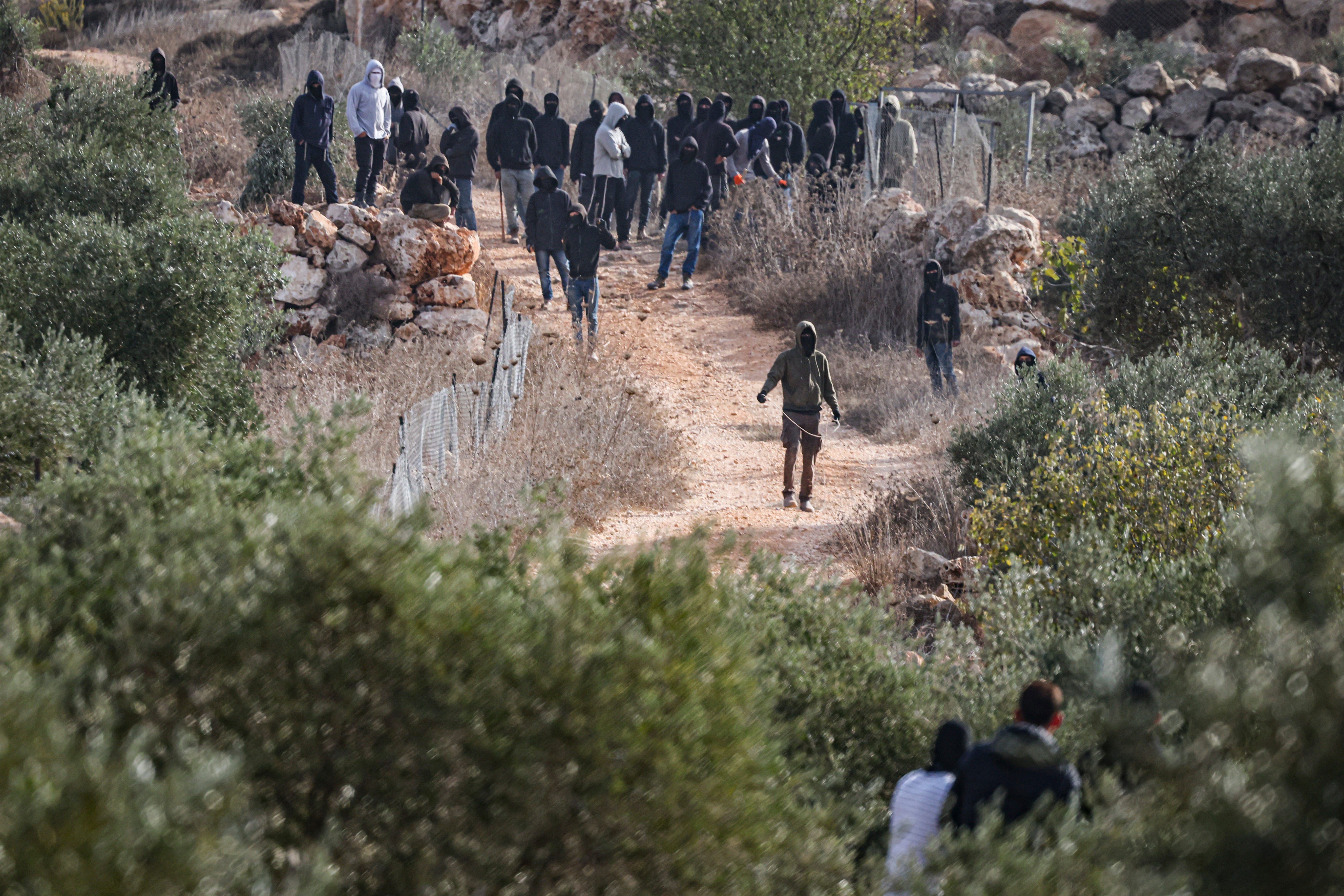
Masked extremist Jewish settlers clash with Palestinians during the annual olive harvest in the village of Abu Falah, near Ramallah in Judea and Samaria, where several people, including American photojournalist Heidi Levine, were injured in an attack by Israeli settlers, October 16, 2026. (Flash90)
It’s Sunday, October 18, and two events on Saturday captured the problem of settler violence. The first was a little-publicized provocation by Palestinians during the olive harvest, when they approached a settlement’s grazing lands pelting a shepherd with stones. The second was an unprovoked settler attack on European diplomats who had come to protect the harvest.
Dozens of Arab “olive harvesters” are throwing stones at Jews near Ma’ale Ahuvia.
At 7:35 a.m., according to an Israeli emergency-response group, a shepherd from the Ma’ale Ahuvia farm was hit by stones in the farm’s grazing land near Taybeh. He was lightly hurt and got himself to treatment. Residents say the harvesters began on Deir Jarir’s land and then crossed into pasture the IDF had approved for the farm.
Palestinians, for their part, claim that settlers advanced on their harvest under IDF guard, firing live rounds. The IDF has not commented on the clash or its alleged presence, and no footage corroborates the gunfire. The casting of the IDF as an accomplice to settler violence is narratively compelling for those who see all Israelis as equally malicious, but it also sets off alarm bells for Israelis who know that if the IDF is there, it is far more likely to be separating the two sides than supporting a settler attack.
The second incident took place six hours after the Ma’ale Ahuvia clash, a few kilometers away. A little before 1:30 p.m., masked men with metal bars descended on a delegation of Belgian, French and Polish diplomats in Taybeh. A French mayor put on his tricolor sash, and it didn’t help. The window of the Belgian consulate’s car was smashed. It was a disgusting act of baseless vigilante justice.
Belgium’s foreign minister blamed Israel’s settlement policy and pledged to push for further EU sanctions. France demanded that Israel arrest those responsible, and Poland declared itself deeply outraged.
The latter incident has rightly been condemned by nearly every corner of the Israeli establishment. The IDF called it a severe act of violence by Israeli rioters, and Foreign Minister Gideon Sa’ar condemned it without caveats. The Prime Minister’s Office said any violence against diplomats is unacceptable.
A similar incident a day earlier is covered in the shadow of provocation and response. According to the Binyamin Regional Council, hundreds of “terrorists and anarchists” threw stones and fired fireworks directly at Israelis, Palestinian Authority vehicles were allegedly on hand, and left-wing activists had organized the confrontation so the cameras could film the Israeli response.
The response, when it came, was itself highly problematic. According to one witness, 50 Israelis, many masked and some carrying gas canisters, came down the hill onto the terraced groves. Some set trees alight and used slings to throw stones at the harvesters, who retreated downhill and threw stones back.
Caught in the middle was Heidi Levine, a photographer working for The Washington Post. Wearing a vest clearly marked “Press,” she was pushed to the ground and beaten, and was left with a broken rib, a broken vertebra and a finger injury that needs surgery. President Isaac Herzog, who called Heidi Levine after Shabbat to apologize for her beating, said Taybeh weighed on his conscience as well.
The past two days are an accurate sample of the situation in Judea and Samaria, in a word: chaos.
Yet what often emerges in media depictions is not chaos, and certainly not tit-for-tat, but a cohesive narrative of victims and victimizers. The olive harvest in particular offers the international media a golden opportunity to write its favorite story, with images to match: ancient trees, grandmothers on ladders and masked young men cresting the ridge. The farmer is old, the settler is new, and the olive tree is a symbol of the former’s indigenous connection to the land.
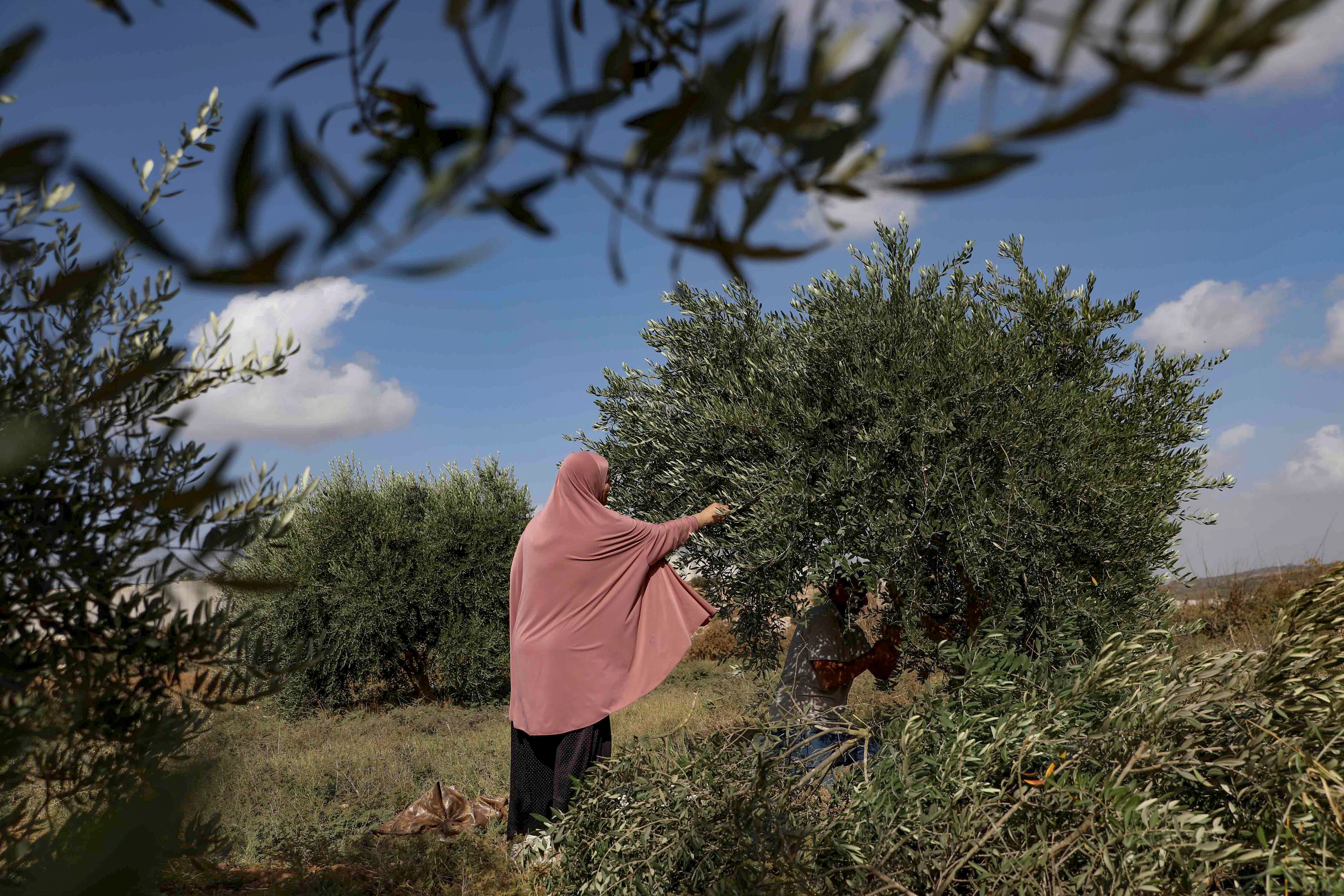
Palestinian farmers harvest olives in an olive grove near the Israeli separation barrier in the town of Beit Awwa, west of Hebron in the West Bank, October 15, 2026. (Wisam Hashlamoun/Flash90)
The PA and its supporting cast of NGOs understand this visual language well. They not only rush to the fields to document any potential clashes but use the tree as a key weapon in the struggle over the territory. The PA buys hundreds of thousands of olive saplings and distributes them free to Palestinians to plant at strategic points. Under the Ottoman law still in force in Judea and Samaria, land cultivated for a decade can be claimed. Olive trees are facts on the ground while they stand and propaganda assets once they fall.
Yet the media’s blind spot is no excuse. What happens in these hills is closer to tribal warfare than to a morality play. Many settlers cite exactly that state of affairs to justify their vigilantism, yet one who seeks to awaken a more statist Israeli to the violent realities of the frontier does less to vindicate violence than to indict the state. Apparently, a country whose writ runs from southern Lebanon to Gaza cannot hold the hills half an hour from its own capital.
As many defenders of the settlements, including myself, are quick to point out, the vast majority of the roughly half-million Israelis in Judea and Samaria have never thrown a stone. Israeli security officials put the violent hard core at a few hundred, around 70 of them leaders. They know their names, and they have mapped the 14 outposts they operate from. If that is the case, finding the people responsible should not be difficult. Justice, as it so often is, is not simply a moral duty. It is a matter of state legitimacy.
That charge may echo the many media outlets, NGOs and governments that seize on these events to challenge Israel’s fundamental legitimacy, but it is nonetheless true. Israelis in general, and right-wingers in particular, bristle at anything bearing the fingerprints of international organizations, whose hand is most often seen pointing accusingly at their very existence.
On one point, they are right. Settler violence is not what primarily drives the push for sanctions. That push is the political momentum of the Gaza war, searching for a new outlet. Had no settler violence existed, British Foreign Secretary Ed Miliband would likely have seen fit to invent it.
But that is not the same as saying settler violence makes no difference. Momentum needs fuel, and every masked man in an olive grove supplies it. Each attack turns a campaign that might have stalled at statements into import bans, and import bans into the next round of measures. Each attack also weakens Israel’s ability to fight back. When U.S. Ambassador Mike Huckabee, among Israel’s staunchest advocates, calls an attack by Israelis “a despicable act of terror,” the masked men are no longer simply handing Israel’s critics a pretext. They are depriving its friends of the ability to disagree.
The tragic reality of Judea and Samaria will not bend to the wishes of its indignant defenders. Palestinian violence against Israelis will always be played down or omitted altogether, while settler violence will always erode Israel’s standing abroad. Israel must reconcile itself to this reality and act accordingly.
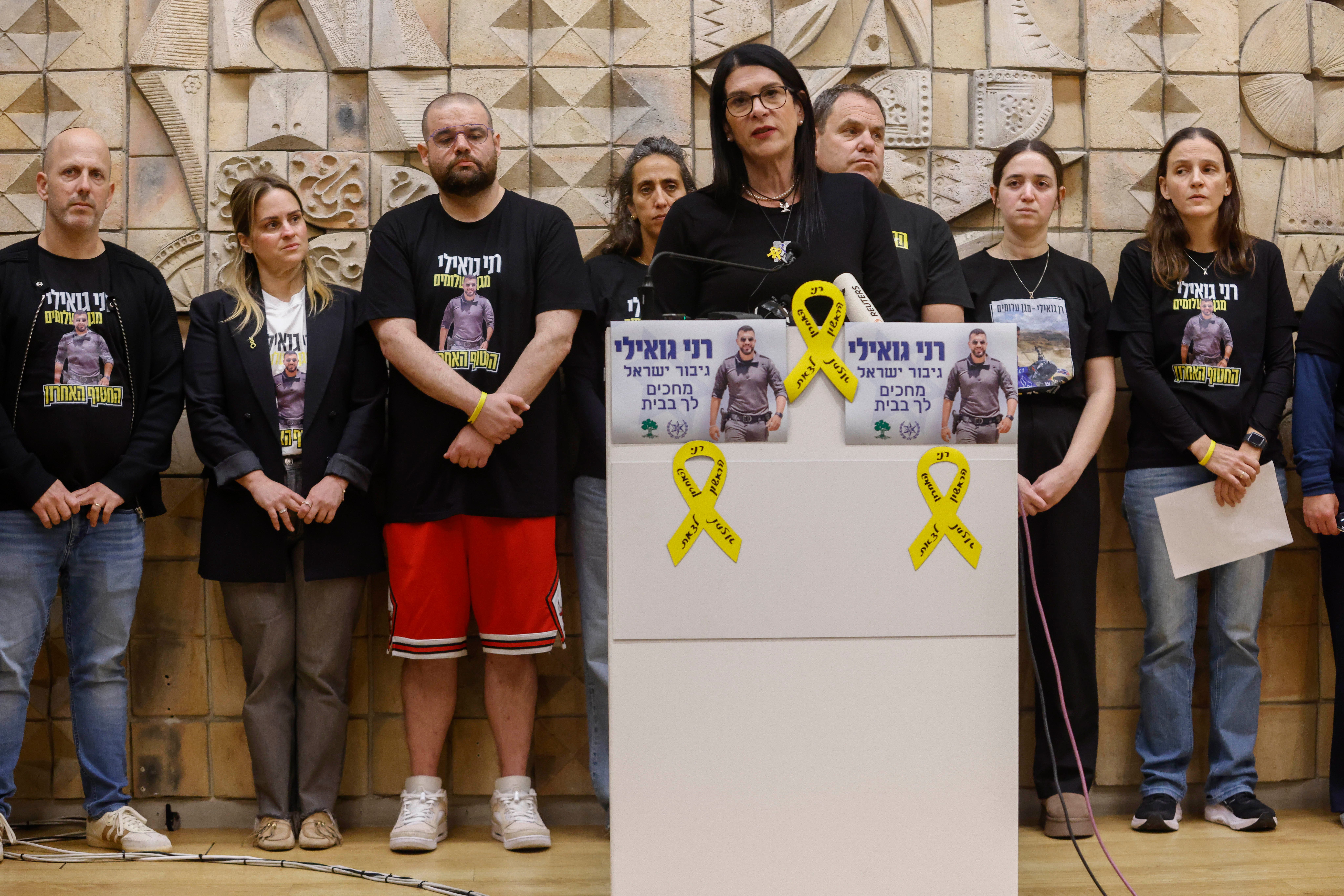
Talik Gvili, mother of the sole remaining deceased hostage Ran Gvili, speaks during a press conference in Tel Aviv, December 24, 2025 (Yehoshua Yosef/Flash90)
The 26th Knesset will be marked by a statistic that probably has no parallel in world history: one in every 10 Knesset members will come from a family bereaved in the last war. Gadi Eisenkot, possibly the next prime minister, lost his son. On his list, in realistic spots, are Shira Shapira, who lost her son Ener at the shelter in Re’im, Nir Hajbi, whose son Yonatan was murdered two kilometers west of there in those very same hours, and Shai Fisher, whose grandmother and uncle were murdered in Kfar Yuval by Hezbollah fire.
Tali Gvili of Likud is the mother of Ran, the hero of the battle at Alumim, five minutes from there, and the last hostage returned from Gaza. On the Yisrael Beiteinu list are Rafi Ben Shitrit, whose son fell on October 7, and Sharon Sharabi, whose brother Yossi was murdered in Hamas captivity. On the Together list is Michal Negri Hirsch, mother of Roi, who fell defending Be’eri on October 7. Religious Zionism chairman Bezalel Smotrich is a cousin of Amishar Ben David, who fell in Gaza, and his No. 2, Moshe Feiglin, is the grandfather of Yair Levin, who fell in Gaza. The Democrats’ Omri Ronen is the grandson of Nira Ronen, who was murdered in Kfar Aza. That is without counting the bereaved brothers Benjamin Netanyahu (Yoni, Operation Entebbe), Eliasaf Peretz (brother of Uriel and Eliraz, who fell in their service) and Limor Son Har-Melech, whose husband Shuli was murdered before her eyes in a terror attack.
Add a parent of freed hostages (Zvika Mor), a wounded war veteran (Elisha Madan) and a host of other contributors to society, and this is exactly the Knesset we supposedly longed for. According to the polls, 60 Knesset members will be replaced. Half a new Knesset is on its way, and we are once again standing in the same dead-end alley.
We were promised a nasty, violent, fateful campaign. We got a boring, nonexistent one. After a brainstorm we funded to the tune of hundreds of millions of shekels, one camp is recycling the line “Bibi or Tibi,” while the other thought and thought and concluded that “anyone but Bibi” is the most effective message.
Maybe it’s connected to the indecision, maybe to the fact that the MKs are new, but the molds they were poured into are very old. Maybe it’s connected to digital changes. Rallies gave way to street signs, which were converted into TV spots, which moved on to internet banners, and in this election everything runs on paid, targeted social advertising. There is almost no trace of it in the public arena, only in the jeans pocket. A similar story played out in the previous election, equally boring, which ended in an exceptionally high turnout.
The story of the week, therefore, may be hiding in jeans pockets in the Arab Triangle. Arab turnout is surging, according to Change Bloc party polls. In one of them it scrapes 70 percent, a 30-year high. These figures are a double-edged sword and pose a very hard dilemma for the opposition parties and their get-out-the-vote operations. Turnout like that would greatly help push Ofer Winter’s Amcha Yisrael and Yaron Zelicha’s New Economic Party below the electoral threshold and widen the gap from Likud. On the other hand, it would push the chance of forming a government even further away. No one talks about a 61-seat coalition anymore, but with 52 seats for the Change Bloc it would be nearly impossible to form even a temporary minority government. The question there is, in short, one of risk exposure. Is it better for Arab voters to turn out in a way that finally ends Netanyahu’s chances of forming a government, at the price of paralysis? Or is it better for them to stay home, which leaves a chance for a coalition but also a bitter surprise from the other side? It’s not certain the dilemma is still in their hands.
This is an excerpt from my weekly column in Israel Hayom.
English Editor: Ari Tatarka
If you enjoy the newsletter, you can show your support by becoming a paid subscriber—it really helps keep this going. I’m also offering a special monthly briefing for a small group of premium members. I’d love to have you join us—just click below to find out more.
Thanks for reading It’s Noon in Israel! Subscribe for free to receive new posts and support my work.


At this sad inflection moment for pro Isreal Americans the woke leftest loon media will use this violence from settlers paint the entire nation
If, as the article states, the security services know who the leaders are, know the networks involved, and have identified the outposts from which they operate, then the question is no longer one of intelligence but of political will. What is stopping enforcement? Is it lack of evidence, fear of confrontation with parts of the settler movement, coalition politics, institutional reluctance, or some combination of all four? A state's legitimacy is not measured by its ability to identify lawbreakers but by its willingness to act against them consistently. As Segal suggests, the deeper issue is that these incidents test the state's monopoly on force and its ability to impose order on those who see themselves not only beyond effective restraint, but in some respects beyond the authority of the state itself. I share the concern about how hostile governments, media outlets, and politicians such as Miliband exploit these events, but that is ultimately a secondary issue. My greater concern is what the repeated failure to address them says about our own government's capacity and resolve to uphold the rule of law. External critics are not creating the problem; they are exploiting a vulnerability that we have been unwilling, or unable, to confront ourselves.