Operation Roaring Lion Day 30: Hezbollah Begs for Peace
Also, the insufficient response to settler violence, Iran's internal split, and more.
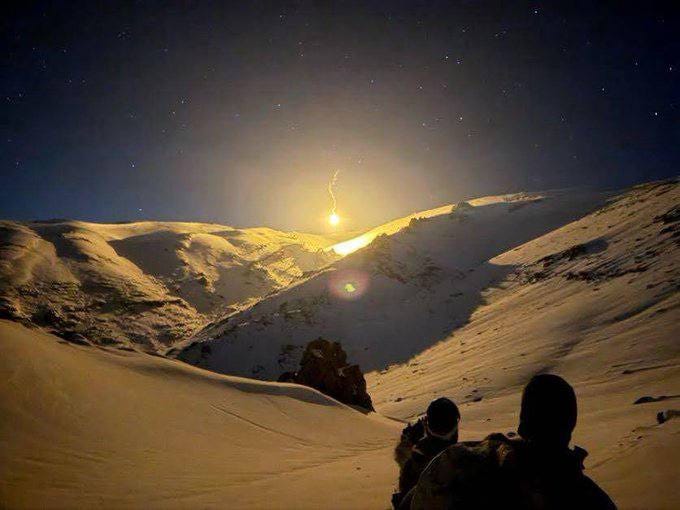
A flare illuminating the path for IDF alpine forces during a recent attack on Hezbollah positions. (IDF)
It’s Sunday, March 29, and the thirtieth day of Operation Roaring Lion. The global price of oil has reached $112, up four percent since yesterday. Here are the latest developments while you were asleep:
The USS Tripoli and its Marine Expeditionary Unit have arrived from Japan, including the forces on the USS Boxer and reinforcements from the 82nd Airborne—this marks the largest U.S. military deployment to the region in over 20 years. Trump has extended his ultimatum on the Strait of Hormuz to April 6, while the Pentagon weighs sending up to 10,000 additional troops and prepares plans for limited, weeks-long ground operations focused on targets like Kharg Island rather than a full-scale invasion.
Iranian missiles and drones struck Prince Sultan Air Base in Saudi Arabia, damaging refueling aircraft and wounding 10–12 U.S. personnel, some critically, according to reporting by The Wall Street Journal and Reuters. The aircraft seem to have been stationed on the tarmac when they were struck, in violation of U.S. Air Force protocol. Open-source imagery verified the attack, while the Pentagon has yet to comment.
According to Iran International, the president of Iran and the commander of the Islamic Revolutionary Guard Corps are in “deep disagreement.” The president warned that without a ceasefire, Iran’s economy could face total collapse within three weeks to a month.
Over the weekend, the Houthis fired a ballistic missile at Israel for the first time since the October 2025 ceasefire with Hamas. This marks their partial entry into the war. So far, they have refrained from attacking U.S. forces, limiting their attacks to Israel. The Yemen-based group has also yet to declare the closure of the region’s other oil chokepoint, the Bab al-Mandab, which would be a significant boon to Iran and mark their full entry into the conflict.
The IDF’s Alpinist force recently climbed from the Syrian slopes of Mount Hermon to Mount Dov in southern Lebanon in an operation against entrenched terrorist organizations along the Lebanese border. This marks the unit’s first cross-border operation in its more than fifty-year history—unsurprising given that Israel and the region are not known for an abundance of snow and cold weather.
Now, on to the details.
IDF forces in Southern Lebanon earlier this month. (IDF)
At this point in the war, the question is less whether there will be a ceasefire and more what kind it will be—negotiated or unilateral. The reality Israel has understood from the outset is that the war in Iran is Trump’s to decide. When he is done, so is Israel—but the question is whether that principle applies to Lebanon as well.
Hezbollah is aware of this question. Behind the scenes, the group is pleading with Iran to be included in any negotiated agreement. Even a unilateral ceasefire—which would likely involve some degree of coordination behind the scenes—Hezbollah wants to be part of it.
To illustrate Israel’s position, here is what the sirens sounded like this morning in the north:
0:43 Kfar Giladi
0:55 Zar’it, Shomera, Shtula
0:56 Abirim and Dovev
1:08 Kiryat Shmona, Tel Hai
1:09 Ma’ayan Baruch, Kiryat Shmona again
1:11 Kiryat Shmona another time, Amir
1:28 Zikhron Ya’akov
1:29 Metula
And that’s just one hour. The bombardment of Hezbollah rockets continued throughout the night and are still ongoing. The Lebanese terror group has turned a small region of Israel’s north into one of the most heavily bombarded territories in the Middle East. That is not a situation Israel can tolerate.
Israel is trying to avoid a unilateral end to the war, yet even if Trump takes that path, Israel can accept it. A very senior official told me last week that, as long as U.S. forces remain in the region as a passive threat of intervention during the protest phase, Israel will be satisfied. But that only applies on the Iran front.
In the north, Israel wants to continue its campaign against Hezbollah. Israel may have started the war hoping to neutralize the threat in Tehran, but if that is off the table, they will settle for Beirut. The IDF views this as an opportunity to devastate the primary Iranian ally to the point that, even if Iran will be a threat in the future, Lebanon will not.
Behind the scenes, Israel is pushing for Hezbollah to be left out of any end-of-war agreement. For Iran to leave Hezbollah out in the cold would be long-awaited karma. In 2024, Hezbollah abandoned Hamas, severing the Lebanon and Gaza fronts with a ceasefire deal with Israel. Little did we know it at the time, but they may have signed the Axis’s death certificate. Once one member broke solidarity, anyone can.
Iran repeating Hezbollah’s decision wouldn’t be revenge—it would reveal an interesting reality: a little pressure strengthens Axis solidarity; add more pressure and it will break.
A group of violent settlers throwing stones in late 2025.
Last week the Israeli government approved the initiative of Defense Minister Israel Katz, the creation of a new unit under the Ministry of Defense to address the recent rise in settler violence in Judea and Samaria. But it isn’t enough.
Settler violence while involving only 100-400 rioters, is both morally inexcusable, and harms the State of Israel—not only through the anarchic acts that often put Israeli forces at risk, but also through broader consequences. It’s no coincidence that two very senior Israeli officials, along with Israel’s ambassador to the United States and the U.S. ambassador here, have publicly warned that this behavior weakens Israel’s base of support abroad.
Some wish to focus solely on Palestinian violence—and indeed, it remains far more dangerous to be Israeli than Palestinian in Judea and Samaria—but as someone who grew up with, and lost, many community members to Palestinian violence, I must stress: settler violence cannot be allowed to continue.
The government’s current response, at the cost of tens of millions of shekels, targets the at-risk youth at the root of much of this violence. The plan is to develop and implement “a national program to reduce risk,” strengthen “personal and community resilience,” and guide youth toward education, military service, and social engagement.
While these youth indeed live at the margins of society and reintegration is not an inherently bad approach, the response lacks immediacy and enforcement capability. At this point, the government’s challenge is not a lack of will, but a lack of tools. It is time to throw the kitchen sink at the problem—and one place to start is administrative detention.
Administrative detention allows individuals to be held without the immediate need for evidence. In the context of random acts of nationalist violence, it is often difficult to gather proof, so despite knowing the likely perpetrators, authorities are unable to detain them. This tool has long been used to address Palestinian terror, but Katz banned its use against Israelis in Judea and Samaria in November 2024. It is time to reinstate it.
This is nationalist terror, and tools to stop terror must be applied.
There is simply no alternative.
Iran’s President Masoud Pezeshkian and Revolutionary Guards Chief-Commander Ahmad Vahidi. (Iran International)
The regime is beginning to show cracks. According to a report from the opposition channel Iran International, Iranian President Masoud Pezeshkian and the commander of the Islamic Revolutionary Guard Corps (IRGC), Ahmad Vahidi, are deeply divided over how the war is being conducted.
Iran International’s source claimed the president warned that: “Without a ceasefire, Iran’s economy could face total collapse within three weeks to a month.”
This aligns with reports from major Iranian cities, which claim ATMs have run out of cash, are malfunctioning, or are physically inaccessible, and online banking services for several major banks are intermittently disrupted. Even before the outbreak of the war, inflation for basic necessities had already reached triple digits, estimated between 105 percent and 115 percent.
Pezeshkian and Vahidi represent different halves of the regime: Vahidi leads the IRGC, while Pezeshkian represents the nominally more moderate, “elected” officials. Cracks between the two became apparent when Pezeshkian apologized in a video for Iran attacking neighboring Gulf countries and ordered the strikes to stop about a week into the war—an order immediately violated by the drones and missiles of the IRGC, who have reportedly consolidated effective control in the country.
The Iran International report further points to IRGC control, stating that Pezeshkian recently demanded that operational and management authority return to the civilian government—only to be firmly rejected by Vahidi.
Recently, The Times of Israel cited a senior Israeli official who claimed:
“There are signs of cracks in the Iranian regime. We are now creating conditions for its overthrow.”
Internal divisions are useful for blunting Iranian responses and actions, but when it comes to regime change the Israeli official’s final caveat remains true: “Ultimately, everything depends on the Iranian people.”
Sergeant Moshe Yitzchak HaCohen Katz. (IDF)
Israel has lost another soldier. Sergeant Moshe Yitzchak HaCohen Katz, 22, was killed in battle in southern Lebanon, bringing IDF casualties to five. Moshe was not the first Israeli or American soldier to fall in this war, but he is the first American-Israeli.
A member of the Chabad community in New Haven, Connecticut, Moshe volunteered to protect Israel despite having no obligation to do so. He is not the first Jew from abroad to give his life in defense of Israel in recent years. There is a unique and beautiful quality that such volunteers bring to the country—a strength of solidarity in sacrifice that is simply unmatched.
Moshe carried the love and support of the diaspora to Israel, and at this time, Israel sends that love back to Moshe’s family.
English Editor: Ari Tatarka
If you enjoy the newsletter, you can show your support by becoming a paid subscriber—it really helps keep this going. I’m also offering a special monthly briefing for a small group of premium members. I’d love to have you join us—just click below to find out more.
Thanks for reading It’s Noon in Israel! Subscribe for free to receive new posts and support my work.


The world and too many Jews in Israel somehow forget the long years of Muslim Arab violence against Jews in Judea and Samaria and Israel that set off this “settler violence”.
Addressing in a meaningful way the settler violence would help Israel.