Destroying the Tunnels Will Take a Decade
Also, treachery behind peace in the Middle East revealed.
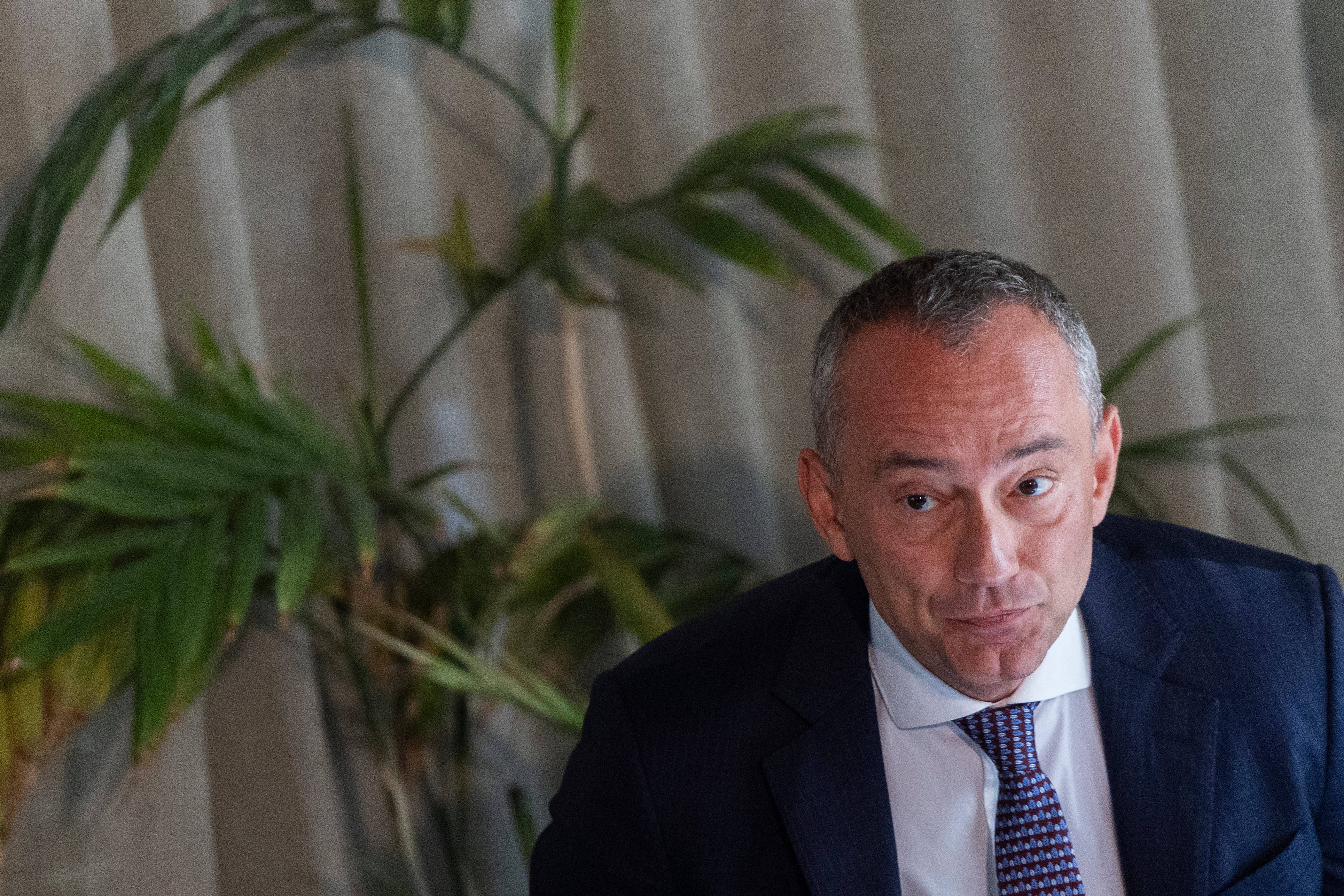
Nickolay Mladenov, the high representative for the International Board of Peace overseeing the Israel-Hamas ceasefire, arrives to a press conference for the foreign media in Jerusalem, May 13, 2026. (Yonatan Sindel/Flash90)
It’s Monday, August 10 and within hours of Benjamin Netanyahu announcing that Israel rejects the 15-point roadmap, Nickolay Mladenov—Director General of the Board of Peace, the Trump-led body meant to oversee postwar Gaza—sat down with me to explain why Israel should want the very thing Bibi had just rejected.
His entire case reduces to one word: verification. Nobody is required to do anything, he insists, “last of all Israel,” before verified steps on the ground. The IDF sits at the yellow line agreed under the comprehensive plan; the Board’s ask is only that it hold there and not fire across unless troops face a real threat. The line moves back only after individual sectors are cleared and their weapons certified, stored, and rendered unusable. If the next stage’s commitments go unmet, “the process stops.”
Why store the weapons in warehouses inside Gaza, where Hamas is “always one wall away from rearming”? Because they will be rendered unusable, he says, by the Board’s National Committee for the Administration of Gaza with backing from the international force. More a reassurance than an answer.
Who destroys the tunnels? Contractors, but at this rate it will take more than a decade, and, he adds, this is precisely why Israel needs the Board of Peace: together it will go faster.
Masked militants of the Islamic Jihad group inspect an Islamic Jihad site that was targeted in an Israeli air strike in Khan Yunis in the southern Gaza Strip on February 25, 2020. (Fadi Fahd/Flash90)
What counts as the “personal arms” Gazans may keep—might that quietly include the Kalashnikovs that actually govern the Strip? No, he says; the framework covers everything, heavy weapons to personal ones. He acknowledges that Gaza is ruled from the barrel of a Kalashnikov—which is why, he insists, those rifles and every other weapon must pass to civilian authority.
And Turkey and Qatar—the two governments Israelis least want inside Gaza? Without Egypt, Turkey, and Qatar, he says flatly, Hamas would never have agreed to the roadmap at all; their role was critical. Told that letting them help dismantle Hamas is the fox guarding the henhouse, he answers: “If I have to speak to the devil, I will speak to the devil”—to make sure no second October 7 ever occurs. The verification mechanism, he stresses, is American-led, backed by the ISF and, on paper, by Saudi Arabia, the UAE, Kuwait, and Morocco.
Pressed on whether Hamas will really disarm itself—whether the whole thing is too good to be true—he offers the tell. “I’m not building any of this on the basis of trust. And none of us are.” Clear-eyed about the risks, he says, and building on verification instead. If it doesn’t work, the process stops.
Mladenov’s offer is difficult. On the one hand, Israel isn’t being asked to withdraw from anywhere at the moment; it only has to stop firing—unless it sees Hamas rearming. On the other, a withdrawal will eventually come before Hamas is entirely disarmed.
The Americans are stunned by one thing. How can a plan this good—by their lights—draw the opposition of the entire Israeli political system, without exception? It’s one of the rare questions on which Netanyahu, Bennett, Lieberman, Eisenkot, and even Yair Golan answer in chorus. Their reason is the same: in 79 days Israel votes. Nobody wants to run as a Hamas sympathizer and a signer of pullouts—even when no pullout would come before the election. Some of them privately suspect this is the best deal Israel is going to get. But compromise is a post-election pastime.
My take: In contrast to the entire political establishment, I support this plan. It won’t dismantle Hamas—nothing will, not completely. But if it nets a third of the tunnels and half the Kalashnikovs, I’ll take it. Will 100,000 Kalashnikovs be handed in? Of course not. But 40,000 collected and another 300 kilometers of tunnel mapped is not nothing—and the next round, which everyone knows is coming, gets fought on considerably more favorable terms.
Arab League General Authority holding a conference on Islamophobia, August 2026. (@arableague_gs/X)
“I do not regard this agreement as any more than the agreement signed between our Prophet Muhammad and the Quraysh,” Yasser Arafat reassured a mosque in Johannesburg. Those present understood the reference: Muhammad honored the truce with the Jewish Quraysh tribe only until he was strong enough, then slaughtered them and conquered Mecca. Little did Arafat know he was being recorded.
It was May 1994, days before Israel withdrew from Jericho as a further gesture of peace, and Israeli radio ran the tape on an endless loop. As with any inflammatory line dressed in scripture, the speech sparked endless Talmudic debate over the meaning of the Hudaybiyyah agreement—its seventh-century context, its traditional commentaries, its modern readings. As with “Amalek” after October 7, the journalists turned theologian: as sure they could parse a politician’s intentions from scripture as the devout are of parsing God’s from the same verses.
The intentions of a more recent interlocutor appear clearer. After months of censorship, I have been permitted to reveal that declassified discussions among regional actors, weighing a possible agreement with Israel, floated a tactical accommodation: reach a deal, and make it temporary. One Arab state put it to the other plainly—sign with Israel now, and open a war when it suits you. Most troubling for Israel, the official dispensing this advice had been among those carrying the hopes of peace—a faith, it seems, misplaced. The identities of the states cannot be given, owing to censorship restrictions.
In the end, no agreement came of it, duplicitous or otherwise.
The conversation is unsettling, but it is not a mandate to write off every future agreement as a ceasefire en route to Israel’s destruction. States, as de Gaulle had it, have no friends—only interests. Agreements have netted Israel near-term gains even with the most extreme Islamists; Hamas returning all the hostages the freshest example. Like Arafat’s speech, the report is a reminder that Israel cannot run blindly into the arms of a smiling Islamist. But like Trump, they are always to be taken seriously—not always literally.
English Editor: Ari Tatarka
If you enjoy the newsletter, you can show your support by becoming a paid subscriber—it really helps keep this going. I’m also offering a special monthly briefing for a small group of premium members. I’d love to have you join us—just click below to find out more.
Thanks for reading It’s Noon in Israel! Subscribe for free to receive new posts and support my work.


It may not just be the politics of the coming election at all. I think It’s probably the double crosses and total failure of Oslo and the 2005 Gaza withdrawal and the scars of the Intifada’s and October 7th which have informed every political class into doubting outsiders “promises which is driving this resistance to the “Bored of Peace”.
"the framework covers everything, heavy weapons to personal ones"
But the framework says personal weapons will be handled according to Palestinian law, not removed. Thus the Kalashnikovs will remain in the hands of Hamas.