


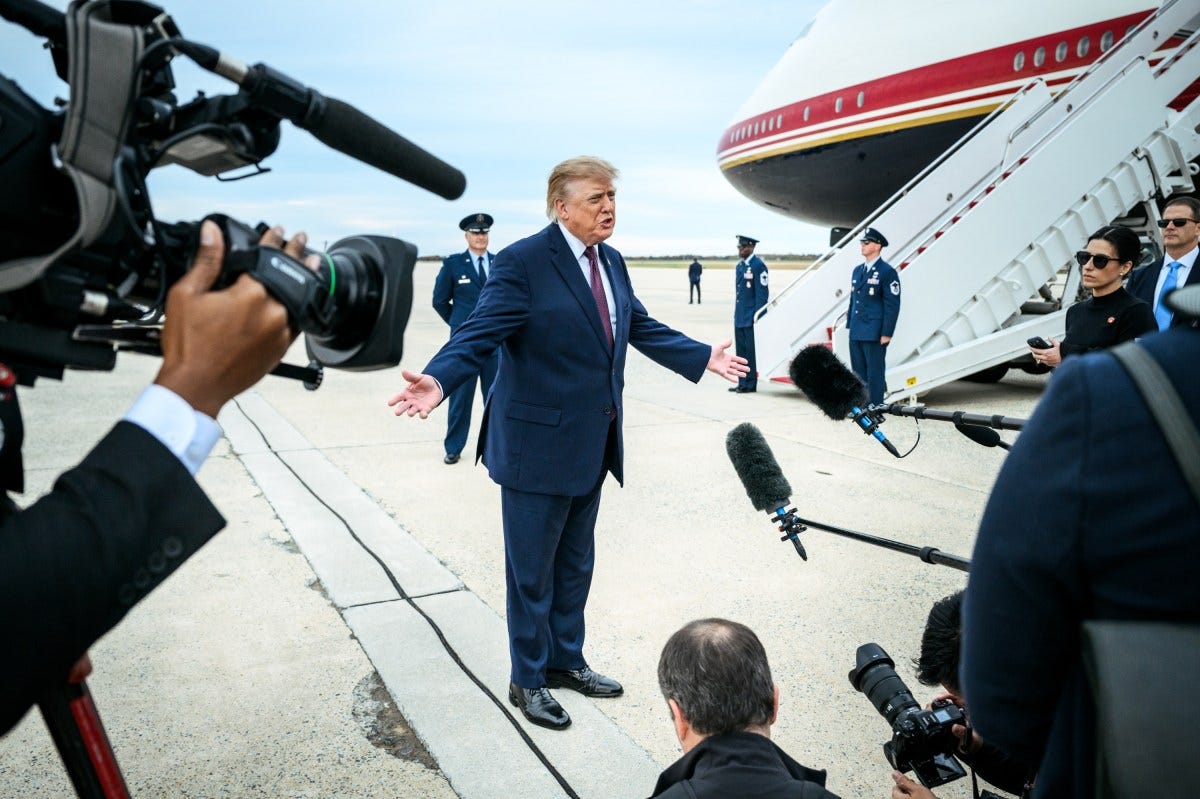
President Donald J. Trump boards Air Force One at Joint Base Andrews, October 28, 2026 (white House)
It’s Wednesday, November 4, and in a last-minute bid to stave off a midterm defeat, President Donald Trump declared that the $4 billion in U.S. aid to Israel “gets cut off at the end of the year.” Whether that was a declaration of policy or a Trumpian slip, the reality after the election is the same: by White House or the House, U.S. aid to Israel is coming to an end.
Depending on whom you ask, this has been inevitable since 2015, when Benjamin Netanyahu addressed Congress against Barack Obama’s Iran deal; since 2016, when Obama let a U.N. Security Council resolution condemning the settlements pass without a veto; or since 2023, when the war in Gaza began. Whenever the trend began, the process was expedited this morning by the Republican expulsion from the Senate at the hands of figures such as Abdul El-Sayed.
But before the rending of garments and gnashing of teeth, it’s important not to get swept up in the blue wave. The Israel-U.S. relationship rests on two foundations: sentiment and strategy. Even as Israel has lost the latter, it has bolstered the former.
Had sentiment been the sole determinant, the aid might have ended under President Joe Biden. Had strategy been the sole determinant, Biden would have spent his last two years wrapping the country that proved itself the unparalleled power of the region in a bear hug. Pulled between the two poles, he settled somewhere in the middle, keeping the vast majority of aid flowing while keeping his distance in public. The chances that a future Democratic administration maintains such a balancing act appear slim. Though Israel’s strategic power has only grown since Trump’s inauguration, by 2028 the increase in negative sentiment will likely eclipse those gains.
The fear in Jerusalem is not losing a $4 billion check, but losing the $700 million in joint projects and the $39.2 billion in equipment Israel is waiting on. The budget can survive without American support; the military cannot. That being the case, for Israel the important question is not when aid gets cut off but how.
Will it be a guarantor recognizing the financial maturity of a dependent, or a parent cutting off a child for bad behavior?
It will likely be both: Trump will play the guarantor, and Congress the parent. The hawks in his administration will ensure Israel is not suddenly deprived of oxygen, even as Congress begins to tighten the valve.
The undeniable truth is that Israel needs a relationship with the U.S. but can rely neither on friendly sentiment nor on its strategic utility. Never underestimate American exceptionalism: from an ocean away, Americans will happily indulge in morality plays to the detriment of their own interests. Just ask Biden’s “pariah,” Saudi Arabia.
So what should Israel do?
I wish I knew the answer, and I imagine Netanyahu wishes the same.
The prime minister acknowledged that such a day was coming long before Trump announced it. In January he proposed tapering American aid to zero over a decade. By June he wanted the cuts to “start now,” arguing that ending aid would “take away the myth that Israel is depleting America’s coffers.” But to the larger question of flagging U.S. support, his public statements have fallen into either vague declarations of renewed PR campaigns or frightening predictions of impending isolation.
Preparations for “Super-Sparta” suggest Bibi doesn’t believe the conversation ends with direct financial aid. Today, Michigan voters are told that the $4 billion to Israel raises the price of eggs. Tomorrow, they will be told they are supplying the weapons for a “genocide,” and then, to no one’s surprise, the defensive weapons for a “genocidal state.”
Little in the party-wide accusations of Rep. Haley Stevens’s sudden mental deterioration at endorsing El-Sayed’s opponent suggests strong Democratic resistance to the predations of anti-Israel candidates.
The best Israel can do is ride the wave: give its defenders ammunition and deny it to its enemies. That means stressing its strategic value while minimizing its offense to American sensibilities. Unfortunately, American sensibilities are not synonymous with Israeli security. Navigating the gap between them will be diplomatically treacherous, and politically dangerous whether or not it succeeds. But as much as no step back sounds good in Jerusalem, the reality is that security, to a significant extent, goes forth from Washington.
On the matter of aid, the goal must be to move smartly, not quickly.
In practice, that means building the next agreement around joint research and co-production rather than grants, and protecting the American-funded purchases Israel has already planned for the next decade. It also means backing the Foundation for Defense of Democracies’ proposal that Congress require the administration to certify, in writing and every year, that each cut serves American security. The more walls Israel can erect between itself and isolation, the better.
Midterm results have shaken Israel, but to paraphrase David Ben-Gurion, it’s not about what Democrats will say, but what Israel will do that matters.
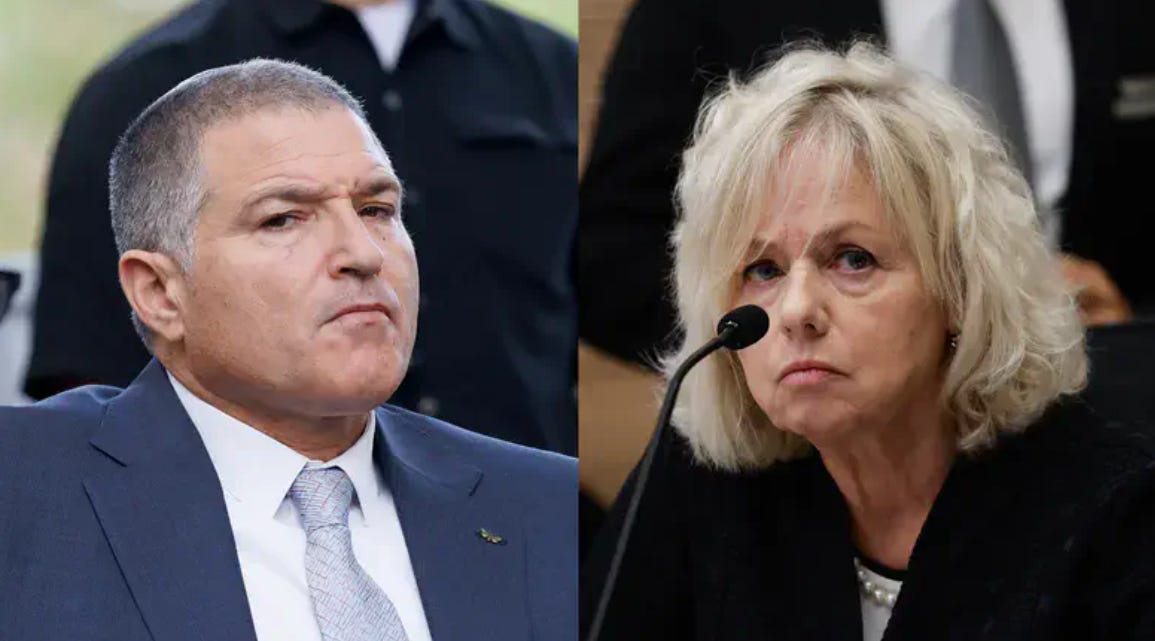
Shin Bet chief David Zini, left, and Attorney General Gali Baharav-Miara. (Moshe Shai/Oren Ben Hakoon/FLASH90)
Conspiracy thrillers often follow an intrepid journalist or spy into the smoky rooms and august halls of power to unravel some vast mystery. The best of the genre leave the audience unsure whom to trust. Israel’s current conspiracy goes one step further. It is not a single story with an ambiguous ending, but a partisan choose-your-own-adventure.
The first path centers on Shin Bet chief David Zini and his quest to uncover what the agency calls a “widespread phenomenon” of foreign money flowing into Israeli politics from “individuals or entities with hidden and even hostile interests,” involving “thousands of people and possibly even more.” In the eyes of his supporters, it explains the skyrocketing Arab turnout. Zini calls the investigation “urgent” and wanted it classified as a matter of “suspicions of security offenses.” To get to the bottom of it, he sought to question four senior Arab party politicians under caution, as criminal suspects: Ahmad Tibi of Ta’al, Mansour Abbas of Ra’am, Sami Abu Shehadeh of Balad, and a fourth senior MK who cannot yet be named and against whom there is said to be significant evidence.
Standing in the way of the spymaster’s quest for truth is an attorney general, Gali Baharav-Miara. She was appointed by the Bennett-Lapid government and has long been, for all intents and purposes, the leader of the opposition. The more conspiratorially inclined cast her as the queenpin of the deep state. In this telling, she is blocking the investigation to keep open the opposition’s path to power through the Arab parties.
The other story follows the courageous attorney general as she tries to stop the Netanyahu-installed spy chief, whose appointment she deemed illegal, from criminalizing the political opposition and calling the result of the election into question. Last night, she declared that “citizens or elected officials cannot be investigated” without “evidence that justifies it.” If the Shin Bet has evidence that meets that standard, “it is invited to present it.”
Zini reportedly complained to Justice Noam Sohlberg, chairman of the Central Elections Committee, that the legal advisers were obstructing the probe. Since then, though, the spymaster has blinked. The Shin Bet now says it sought to question people around the MKs, not the MKs themselves, and Zini has told Sohlberg: “I won’t move a centimeter from what the attorney general instructs me to do. I won’t let the country burn.”
The scandal’s stakes are huge but short of the “earthquake” that some of the coalition parties are claiming. Regardless of the outcome of the probe, the election results will not change. As Sohlberg stated on the verification of the election results, “The integrity of the elections as a whole should not be called into question, even if the suspicions are confirmed, as the extent of their impact is limited.” Talk of a stolen election has proven overblown, but claims of foreign interference may not have been.
If Zini is right, Arab party leaders worked with malicious foreign actors to influence an Israeli election, an act tantamount to treason. For the sake of not only election security but also societal cohesion, such a possibility needs to be investigated and the results clearly published.
If that is indeed the case, it is troubling. If the attorney general is right that the probe is politically motivated, that is equally scandalous. And if both have elements of truth, it is still bad. But this isn’t a cinematic thriller. The public needs to know who was right and who was wrong.
English Editor: Ari Tatarka
If you enjoy the newsletter, you can show your support by becoming a paid subscriber—it really helps keep this going. I’m also offering a special monthly briefing for a small group of premium members. I’d love to have you join us—just click below to find out more.
Thanks for reading It’s Noon in Israel! Subscribe for free to receive new posts and support my work.


I've been writing for a while that this moment was coming. The DSA wing of the Democratic Party is ascendant, and it will demand not only an immediate end to all military aid for Israel (that's a given), but the imposition of sanctions on Israel and possibly even the U.S. signing on to the treaty that created the ICC, so that Israeli leaders could be arrested if they set foot in this country. Just watch..............
American political operatives have been trying to influence Israeli elections for years. I don’t think it is good, but if the current election was subject to foreign influence, it wouldn’t be the first time. Just a different influencer.